
You Know Me, but Do You Know Jonah?
A study by Jonah
If you know me, you know I appreciate gematria—the numerical values of Hebrew letters—and use it to look for clues and pointers as I seek understanding.
Yet something occurred to me: nobody who knows me and my appreciation of gematria has ever asked me about my name.
What does Jonah mean? What numerical values do its Hebrew letters carry? And might those numbers point us toward a deeper understanding of the prophet whose name I share?
So I decided to tell you anyway—to help you get to know Jonah like I know Jonah.
You know me. But do you know Jonah?
Begin with the name
In Hebrew, Jonah is יוֹנָה—Yonah, meaning “dove.” Many people know him as the prophet swallowed by a great fish. But his story asks us to consider much more than what happened inside that fish.
God sends Jonah to warn Nineveh, an Assyrian city, about its wickedness. Jonah boards a ship headed elsewhere. A storm overtakes the ship, Jonah is thrown into the sea, and God appoints a great fish to swallow him. After his deliverance, he goes to Nineveh. Its people turn from their evil ways, and God spares them.
That sounds like a happy ending. But Jonah is angry. Understanding that anger takes us deeper into the man behind the familiar story.
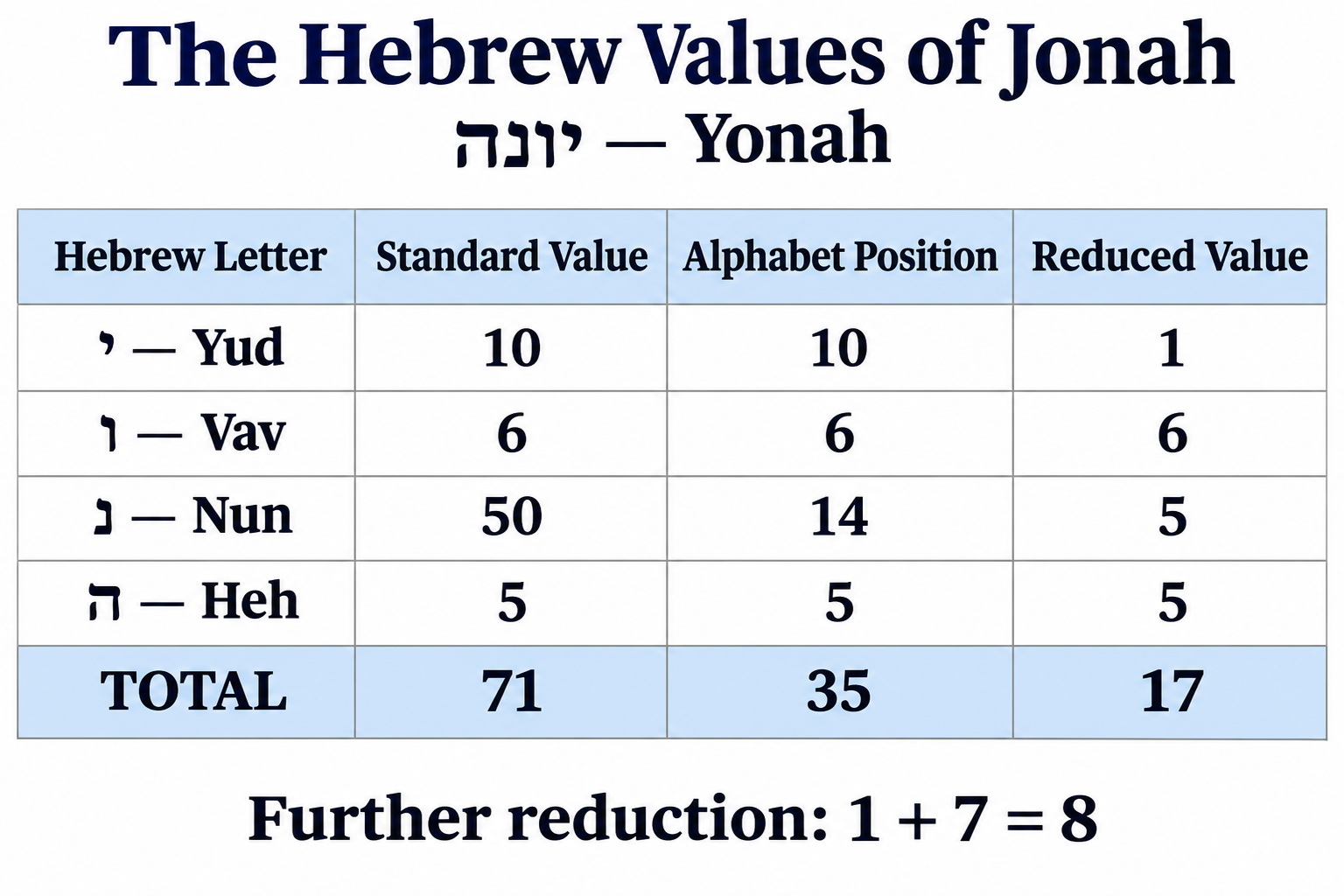
You do not need to know Hebrew to follow this. Each Hebrew letter has a numerical value, and we can add those values together. Another method uses each letter’s place in the alphabet. A third drops the zeroes from each letter’s value.
The table shows how those three methods work with the same four letters. The numbers give me clues to explore as I return to Scripture.
Seventy-one: A human life responding to God
Jonah’s standard numerical value is 71.
The Hebrew word אדם, Adam, meaning man or humanity, equals 45: Aleph is 1, Dalet is 4, and Mem is 40. The four-letter divine name, יהוה, equals 26.
45 + 26 = 71.
A Jewish mystical commentary published by Chabad sees Jonah’s journey as a picture of the soul entering the body. It also connects his name’s value with 45 plus God’s name, 26. The commentary leaves the meaning of 45 unexplained at that point; my connection with Adam suggests a simple theme to consider: a human life responding to God.
Jonah makes that relationship painfully recognizable. He receives a divine calling, yet brings his own fears, loyalties, judgments, and resistance to it.
In the storm, he identifies himself as a Hebrew who fears the LORD, the God who made the sea and dry land (Jonah 1:9). His confession makes his flight especially striking. He knows whose world he inhabits, even as he tries to escape the assignment he has received.
That tension reaches beyond Jonah. How often do we recognize God’s authority while struggling to surrender our own preferences?
Thirty-five: Where are the boundaries?
Counting each letter by its place in the Hebrew alphabet—called its ordinal value—gives Jonah’s name a total of 35:
10 + 6 + 14 + 5 = 35.
The Hebrew word גבול, gevul, meaning boundary or border, also equals 35 under standard gematria:
Gimel 3 + Bet 2 + Vav 6 + Lamed 30 = 35.
The methods differ: for Jonah, I have counted alphabet positions; for gevul, I have added the usual letter values. Their shared total draws my attention to the boundaries running through his story.
Jonah leaves for Tarshish when God sends him to Nineveh. He moves from dry land to the sea, from the ship into the water, and from the water into the fish. In his prayer, he describes an experience at the edge of death, with the depths closing around him (Jonah 2).
Yet the most searching boundary emerges after his deliverance.
Jonah can receive mercy for himself. How will he respond when that mercy reaches Nineveh?
At the end of the book, God confronts him with the lives of a great city and even its animals (Jonah 4:11). Jonah’s concern has narrowed around his own distress. God directs his attention outward.
The question becomes personal: Where have I drawn a boundary around the compassion I am willing to show?
A theme that keeps finding me
This subject has already moved me to write several articles. Looking back, I recognize how often boundaries have drawn my attention—and how often Jonah has appeared in those reflections.
In my earlier article, “Boundaries”, I explored the limits God places around knowledge and our need to trust what He has revealed. Through Eden, Job, and Saul, I kept returning to the same question: can we trust God when we do not understand His purposes? That question fits Jonah too. He knew God’s character, yet struggled to accept what God chose to do.
In “In the Beginning, God Created Boundaries”, I explore how God establishes distinctions that make life possible: light and darkness, sea and land, work and rest. The question running through that article is which boundaries God establishes and which walls we build ourselves.
There is also a direct biblical connection to Jonah. In 2 Kings 14:25, Israel’s boundary is restored according to God’s word spoken through Jonah. The prophet associated with Israel’s restored border is later sent beyond that border to Nineveh. God’s boundaries matter, and His concern reaches beyond them.
In “Boundaries and Broken Walls”, I consider broken boundaries, Jerusalem’s breached walls, and the barriers that can keep us from considering Yeshua. Notice the date: July 2, 2026—the 17th of Tammuz, the very observance that prompted the article.
In “40 Is a Lot”, I follow another connection through Jonah: measured territory and measured time. The prophet speaks about Israel’s boundary and gives Nineveh a forty-day warning. Both land and time have limits, and within those limits people must respond.
And in “A New Team with Redrawn Boundaries”, I explore how the Holy Spirit guides the early believers beyond familiar lines, carrying the message from Jerusalem toward the nations.
These reflections keep bringing me back to the same question: Which boundaries protect what God has entrusted to us, and which have we built that hinder the mercy He wants us to share?
Seventeen. The same number we find when we reduce the values of Jonah’s letters. That catches my attention, especially as we move from boundaries to the next meaning in his name.”
Seventeen: Goodness in the depths
For the third method, drop the zeroes: Yud’s 10 becomes 1, and Nun’s 50 becomes 5. Vav and Heh stay 6 and 5. Jonah’s name now totals 17:
1 + 6 + 5 + 5 = 17.
The Hebrew word טוב, tov, meaning good, has a standard value of 17:
Tet 9 + Vav 6 + Bet 2 = 17.
This compares Jonah’s reduced total with the usual value of tov. It draws my attention to the goodness working through a story filled with danger and discomfort.
The fish is an extraordinary example. Being swallowed seems like the end. Within the narrative, however, God appoints the fish, and Jonah survives inside it. The place of confinement becomes a means of preservation.
There is another water story worth considering. Noah’s ark comes to rest on the seventeenth day of the seventh month (Genesis 8:4). Later, Noah sends out a dove—the Hebrew word yonah—to discover whether the waters have receded (Genesis 8:8–12).
The ark, the seventeenth day, the dove, the waters, and the preservation of life form a striking set of associations. I see them as an invitation to read the accounts alongside one another.
In both stories, life continues through God’s provision amid waters that threaten to overwhelm it.
Jonah eventually receives another commission. Nineveh receives a warning and an opportunity to turn from evil. God’s goodness is at work in preservation, correction, and the possibility of repentance.
Eight: Beyond the expected ending
Reducing 17 further gives us 8.
Jewish mystical teaching often associates seven with the created order and eight with what reaches beyond that order. The covenant of circumcision on the eighth day is one familiar setting in which this symbolism is explored.
Applied to Jonah, that symbolism invites reflection on his extraordinary deliverance and renewed calling.
The sea does not have the final word. The fish releases him. The word of the LORD comes to him a second time (Jonah 3:1).
Jonah is given another opportunity to respond.
I see that symbolism reflected in Jonah’s second chance. His renewed calling carries a hope many of us need: failure can be followed by another call to obedience.
And the simplest meaning: A dove
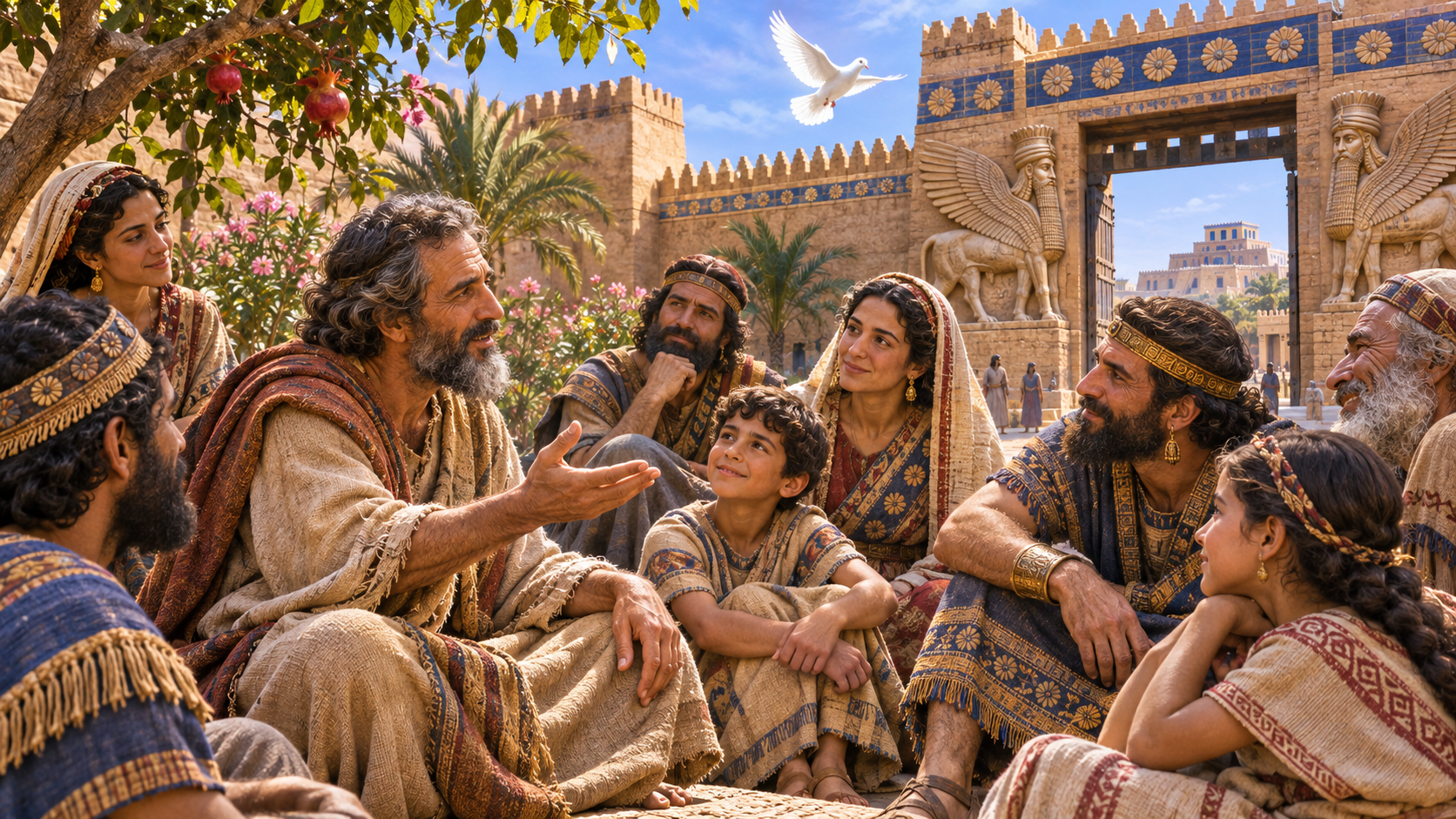
After exploring the numbers, I return to the simplest meaning of Jonah’s name: a dove.
Noah’s dove returned with an olive leaf, showing that the floodwaters were receding (Genesis 8:11). That image has become a familiar symbol of peace. In the Gospels, the Spirit of God descends like a dove upon Yeshua after His baptism (Matthew 3:16).
Peace and the Holy Spirit. Both bring to mind what Yeshua promised to leave His followers.
In the same conversation, Yeshua promises the Holy Spirit and gives His peace:
“But the Comforter, which is the Holy Ghost, whom the Father will send in my name, he shall teach you all things, and bring all things to your remembrance, whatsoever I have said unto you.”—John 14:26, KJV
“Peace I leave with you, my peace I give unto you: not as the world giveth, give I unto you. Let not your heart be troubled, neither let it be afraid.”—John 14:27, KJV
The Holy Spirit would teach them and remind them of His words. His peace would sustain their hearts through trouble.
That brings me back to God’s question at the end of Jonah. God describes Nineveh’s people as unable to “discern between their right hand and their left hand” (Jonah 4:11). They had turned from evil, but what would come next? They still needed guidance.
Here I see Jonah as a picture of the Holy Spirit’s continuing work. The book does not tell us that Jonah stayed to teach Nineveh, but God’s question invites me to consider that possibility as a calling: would Jonah remain available to guide the people God had spared?
The warning had brought them to repentance. Mercy had given them another opportunity. Now they needed to learn how to live.
For me, those promises give the name Jonah another beautiful connection. A dove. Peace. The Holy Spirit. A presence that guides people beyond repentance and into a changed life.
After all the calculations, the simplest meaning carries a depth of its own.
Knowing mercy—and learning to welcome it
Jonah’s own explanation brings the story into focus. In Jonah 4:2, he says that he fled because he knew God was gracious, compassionate, patient, and abundant in kindness.
He already understood something profound about God.
His struggle was with what that knowledge meant for Nineveh. This was an Assyrian city, not his own community. We should pause before treating his resistance as something we could never share. Showing compassion to people we fear or distrust can be difficult.
That is why I find Jonah so compelling. He can speak truthfully about God and still need God to question his anger. He can obey the command to preach while continuing to struggle with the outcome.
The book ends with God’s question and leaves Jonah’s answer unrecorded.
That ending gives me room to consider my own answer.
Can I welcome God’s goodness when it reaches someone I would rather see judged? Can I accept correction from the same God whose deliverance I celebrate? Can my compassion grow beyond the boundaries I have drawn?
The numbers have led me back to the man—and the man has led me back to those questions.
Jonah knew God was merciful. Could he accept how far that mercy reached—and remain to help the people it had restored?
You know me. Now perhaps you know a little more about Jonah.
And perhaps, through Jonah, we can come to know God more deeply.
Sources and further reading
Scripture: Genesis 8:4, 8–12; 2 Kings 14:25; Jonah 1–4; Matthew 3:16; John 14:26–27.
The connections with boundaries, goodness, and a fresh beginning are my reflections on the calculations and biblical story.
“The Finger of G-d: Part 3,” Chabad/KabbalaOnline: Jonah’s 71 and the allegory of the soul’s descent.
“Running From G-d,” Chabad/KabbalaOnline: the meaning of Yonah and a mystical reading of the story.
“The Eighth Dimension,” Chabad: the symbolism of seven and eight.