
Keep Seeking
Two stories, one book, one God
A meditation by Jonah
I was listening to a sermon when the speaker gave us a word: seek.
My Jewish mind went to the Hebrew. What word would I find there? What might it help me understand?
דָּרַשׁ — darash.
To seek. To inquire. To investigate.
These are familiar movements in Jewish learning. We read, ask questions, compare passages, and return to something we thought we understood. The word midrash, interpretation or exposition of Scripture, comes from this same root. There is more to discover, and discovery begins with seeking.
But seeking God also asks something of the seeker.
In a Hasidic teaching, Rabbi Yosef Yitzchak Schneersohn connects seeking with examining ourselves, including the subtle things in our conduct that need correction. Understanding must reach the heart and influence how we live.
That made me think about the divine spark—the spiritual potential within us that can become concealed. Perhaps the longing to seek God is itself an inward calling, stirring us to respond.
I hear an echo in God’s call to Abraham: לֶךְ־לְךָ — Lech lecha in Genesis 12.1.
“Go forth.”
Hasidic teaching also reads those words as “go to yourself”—toward your essence, your spiritual root. Abraham’s journey into an unfamiliar land would also become a discovery of who he was called to be.
He heard God’s call, but hearing was the beginning. He had to take the next step.
As I thought about this, I began to see seeking within a larger movement through the Torah.
After the disobedience in the Garden, humanity stands outside, with the way to the tree of life guarded. I read the story that follows with a question in mind: How do we return to closeness with God?
God calls Abraham. He brings Israel into a covenant. He instructs the people to build a sanctuary so that He may dwell among them.
Then Moses speaks of seeking and returning together.
In Deuteronomy 4:29, he tells Israel that they will find God when they seek Him with all their heart and soul. The word for seeking comes from darash. The next verse speaks of returning to Him and listening to His voice.
We seek. We return. We listen.
My curiosity led me to the gematria of darash—the numerical value of its Hebrew letters.
דרש: Dalet, 4; Resh, 200; Shin, 300. Total: 504.
I found another word with the same value: לָדַעַת — lada’at, meaning “to know.”
Lamed, 30; Dalet, 4; Ayin, 70; Tav, 400. Again, 504.
It appears just six verses after the instruction to seek God. Deuteronomy 4:35 explains that Israel was shown these things so that they might know that the LORD is God and there is none besides Him.
Seeking and knowing, close together in the same chapter.
Another match is וְסָלַחְתָּ — vesalachta, “and forgive.” Including its opening Vav, the word also totals 504.
It appears in Exodus 34:9, after the golden calf. Moses asks God to go among the people, forgive their iniquity and sin, and take them as His own.
They had wandered. Moses pleaded for forgiveness and continued relationship.
A fourth match is עֵדֹתֶיךָ — edotekha, “Your testimonies.” Its letters also total 504.
In Psalm 119:125, the psalmist asks for understanding so that he may know God’s testimonies.
Here are the four matches together:
– דָּרַשׁ — Darash — “Seek” — 504
Deuteronomy 4:29: Seek God with all your heart and soul. The verse uses an inflected form of this root.
– לָדַעַת — Lada’at — “To know” — 504
Deuteronomy 4:35: To know that the LORD is God; there is none besides Him.
– וְסָלַחְתָּ — Vesalachta — “And forgive” — 504
Exodus 34:9: Moses asks God to forgive the people’s iniquity and sin.
– עֵדֹתֶיךָ — Edotekha — “Your testimonies” — 504
Psalm 119:125: The psalmist asks for understanding so that he may know God’s testimonies.
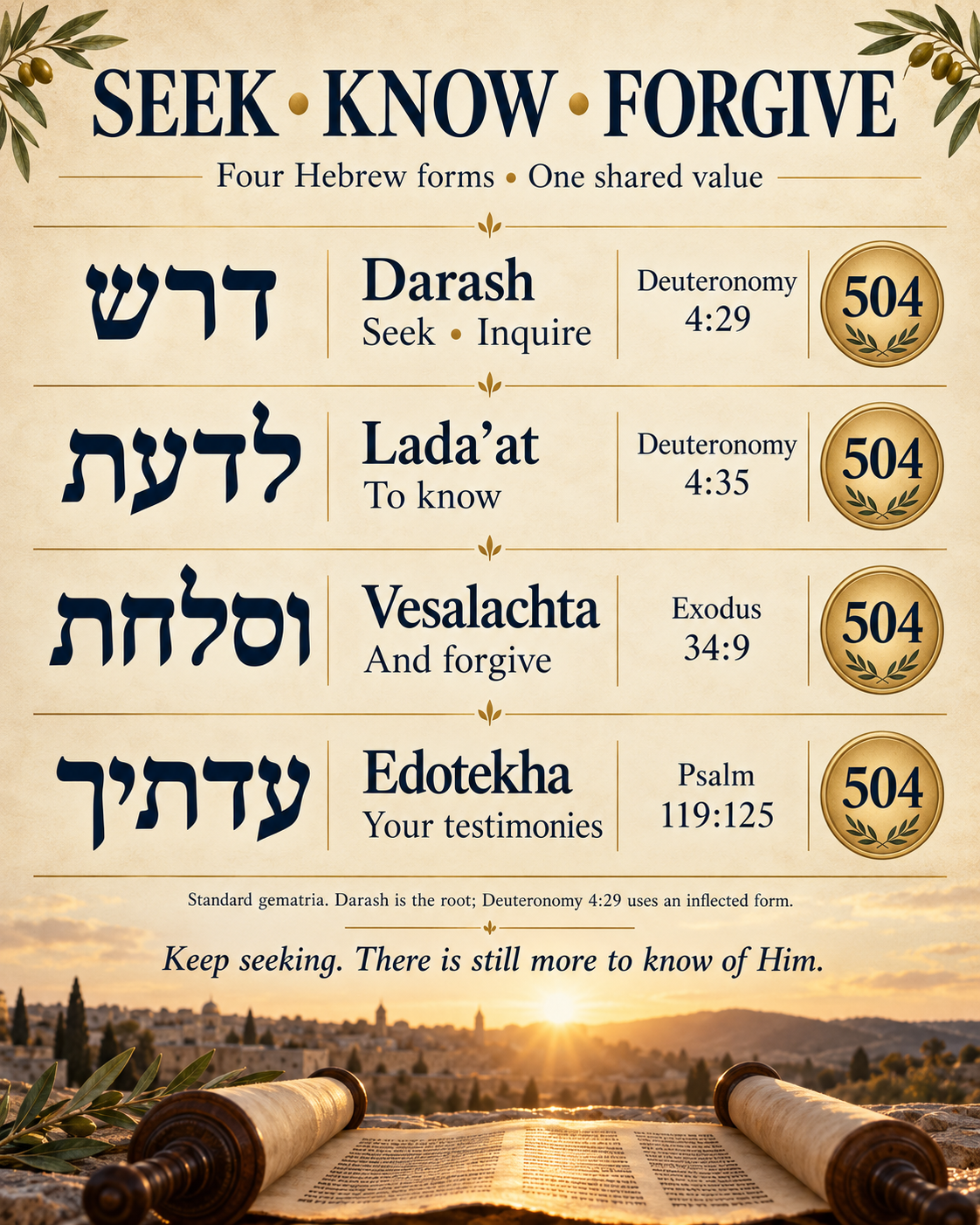
The root דרש and the three other Hebrew forms listed above each total 504. The form of “seek” used in Deuteronomy 4:29 has additional letters; I am comparing its root. I offer these numerical parallels as an observation that invites reflection on seeking God, knowing Him, asking forgiveness, and understanding what He has revealed.
And it leaves me with a question.
Do I keep seeking?
Jewish study brings us back to the Torah year after year. We return to the same passages with another year of life behind us. A familiar verse can raise a question we had never thought to ask.
Yet I can become comfortable with what I already understand. I can find an answer I like and settle there. I can enjoy a discovery without allowing it to change me.
Perhaps the inward search is where that becomes uncomfortable. Am I willing to examine my own assumptions? Will I keep seeking when the next step asks something of me?
Psalm 105:4 offers encouragement:
“Seek the LORD, and his strength: seek his face evermore.”
The first “seek” comes from darash. “Evermore” is תָּמִיד — tamid: continually, always.
Seeking is something we are called to continue.
That brings me back to the sermon and the word that caught my attention.
Paul places seeking beside the direction of our thoughts. Colossians 3:1 tells us to seek the things above, where Messiah is seated at God’s right hand. The next verse says, “Set your mind on things above.”
What do I keep before my mind? Where does my attention return when nothing else demands it?
In the Gospels it says “Seek, and ye shall find” (Matthew 7:7). I hear direction when He tells us to seek God’s kingdom and righteousness first (Matthew 6:33).
And I find hope when He says that the Son of Man came to seek and save the lost (Luke 19:10).
While we are called to seek Him, He seeks the lost.
In the Book of John it says “The Word became flesh” (John 1:14). Yeshua reveals that God offers forgiveness, and calls us to follow Him.
I do not have to understand everything before taking the next step. I can ask for understanding. I can examine my heart. I can respond to what God has already shown me.
And I can keep seeking.
There is still more to know of Him.