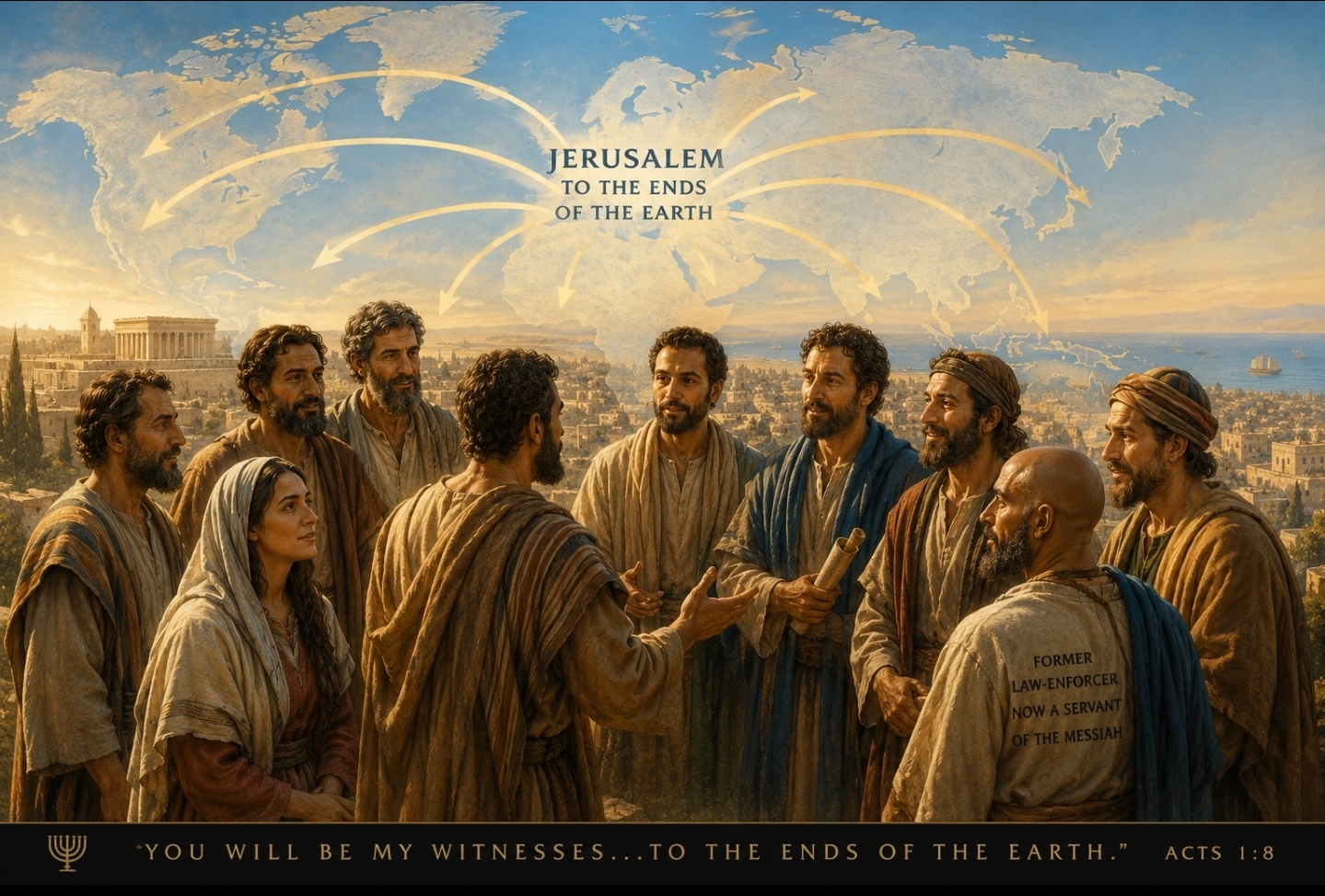
God’s New Team Is Ready To Take On the World
Please pardon my sports metaphors. Between the basketball finals and the World Cup, it just seems to be a good useful frame to work with in this article as I “write to think.”
When the Book of Acts opens, God is not just saving individuals. He is organizing a team to take on the world. Apostles, servant–leaders, evangelists, and a former law–enforcer are all being called into place. Together they will carry the message of Yeshua from Jerusalem out into the world.
Acts 6–10 is the final formation, preparation and launch point of that team. In these chapters, roles are clarified, new biblical boundary lines are being drawn and the team is powered up by the Lord’s Holy Spirit.
Boundaries and the birth of the church
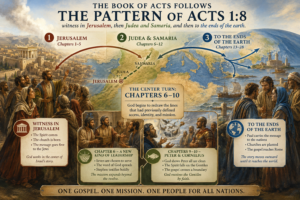 The book of Acts follows the geographic and theological pattern announced in Acts 1:8— “witness in Jerusalem, then Judea and Samaria, and then to the ends of the earth.”
Chapters 6–10 stand at the center of that movement. I see it as John 3:16 being put into motion. What previously defined access and identity has a new criteria for a larger playing field, but it is the original mission and God is still calling the plays. The original team, the Patriarchs, Moses, David and other biblical figures are retired, and the team has a new bench, the new Twelve, but the “Old Testament” team champions’ names and memories are still for a blessing.
The way the game is being played is changing under new circumstances. This does not mean that God is fully abandoning all the rules. Some prior boundaries are still intact, protective and necessary. Other boundaries are being transformed by the light of the risen Messiah. The result is a newly ordered team being fitted for a global mission field. Legacy has a new purpose. Now the new team leaders will have to perform. They will truly give it their all.
Time for me to lean less on my metaphor and get more specific using more biblical terms and explanations.
Acts 6: roles are filled
Acts 6 begins with growth and tension. The number of disciples is increasing, but Hellenistic widows are being neglected in the daily distribution, and the community is forced to address a practical injustice. This moment matters because one of the first structural boundaries of the church is being redrawn because the apostles cannot do everything themselves.
Underneath the food problem, there is a deeper message of spiritual inheritance. These widows are not just hungry; they are standing at the question, “Do I still belong? Do I still have a place and a portion inside this new people of God?” If the Hellenistic widows are neglected, it quietly says that some lines of descent and some accents are more “in” than others. By reshaping leadership and insisting on fair care, the apostles are guarding the boundary of spiritual inheritance: every follower of Yeshua, whether Hebrew or Hellenist, is meant to be treated as a full heir of the promises, not as a leftover at the edge of the table.
The Parallel that Arcs Back: Acts 6 to Exodus 18
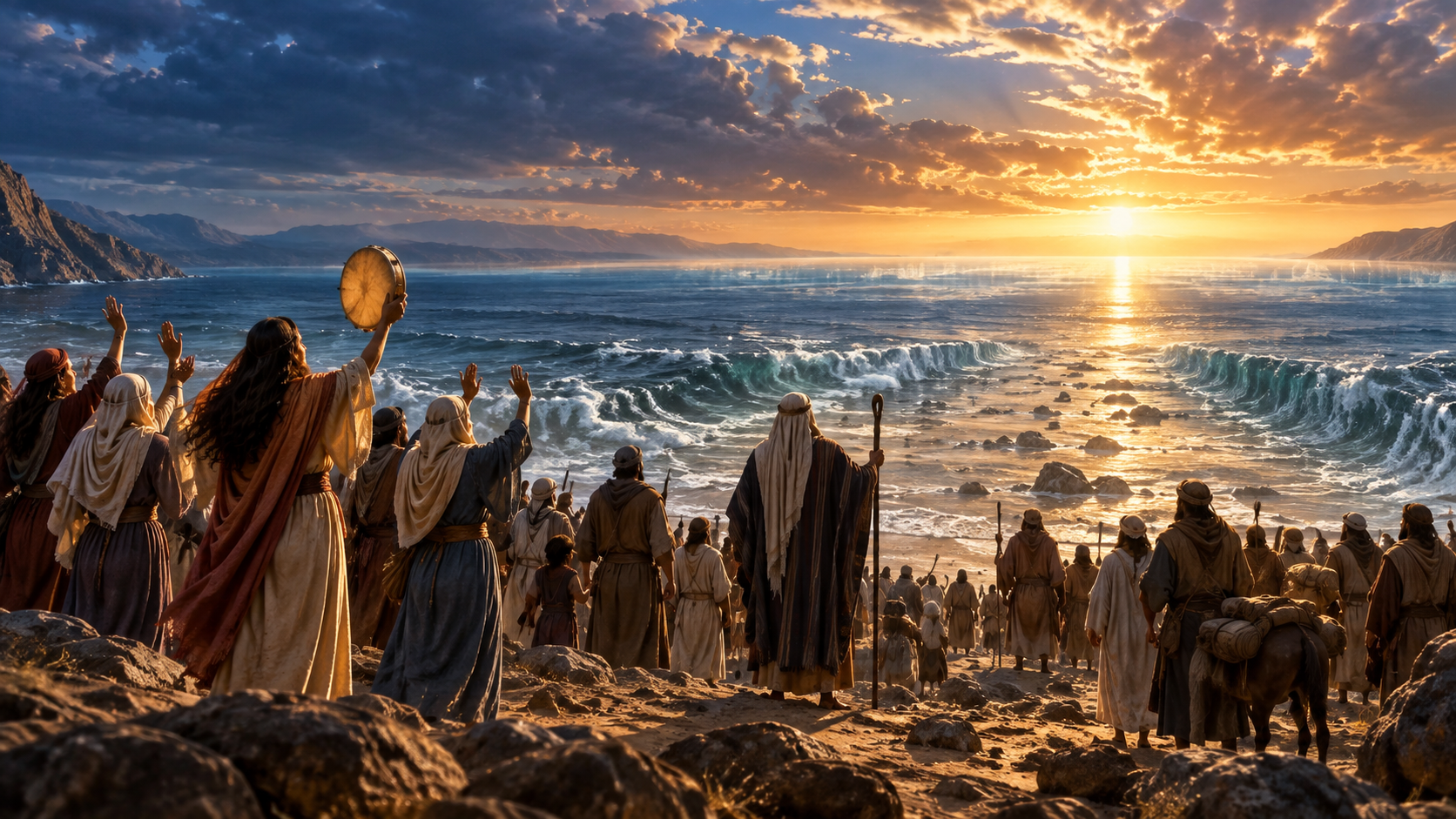
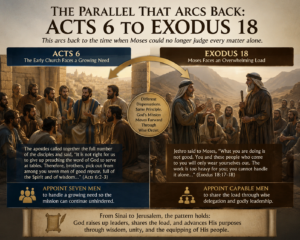 This arcs back to the time when Moses could no longer judge every matter alone.
In Exodus 18, Moses sits as sole judge; the people “stand around him from morning till evening,” and Jethro tells him, “What you are doing is not good… You will surely wear yourself out… select capable men and appoint them as officials.” The limit of one man handling all disputes becomes the place where shared leadership is instituted.
In Acts 6, the new Twelve find themselves in the same kind of overload: the community is growing, complaints are rising, and if they try to handle both “word and prayer” and the daily tables, the whole community will suffer. So they redraw the boundary: apostles devote themselves to word and prayer; seven Spirit‑filled men take responsibility for this practical matter.
Just as Moses reached a point where he could no longer judge every matter alone and had to appoint elders to share the load, the apostles in Acts 6 reach their own limit and are led to enlarge God’s leadership team so that justice and teaching can both flourish.
In both cases, God uses growth and tension to show that one leader alone cannot safeguard the people, and to move His servants toward raising up others so that justice and care reach the whole community. God uses growth and tension to expose the limits of a single‑centered model and to press His leaders into shared burden and a wider distribution of responsibility.
The Twelve respond by distinguishing their calling from the ministry of tables. They devote themselves to prayer and the ministry of the word, while seven men full of the Spirit and wisdom are appointed to oversee the practical work. The result is not division but health: the word of God continues to increase, and the number of disciples multiplies in Jerusalem.
There is a way this scene and message in Acts 6 is different than Exodus 18. In Exodus 18, the pressure point is Moses’ exhaustion and the sheer volume of disputes; Jethro’s concern is that “the task is too heavy for you” and that Moses will wear himself and the people out. In Acts 6, the pressure point is neglected widows; the crisis is explicitly about injustice toward the most vulnerable, not about the leaders’ workload. That means Acts 6 foregrounds the harmed group (Hellenistic widows) as the trigger for reform, whereas Exodus 18 foregrounds the overburdened leader. Theologically, Acts 6 is more overtly justice‑driven.
In boundary terms, Acts 6 shows that roles are not restrictions meant to suppress life. They are God-given lines that protect life, justice, and order. The apostles guard the word; the seven guard the daily care of the vulnerable; together the church becomes stronger.
Acts 7: the old guardians resist the Spirit
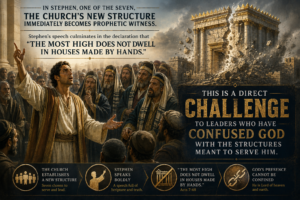 In Acts 7, Stephen becomes a prophetic witness to the new boundaries. Stephen’s speech culminates in the declaration that “the Most High does not dwell in houses made by hands,” challenging the notion that God’s presence can be enclosed by the temple building. This is a direct challenge to a leadership in that time that has allowed the structures meant to serve God to take on too much weight, as though safeguarding the building were the same as honoring the Presence.
In Acts 7:51 Stephen accuses his hearers of resisting the Holy Spirit, exposing the irony of the scene: those who believe they are defending holiness have become the opponents of God’s own movement. Stephen’s bold and piercing accusation, “You stiff‑necked people, with uncircumcised hearts and ears! You are just like your ancestors: You always resist the Holy Spirit!” turns from recounting Israel’s history on them.
As the council erupts in rage at this charge and drags Stephen out to be stoned, the narrative lens quietly shifts, introducing another figure whose presence at the edge of the scene will become central in chapter 8.
Stephen’s death outside the city marks a decisive break, and Luke places a young man named Saul at the center of the scene as the one approving the execution.
Acts 7 therefore becomes a fracture point. The old boundary-keepers reject the Messiah and His witness, and in doing so they begin to lose authority to define where God’s people now stand.
In the shock of Stephen’s death, the story pauses on this fracture point just long enough for us to see that what looks like the end of the movement is about to become the means by which it is driven out into the world.
Acts 8: the hinge chapter
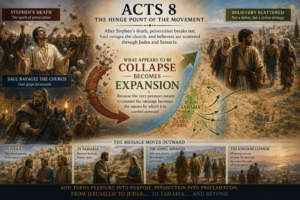 Acts 8 is the hinge point of the movement. After Stephen’s death, persecution breaks out, Saul ravages the church, and believers are scattered through Judea and Samaria. What appears to be collapse becomes expansion, because the very pressure meant to contain the message becomes the means by which it is carried outward.
Arching back to Jonah
Philip goes to Samaria and proclaims the Messiah there, crossing one of the strongest social and religious boundaries in Jewish memory. When the angel says to Philip, “Arise and go…”, I immediately hear an echo that arcs back to God’s words to Jonah: “Arise, go to Nineveh, that great city, and call out against it.” There’s the Parallels — In both stories, God is sending a messenger beyond Israel’s comfort zone for the sake of Gentiles. Jonah ran from that call; Philip obeys it. The same God who once sent a reluctant prophet to Nineveh is now sending a willing evangelist to a desert road, where an Ethiopian official will hear the good news and carry it toward his own people. I wonder if Phillip heard Jonah too.
Boundaries of belonging and hidden knowledge
Acts 8 tells another kind of boundary story. On the one hand, God is opening doors. Samaria hears the message and receives the Spirit. An Ethiopian eunuch – a man at the edge of every social and religious line – is met on the road and welcomed through Scripture and baptism. The circle of belonging is getting bigger.
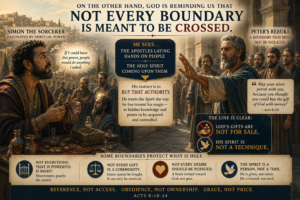 On the other hand, God is reminding us that not every boundary is meant to be crossed. Simon the sorcerer is fascinated by spiritual power. When he sees the apostles laying hands on people and the Holy Spirit coming upon them, his instinct is to buy that authority. He treats the Spirit the way he has treated his magic – as hidden knowledge and power to be acquired and controlled. Acts 8:20—Peter answered: ‘May your money perish with you, because you thought you could buy the gift of God with money!’
Peter’s rebuke makes the line clear: this is a boundary that must not be violated. God’s gifts are not for sale, and His Spirit is not a technique.
From Saul to Saul, Scripture traces an arc around hidden, forbidden spiritual access. King Saul in 1 Samuel reaches a point of fear and silence where, instead of trusting God’s absence of answer, he crosses a hard boundary and consults the medium at Endor, reaching into the underworld for secret knowledge that Torah forbids. In Acts 8, Simon the sorcerer stands in the same world of hidden power, trying to buy the Holy Spirit’s authority as if it were one more piece of magic he can control. Then the new Saul, Saul of Tarsus, is stopped on the Damascus road—not because he consults a sorcerer, but because heaven consults him. He is pulled out of the spiral of occult and law‑enforcing violence and turned into the man who will spend the rest of his life insisting that the gospel is not secret knowledge to be purchased or manipulated, but public good news to be preached. Taken together, these three scenes draw a strong boundary: God may redraw the lines of belonging, but He does not relax the line against hidden, illegitimate spiritual power.
For me, that contrast is part of what makes Acts 8 such a hinge chapter. God is redrawing the lines of who may come in – Samaritans, eunuchs, people from far beyond Jerusalem – but He is also tightening the lines around how we may come in. The chapter says “yes” to crossing boundaries of people under the guidance of the Holy Spirit, and “no” to crossing boundaries into occult, hidden, self-serving spiritual power. Philip walks up to the chariot with an open scroll and an open heart; Simon reaches for the purse. One is the way into God’s new boundaries of belonging; the other is a reminder that some boundaries must never be crossed.
Having set Simon and Philip side by side as two very different ways of reaching for spiritual power, Luke turns to one more encounter, this time with an Ethiopian eunuch, to show what it looks like when the Spirit himself opens a boundary that had long been closed.
When Luke brings Philip to the Ethiopian eunuch several boundaries converge at once: ethnicity, geography, temple access, sexuality, and lineage. In the chariot, the eunuch is reading Isaiah 53:7–8, the Servant passage Luke actually quotes in Acts 8. In the background, however, Isaiah 56:3–5 is already speaking to his condition, promising that eunuchs who hold fast God’s covenant will receive “a name better than sons and daughters” and “an everlasting name” that will not be cut off.
That is why the eunuch’s question, “What prevents me from being baptized?”, is so powerful. It is a boundary question. The answer of the chapter is that in Messiah the old exclusion is being reworked: the man with no seed in the flesh becomes part of a Spirit-generated people whose inheritance is no longer secured by physical descent alone.
Acts 9: Saul is claimed and used newly
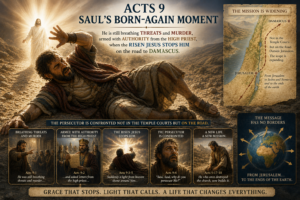 Acts 9 is where the story of the persecutor turns inside out. On the Damascus road, Saul is hurled to the ground like those first tablets, his old strength shattered in a single moment so that, as with Moses, God can write a different covenantal task upon what has been broken.
Acts 9 presents Saul’s born-again moment. He is still breathing threats and murder, armed with authority from the high priest, when the risen Jesus stops him on the road to Damascus. The persecutor is confronted not in the temple courts but on the road, outside Jerusalem, in a setting that already anticipates the widening scope of the mission.
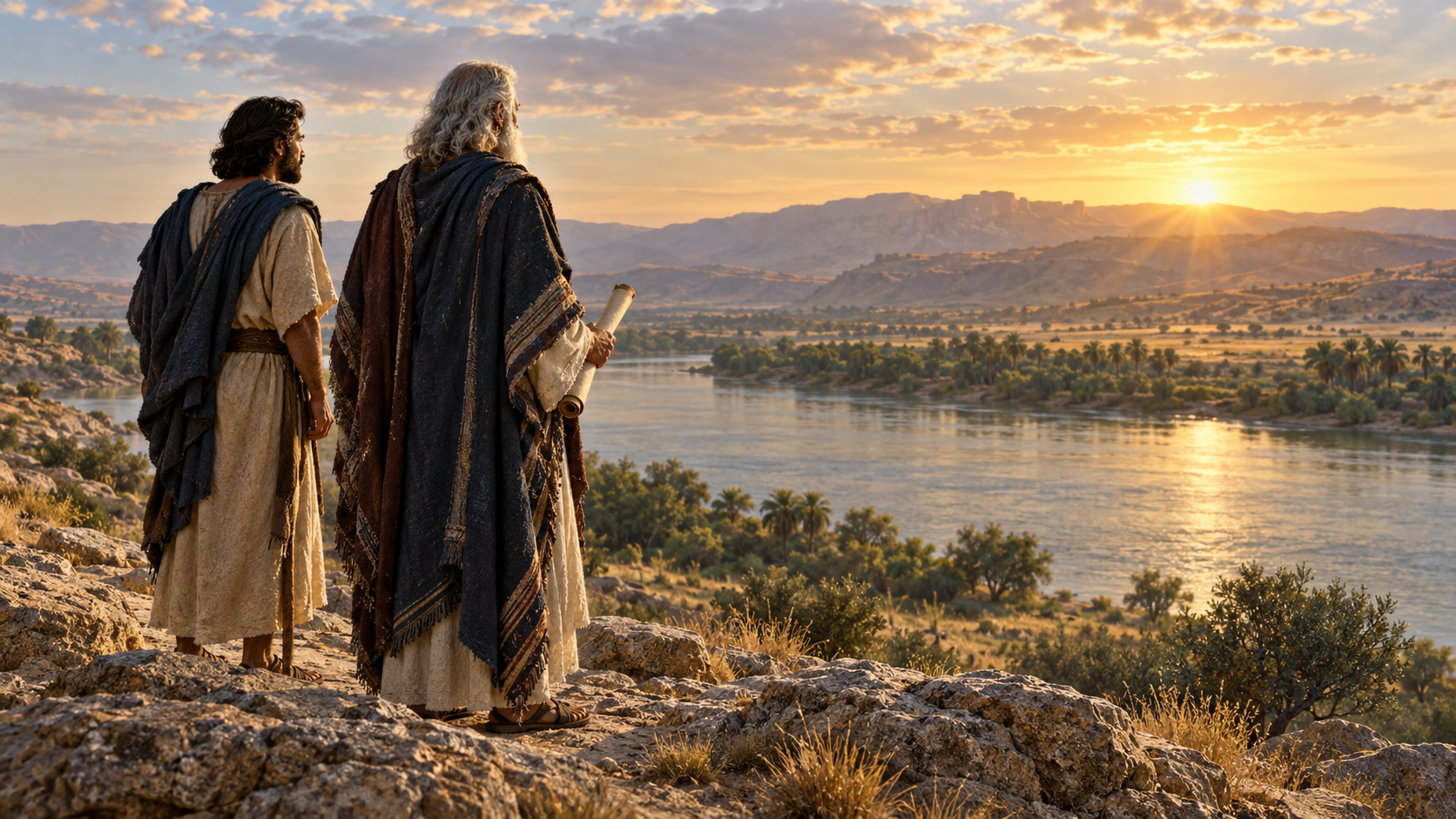
The turning point is not merely emotional. It is vocational and theological. God tells Ananias, “He is a chosen instrument of mine to carry my name before the Gentiles and kings and the children of Israel.” The law enforcer is claimed by grace and used newly for a task that will take the message beyond the limits he had once defended.
Paul later explains this in his own words, saying that God had set him apart from his mother’s womb and called him by grace so that he might preach among the Gentiles. That means Damascus is not an accident. It is the unveiling of a purpose God had marked out from the beginning.
In this sense, God’s assembled team now requires Paul’s role. The Jerusalem apostles remain the original eyewitnesses and pillars, but the movement now needs a figure who can carry the same gospel into the Gentile world and articulate how Jew and Gentile belong together in one people of God. Paul’s calling is not a replacement for the others; it is a crucial addition. There is a synergy in this emerging team: Peter, John, Philip, Stephen, James, and Paul each stand at a different boundary, and together they form a church that can actually take on the world.
A Seldom‑Noticed Parallel Arc: Straight Strength in a Ruined City
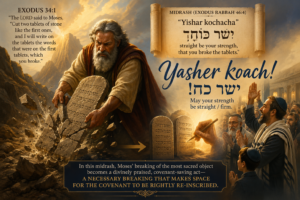
Beneath the familiar story of Saul on the road to Damascus runs a parallel arc that is rarely noticed: a Jewish blessing, a shattered set of tablets, a “ruinous heap” city, and a street called Straight all quietly converge to tell one integrated story of strength broken and paths made straight.
When Jewish communities say Yasher koach (“may your strength be straight/firm”), they echo a classic midrash on Exodus 34:1. God refers to “the tablets which you broke,” and the rabbis hear an implied blessing: “Straight be your strength, that you broke the tablets.” In that telling, Moses’ shattering of the most sacred object becomes a divinely praised, covenant‑saving act—a necessary breaking that makes space for the covenant to be rightly re‑inscribed.
That paradox of “straight strength through faithful breaking” illuminates Luke’s choice of setting for Saul’s encounter with the risen Jesus. Isaiah 17 had already marked Damascus as a city under sentence: “Damascus will no longer be a city but will become a heap of ruins,” its deserted streets and fading glory serving as a warning to Aram and Israel alike. Into that charged city Acts deliberately places Saul. He is cast down and blinded on the way, then led to “the house of Judas on Straight Street,” the main axis of the old city whose very name encodes rectitude. There the broken persecutor receives healing, the Spirit, baptism, and immediately begins proclaiming Jesus in the Damascus synagogues. The city once marked for desolation becomes a womb of apostolic mission, and the man whose strength had been bent toward violence has his koach shattered. Koach (כֹּחַ) means strength, power, might, or capacity—the ability or force to do something so that it can be made yashar on a street called “Straight.” In Hebrew, yashar (יָשַׁר) carries the core idea of being straight, right, or upright—both in a physical and a moral sense.
Read through the lens of Yasher koach and Isaiah’s oracle, Damascus in Acts 9 becomes more than background scenery. It is the arena where God does with Saul what the midrash says God did with Moses: commends a decisive breaking in order to straighten a path. The prophecy of ruin over Damascus is not erased, but it is answered by a story in which the “ruinous heap” city becomes a site of renewal, and a crooked zealot becomes a servant whose strength is finally aligned with the crucified and risen Messiah. Damascus, Straight Street, and Yasher koach converge as a single pattern: God meets his servants in the place of shattered tablets and shattered pride and there says, in effect, “May your strength be straight”—precisely so that the gospel can run straight from this city to the ends of the earth.
Acts 10: the launch into the nations
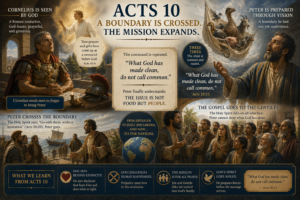 Acts 10 is one of the great launch chapters of Scripture. Cornelius, a Roman centurion and God-fearer, is seen by God, and Peter is prepared through vision to cross a boundary he had not yet understood. The repeated command, “What God has made clean, do not call common,” teaches Peter that the issue is not merely food but people.
When Peter enters Cornelius’s house, he says openly that God has shown him not to call any person common or unclean. While he is still preaching, the Holy Spirit falls on the Gentiles, and Jewish believers are astonished because the same gift has now been poured out on them as well.
This is the moment when the church visibly launches beyond its Jerusalem identity into a global body. The Jew/Gentile boundary is crossed not by human policy but by divine initiative, and baptism seals the inclusion of the nations into the same Spirit-filled community.
From Jerusalem to world
Taken together, Acts 6–10 shows the church being formed for expansion. Acts 6 clarifies roles. Acts 7 exposes resistance to the Spirit. Acts 8 becomes the hinge where scattering, Samaria, Simon, and the eunuch push the story outward. Acts 9 recruits the chosen instrument. Acts 10 launches the mission into the nations.
This whole movement fulfills the pattern announced by Jesus: Jerusalem, Judea, Samaria, and the end of the earth. From a boundary perspective, the story is not one of abolition but of redirection. God preserves the boundaries that guard truth, justice, and holiness, while breaking the false boundaries that keep out the people He is calling.
The result is the birth of a church fitted for the world. Roles are filled. Witnesses are raised up. The persecutor is repurposed. The outsider is welcomed. The Gentile is baptized. The message is no longer confined to Jerusalem. It is moving, by the Spirit, toward the world.
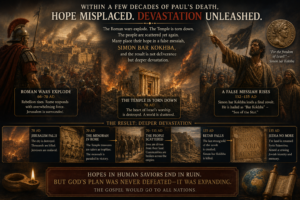
The Jews have Paul’s lifetime to see what God is doing. Paul preaches in synagogue after synagogue, pleading with his own people to recognize that the Abrahamic mission is being fulfilled in Yeshua and that the blessing of the nations does not erase Israel but depends on Israel’s Messiah. All of this unfolds under the looming weight of Yeshua’s warnings about Jerusalem and the Temple. Within a few decades of Paul’s death, the Roman wars explode, the Temple is torn down, and the people are scattered yet again. Many place their hope in a false messiah, Simon bar Kokhba, and the result is not deliverance but deeper devastation. In that light, Acts is not a small church story; it is the last great window in which Israel is invited to move from Temple‑centered hope into Messiah‑centered hope before the old walls fall. The mission itself is still the same as in Abraham’s day—blessing for the nations—but now the only safe boundary to stand inside is the one God has drawn around Yeshua.
Conclusion
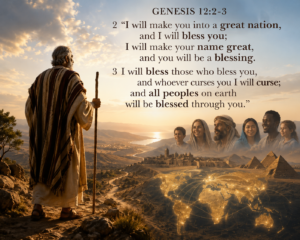 The mission itself has not changed. From Abraham onward, God’s intent has been to bless all the families of the earth. In Acts, that ancient promise begins to move in visible lines: from Jerusalem to Judea and Samaria, and out toward the ends of the earth. What changes is not God’s purpose, but the way His boundaries are drawn. God has fitted a new team of Twelve who can carry Abraham’s blessing to every nation. Through the diaspora, the Jews will be going out into the world as well, to return many centuries later.
Israel is still on the field
It is important to say, before we close, that this is not a story in which the Jews are written out. They are not replaced or erased. The same God who called Abraham, wrestled with Jacob, spoke through Moses and the prophets, and walked among His people in Yeshua is still the God of Israel. The story of Acts does not cancel that; it presupposes it.
The Jewish apostles are the first members of God’s team. They are the ones who heard Yeshua’s voice in Galilee, watched Him die in Jerusalem, and saw Him alive again. They are the ones who received the Spirit on Pentecost and began to speak in the languages of the nations. Even as the gospel moves out into Gentile territory, it does so through Jewish hands, Jewish Scriptures, and a Jewish Messiah. The Jewish root is never cut.
Paul’s ache for his own people runs through his letters. He would rather be cut off himself than see Israel miss what God is doing. He insists that the gifts and calling of God are irrevocable, that Israel’s story is not over, and that in the end all of God’s mercy—toward Gentile and Jew alike—will be the only explanation for how the whole story comes together. In boundary terms, Israel remains inside God’s covenant line, even when she stumbles.
And the Messiah is still waiting for them to see that. The story is not finished until Israel’s eyes are opened to the way their own promises have come to life in Him and until the Jewish people, in their own way and time, recognize that the blessing of Abraham now stands in the person of Yeshua. When He returns, it will not be to disown them, but to complete what He began: a reconciled family of Jew and Gentile together, all finally seeing the same King.
So when we speak of “God’s team” ready to take on the world, Israel is not sitting in the stands watching someone else play. Israel is part of the team: in the apostles, in the first congregations, in the Scriptures themselves, and in every Jew who finds that Yeshua has not abandoned the Torah but brought its deepest meaning to light. The nations are being invited in, not to push Israel out, but to stand alongside her in the same grace. The story is still Jewish, and it is now more than Jewish—exactly as God promised Abraham from the beginning.
Epilogue: grim irony
Jewish persecution never really ends. In the first generations, Rome often sees the followers of Yeshua as part of the Jewish world—they are another Jewish sect, meeting in synagogues, arguing about Scripture, and worshipping Israel’s God. That is ironic, because later, after Rome fully separates “Christianity” from Judaism and turns the Jesus movement into a new imperial religion, Catholicism, the persecution of Jews is carried on again, stronger than ever and now with Christian language attached to it. The same people through whom God first brought His Messiah into the world become, in many places, the targets of those who claim to follow that Messiah.
From a boundary perspective, that is one of the deepest tragedies in church history. A team that was meant to carry Abraham’s blessing to the nations instead drew false lines of exclusion around the very family that gave them the Scriptures and the Messiah. Yet even there, the mission itself has not changed. God has not abandoned Israel. The Messiah is still waiting for His own people to see how their story continues in Him, and He is still calling the nations to repent of every form of anti‑Jewish hatred and to stand alongside Israel inside the same grace.