WHAT IF WE STOPPED TELLING THIS STORY?
By Jonah
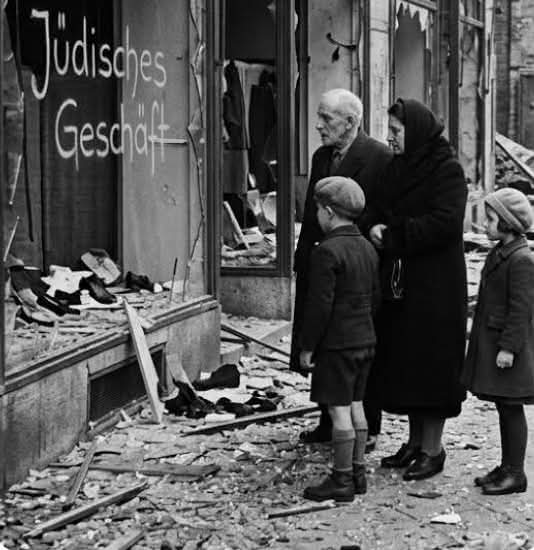
“Jüdisches Geschäft.” “Jewish business.”
Those words appear on the window in this photograph. Around it are shattered glass, damaged storefronts, and people standing before the destruction. But that window is also a mirror that Jews see ourselves in!
It reflects words we Jews recite at the Passover Seder from the Haggadah—a sefer, a book that tells the Passover story in a prescribed order, seder in Hebrew. The passage is called Vehi She’amda:
“And this is what has sustained our ancestors and us. For not just one has risen against us to destroy us, but in every generation they rise against us to destroy us; and the Holy One, blessed be He, saves us from their hands.”
What is the “this” that has sustained us? God’s covenant promise to Abraham.
Before Israel even existed as a nation, God called Avram to leave his country and his father’s household and go to a land He would show him. He promised to make Avram a great nation, through whom all the families of the earth would be blessed (Genesis 12:1–3).
Such an amazing prophecy. A man without the promised heir receives a promise concerning a nation—and a blessing that will reach the world.
Abraham will be 100 years old when Isaac is born. His wife Sarah will be the righteous age of 90—a hint through the Hebrew letter tsadi (צ), which has the value 90 and is traditionally associated with the tzaddik, a righteous person. Lech Lecha—“Go forth”—God tells Abraham. Those two Hebrew words, לך לך, themselves equal 100: each word contains a lamed (30) and a kaf (20), giving us 50 + 50 = 100. Read through gematria, they offer a remarkable echo of the prophecy—the age at which Abraham will receive his promised son.
And God will use those same words again in Genesis 22:2: לֶךְ־לְךָ—Lech Lecha, “Go forth.” This time, Abraham is to go to the land of Moriah to offer the one son God had promised. A reminder of His covenant.
But walking in that promise would require sacrifice. Avram would leave what was familiar and trust God with what he could not yet see. Earlier, in Genesis 15:13–14, God had told him that his descendants would endure enslavement and oppression. He had also promised their deliverance.
The blessing did not mean a life without suffering. The suffering would not mean the promise had failed.
Moses connected the dots. He explained that God brought Israel out of slavery because He loved them and kept the oath He had sworn to their ancestors (Deuteronomy 7:8). The Exodus was the fulfillment of a promise made generations earlier.
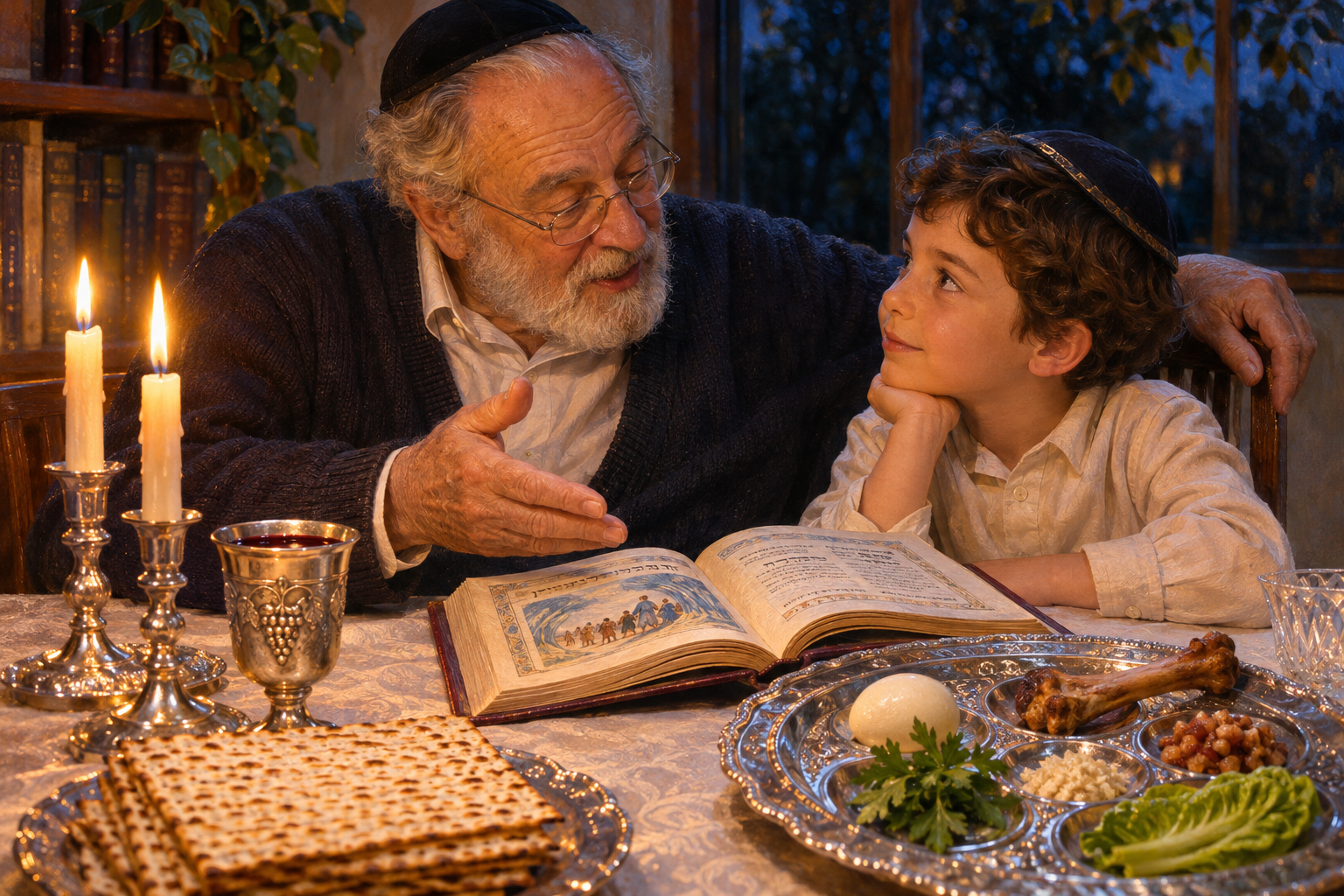
And Moses commanded us to tell our children: “You shall tell your son on that day, ‘It is because of what the LORD did for me when I came out of Egypt’” (Exodus 13:8).
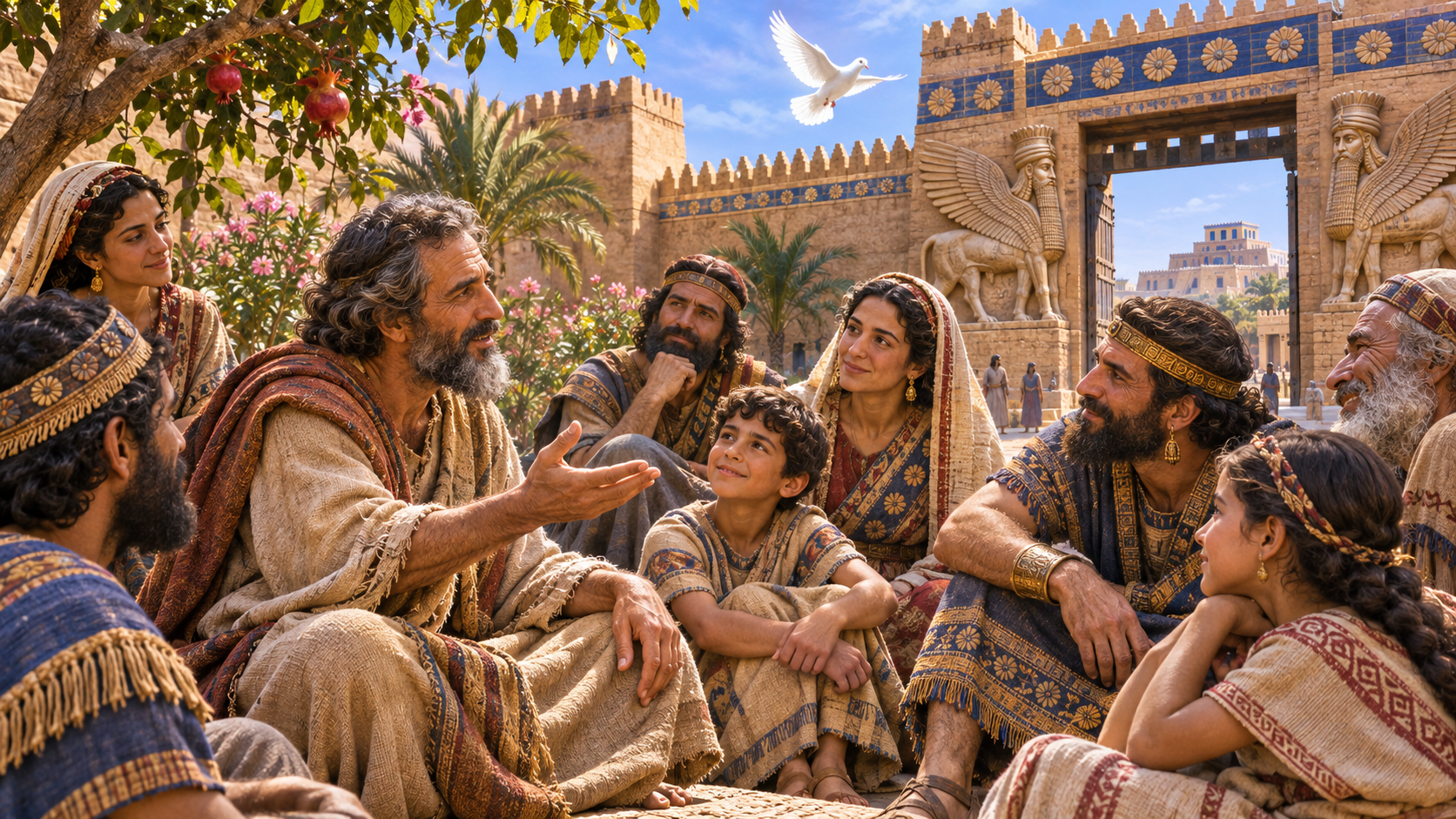
On that day. At Passover. For thousands of years, we Jews have told that story again and again. The Seder has developed over time, but the responsibility remains: tell the next generation what God has done.
Notice the personal language: “for me.” We inherit more than information about our ancestors. We inherit a place in the story—and a responsibility to carry it forward.
Perhaps this is among the most important commandments in the Bible because it preserves the knowledge that gives meaning to the first declaration of the Ten Commandments: “I am the LORD your God, who brought you out of the land of Egypt, out of the house of slavery” (Exodus 20:2).
God identifies Himself through the very deliverance we are commanded to recount. Who is our God? The One who brought us out.
And why did He call us? The promise to Abraham reaches beyond our own survival. All the families of the earth were to be blessed through him.

Psalm 67 returns to that purpose. In its traditional menorah arrangement, the psalm’s seven verses form a central shaft with three branches on either side. At its center stands verse 4: “Let the nations be glad and sing for joy: for thou shalt judge the people righteously, and govern the nations upon earth.”
The nations are invited to rejoice in God’s righteous rule. The psalm closes: “God shall bless us; and all the ends of the earth shall fear him” (Psalm 67:7). God’s blessing upon our people carries a purpose for the world.
Then what if we stopped telling the story? Would our children forget who they are? Would they forget the covenant, the deliverance, and the God who introduces Himself through it? Would we lose His protection?
We cannot claim that God’s faithfulness depends on our perfect remembrance. Nor should we suggest that those who suffer persecution have somehow failed to remember enough. But Moses explicitly warned that forgetting God was a danger: “Beware lest thou forget the LORD, which brought thee forth out of the land of Egypt, from the house of bondage” (Deuteronomy 6:12).
The command to tell and the warning against forgetting belong together.
Now look again at that window. “In every generation they rise against us to destroy us.”
The photograph gives those words a terrible immediacy. Yet we must also remember the Jews whose lives were taken. Six million were murdered in the Holocaust. Our people’s survival does not erase their deaths. Their names, their lives, and what was done to them must also be told.
There are still Holocaust survivors among us. One day, there will be no one left who can tell that history from firsthand experience. Will our children know what they must tell theirs?
Forgetting Passover would not automatically mean forgetting the Holocaust. But if we abandon the responsibility to gather our children and tell them who we are and what happened to our people, both memories become vulnerable.
At the Passover table, we practice remembrance. We gather. We ask questions. We listen. We tell. We give the next generation something it must carry.
What would happen if that chain were broken? What would our people lose? What would the nations lose if the people entrusted with this covenant and its witness disappeared?
God’s promise to Abraham concerned a blessing for all the families of the earth. The responsibility to remember therefore reaches beyond our own household.
But in those same verses, God also gives a warning: “I will bless those who bless you, and him who dishonors you I will curse” (Genesis 12:3). That makes the covenant with Abraham as important to the world as it is to the nation of Israel, the Jewish people. The world has a lot riding on how it treats the Jews. And right now, it’s doing a lousy job.
That brings me back to the window. “Jewish business.” A mirror that Jews see ourselves in. A reflection of the danger our Haggadah teaches us to remember—and a question facing those of us looking at it today.
What if we stopped telling that story? We might forget more than what happened to us. We might forget the God who brought us out—and why we were called to be a blessing to the world.