Jonah, Ezekiel and the Soul’s Response to God
A Study by Jonah
Preface
One small Hebrew letter caught my attention. Add yod—worth ten—to nefesh, “soul,” and it becomes nafshi: “my soul.” That simple change led me to explore other passages where an added yod changes an expression—and whether their meanings might speak to one another.
This study brings Jonah’s prayer, Ezekiel’s confinement, Joshua’s changed name, and Job’s continuing devotion into conversation with Jewish interpretations of yod and aleph. Together, they suggest a connection between receiving from God and making that experience personal through our actions.
The individual insights have established roots; the thread connecting them is the observation explored here. I invite you to follow it with me and consider what these connections might reveal.
This is a longer study, moving through Hebrew letters, numbers, and several biblical stories. Some connections take a little time to unfold, and I hope you’ll stay with me as we follow them. Running through the article is a question we all face: when life bears down on us, how do we respond? That question leads us toward the actions we take in faith—and how those actions deepen our personal relationships with God and one another.
One small Hebrew letter adds ten—and makes it personal.
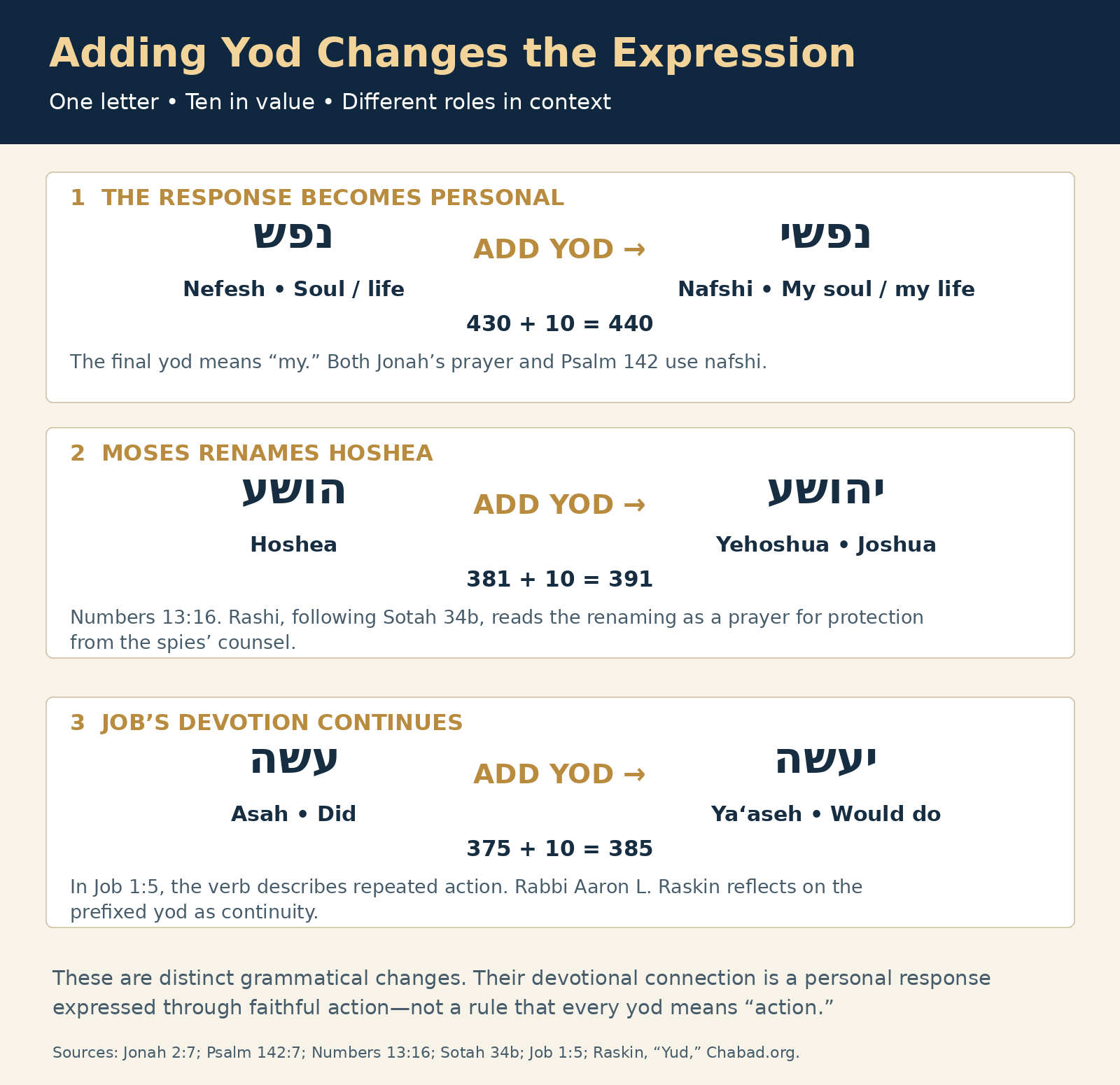
The Hebrew word nefesh (נפש), meaning “soul” or “life,” has a numerical value of 430. Add a final yod (י), worth ten, and it becomes nafshi (נפשי): “my soul” or “my life,” totaling 440.
That is the word Jonah uses while praying inside the fish. It is also the word in the psalmist’s plea for release from confinement. The added letter performs an ordinary grammatical task, yet it invites a searching personal question: When God’s warning reaches my soul, what will I do?
Ten Is the Clue
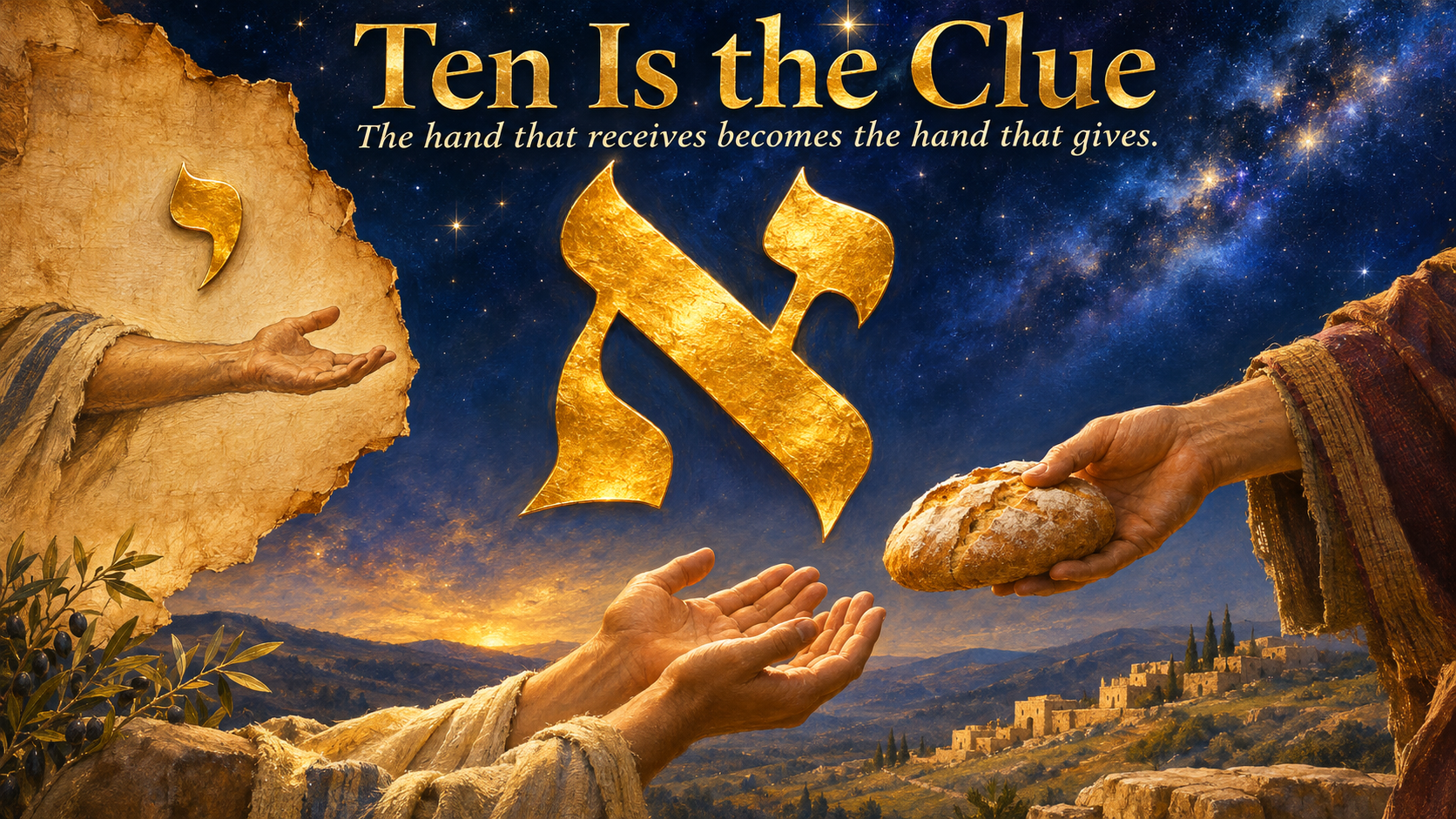
Ten draws our attention to yod. That is what gematria contributes to this study: a numerical correspondence prompts us to look more closely at a letter, a word, or a passage. The meaning develops as we consider the language, Scripture, and Jewish interpretation together.
Yod’s early pictorial ancestor represented a hand with a forearm, and its name is associated with yad, “hand.” This gives our reflection a concrete image: the hand reaches, receives, works, gives, and serves. In nafshi, the final yod grammatically means “my.” Its hand imagery invites the personal application: what will my hands do in response to God?
A traditional reading of aleph (א), the first Hebrew letter, brings that image into a relationship between above and below. Its square form is understood as an upper yod, a lower yod, and a diagonal vav connecting them. Rabbi Aaron L. Raskin explains the upper yod as representing God, the lower yod as His people on earth, and the vav as faith—or, in another interpretation, Torah—uniting them.
The two yods and the vav total 10 + 10 + 6 = 26, matching the numerical value of God’s four-letter name. Aleph’s own standard value remains one. This symbolic reading of its later form is distinct from the ancient pictorial ancestry of yod.
Raskin also connects the lower yod with humility: recognizing our smallness makes us a vessel to receive God’s wisdom. That gives the article its movement. We make room to receive from God, then carry what we receive into earthly action. The hand that receives becomes the hand that gives.
These associations do not assign one hidden meaning to every yod. They explain why the added ten deserves attention here: it leads us from a number to a letter, from a letter to relationship, and from relationship to a personal response of love.
The thread is personal response: a soul calls to God from confinement, receives His word, and must decide how to act. We will follow it from the prophets’ restricted bodies to our own capacity to make room for others.
“Bring my soul out of prison, that I may praise thy name.”
Psalm 142:7 KJV (142:8 in Hebrew numbering)
Ezekiel brings the number 430 into view through his own confinement. God assigns him 390 days on his left side, followed by 40 on his right, each day representing a year associated with the people’s iniquity (Ezekiel 4:4–8). These are the numbers we turn to next.
Heaven and the Soul in the Confined Place

In standard Hebrew gematria, letters have numerical values. Shamayim (שמים), meaning “heavens,” totals 390: shin 300 + mem 40 + yod 10 + final mem 40. Nefesh (נפש), meaning “soul,” “life,” or “living being,” totals 430: nun 50 + pe 80 + shin 300. Ezekiel’s two periods together total that same number: 390 + 40 = 430.
These associations have roots in Jewish interpretation. Rabbeinu Bahya, commenting on Genesis 1:2, cites a tradition about 390 heavens, corresponding to the value of shamayim, “heavens.” A Chabad exposition of the Haggadah connects nefesh, “soul” or “life,” totaling 430, with the 430 years from God’s covenant with Abraham to the Exodus. That period culminates in Egyptian bondage and deliverance. The confinement theme thus extends from an individual to a people: Jonah cries from the fish; Israel cries from bondage. God hears both, brings them out, and calls them to serve Him.
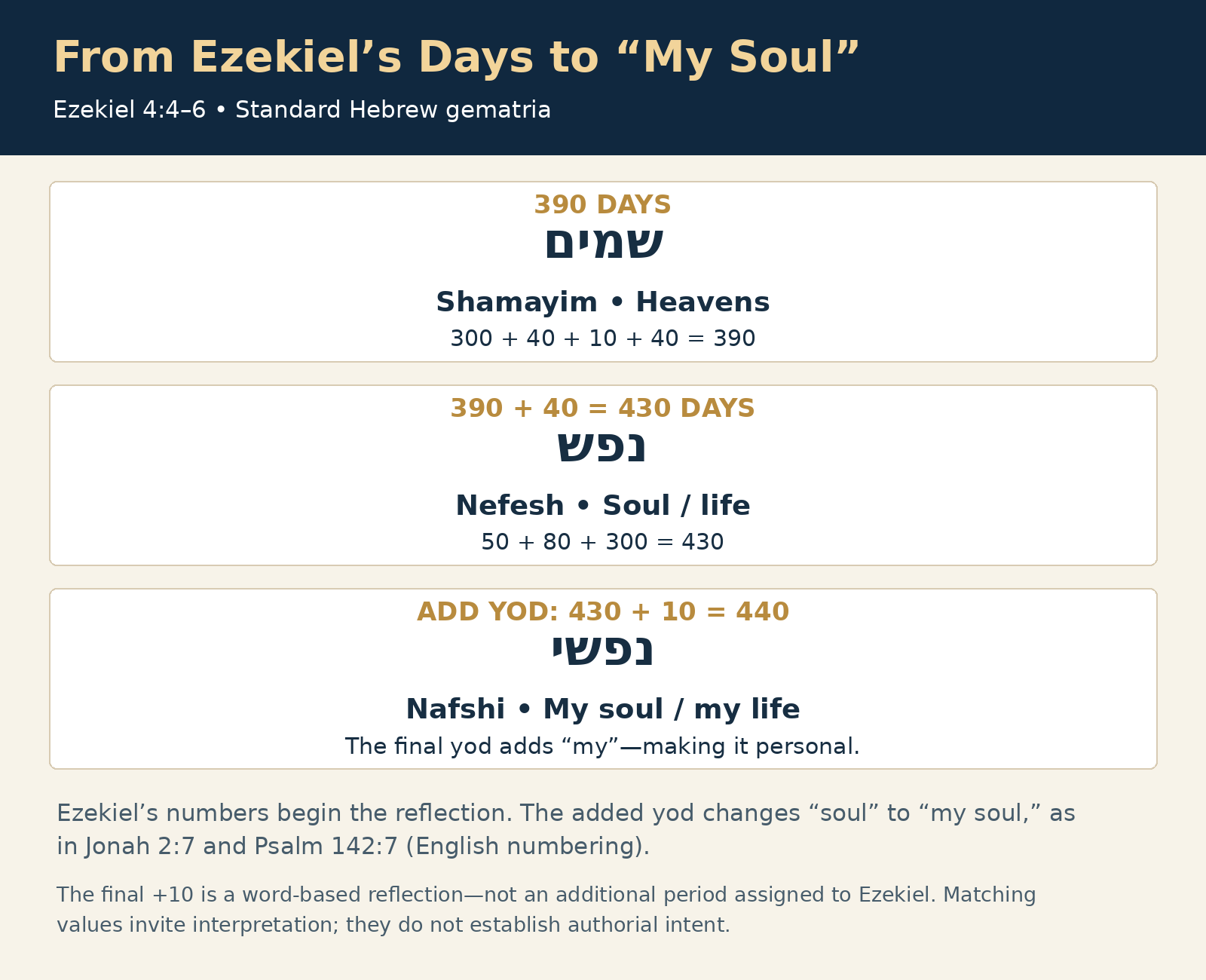
These numerical associations invite reflection; they do not establish that Ezekiel intended to encode “heavens” and “soul.” The connection rests more firmly in the biblical experiences themselves: Israel cries from bondage, Jonah prays from the fish, and Ezekiel continues to receive God’s word while his movements are restricted. Confinement does not place them beyond God’s reach.
Jonah makes that relationship especially vivid. Inside the fish, with his life ebbing away, he remembers the Lord, and his prayer reaches God’s holy temple (Jonah 2:7). His body is enclosed beneath the sea, yet his appeal reaches heaven. The soul can turn toward God even when the body cannot move freely.
Although Jonah and Ezekiel ministered roughly two centuries apart, their stories reveal a shared pattern of restriction, dependence, and response. This brings us from the numerical reflection to the prophets’ actual experiences: how does confinement itself become part of the message God entrusts to them?
Confinement Becomes a Message
Jonah descends into the sea and is swallowed by a great fish. His movements are restricted, his survival depends upon God, and he prays from a place he describes as the belly of Sheol. Yet God preserves him and brings him out alive (Jonah 1:17–2:10).
Ezekiel also experiences restriction. God directs him to shut himself inside his house, then describes him as bound. Later, Ezekiel lies on his sides, with his movements constrained, bearing a representation of Israel’s and Judah’s iniquity (Ezekiel 3:24–27; 4:4–8).
Jonah’s confinement follows his attempt to flee God’s commission. Ezekiel’s restriction comes through obedience. In both accounts, however, the prophet’s bodily experience becomes inseparable from his mission.
Bound Yet Within God’s Reach
Psalm 142 gives this study a direct biblical expression: “Bring my soul out of prison.” The Hebrew joins nafshi (נפשי), “my soul” or “my life,” with masger (מסגר), “prison” or “confinement.” Nafshi totals 440; its base word nefesh totals 430. The final yod supplies the additional ten and the meaning “my.” Here the connection between soul and confinement is explicit in Scripture, independently of our numerical reflection.
Masger comes from the root sagar (סגר), “to shut.” Ezekiel’s instruction to shut himself inside his house uses hissager (הסגר), from that same root (Ezekiel 3:24). The psalm’s confined soul and Ezekiel’s shut house therefore share actual Hebrew vocabulary.
Ezekiel 3:25 then uses asar (אסר), “to bind,” alongside avotim (עבותים), “cords” or “ropes.” Rashi understands this as confinement under God’s decree, as though Ezekiel were bound with ropes. The image communicates restriction under divine authority; it need not require us to imagine literal ropes around him.
Jonah uses a different binding word. He describes seaweed as chavush (חבוש), “bound” or “wrapped,” around his head (Jonah 2:5; 2:6 in Hebrew numbering).
In that same verse, the waters engulf him “to the point of death”—ad nefesh (עד נפש), an expression describing a threat to his very life. The imagery of being bound and the word nefesh, “life” or “soul,” appear together in the description of his descent. He also pictures the earth’s bars closing behind him before declaring that God brought his life up from the pit (Jonah 2:6). These images recall his peril in the sea within the prayer he offers from the fish.
Psalm 116 brings together another set of related images: death’s cords surround the speaker, who calls upon God to deliver his soul (verses 3–4), then thanks God for loosening his bonds (verse 16). The psalms supply a vocabulary of distress, prayer, and deliverance through which we can read the prophets’ experiences.
The shared picture is a life hemmed in, still able to call upon God. Jonah’s fish both encloses him and preserves him from drowning; Ezekiel’s restriction makes him a sign to his people. Their prayers now bring that continuing relationship into focus.
Jonah prays from inside the fish. He remembers God, looks toward His holy temple, and acknowledges that deliverance belongs to the Lord (Jonah 2:1–9).
Ezekiel also appeals to God during his enacted ordeal. When instructed to cook his bread over human dung, he protests that he has kept himself from defilement. God responds by permitting cattle dung instead (Ezekiel 4:12–15).
Jonah’s thanksgiving and Ezekiel’s plea concerning purity serve different purposes. Both nevertheless show that restriction leaves room for relationship with God. The next question is what happens when the prophet comes out.
Coming Out and Going Forward
At God’s command, the fish releases Jonah onto dry land. His emergence leads to a renewed commission to preach to Nineveh (Jonah 2:10–3:2).
In a separate prophetic action, Ezekiel prepares baggage, digs through a wall, and carries his belongings outside at dusk. This departure portrays Jerusalem’s people going into exile (Ezekiel 12:3–7).
Emergence changes their circumstances, but it also serves the prophetic message: Jonah is rescued for a renewed mission; Ezekiel portrays displacement into exile. Their outward movements point us toward the people who must hear—and respond.
Forty and the Response to Warning
Jonah announces forty days before Nineveh’s threatened overthrow. The people turn from their evil, and God withholds the announced disaster (Jonah 3:4–10).
Ezekiel lies on his right side for forty days, representing forty years associated with Judah’s iniquity. His forty days are a symbolic reckoning, rather than the same kind of countdown Jonah announces (Ezekiel 4:6).
Ezekiel’s commission makes the comparison especially relevant. God tells him that foreign peoples would listen, while the house of Israel will refuse to hear (Ezekiel 3:5–7). Nineveh demonstrates the response Ezekiel’s own audience resists. The importance of forty leads us to the more consequential question: what do people do with the warning?
A Warning Is an Act of Mercy
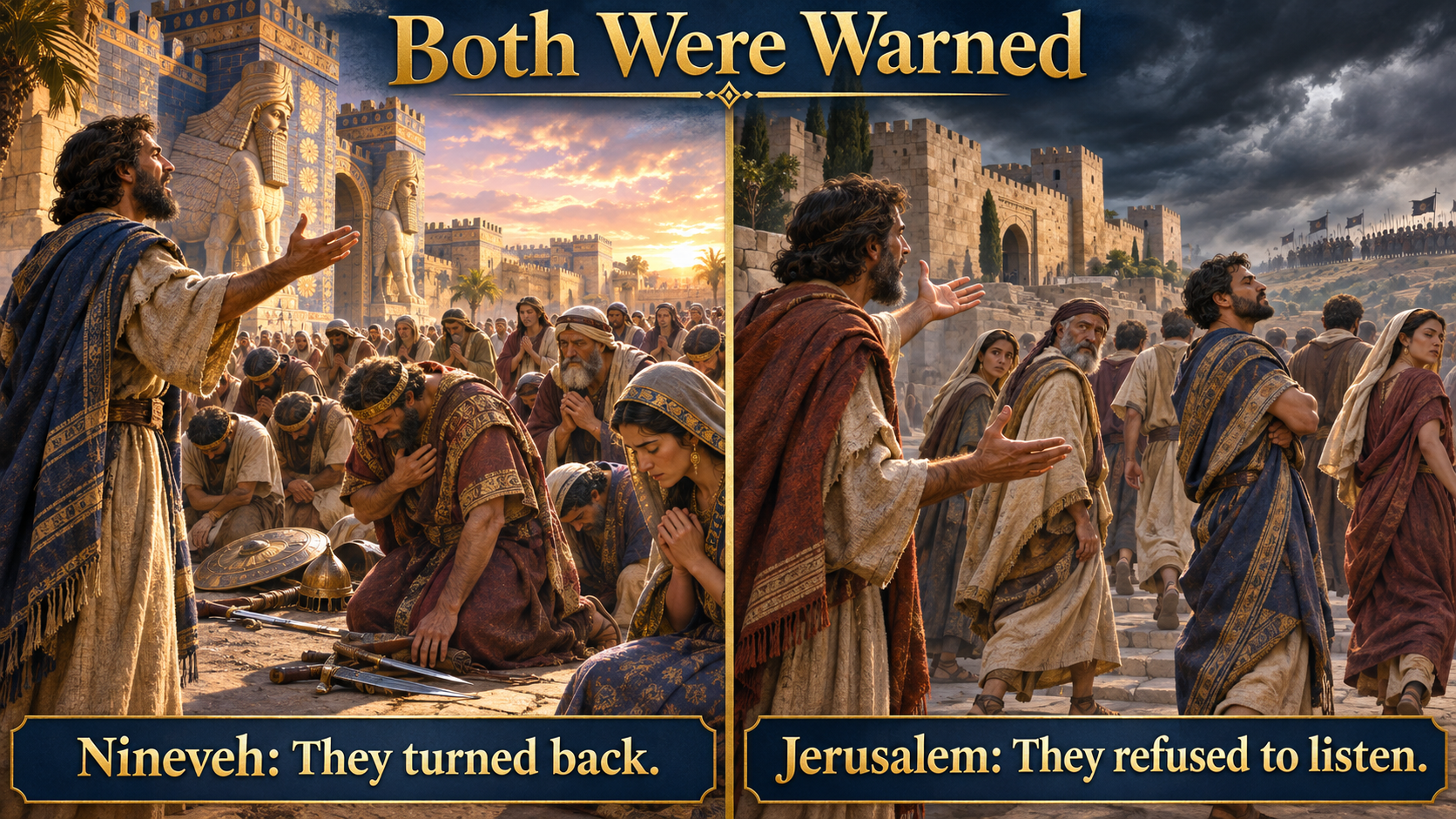
Read together, these accounts create a searching contrast. In Jonah, a foreign city hears and repents. In Ezekiel, God confronts His own people as Jerusalem’s judgment approaches.
The roughly two centuries between their ministries were not an explicitly announced grace period. Still, the historical sequence invites reflection: the earlier story demonstrates what repentance can change; the later prophecy exposes the tragedy of persistent resistance.
Read together, the accounts show why a warning can be merciful: it confronts people with the need to turn.
Ezekiel states the invitation plainly: God takes no pleasure in the death of anyone; therefore, turn and live (Ezekiel 18:32).
Nineveh responded; Jerusalem’s repeated warnings ended in destruction. Individuals could listen and turn, but the nation did not respond as Nineveh had. This brings us back to the opening yod: the response cannot remain someone else’s responsibility. It must become mine.
Adding Ten and Making It Personal
Jewish interpretation offers an important precedent for finding significance in an added yod. Before the spies explore Canaan, Moses changes Hoshea (הושע) to Yehoshua (יהושע), adding yod and increasing the name’s value by ten (Numbers 13:16). Rashi, following Sotah 34b, understands this as Moses’ prayer that God would save Joshua from the spies’ evil counsel. This is Joshua son of Nun. His Hebrew name, Yehoshua, is related to the shorter form Yeshua.
The connection with forty is striking. The spies explore the land for forty days. Joshua and Caleb urge the people to trust God and enter, but the people refuse. The forty days become forty years of wandering, one year for each day (Numbers 13:25; 14:6–9, 34). Ezekiel later uses the same day-for-year pattern. Jonah’s forty-day warning serves a different purpose, yet again confronts people with a response to God’s word.
Joshua’s added yod accompanies a prayer for protection; it does not remove his responsibility to choose. He must still stand against fear and remain faithful. Sanhedrin 107a adds an imaginative rabbinic account: the yod removed when Sarai became Sarah protests until it is placed at the beginning of Joshua’s name. A small letter becomes a thread connecting biblical lives across generations.
Rabbi Aaron L. Raskin offers a later Hasidic reflection on Job 1:5. Discussing Job’s repeated offerings for his children, he contrasts asah (עשה), “did,” with ya‘aseh (יעשה), “would do.” In that context he interprets the prefixed yod as expressing continuing action. He also associates yod with yad, “hand” (Raskin, “Yud,” Chabad.org). This concerns a different use of yod from the possessive ending in nafshi; together they provide material for reflection rather than a single grammatical rule.
 Jonah’s prayer itself moves toward commitment: he promises thanksgiving, sacrifice, and fulfillment of his vow (Jonah 2:9). After his release, God commissions him again, and this time he goes (Jonah 3:1–3). Nineveh likewise expresses repentance through changed conduct. The movement from prayer toward action is present in the story.
The final yod in nafshi means “my”; its association with the hand and continuing action supplies our devotional application. Joshua stands faithfully, Job practices devotion repeatedly, and Jonah goes when called again. The connection is personal faith expressed in conduct. But conduct has a deeper purpose: learning to love.
On Earth as It Is in Heaven
The traditional reading of aleph brings us back to the relationship between heaven and earth. Its upper yod represents God; its lower yod represents His people here below; the connecting vav represents faith. The lower yod’s association with humility reminds us that receiving from God begins with making room for Him.
This study invites us to take that image into our daily conduct. If the lower yod represents us on earth, our actions give visible expression to our response to God. Yod’s association with the hand makes the question concrete: what will my hands do with what I have received?
There is an echo here of Yeshua’s prayer: “Thy will be done in earth, as it is in heaven” (Matthew 6:10, KJV). We pray for God’s will to be fulfilled here below—and that prayer calls for our participation. Forgiving, giving, serving, and making room for another person become ways of putting that prayer into practice.
Yeshua connects love with obedience: “If ye love me, keep my commandments” (John 14:15, KJV). The faith represented by the connecting vav finds expression in the life represented by the lower yod. This is our devotional application of aleph: what we receive from above calls for faithful action below.
Adding yod makes “soul” become “my soul.” Its hand imagery invites a personal response: my prayer, my choice, my obedience. What I receive from God calls for a response that no one else can make for me.
That response takes shape in the space we give to others—in our homes, our relationships, and our willingness to love.
Making Room for One Another

The question of faithful action now enters the home. The number 390, which drew our attention to heaven, also appears in the value of Genesis’s phrase ‘male and female.’ This numerical echo leads us toward a practical question: how do two people make room for one another—and for God?
In Genesis 1:27, the phrase “male and female” is zakhar u’nekevah (זכר ונקבה). Zakhar totals 227: zayin 7 + kaf 20 + resh 200. U’nekevah totals 163: vav 6 + nun 50 + qof 100 + bet 2 + hei 5. Together they total 390, the same value as shamayim, “heavens.” The connecting vav, “and,” belongs to the actual biblical wording; no letter has been supplied to make the sum work.
A second expression, haShekhinah (השכינה), “the Divine Presence,” also totals 390: hei 5 + shin 300 + kaf 20 + yod 10 + nun 50 + hei 5. The initial hei, “the,” is necessary for this value; Shekhinah without it totals 385.
The marriage connection has its own established rabbinic foundation. In Sotah 17a, Rabbi Akiva teaches that when husband and wife merit it, the Divine Presence dwells between them. Ish (איש), “man” or “husband,” contains a yod; ishah (אשה), “woman” or “wife,” contains a hei. Together these distinctive letters spell Yah (יה), a divine name. Without them, both words leave esh (אש), “fire.” This is rabbinic wordplay, not an explanation of the historical origins of the words.
Here the added yod leads into a traditional meditation on marriage. Alongside the shared value 390, it gives us a devotional bridge from heaven to the home. The question becomes practical: how do we make a relationship a place where God’s presence is welcomed?
Scripture also gives us the language of making room. Isaiah tells Zion to enlarge her tent, stretch its curtains, and strengthen its stakes; shortly afterward, he identifies her Maker as her husband (Isaiah 54:2–5). The original promise concerns Zion’s restoration and growing family. Its marriage imagery nevertheless offers a fitting picture for our reflection: renewed relationship opens space for life to flourish.
Paul uses an equally direct spatial metaphor for affection. He describes his heart as open to the Corinthians, says their restriction lies in their own affections, and asks them to widen their hearts (2 Corinthians 6:11–13). This addresses his relationship with a congregation, rather than marriage, but the application is clear: love can be constricted, and hearts can make room.
We make room in the bed. We make room at the table. We make room in the house. We make room in our lives. Sharing space means surrendering our exclusive claim to it. We give our spouse attention when we would rather pursue our own plans. We devote time, money, and energy to what matters to the other person.
This is humility in action: making ourselves small enough to put another person first. Our worth remains, but our preferences no longer occupy all the room. Both spouses are called to give and receive this care. Making room is a sacrifice because we willingly share something we could have kept for ourselves.
Jonah makes the contrast vivid. He leaves the fish, yet still resents God’s compassion toward Nineveh (Jonah 4:1–11). His body has emerged from confinement; his compassion still needs room to grow. God’s mercy reaches people whom Jonah struggles to welcome into his concern.
Jonah’s story brings confinement inward. A body can be free while a heart remains restricted by resentment. That is why making room belongs in this study: the response God seeks reaches beyond our movements to the people we are willing to love.
Hearing Requires a Response
Love is an action, not simply an emotion. Love takes sacrifice. Its action begins in humility: yielding our insistence on having our own way and making room for God and the people He asks us to love. Obedience gives that love visible expression.
Nineveh did more than feel afraid or express sorrow. God saw what the people did: they turned from their evil ways (Jonah 3:10). Their repentance became visible in changed behavior.
Ezekiel later describes people who listen eagerly to his words and express devotion with their mouths, yet fail to put his words into practice (Ezekiel 33:30–32). They hear the message, but their lives do not follow it.
That brings the warning home to us. We can appreciate a message, agree with it, and even be moved by it. Obedience requires action.
“My soul” makes the prayer personal. “My obedience” makes the response visible. Love makes room.
Sources and Interpretive Notes
Biblical passages: Genesis 1:27; Numbers 13:16, 25 and 14:6–9, 34; Jonah 1–4; Ezekiel 3:24–27, 4:4–15, 12:3–7, 18:32, and 33:30–32; Psalms 116 and 142; Job 1:5; Isaiah 54:2–5; and 2 Corinthians 6:11–13. References follow common English verse numbering; Hebrew numbering differs in Jonah 2 and Psalm 142.
Heaven and the soul: “Rabbeinu Bahya on Genesis 1:2” cites the tradition of 390 heavens, associated with the numerical value of shamayim. “Questions and Answers on Maggid—Reciting the Haggadah,” Chabad.org” connects nefesh, whose value is 430, with the period from the Covenant Between the Parts to the Exodus.
Ezekiel’s confinement: “Rashi on Ezekiel 3:25” explains the prophet’s restriction under God’s decree as though he were bound with ropes.
The ancient hand imagery: “Yod,” Encyclopaedia Judaica describes the letter’s early pictorial ancestor as a hand with a forearm. This historical ancestry is distinct from later symbolic interpretations of Hebrew letters.
Yod and continuing action: Rabbi Aaron L. Raskin, “Yud—The Tenth Letter of the Hebrew Alphabet,” Chabad.org, discusses yod’s association with the hand and offers a Hasidic reflection on continuing action in Job 1:5.
Aleph and humility: Rabbi Aaron L. Raskin, “Aleph—The First Letter of the Hebrew Alphabet,” Chabad.org explains the traditional reading of aleph as two yods joined by a vav. He associates the upper yod with God, the lower with His people on earth, and the connecting vav with faith or Torah. He also discusses humility and the components’ combined value of 26. Aleph’s standard numerical value remains one.
Joshua’s added yod: “Rashi on Numbers 13:16” following Sotah 34b, interprets Moses’ renaming of Hoshea as Yehoshua as a prayer for protection from the spies’ counsel. “Sanhedrin 107a” preserves the rabbinic account connecting the yod removed from Sarai’s name with the yod added to Joshua’s.
Marriage and the Divine Presence: Sotah 17a records Rabbi Akiva’s teaching about husband and wife and the Divine Presence dwelling between them. The interpretation draws upon the yod in ish and the hei in ishah. See also “Explanations of Wedding Rituals and Customs,” Chabad.org“. The phrase zakhar u’nekevah, “male and female,” appears in Genesis 1:27.
Gematria and interpretation: Calculations use standard Hebrew letter values, with final letters retaining their ordinary values. Prefixes and suffixes are counted as written: nefesh = 430; nafshi = 440; shamayim = 390; zakhar u’nekevah, including “and,” = 390; and haShekhinah, including “the,” = 390.
The shared values invite exploration; they do not by themselves establish that biblical writers intended these connections. Yod’s grammatical roles also differ across the examples. The connections drawn among the passages—and their application to humility, marriage, sacrifice, and love in action—are the author’s devotional reflections.