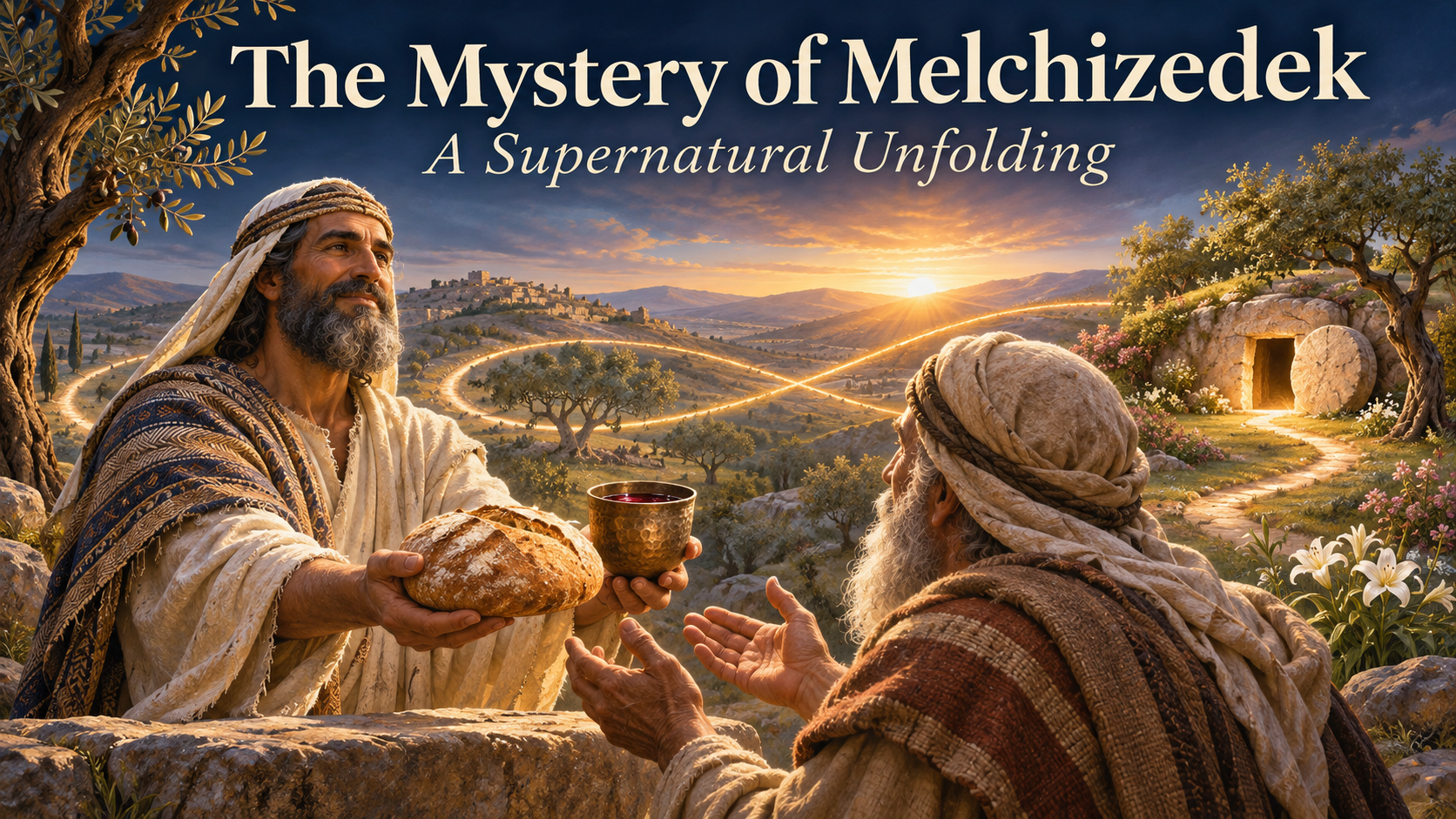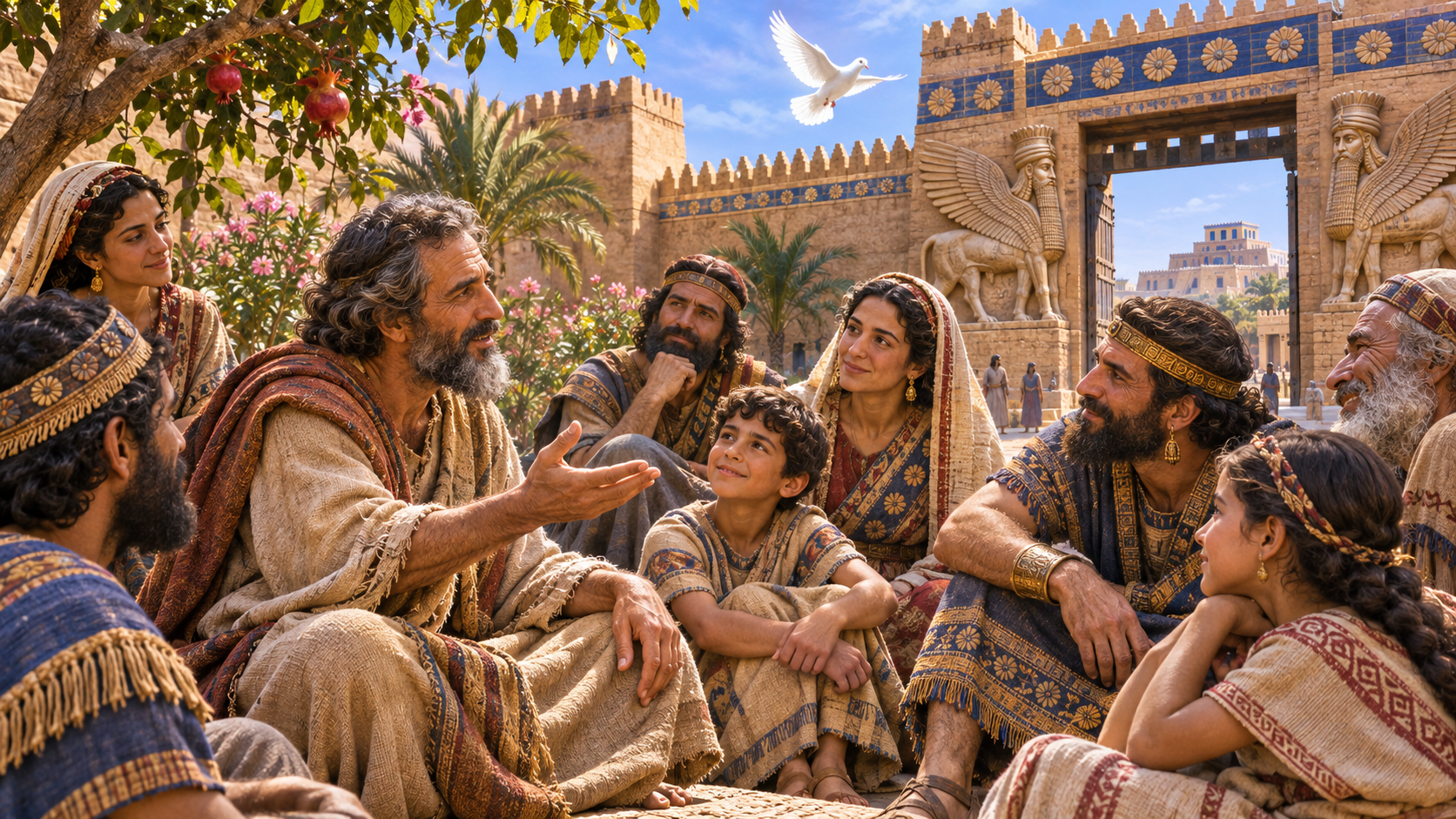

Ruth holds the grain from which bread is made. Miriam holds Yeshua, who declares, “I am the bread of life” (John 6:35). The grain recalls the Omer offering and the counting of days from Passover to Shavuot—the festival called Pentecost in Acts. Bethlehem, the “house of bread,” connects their stories.
From Ruth’s Faithfulness to the Messiah’s Care
By Jonah
The other day, I was sorting through artwork, deciding what to hang and what to store. My wife wanted to repurpose and redecorate the room that had been my “man cave.” I gave up the room to honor her wishes.
My wife’s name is Mary. That detail would become interesting as my thoughts developed.
Among the pieces, I came across a framed ceramic artwork depicting Ruth, made by an artist in Israel. My mother brought it back from Israel more than sixty years ago. I decided to hang it in the room we were repurposing. That piece has had me thinking about the Book of Ruth for weeks.
Ruth had found a place on the wall, and her story had found a place in my thoughts.
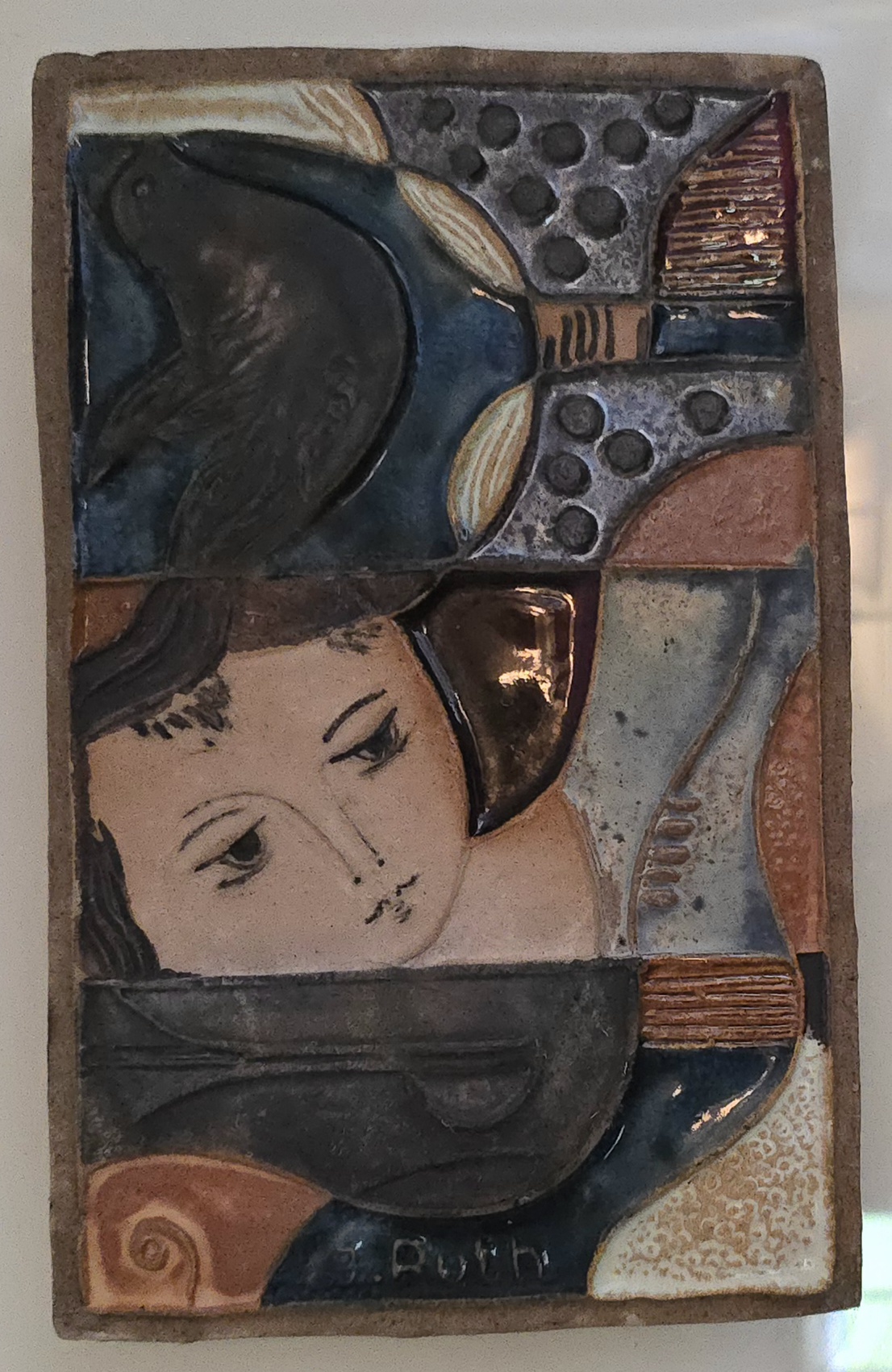
Then I noticed the dove in the artwork. In Hebrew, a dove is a יוֹנָה—Yonah, Jonah. My name. The dove also brought to mind the Holy Spirit, who descended like a dove at Yeshua’s baptism (Matthew 3:16). I cannot say what the artist intended, but this small detail in my mother’s artwork gave me another reason to look more closely—and eventually led my thoughts toward Shavuot and Pentecost.
As I considered her faithfulness, I began noticing connections to another woman: Miriam, whom English readers know as Mary, the mother of Jesus. Ruth remains beside Naomi. Miriam remains beside Yeshua at the cross. Both accept commitments whose consequences reach far beyond anything they could have seen at the beginning.
The Jewish calendar brought these connections together.
In many Jewish communities, the Book of Ruth is read during the morning service on Shavuot, generally before the Torah reading. For congregations observing two days outside Israel, that reading usually takes place on the second day. Customs vary, but Ruth has an enduring place in the celebration of Israel’s reception of the Torah.
Shavuot is also the festival called Pentecost in Acts.
Before Acts describes the outpouring of the Holy Spirit, it names Miriam among those continuing together in prayer (Acts 1:14). The mother who stood beside her son at the cross remains with His followers afterward. Then, at Shavuot, Jews from many nations hear the message proclaimed in their own languages (Acts 2:1–11).
Ruth’s place in Jewish worship and Miriam’s place in the community approaching Pentecost draw my attention to the same theme: faithful commitment whose consequences reach generations and nations.
I began by deciding where to hang an old family keepsake. I found myself considering how these women’s faithfulness helped shape a story reaching across Judaism, Christianity, and the world.
What does a woman of valor look like?
We might imagine someone powerful, accomplished, and secure—a woman whose circumstances make her strength easy to recognize.
But Scripture gives that description to a foreign widow gathering grain behind other people’s harvesters.
Her name is Ruth.
She has lost her husband. She has left her homeland. She is helping support a grieving mother-in-law whose own losses have left her feeling empty. Ruth cannot see where her decisions will lead. She knows only whom she has chosen to accompany and the God beneath whose wings she has sought refuge.
Yet Boaz tells her:
כִּי אֵשֶׁת חַיִל אָתְּ Ki eshet chayil at. “For you are a woman of valor.” —Ruth 3:11, author’s translation
He recognizes her character before she becomes his wife, before she bears a son, and before anyone knows that kings will descend from her.
Ruth’s valor is already visible in the way she loves.
The Strength Within the Word
Proverbs asks:
אֵשֶׁת חַיִל מִי יִמְצָא Eshet chayil mi yimtza. “A woman of valor, who can find?” —Proverbs 31:10, author’s translation
The expression eshet chayil carries more strength than we sometimes hear in the familiar translation “virtuous woman.”
The Hebrew word חַיִל—chayil can describe strength, capability, wealth, military forces, or valor, depending on its context. In Exodus 14:28, a form of this word describes Pharaoh’s army. Applied to a woman, it conveys worth and strength of character.
That range of meaning invites us to take Ruth’s courage seriously.
She faces grief, uncertainty, exhausting work, and the vulnerability of being a foreigner. Her strength appears in her willingness to continue, act wisely, and shoulder responsibility for someone besides herself.
Boaz also receives a description containing chayil. Ruth 2:1 introduces him as an אִישׁ גִּבּוֹר חַיִל—ish gibbor chayil, a man of standing, wealth, or valor.
Their circumstances are unequal. He owns the field; she gathers what remains after the harvesters. Yet the language allows us to recognize strength in both.
His resources give him the ability to help. Her circumstances reveal the depth of her resolve.
Will You Stay?
Before Ruth reaches that field, she faces a decision on the road.
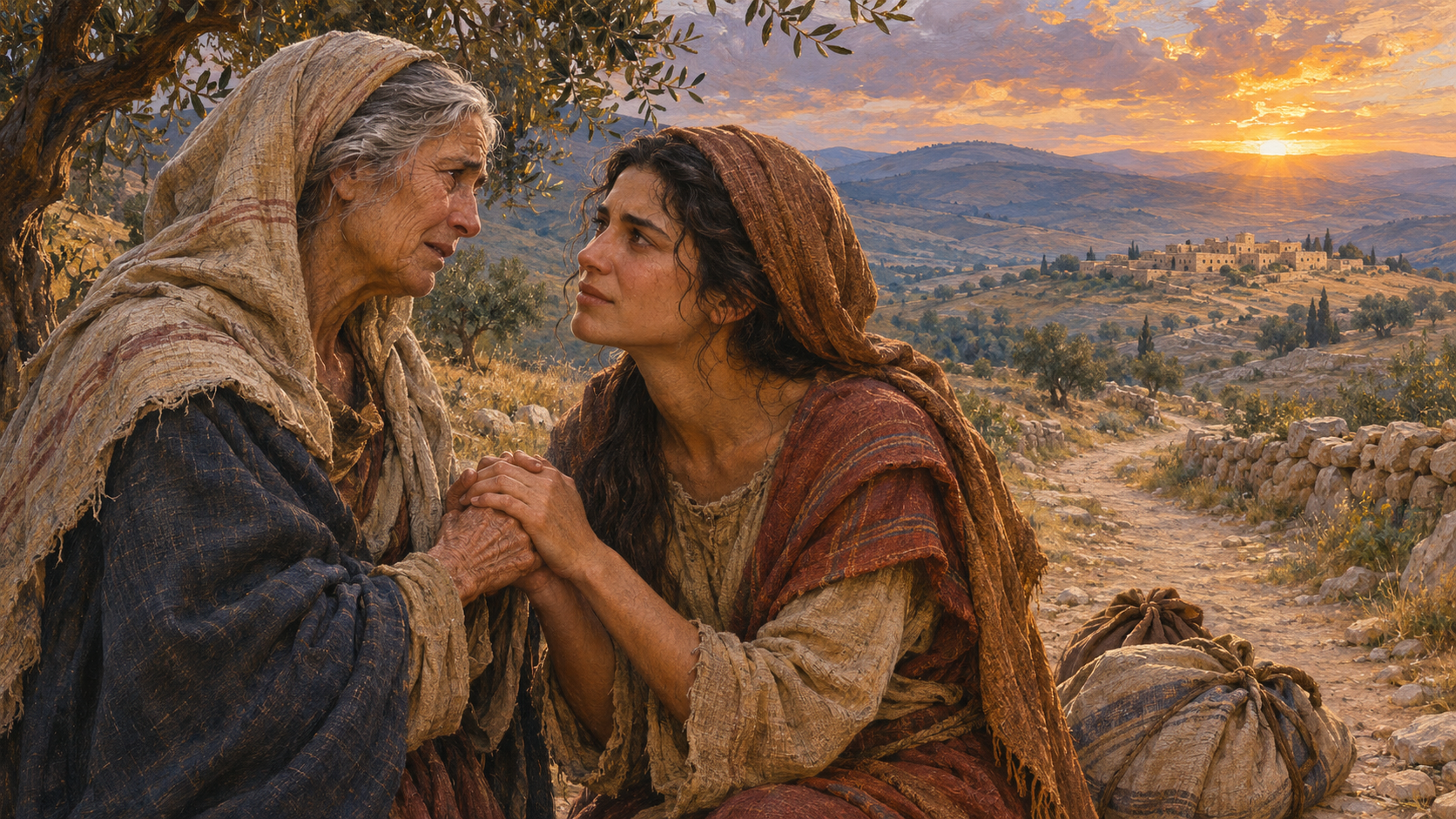
Naomi has lost her husband and both sons. Her daughters-in-law, Ruth and Orpah, have also become widows. Naomi urges them to return to their mothers’ homes, where they might find new husbands and security.
She offers them opportunities to turn back. She explains how little she can promise them. Orpah eventually departs, but Ruth clings to her.
Naomi then points out that Orpah has returned to her people and her gods. Ruth could follow.
Instead, Ruth answers:
“Whither thou goest, I will go; and where thou lodgest, I will lodge: thy people shall be my people, and thy God my God.” —Ruth 1:16, KJV
These words are often read at weddings. In their original setting, they are spoken by one widow to another.
Ruth commits herself to a grieving woman who cannot guarantee her a comfortable future. In doing so, she also commits herself to Israel’s people and God.
Her words remind me of Abraham’s departure. He, too, left familiar surroundings for a future he could not fully see. Boaz later recognizes that Ruth has left her parents and the land of her birth to live among a people previously unknown to her (Ruth 2:11).
Faith sometimes begins with a departure. It also requires the resolve to stay.
Ruth’s declaration will require a lifetime of faithfulness. Generations later, Miriam’s acceptance of her calling will also become a life she must live, with consequences she cannot yet see.
Do You Love Me?
Naomi’s repeated urging reminds me of Yeshua’s questioning of Peter.
The circumstances are different. Ruth is affirming a loyalty she has already demonstrated. Peter, after denying Yeshua three times, needs restoration.
Yet both encounters give a person repeated opportunities to express commitment.
In John 21, Yeshua asks Peter three times whether he loves Him. Peter answers, and each affirmation receives a responsibility:
“Feed my lambs.” “Feed my sheep.” —John 21:15–17, KJV
Peter’s love must become care for those entrusted to him.
Ruth’s declaration also becomes care. She accompanies Naomi, goes into the fields, works, and brings food home.
In both stories, love becomes a commitment that accepts responsibility.
There is something searching in that connection. We can speak movingly about faithfulness, but eventually someone needs to be fed. Someone needs companionship. Someone needs us to remain when leaving would be easier.
Ruth’s answer on the road becomes visible in the harvest field.
When Coincidence Becomes Providence
Ruth 2:3 describes her arrival in Boaz’s field with a striking Hebrew expression:
וַיִּקֶר מִקְרֶהָ—vayiker mikreha.
The wording conveys that she happened upon that particular portion of the field.
From Ruth’s position, she is finding somewhere to work. She does not arrive carrying a genealogy of future kings. She is seeking food for herself and Naomi.
The reader, however, will discover where this apparently ordinary event leads.
Boaz. Marriage. Obed. Jesse. David.
As a Jewish man who reads both the Tanakh and the New Testament, I also see the continuation presented in Matthew’s genealogy: Yeshua the Messiah.
This is why Ruth’s story draws my attention to providence—to God’s care within events that may initially appear accidental.
The Hebrew expression describes an occurrence; our recognition of providence comes from reading the unfolding story.
Ruth sees a field. We eventually see a place in the history of redemption.
It makes me wonder how often we judge the significance of our own lives before we have seen enough of the story.
The Torah Had Already Made Room
Ruth’s access to the harvest also rests on something established before she arrived.
The Torah instructed landowners to leave provision for the poor and the stranger. Deuteronomy specifically includes the widow among those entitled to gather what remains in the field (Leviticus 19:9–10; Deuteronomy 24:19–22).
God’s concern for vulnerable people had been given a practical form.
A landowner’s obedience could become another person’s meal.
Boaz carries that concern into his treatment of Ruth. He provides access to food and water, gives instructions for her protection, and directs his workers to leave additional grain for her (Ruth 2:8–16).
Here we encounter חֶסֶד—chesed: loving-kindness, steadfast kindness, loyalty expressed through action.
Ruth shows it toward Naomi. Boaz shows it toward Ruth.
The story asks us to notice what people do with the strength available to them.
Beneath His Wings
Boaz blesses Ruth for seeking refuge with the God of Israel:
“Under whose wings thou art come to trust.” —Ruth 2:12, KJV
Later, Ruth approaches Boaz and asks him to spread his garment over her because he is a redeeming kinsman (Ruth 3:9).
The Hebrew connects these scenes. כָּנָף—kanaf can refer to a wing or the edge of a garment. The shelter pictured in Boaz’s blessing returns in Ruth’s request.
She has sought refuge beneath God’s wings. Now she asks Boaz to act as a protector.

That connection moves me. Boaz has prayed that God reward and shelter her. He subsequently has the opportunity to participate in the provision for which he prayed.
How often might that be true for us?
We ask God to comfort the grieving, feed the hungry, or protect the vulnerable. Sometimes the next step is ours to take.
A Redeemer and a Family’s Future
Ruth identifies Boaz as a גֹּאֵל—go’el, a redeeming kinsman.
His role belongs within Israel’s family and inheritance responsibilities. In Ruth 4, he acts publicly to acquire the family property and marry Ruth, preserving the deceased man’s name in connection with his inheritance.
His action addresses an immediate need while opening a future the family could scarcely have imagined.
Ruth bears Obed. Obed becomes the father of Jesse. Jesse becomes the father of David.
The widow gathering grain becomes the great-grandmother of Israel’s king.
Proverbs asks who can find a woman of valor. In Ruth, we meet a woman who embodies that description while facing circumstances that might have caused others to overlook her.
Her worth precedes the recognition of her descendants.
For those of us who recognize Yeshua as Messiah, Boaz’s role also offers a picture through which to consider redemption: someone with the standing and willingness to act accepts responsibility for another’s future. The comparison grows from the family obligations and loving-kindness already present in Israel’s Scriptures.
From Ruth to Miriam
This brings me to another woman: מִרְיָם—Miriam, whom English readers know as Mary, the mother of Jesus.
Ruth and Miriam occupy different places in Scripture, but their stories share meaningful features.
Both entrust their futures to God. Ruth declares her allegiance on the road with Naomi. Miriam accepts her calling with the words:
“Behold the handmaid of the Lord; be it unto me according to thy word.” —Luke 1:38, KJV
Both stories bring us to Bethlehem.
Ruth arrives there at the beginning of the barley harvest. Generations later, Miriam gives birth there to Yeshua, in the city associated with David.
Miriam’s song praises the kind of divine care we witness in Ruth’s story: God regards the humble, lifts the lowly, and fills the hungry with good things (Luke 1:48–53).
Their declarations also carry demands that must be lived out.
Ruth’s commitment becomes work, uncertainty, and responsibility for Naomi. Miriam’s acceptance becomes motherhood, danger, and eventually the grief of witnessing her son’s crucifixion.
Joseph has decisions to make as well. He accepts responsibility for Miriam and the child, and he acts to protect them when danger comes (Matthew 1:18–25; 2:13–15).
The calling enters the household. Its consequences reach much farther.
Decisions That Reach the World
Ruth could not have known the full implications of her decision.
Her commitment to Naomi and the God of Israel would place her within the family line of David, shaping Israel’s royal history and its messianic hope. Judaism remembers her faithfulness, her loving-kindness, and her embrace of Israel’s people and God. Christianity also recognizes her within the genealogy of Jesus.
Matthew explicitly names Ruth, follows the generations through David to Joseph, and identifies Joseph as Miriam’s husband and Miriam as Yeshua’s mother (Matthew 1:5–16).
The genealogy brings these women into one unfolding account of God’s faithfulness.
Miriam’s acceptance of her calling would likewise reach far beyond her household. A Jewish woman raising a Jewish son within Israel’s covenant life would become the mother of the one Christians—and Jews like me who follow Yeshua—recognize as the Messiah.
Through Yeshua, Israel’s Scriptures and messianic hope would reach nations across the world. Christianity would emerge from this Jewish setting, while the identity of the Messiah would become a defining point of disagreement between Judaism and Christianity.
These women therefore occupy places of extraordinary consequence. Their stories touch the identity of Israel, the hope of redemption, and the faith of generations.
Neither could see the full history ahead.
Yet Ruth’s answer to Naomi and Miriam’s answer to the angel would become part of a story that billions would read, interpret, and build their lives around.
A faithful response made within one life can carry implications for the world.
Even From the Cross
There is another connection that I find especially moving.
Ruth stays with Naomi. Miriam stays with Yeshua. John places His mother beside the cross, remaining near her son in His suffering (John 19:25). The woman who accepted her calling before His birth is still present as He faces death.
Her presence brings Ruth’s faithfulness to mind: love remains beside the suffering person when it cannot remove the suffering. Then, from the cross, Yeshua responds with care for her. She stays beside Him, and He ensures that someone will stay beside her.
Ruth’s story shows what protection and provision can mean for a widow. At the cross, Yeshua attends to His own mother’s future.
He says to Miriam:
“Woman, behold thy son!”
Then He says to the beloved disciple:
“Behold thy mother!” —John 19:26–27, KJV
The disciple receives her into his home.
John does not explicitly call Miriam a widow, although Joseph’s absence has commonly been understood to suggest that he had died. What John clearly records is Yeshua ensuring that His mother will receive care.
Even in His suffering, He sees her.
I recognize in that act the concern for vulnerable people already expressed in the Torah and embodied in Ruth’s story. He honors His mother and entrusts her to someone who will accept responsibility for her.
The family story that includes provision for Ruth reaches the Messiah, who provides for His mother even while dying.
The reach of His mission does not cause Him to overlook the person before Him.
That matters. We can become so absorbed in the great implications of faith that we miss the immediate responsibilities it places in our hands.
At the cross, we see both.
The Valor of Faithful Love
Ruth’s decision carried consequences for generations. Yet her immediate responsibility was a grieving woman who needed her.
Boaz could see a widow whose faithfulness deserved protection and respect.
Miriam accepted a calling whose joy and sorrow she would experience over a lifetime.
Peter, restored after failure, was given people to tend.
The beloved disciple was given a mother to receive.
Each story places love within reach of human action, while its consequences extend beyond what those involved can see.
Ruth stays. Boaz provides. Miriam accepts. Peter is called to feed. A disciple opens his home.
Perhaps this helps us recognize valor in the people around us: in the person who remains beside the grieving, in the one who shares a harvest, in the one who accepts responsibility when there is no audience to applaud.
A woman of valor was gathering grain in a field.
God saw her. Boaz recognized her.
Her faithfulness helped shape a family’s future, Israel’s history, and a story of redemption that would reach the world.
May we recognize such faithfulness, honor it, and answer the needs God places before us—even when we cannot see how far our answer will reach.
Two stories, one book, one God.
Epilogue
Love Takes Responsibility
This reflection connects with my article, “Feed My Sheep”, where I consider God’s compassion, Jonah’s struggle to reflect it, and Yeshua’s charge to Peter. Here, Ruth and Boaz show that loving-kindness through provision and protection, while Miriam’s presence at the cross shows the faithfulness of remaining beside someone who suffers. Across these stories, the question becomes personal: how will the love we profess become care for someone God has placed before us?