
Parallels between John 21 and the Book of Jonah
A study on Jonah
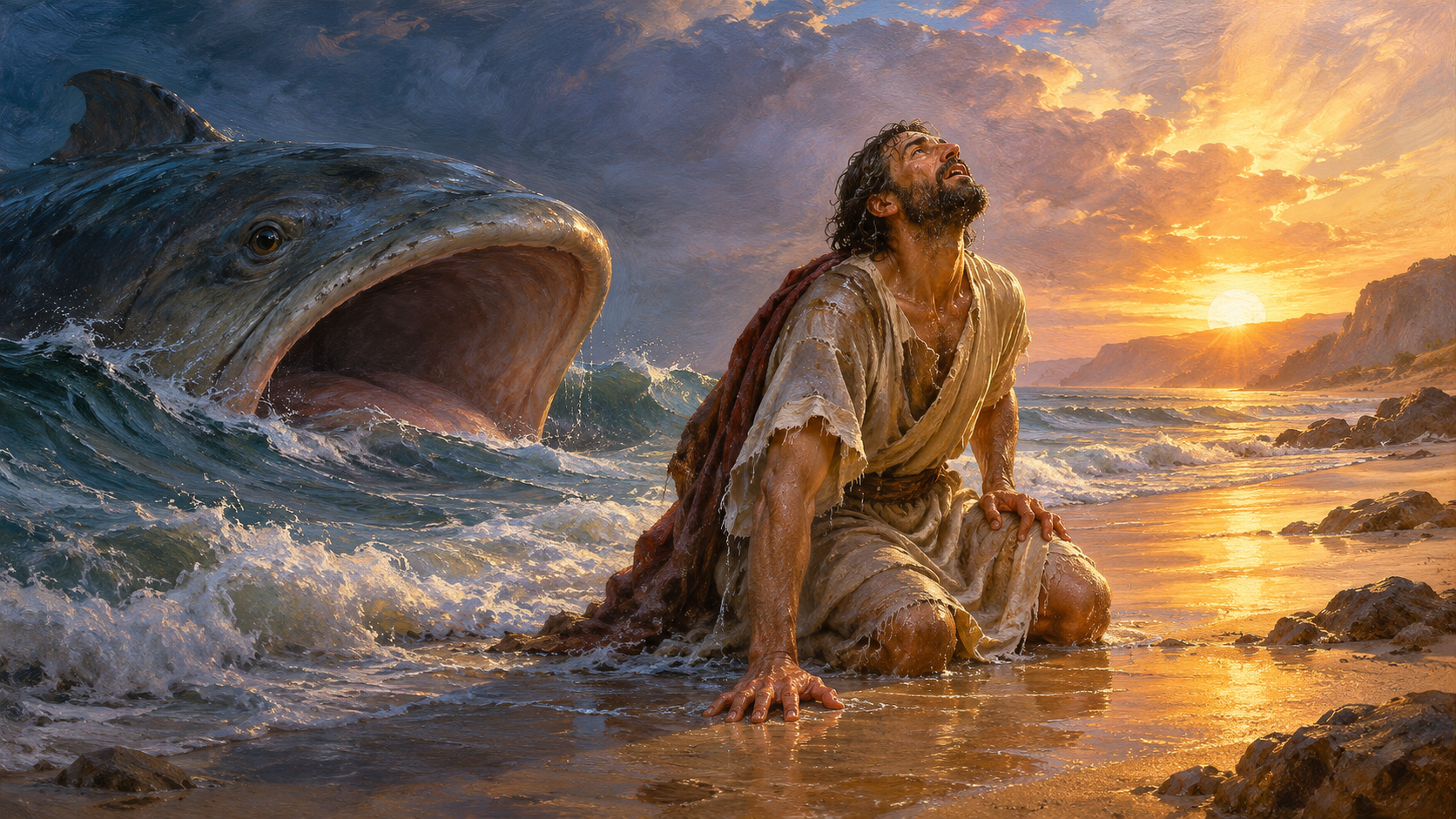
Jonah enters the sea. Peter enters the sea.
One has been running from God. The other cannot reach Him quickly enough.
Between these scenes lies a remarkable series of parallels: boats and fish, darkness and deliverance, failure and repentance, and servants called again to carry out God’s purposes.
Yeshua Himself gives us the starting point. He identifies Jonah’s experience as a sign pointing toward His death and resurrection. When we reach John 21, the risen Messiah is standing beside the sea. What happens there invites us to look back at Jonah with fresh eyes.
The Darkness Before Deliverance
Peter announces that he is going fishing. Several disciples join him. They spend the night on the water and catch nothing.
Read alongside Jonah, that fruitless night takes on additional meaning. Jonah is enclosed in the darkness of the great fish. The disciples labor in the darkness of a night that produces nothing. Both scenes can evoke the apparent defeat surrounding Yeshua’s crucifixion, when darkness covers the land and hope seems buried with Him.
John does not describe Peter’s emotions during the fishing trip. Yet Peter comes to this encounter carrying the history of his denial. The empty nets provide a fitting picture of discouragement: effort without results, a long night without an answer.
Jonah gives words to the experience of separation. He describes being driven from God’s sight, sinking into the depths, and descending into a realm whose bars seem to close upon him forever.
But his prayer does not end there. God brings his life up from the pit (Jonah 2:2–6).
The depths are real. So is the deliverance.
The Sign of the Resurrection
The connection between Jonah and the resurrection is explicit. In Matthew 12:40, Yeshua compares Jonah’s three days and nights inside the fish with His own coming experience in the heart of the earth.
There is even a verbal echo. Jonah describes being cast into the heart of the seas (Jonah 2:3). Yeshua speaks of entering the heart of the earth.
Jonah’s prayer moves downward toward death’s domain, then upward toward life restored. The narrative does not explicitly state that Jonah physically dies, but it describes his rescue in language that makes the resurrection comparison powerful.
John 21 takes place after that promised resurrection. The One who spoke about the sign of Jonah now stands alive on the shore.
Dawn is breaking.
The disciples do not yet recognize Him.
His presence precedes their awareness of it.
Their inability to recognize Him does not mean He has abandoned them. Before their empty nets are filled, the risen Lord is already there.
Wrapped in the Depths Jonah’s prayer contains another detail worth considering: “The weeds were wrapped about my head” (Jonah 2:5, KJV). The Hebrew word translated “wrapped” comes from a verb meaning to bind or bind up. Surrounded by the depths, Jonah describes his head as bound, then speaks of the earth’s bars closing around him.
John’s resurrection account also draws attention to wrappings. Yeshua’s body is bound in linen for burial (John 19:40). When Peter enters the tomb, he sees the linen cloths and, separately, the cloth that had covered Yeshua’s head (John 20:6–7).
Read alongside Jonah, these details suggest an echo: a head wrapped, confinement in death’s domain, and deliverance through God’s power. This is a possible correspondence with the burial wrappings, rather than an explicit prediction of a particular surviving shroud.
Peter witnesses both sides of that movement. In John 20, he enters the tomb and sees the burial cloths. In John 21, he enters the sea to reach the risen Messiah. The Lord whose burial wrappings he has seen now stands alive on the shore, ready to call him again.
The movement from confinement to freedom also raises a deeper question: once God brings us out, will we make room in our hearts for the people He calls us to love?
From Confinement to Compassion
In “Adding 10 (Yod)”, I explored how confinement does not put a person beyond God’s reach. Jonah’s body is enclosed, yet his prayer reaches God’s holy temple. His circumstances restrict his movement without preventing his appeal to God.
But Jonah’s release reveals another kind of confinement. His body emerges from the fish while his compassion remains restricted. He accepts God’s mercy for himself, then resents that mercy when it reaches Nineveh.
God’s final question concerns His compassion for a city filled with people—and even animals—whose lives matter to Him (Jonah 4:11). Jonah has been delivered, but his heart still needs room to grow.
That question prepares us to consider Peter. His restoration will likewise direct him beyond his own failure toward the lives God entrusts to his care.
When Human Effort Reaches Its Limit
In Jonah’s story, the sailors row desperately to return to land, but they cannot overcome the storm (Jonah 1:13).
In John’s account, experienced fishermen work through the night and catch nothing. The situation changes when they follow Yeshua’s instruction to cast their net on the right side of the boat (John 21:3–6).
The circumstances differ, but both stories show human ability reaching its limit. Deliverance and provision come through God’s intervention.
Jonah is returned to dry land. Peter reaches the shore. In both accounts, the movement from sea to land leads to a renewed commission.
Peter Throws Himself Into the Sea
When the beloved disciple recognizes Yeshua, he tells Peter. Peter puts on his outer garment and throws himself into the water (John 21:7).
Here the parallel with Jonah becomes a reversal.
Jonah boards a ship to flee the Lord’s presence. Peter leaves a ship to move toward Him.
Jonah asks others to throw him into the sea. Peter throws himself in.
The water becomes the setting for two different responses to God. One servant has resisted his calling. The other, after his own failure, urgently moves toward the One who called him.
That movement brings repentance into the center of the story.
From Bitter Tears to Renewed Love
 Peter’s repentance begins before the fishing trip. After denying Yeshua three times, he remembers the warning he had received and weeps bitterly (Luke 22:61–62).
John 21 shows what comes after those tears.
An earlier miraculous catch helps us appreciate the change. In Luke 5:8, Peter falls before Yeshua and asks Him to depart because he is a sinful man. In John 21, Peter plunges into the sea to reach Him.
The man who once asked the Lord to depart now cannot get to Him quickly enough.
Read together, the scenes portray repentance as a return to the One whose holiness exposes our sin and whose mercy makes restoration possible.
Then comes another striking detail: a charcoal fire.
Peter had warmed himself beside a charcoal fire during the denial scene (John 18:18). On the shore, another charcoal fire burns as Yeshua receives the disciples (John 21:9).
The setting of failure finds an echo in the setting of restoration.
After breakfast, Yeshua asks Peter three times about his love. Each answer is followed by a responsibility: feed His lambs, tend His sheep, feed His sheep.
His sorrow must now find a faithful direction. His renewed love must become care for others.
Jonah receives another commission to carry God’s message to Nineveh. Peter receives another commission to shepherd Yeshua’s flock. In both stories, mercy received leads toward responsibility for other lives.
Repentance becomes visible as the mercy we receive changes the way we treat others.
The Great Catch and the Number 153
 John records a precise total: 153 large fish.
That number has prompted many interpretations. One intriguing proposal involves the proportions of a fish-shaped geometric figure.
More than two centuries before Yeshua’s ministry, Archimedes used 265/153 as a lower approximation to the square root of three. The same proportion closely describes the length and width of the pointed oval formed by two equal overlapping circles, each passing through the other’s center. This figure is commonly called the vesica piscis.
John Michell and David Fideler connect this geometry with John’s catch. Fideler discusses it under the heading “153 as the Measure of ‘the Fish’ in Archimedes.”
The expression ‘the measure of the fish’ describes the shape’s proportions. The mathematical relationship is clear; whether John intended this connection, or whether ancient readers used that expression, remains uncertain.
Even with that distinction, the connection offers another possible layer to a passage already rich with fish imagery.
The Fish and the Risen Messiah
The fish became one of early Christianity’s important symbols. Clement of Alexandria recommended it among the images Christians could use on their seals.
The Greek word for fish, ichthys, also supplied the initials of a confession meaning “Jesus Christ, God’s Son, Savior.”
Fish symbolism was prominent before cross imagery became publicly widespread under Constantine and in subsequent centuries. Christians already honored the cross before that period, but the fish reminds us of the range of images through which early believers expressed their faith.
John 21 gives that image a vivid resurrection setting: fish, bread, a meal, and the Messiah alive among His disciples.
Called Again
The connection between Jonah and Peter continues beyond the shore.
Jonah goes to Joppa to flee a mission involving Gentiles. In Acts 10, Peter is staying in Joppa when God prepares him to visit Cornelius, a Gentile.
The same city becomes a departure point for confronting the reach of God’s mercy.
Jonah must learn that God’s compassion extends to Nineveh. Peter must learn that he cannot call people unclean whom God has welcomed.
Their stories ask what happens after we ourselves receive mercy.
Will we return to our calling? Will we care for those God places before us? Will we welcome the reach of His compassion?
The great fish carries Jonah toward another opportunity to obey. The great catch accompanies Peter’s restoration after failure. Both receive mercy. Both are called to respond.
For Peter, repentance leads from bitter tears to renewed love—and from renewed love to caring for others.
The night has ended. The risen Messiah stands on the shore. Peter’s failure has not ended his calling.
“Follow me.”
Sources and Interpretive Notes
Biblical passages: Jonah 1–4; Matthew 12:38–41 and 27:45–46; Luke 5:1–11 and 22:54–62; John 18:15–27, 19:38–42, 20:1–9, and 21; Acts 10. Jonah references follow common English verse numbering.
Related study: “Adding 10 (Yod)” develops the themes of confinement, prayer, deliverance, and making room for others.
Archimedes and 153: Archimedes used 265/153 as a lower bound for √3 in Measurement of a Circle, proposition 3. See Thomas L. Heath, Archimedes, for discussion.
The geometric interpretation: David Fideler, Jesus Christ, Sun of God: Ancient Cosmology and Early Christian Symbolism, especially appendix 1, page 307, develops the connection between 153 and fish geometry, drawing on John Michell’s work. This is a proposed symbolic reading, rather than an established explanation of John’s intention.
Early Christian symbols: Clement of Alexandria, Paedagogus, book III, chapter 11, recommends fish among suitable seal images. Tertullian, De Corona, chapter 3, documents the practice of signing the forehead before Constantine. See also “Symbolism of the Fish,” Catholic Encyclopedia.
Interpretive approach: Yeshua explicitly connects Jonah with His coming burial. The additional connections developed here—including the fishing night as an echo of darkness and the seaweed as an echo of burial wrappings—are devotional readings of the passages together.