
Three Letters, Time, and Intention
A study by Jonah
Have you ever questioned someone’s intentions? Has anyone questioned yours?
Perhaps the intentions we should examine first are our own.
That thought came into focus for me through an unexpected question.
The other day, a friend asked me, “What is the name of the Hebrew Bible?” They were searching for the word Tenach. I supplied it, but afterward I realized the question deserved more than a one-word answer.
This article is my meditation on the word, Tenach.
To give a fuller answer, I needed to look more closely at how the name itself is formed.
Hebrew words commonly grow from roots—often three letters that carry a basic meaning. Tenach, also spelled Tanakh, brings three letters together as an acronym, TAV, NUN and KAF. Each letter stands for the name of an entire division of the Hebrew Bible:
Tav begins Torah, meaning instruction or teaching.
Nun begins Nevi’im, meaning prophets.
Kaf begins Ketuvim, meaning writings.
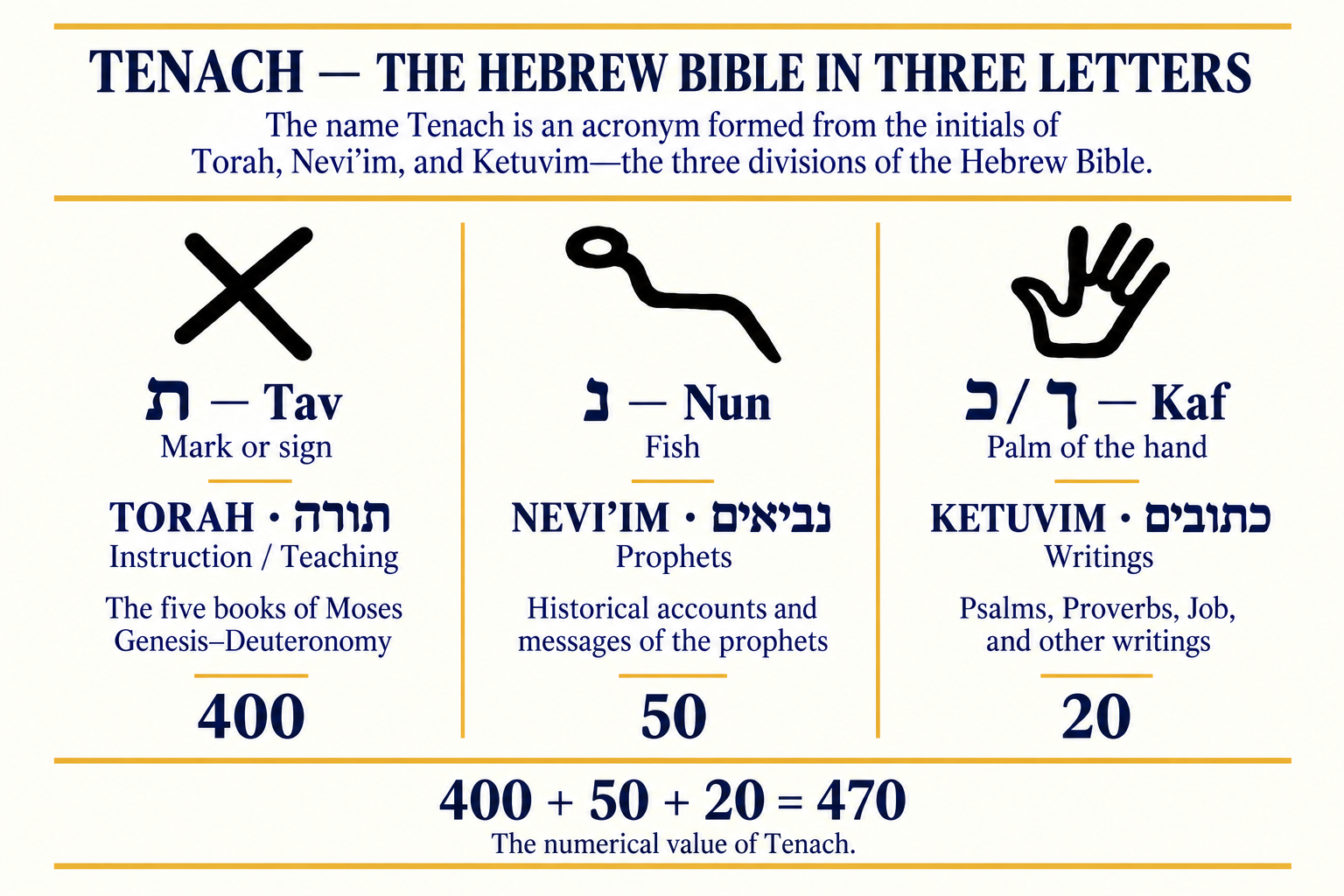
Together, Tav–Nun–Kaf form תנ״ך—Tenach. These three initials give the whole Hebrew Bible its name. Each represents a part; together, they represent the whole.
The ancient letter shapes invite us to pause and look more closely.
Tav—A Mark or Sign
The ancient Tav is shaped like two crossed sticks, forming an X. Its name means a mark or sign. A mark can attest to a covenant or agreement, giving the letter a symbolic connection to commitment. Even today, someone may sign a document by making an X—their mark.
Nun—Life and Fifty
The early Nun shown in the graphic has a small head and a long, bending tail. Its shape may bring to mind a fish, a sprouting seed, or a sperm cell—images suggesting life and its continuation. Nun’s name means fish in Aramaic. These visual associations invite reflection on life, fruitfulness, and future generations, without establishing what the earliest symbol originally depicted.
Nun has the numerical value 50, bringing to mind two biblical observances. Shavuot, also called Pentecost, follows the counting of seven weeks and falls on the fiftieth day (Leviticus 23:15–16). Jubilee sanctifies the fiftieth year, proclaiming liberty and a return to family and ancestral property (Leviticus 25:10).
One counts days; the other counts years. Both remind me that time can be set apart for a purpose.
Kaf—The Palm and Our Actions
Kaf means the palm of the hand, and its early pictograph resembles an open hand. It brings to mind the familiar words, “He’s got the whole world in His hands.”
Scripture gives substance to that image. God holds the earth’s depths and forms the dry land with His hands (Psalm 95:4–5). In a passage concerning judgment against Assyria, Isaiah connects God’s outstretched hand with the accomplishment of His purposes (Isaiah 14:26–27). His hand expresses purposeful authority.
The palm also brings us to our individual actions. With our hands we receive and give, build and plant, help and hold. We pray, “Establish thou the work of our hands” (Psalm 90:17), and are instructed to commit our works to the LORD (Proverbs 16:3).
What purpose directs the work of our hands?
These three letter associations offer another way to remember the letters, while their role in the acronym remains straightforward: they are the initials of the three divisions.
470—A Connection to Time
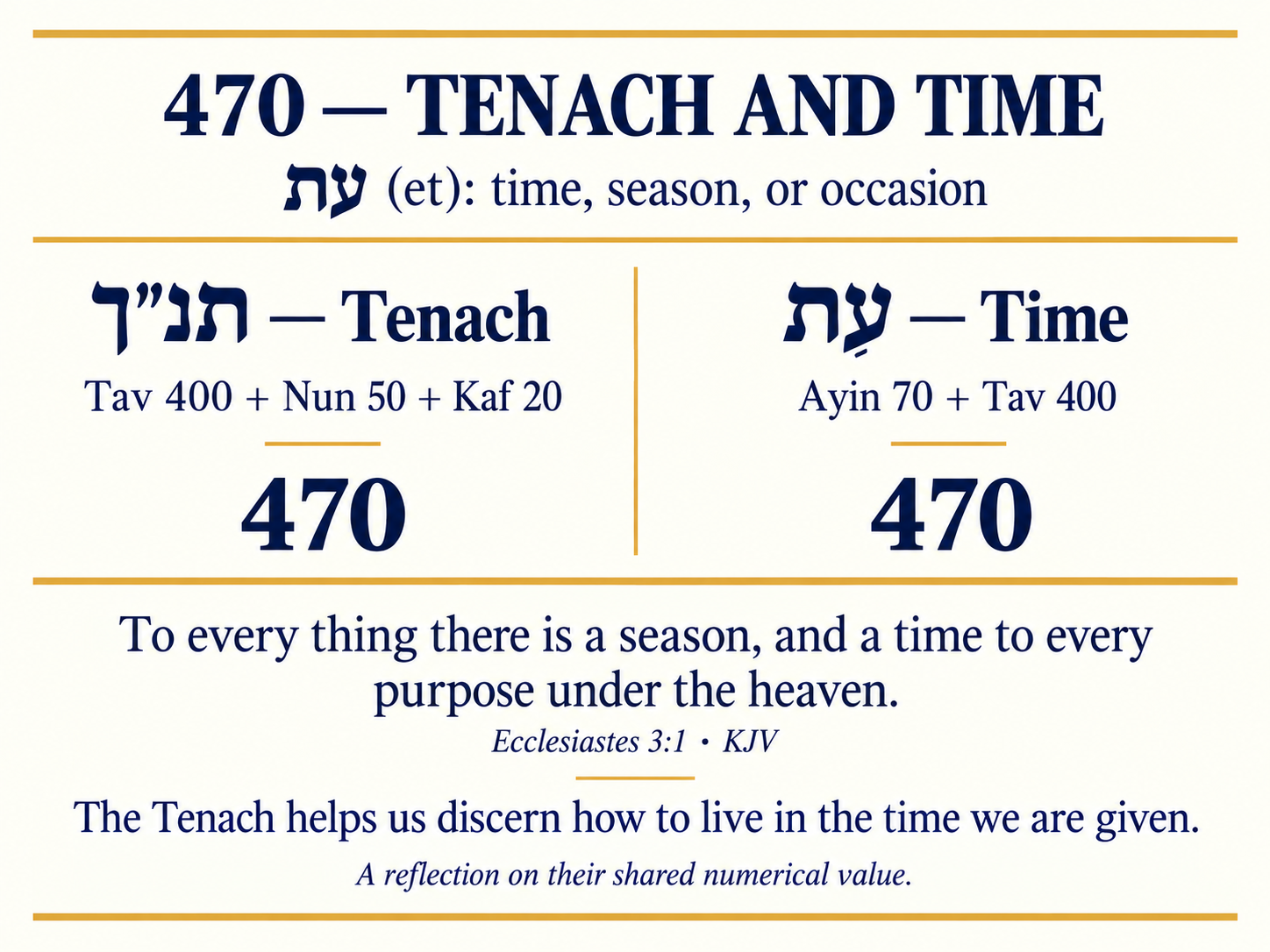
Hebrew letters have numerical values, and each word has a value equal to the sum of its letters. In the Jewish interpretive practice called gematria, another word with the same value may be so closely relevant that the association invites further meditation on the meaning of Scripture.
The three letters of Tenach total 470. Another Hebrew word shares that value: עֵת (et), meaning “time,” “season,” or “occasion.”
TENACH
TAV, 400 + Nun, 50 + Kaf, 20 = 470.
TIME
Ayin, 70 + Tav, 400 = 470.
That brings me to Ecclesiastes:
“To every thing there is a season, and a time to every purpose under the heaven.”
—Ecclesiastes 3:1, KJV
Throughout the chapter, עֵת (et) returns again and again: a time to plant, a time to weep, a time to laugh, a time to remain silent, and a time to speak. Life presents different moments, and those moments call for different responses.
The phrase “a time to every purpose under heaven” catches my attention. Recognizing the time raises another question: what intention will I bring to it? That brings me to kavvanah—intention, the directing of our heart and mind.
Bringing Purpose to the Moment
I have been thinking of kavvanah, intention, as calling something to mind and applying it. Before an action, there is an opportunity to consider its purpose: What am I trying to accomplish? What should guide my response? What am I keeping at the top of my mind?
If I bring God and His teaching to mind, that awareness can shape the intention behind what I do with my hands and say with my mouth.
The shared numerical value does not establish that this was the intended meaning of the name Tenach. But it invites a reflection: the Tenach helps us discern how to live in the time we are given; kavvanah is the intention we bring to living it.
Conclusion
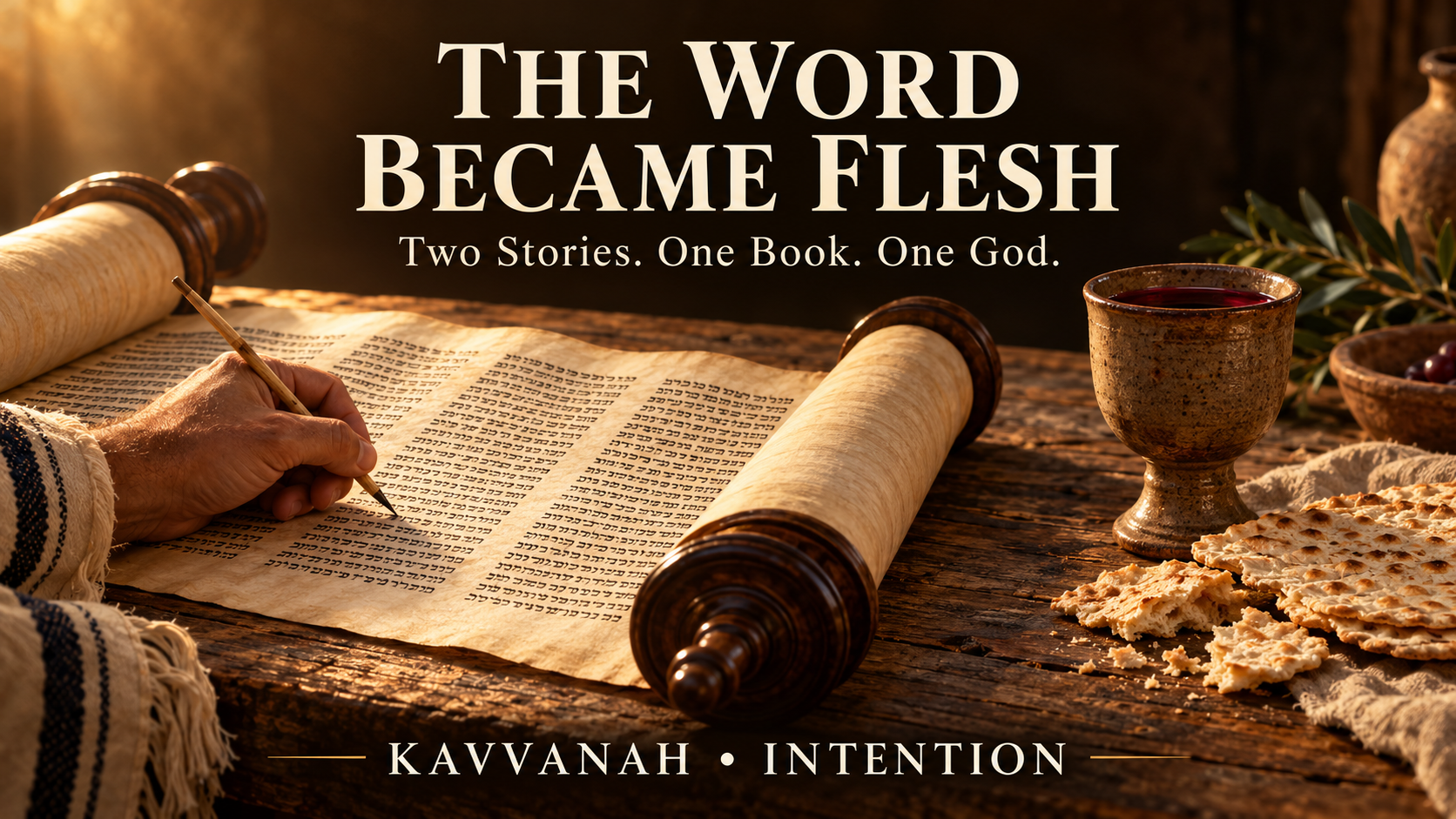
This brings me back to Ketuvim—the Writings—and Kaf, the palm of the hand. Ketuvim and kavvanah both begin with Kaf. Though their roots differ, the Torah scribe offers a concrete connection between writing and intention.
A scribe uses his hand to form the letters, but the work also requires sacred intention. He writes lishmah, for the sake of the Torah scroll’s holiness, with particular intention when writing God’s names. Here, hand and intention come together: he calls the sacred purpose to mind and applies it through the work of his hand.
Perhaps that offers a pattern for our own lives: to bring God’s teaching into our awareness and let it direct what we do.
There is a time to speak. What will I intend with my words?
There is a time to act. What purpose will guide my hands?