
Torah Guides Us Toward Lovingkindness
Study by Jonah
PREFACE
An old expression captures the relationship between the two Testaments: “The New Testament is the Old Testament revealed, and the Old Testament is the New Testament concealed.”
Reading the Tanakh and the New Testament together helps us recognize connections between God’s instructions and Yeshua’s teaching. Hebrew words, their letters, and their numerical values—known as gematria—can draw our attention to those connections and deepen our understanding of them.
The connections explored here follow a practical theme: God’s instruction illuminates our path, shapes our hearts, and guides our actions toward lovingkindness.
“Let the words of my mouth, and the meditation of my heart, be acceptable in thy sight, O LORD, my strength, and my redeemer.”
—Psalm 19:14, KJV
David asks that both his words and his thoughts be acceptable to God. It is a familiar prayer, but it raises a practical question: How do we direct our thoughts toward what pleases Him?
Paul addresses that question in Philippians 4:8. He tells us to consider what is true, honorable, just, pure, lovely, and commendable—whatever has excellence and deserves praise.
Then, in verse 9, he tells us to put what we have learned into practice.
David expresses the desire. Paul gives direction for pursuing it.
God’s instruction guides our thoughts and actions toward serving Him through lovingkindness.
That is the connection we will follow.
Two stories, one Book, one God.
TORAH MEANS INSTRUCTION
Torah is commonly translated as “law,” but its meaning includes instruction and teaching. It gives direction for how we live. Torah also names the first five books of the Bible.
Psalm 119 describes the purpose of God’s word:
“Thy word is a lamp unto my feet, and a light unto my path.” —Psalm 119:105, KJV
The light helps us see where to walk. God’s instruction helps us recognize which choices to make.
Proverbs makes the connection explicit:
“For the commandment is a lamp; and the law is light; and reproofs of instruction are the way of life.” —Proverbs 6:23, KJV
The Hebrew brings several important words together: mitzvah, commandment; Torah, instruction; or, light; and derekh chayim, the way of life.
The instruction has a purpose. It helps us live according to God’s ways.
THE MEDITATION OF THE HEART
Return to David’s prayer in Psalm 19.
Before asking that his words and meditation be acceptable, David describes God’s instruction. His precepts are right. Reverence for Him is pure. His judgments are true and righteous.
These are several of the qualities Paul tells believers to consider in Philippians 4:8.
The Hebrew of Psalm 19 includes:
- אמת—Emet: Truth.
- ישרים—Yesharim: Right or upright.
- טהורה—Tehorah: Pure.
Note: The Hebrew New Testament translation by Franz Delitzsch, a nineteenth-century Christian scholar of Hebrew, uses the same word for truth and related forms for uprightness and purity in Philippians 4:8. The Hebrew New Testament comparisons in this study use that translation. The New Testament was written in Greek; these Hebrew comparisons help us explore its connections with the Tanakh.
David describes what God’s instruction is like. Then he asks that his own thoughts and words be acceptable to God.
Paul’s instruction helps us put David’s prayer into practice.
The Hebrew noun translated “meditation” is higgayon, related to הגה—hagah, which can mean to meditate, ponder, utter, or murmur. Meditation can include quietly repeating words and considering them carefully.
Throughout this study, we will also use gematria, the practice of adding the numerical values assigned to Hebrew letters. We use standard letter values and the spellings shown. These numerical associations offer another way to reflect on the connections between the passages.
One simple comparison concerns the related verb hagah:
הגה—Hagah, meditate = 13
אהבה—Ahavah, love = 13
אחד—Echad, one = 13
These equal values invite reflection on meditation as an expression of love directed toward the one God.
We all return to certain thoughts. We may repeatedly consider an insult, a fear, or a resentment. We can also return to God’s promises, remember His kindness, and consider what He asks of us.
What occupies the heart shapes what we practice.
KAVVANAH: BRINGING INTENTION TO ACTION
The Jewish concept of kavvanah concerns intention—the direction of the heart.
We can say a prayer while thinking about something else. We can perform a good deed because we care about someone, because we feel obligated, or because we want recognition.
The action matters. So does the intention behind it.
Kavvanah connects our attention to our conduct. We direct our hearts toward God and bring that intention into what we do.
The Hebrew word לב—lev, heart, equals 32.
That number also appears at the beginning of Sefer Yetzirah, the “Book of Formation,” an early Jewish mystical text. It describes thirty-two paths of wisdom, understood through ten sefirot—divine attributes or emanations in later mystical interpretation—and twenty-two Hebrew letters.
The shared number offers an association between heart and wisdom.
For our study, the practical concern is clear: the heart needs direction.
Joshua 1:8 connects meditation on God’s instruction with carefully doing what it says. Paul makes the same practical movement in Philippians 4:8–9: consider these things, then practice what you have learned.
Good intentions do not complete the task. Someone who needs help still needs us to act.
A heart directed toward God should produce actions that reflect His instruction.
YESHUA CONNECTS THE HEART AND THE MOUTH
In Matthew 15, Yeshua’s disciples are criticized for eating without the ritual handwashing required by the tradition of the elders.
Yeshua responds by quoting Isaiah 29:13, which describes people who honor God with their lips while their hearts remain far from Him.
He then explains:
“But those things which proceed out of the mouth come forth from the heart; and they defile the man.” —Matthew 15:18, KJV
He identifies evil thoughts and harmful actions as things that come from the heart.
This helps explain why David includes his heart and mouth in the same prayer. We need to examine the source of our words as well as the words themselves.
Rabbinic teaching also recognizes that particular acts of religious observance must be accompanied by holy conduct. Ramban, also known as Nachmanides, a thirteenth-century Jewish scholar and Torah commentator, explains this in his commentary on Leviticus 19:2. Someone can eat permitted foods yet indulge in excess and offensive speech.
His discussion concerns the command to be holy. Observing kashrut, the Jewish dietary laws, should be part of a life consistent with that command.
Care about what enters the mouth should be accompanied by care about what comes out of it.
David asks that his heart and words be acceptable. Yeshua explains their connection. Paul directs our attention toward what should occupy the heart.
CLEAN HANDS AND A PURE HEART
Psalm 24 asks who may approach God’s holy place:
“He that hath clean hands, and a pure heart; who hath not lifted up his soul unto vanity, nor sworn deceitfully.” —Psalm 24:4, KJV
Actions, thoughts, and speech appear together.
Clean hands concern our deeds. A pure heart concerns our inward life. The final words concern honesty in what we say. Meiri, a medieval Jewish commentator, likewise understands clean hands and a pure heart in terms of action and thought.
David also asks God to produce that inward cleansing:
“Create in me a clean heart, O God; and renew a right spirit within me.” —Psalm 51:10, KJV
The Hebrew expression here is לב טהור—lev tahor, a clean or pure heart. Earlier in the same psalm, David asks God to wash and cleanse him.
The word טהור—tahor, pure, equals 220.
בחיר—bachir, chosen, also equals 220. It is the base word behind בחירי—“my chosen one,” God’s description of His servant in Isaiah 42:1.
The numerical match offers a reflection on purity and being chosen for service. Being chosen brings responsibility for how we live.
Psalm 24 describes the conduct and heart of someone approaching God. Psalm 51 asks God for cleansing. Psalm 19 asks that our thoughts and words be acceptable to Him.
Isaiah explains what changed conduct looks like. In Isaiah 1:15–17, God tells people whose hands are full of blood to wash and become clean. He then commands them to stop doing evil, learn to do good, seek justice, and defend the vulnerable.
An exact numerical relationship occurs within these instructions:
חדלו הרע—“Cease doing evil” = 323
למדו היטב—“Learn to do good” = 106
323 + 106 = 429
משפט—Mishpat, justice = 429
Immediately after “learn to do good,” Isaiah says to seek justice. The numerical match follows the direction of the passage itself.
The cleansing must affect how they treat others.
WASHING BEFORE SERVICE
Torah connects washing with service.
Exodus 30:19–21 commands Aaron and his sons to wash their hands and feet before entering the tent of meeting or approaching the altar to minister. Ramban explains this washing as preparation for holiness in serving God.
The wording provides another numerical connection:
ורחצו—“And they shall wash,” Exodus 30:19 = 310
נקי כפים—“Clean hands,” Psalm 24:4 = 310
שבח—“Praise,” in Delitzsch’s translation of Philippians 4:8 = 310
These exact expressions connect numerically with the same subjects the passages address: cleansing, right conduct, and honoring God.
In John 13, Yeshua washes His disciples’ feet.
Peter initially refuses. Yeshua tells him that unless He washes him, Peter has no part with Him. Peter must first receive what Yeshua does for him.
Afterward, Yeshua tells the disciples to follow His example and serve one another.
“If ye know these things, happy are ye if ye do them.” —John 13:17, KJV
Washing prepares the priests to serve. Yeshua’s washing teaches His disciples to serve one another.
John the Baptist says he is unworthy to stoop down and untie Yeshua’s sandal strap. Yet Yeshua personally washes His disciples’ feet.
Yeshua demonstrates the humble service He asks His disciples to practice.
The Hebrew word נכבד—nikhbad, honorable, appears in Delitzsch’s translation of Philippians 4:8. It equals 76.
עבד—eved, servant, also equals 76. It is the base word behind עבדי—“my servant,” in Isaiah 42:1.
The numerical match offers another fitting reflection: honor can be expressed through service.
OIL, NAILS, AND THE COST OF SERVICE
The same chapter of Exodus that commands washing also commands anointing.
In Exodus 30:30, God tells Moses to anoint Aaron and his sons and consecrate them to serve as priests. Oil prepares them for service.
Leviticus 8 adds further detail. During the priests’ ordination, blood is placed on the right ear, right thumb, and right big toe. Anointing oil and blood are also sprinkled on the priests and their garments.
Hands, feet, blood, oil, and consecration appear together in the ritual.
There is an exact numerical match between the Hebrew words for oil and nails:
שמן—Shemen, oil
ש 300 + מ 40 + ן 50 = 390
מסמרים—Masmerim, nails
מ 40 + ס 60 + מ 40 + ר 200 + י 10 + ם 40 = 390
John’s account gives this numerical connection a meaningful setting.
In John 12:3, Mary anoints Yeshua’s feet with costly nard and wipes them with her hair. Yeshua connects her action with His burial.
In John 13, Yeshua washes His disciples’ feet and teaches them to serve.
Then comes His crucifixion. After the resurrection, John records Thomas speaking of the nail marks in His hands, while Luke records Yeshua showing His hands and feet.
Anointing, humble service, and suffering appear in this sequence.
The match between oil and nails invites us to consider the cost of Yeshua’s service.
He calls His disciples to care for others, and He demonstrates that love through His own actions.
THE PURPOSE IS LOVINGKINDNESS
What should God’s instruction produce in us?
Yeshua’s example gives a practical answer: care for others.
Jewish teaching makes lovingkindness central as well. Pirkei Avot, often translated “Ethics of the Fathers,” is a collection of rabbinic ethical teachings within the Mishnah, an early compilation of Jewish oral teaching. Its opening chapter names Torah, service, and acts of lovingkindness as three things on which the world stands.
The Babylonian Talmud, a collection of rabbinic discussion of Jewish law and interpretation, develops this connection. In tractate Sotah, page 14a, Rabbi Samlai teaches that Torah begins and ends with acts of kindness. It begins with God clothing Adam and Eve and ends with God burying Moses.
The same discussion explains following God through actions such as clothing the naked, visiting the sick, comforting mourners, and burying the dead.
Following God includes practicing His kindness.
Another numerical match fits this teaching:
תורה—Torah = 611
The word appears in Deuteronomy 33:4, which describes Torah as the instruction Moses commanded Israel.
גמילות חסדים—Gemilut chasadim, acts of lovingkindness = 611
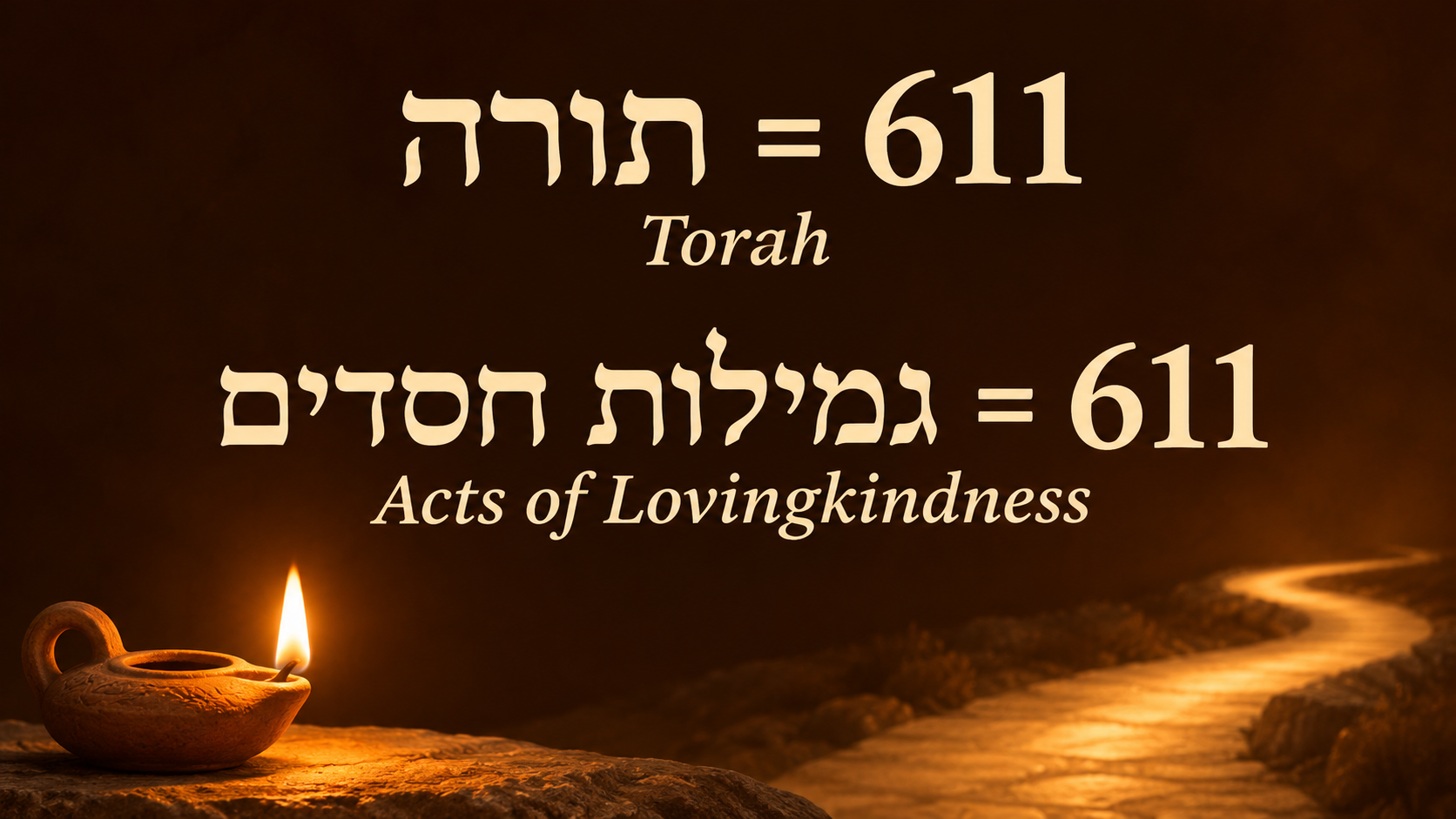
This expression appears in Pirkei Avot 1:2 and Sotah 14a.
The numerical equality accompanies an explicit rabbinic teaching: Torah begins and ends with lovingkindness.
God’s instruction should be expressed in what we do for others.
Paul recognizes this in the generosity of the Philippians. In Philippians 4:18, he describes their gifts to support him as an offering acceptable and pleasing to God.
Their generosity meets a human need and honors God. Paul describes it through the sacrificial language familiar from Torah.
There is another numerical association with praise. ישר—yashar, upright, appears in Delitzsch’s translation of Philippians 4:8 and equals 510.
שיר—shir, song, also equals 510. The word appears, for example, in Psalm 96:1, which calls people to sing a new song to the LORD.
The words contain the same letters rearranged. Their equality offers a simple reflection: upright conduct can honor God just as a song of praise does.
We serve God through how we treat others. Our actions can become praise.
LOVE FOR GOD AND THE INHERITANCE OF THE RIGHTEOUS
The value 310, shared by washing, clean hands, and praise, also has an established place in rabbinic teaching.
יש—Yesh = 310
The word can mean being, substance, or that which exists. It appears in Proverbs 8:21, where Wisdom speaks of granting an inheritance to those who love her.
Mishnah Uktzin 3:12, the closing passage of a rabbinic tractate concerned with ritual purity, draws on that verse. Rabbi Yehoshua ben Levi teaches that God will grant each righteous person 310 worlds in the world to come.
The teaching draws on the numerical value of yesh. Alongside our other comparisons, it gives us:
Washing—clean hands—praise—yesh: 310.
The traditional teaching adds a reflection on the inheritance of the righteous. Our concern in this article remains how faithfulness is expressed now: through a heart directed toward God and conduct consistent with His instruction.
JONAH STILL NEEDS TO CHANGE HIS HEART
Isaiah tells his hearers to stop doing evil and learn to do good. The conclusion of Jonah helps us see both parts.
In Jonah 3:10, God sees that the people of Nineveh have turned from their evil conduct. He spares the city.
Jonah is angry.
He has delivered God’s message, but he resents the mercy God shows. He knows God is gracious and compassionate. His difficulty is accepting that compassion toward Nineveh.
Nineveh changes its behavior. Jonah still needs to change his heart.
God’s final question asks whether He should not have compassion on the city. The book ends without recording Jonah’s answer.
That question also challenges the reader. Are we willing to show the compassion we know God possesses?
Jonah brings us back to kavvanah. He has carried out the assignment, but his heart still needs to agree with the purpose of the God he serves.
There is a numerical connection worth noting.
In Isaiah 1:17:
למדו היטב—“Learn to do good” = 106
Within God’s question in Jonah 4:11:
לא אחוס—“Should I not pity…?” = 106
It offers a fitting reflection: learning to do good includes learning to share God’s compassion.
LUKE PUTS THESE SUBJECTS TOGETHER
Yeshua refers to the sign of Jonah in Luke 11:29–32. He points to Nineveh’s repentance in response to Jonah’s preaching.
What follows is especially relevant to our study.
In verses 33–36, He speaks about a lamp, light, and whether darkness remains within us.
In verses 37–40, a Pharisee is surprised that Yeshua has not washed before eating. Yeshua challenges concern for outward cleanliness while greed and wickedness remain within.
In verse 41, He directs attention toward giving to the poor and being clean.
Jonah, light, washing, inward character, and generosity occur together in this passage.
Luke’s account helps us follow the relationship: respond to God’s message, examine what is within, and express the change through action.
Delitzsch’s Hebrew translation of Luke 11:41 also provides an exact numerical match:
לצדקה—Litzdakah, “for charitable giving” = 229
הדרך—Haderekh, “the way” = 229
The first expression appears within תנו לצדקה, “give for charity.” The second appears in the Hebrew rendering of Yeshua’s statement, “I am the way,” in John 14:6.
Walking in God’s way includes generosity toward others.
WHAT DOES THE WEALTHY RULER LACK?
The wealthy ruler gives us a personal example.
In Luke 18:18–23, he asks Yeshua what he must do to inherit eternal life. Yeshua names several commandments, and the ruler says he has kept them since his youth.
Yeshua then tells him to sell his possessions, distribute to the poor, and follow Him.
The ruler becomes sorrowful because he is very wealthy.
In Matthew’s account, the man asks, “What lack I yet?” Yeshua’s response exposes an attachment he is reluctant to release.
He is considering what remains to be done. The instruction reveals something within his heart.
His possessions are plentiful. His willingness to give is where he struggles.
Like Jonah, he faces an instruction that exposes an inward resistance. Jonah resents mercy toward Nineveh. The ruler struggles to release his wealth and follow.
Their circumstances differ, but both accounts help us examine our response to God.
Do we welcome His direction when it asks something difficult of us? Are we willing to extend compassion? Are we willing to give?
God’s instruction reaches the heart so that lovingkindness can become action.
LIGHT, MYSTERY, AND THE INFINITE
In Psalm 119:105, the word for lamp is:
נר—Ner = 250
The word for light, also found in Proverbs 6:23, is:
אור—Or
א 1 + ו 6 + ר 200 = 207
Two other expressions equal 207:
רז—Raz: Secret or mystery.
אין סוף—Ein Sof: Without end.
Ein Sof is a term used in Kabbalah, the Jewish mystical tradition, for divine infinity. Jewish mystical teaching explicitly notices these numerical equalities. They associate light with mystery and the infinite.
That offers a reflection on studying Scripture. A passage can help us recognize something we had not understood in another.
The light helps us see. God’s instruction helps us know how to proceed.
THE BURNING BUSH: TRUTH AND A CALL TO ACT
The burning-bush account brings several of these subjects into one encounter.
In Exodus 3:2, Moses sees a flame of אש—esh, fire.
אש = 301
מנורה—Menorah, lampstand, also equals 301 in this spelling, which includes the letter Vav.
God tells Moses to remove his sandals because he is standing on holy ground. Then He gives Moses a task: go to Egypt and help bring Israel out of bondage.
Moses receives both instruction and assurance of God’s presence.
In Exodus 3:14, God gives the name:
אהיה אשר אהיה—Ehyeh asher Ehyeh
Traditionally translated “I AM THAT I AM,” it can also be rendered “I will be what I will be.”
אהיה—Ehyeh = 21
Jewish mystical teaching connects the two occurrences of Ehyeh by multiplying their values:
21 × 21 = 441
אמת—Emet, truth = 441
The same word, emet, appears in Psalm 19:9, describing God’s judgments as true, and in Delitzsch’s translation of Philippians 4:8.
Rashi, an eleventh-century Jewish Bible commentator, understands God’s words to Moses as assurance of His presence with Israel in their suffering.
Moses encounters God, receives instruction, and is sent to help others.
THE WAY, THE TRUTH, AND THE LIFE
Yeshua says:
“I am the light of the world: he that followeth me shall not walk in darkness, but shall have the light of life.” —John 8:12, KJV
Light gives direction to the person who follows Him.
He also says:
“I am the way, the truth, and the life: no man cometh unto the Father, but by me.” —John 14:6, KJV
These statements bring together the themes we have followed.
The way: direction for how we walk.
The truth: what deserves our trust and should shape our thoughts.
The life: living in relationship with God and acting on what we receive.
The Hebrew word חיים—chayim, life, equals 68.
חכם—chakham, a wise person, also equals 68. The word appears in Proverbs 10:8, which describes a person wise in heart as receiving commandments.
The numerical match fits the relationship between instruction and living wisely.
The complete expression הדרך והאמת והחיים, including the two “and” prefixes, totals 760:
הדרך = 229
והאמת = 452
והחיים = 79
Total: 760
A relevant numerical match appears in Joshua 1:7:
תשכיל—Taskil = 760
The word concerns acting wisely or prospering. God tells Joshua to carefully practice Torah so that he may do so wherever he goes. The following verse connects meditation with obedience.
The complete Hebrew text of Psalm 96:4 also totals 760:
כי גדול יהוה ומהלל מאד נורא הוא על כל אלהים
“For the LORD is great, and greatly to be praised: he is to be feared above all gods.” —Psalm 96:4, KJV
These numerical comparisons bring together “the way, the truth, and the life,” wise conduct, and praise to God.
The practical connection is already present in the passages: receive God’s instruction, consider it carefully, and live according to it.
INSTRUCTION PUT INTO PRACTICE
David asks that his thoughts and words be acceptable to God.
Paul tells us what deserves our attention and urges us to put what we learn into practice.
Yeshua explains that our words and deeds come from the heart. He serves His disciples and tells them to follow His example. His own service carries a cost that the anointing before His burial and the wounds of His crucifixion bring into view.
Jonah reminds us that carrying out an assignment does not mean our hearts fully agree with God’s compassion. The wealthy ruler shows how an instruction can expose something we are unwilling to release.
These accounts bring the responsibility closer to home.
Torah provides instruction. The instruction lights our path. Pure thoughts shape our conduct. Lovingkindness puts that instruction into practice.
Kavvanah means directing our hearts toward God as we make those choices.
Speak truthfully. Help someone. Give generously. Act fairly. Show patience. Defend someone who is being mistreated.
We also examine what prevents us from doing those things.
Our actions praise God. We serve Him through what we do.
Two stories, one Book, one God—and a life directed toward lovingkindness.