12 Ways Jonah’s Story Points Beyond Itself
Jonah is remembered as the prophet swallowed by a great fish. But the fish is only part of what makes his story extraordinary.
In four short chapters, we encounter rebellion, repentance, judgment, mercy, deliverance, and salvation. We see a Gentile city respond to Israel’s God. And we meet the prophet whom Yeshua singles out when asked for a sign.
Some of the connections below are explicit in Scripture. Others are the Messianic reading I draw from the text. Together, they reveal a story whose significance extends far beyond Nineveh.
1. Israel’s Prophet Speaks—and a Gentile City Repents
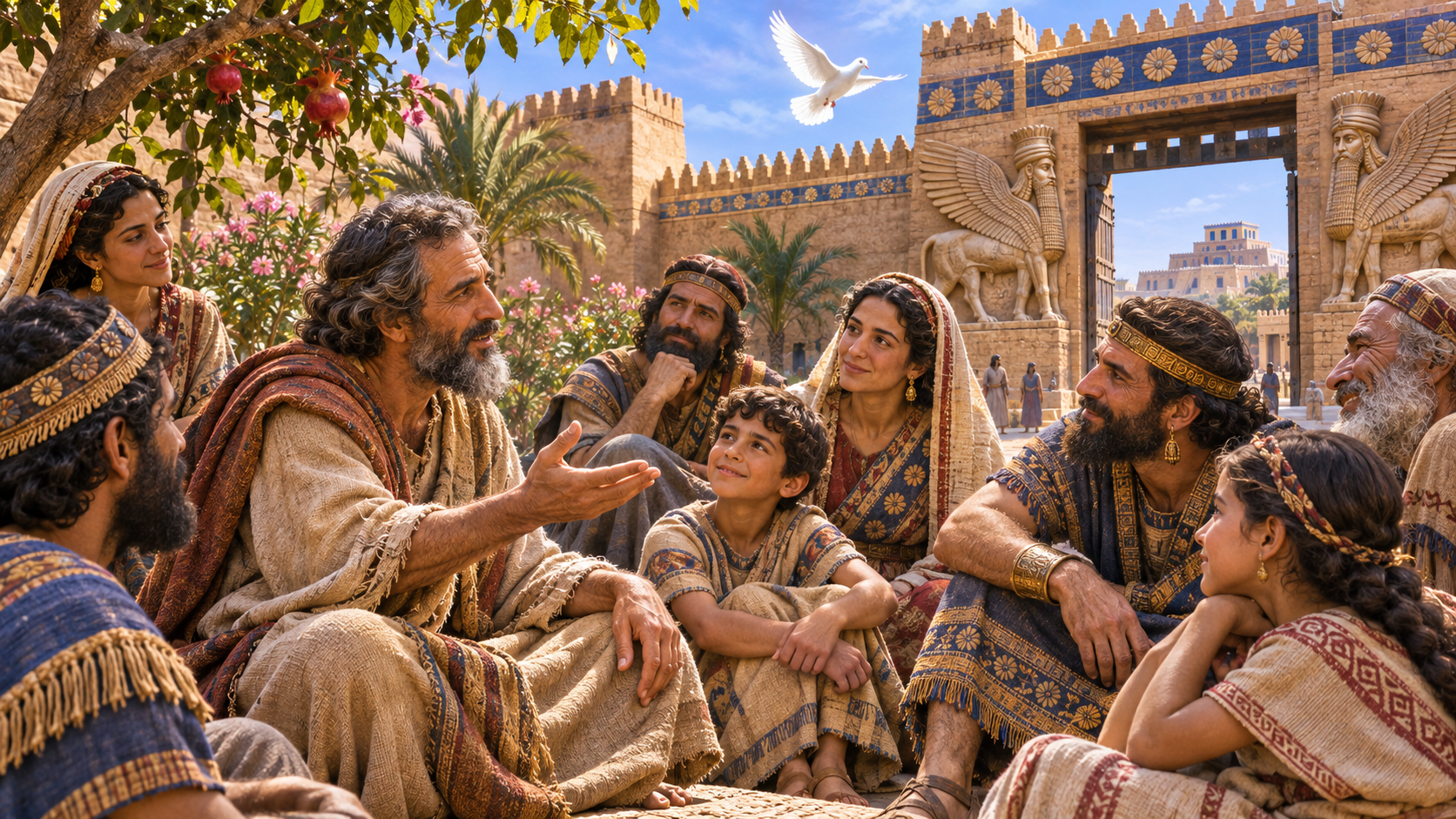
God sends Jonah beyond Israel to warn Nineveh, a great city of Assyria—the nation that would devastate the northern kingdom.
Other Gentiles feared the God of Israel, but what distinguishes Jonah’s mission is the collective response: Israel’s fierce enemies believe Jonah’s God, the king leaves his throne, and a decree calls everyone to abandon evil and violence. An Israelite prophet delivers God’s warning, and an entire Gentile city takes it seriously. The outsiders listen.
Jonah 3:1–9
2. A Warning of Destruction Becomes an Extraordinary Act of Mercy
Jonah announces catastrophe. The story ends with a city spared.
God sees that the Ninevites have turned from their evil ways and withholds the destruction He had threatened. More than 120,000 people—and many animals—are spared as God extends mercy to Nineveh.
Jonah 3:10; 4:11
3. The Prophet Lives a Pattern of Death and Resurrection
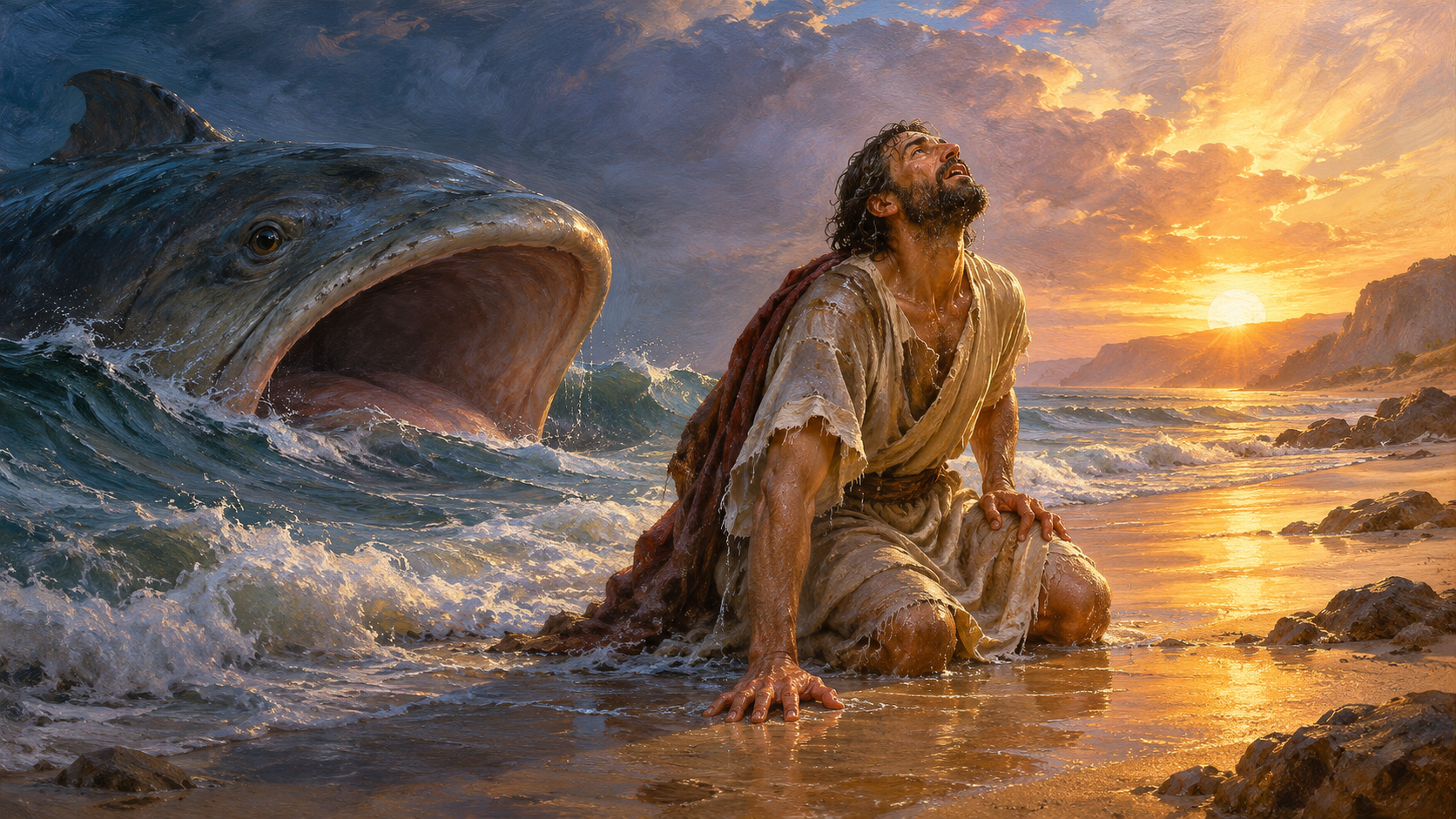
Jonah willingly descends into the sea. The waters surround him. He speaks of Sheol, the roots of the mountains, and the earth’s bars closing behind him. Then comes the reversal: God brings his life up from the pit.
Jonah’s experience unmistakably mirrors descent into death and restoration to life. Before Jonah becomes a sign through his preaching, his own body carries the pattern of deliverance.
Jonah 2:2–6
4. The Gospel Stands at the Heart of the Book
The central message of Jonah’s book is the message of the gospel: turning to God, abandoning worthless idols, and receiving His mercy and salvation.
That message also emerges at the book’s numerical center. In the usual English numbering, Jonah contains 48 verses. Its two middle verses—the 24th and 25th—describe remembering the LORD in distress, prayer reaching His holy temple, and the warning that devotion to worthless idols means forsaking one’s own mercy.
Immediately afterward comes the declaration: “Salvation is of the LORD.”
In the Hebrew the book of Jonah centers on verses 2:8-9:
“Those who regard worthless idols Forsake their own Mercy. But I will sacrifice to You With the voice of thanksgiving; I will pay what I have vowed. Salvation is of the LORD.”
In this Messianic reading, the heart of Jonah’s story announces the heart of the gospel: our hope rests in the God who saves.
Jonah 2:7–9
5. Clinging to Falsehood Can Cost Us the Mercy We Need
Jonah’s warning about worthless idols is more than a criticism of carved images. It exposes the danger of attaching ourselves to what cannot save us.
That warning resonates with Yeshua’s words about the day of His revealing: “Remember Lot’s wife.” He then warns that whoever seeks to preserve their life will lose it.
The connection is thematic: what we refuse to release can become the very thing through which we forfeit our welfare. Jonah’s words invite us to examine what we cling to—and whether it draws us toward God’s mercy or away from it.
Jonah 2:8; Luke 17:30–33
6. Yeshua Names Jonah as the Sign
When challenged to provide a sign, Yeshua singles out Jonah.
He connects Jonah’s three days and nights inside the great fish with His own time in the heart of the earth. He then says the Ninevites will rise at the judgment and condemn the generation that rejected Him.
The connection to His death and resurrection is explicit. The passage also reaches forward to judgment. I therefore see the sign of Jonah speaking both to Yeshua’s generation and, prophetically, to the generation that will face His return.
The prophet who warned Nineveh becomes a sign through whom Yeshua warns His hearers.
Matthew 12:39–41; Luke 11:29–32
7. Five Hebrew Words Shake a City
Jonah’s recorded proclamation contains only five Hebrew words:
עוֹד אַרְבָּעִים יוֹם וְנִינְוֵה נֶהְפָּכֶת
“Forty days more, and Nineveh shall be overthrown.”
We cannot establish that these were the only words he spoke. Yet this is the warning Scripture preserves—and its brevity makes the response even more striking.
In the declaration, “Forty days more, and Nineveh shall be overthrown.” The final Hebrew word for overthrown נֶהְפָּכֶת—nehepākhet has two meanings. One is overturned through destruction. The other is transformed through repentance.
Five recorded words. A city brought to repentance. The power of the message rests in the authority of the One who sent it.
Jonah 3:4–5
8. A Fish Preserves Jonah—and a Fish Represents Yeshua
God appoints a great fish to swallow Jonah. What appears to be his final confinement becomes the means of preserving his life.
Centuries later, a fish becomes an early Christian symbol of Yeshua. Early Christians also portray Jonah’s emergence from the sea creature as an image of resurrection.
These are distinct historical observations, yet their correspondence is striking: the creature associated with Jonah’s deliverance also belongs to the visual language through which early believers expressed faith in the Savior.
9. The Great Fish, the Great Catch, and the Jesus Fish Converge
A great fish preserves Jonah. After Yeshua’s resurrection, Peter brings ashore a net containing 153 large fish. A fish also becomes an early symbol of Yeshua.
The number adds an intriguing correspondence: the fish-shaped vesica piscis has proportions approximated by 265:153, using Archimedes’ approximation of √3. These connections invite reflection on deliverance, resurrection, and the God who provides.
For further exploration of the language, geometry, number 153, and Passover eclipse, see the appendix.
Jonah 1:17; John 21:11
10. Jonah Embodies Turning from Sin and Receiving Salvation
Jonah does more than preach a message that produces repentance. His own experience depicts a turning.
He begins by fleeing God’s command. In his distress, he turns toward God in prayer. He receives deliverance. When the command comes again, he goes.
God’s mercy is already at work before Jonah’s obedience is restored. His rescue is a gift, and his renewed obedience follows.
The messenger himself becomes a living picture of rebellion, mercy, salvation, and a changed direction.
Jonah 1:3; 2:1–10; 3:1–3
11. Jonah Announces the Restoration of Israel’s Borders
Jonah also appears in Kings as the prophet through whom God announces the restoration of Israel’s boundaries.
Jeroboam II restores Israel’s border from Lebo-hamath to the Sea of the Arabah, according to the word of the LORD spoken through Jonah son of Amittai. The following verses explain that God saw Israel’s bitter suffering and acted to save them.
2 Kings 14:25–27
12. Jonah Declares the Truth Echoed in Yeshua’s Name
Jonah’s prayer culminates in a declaration:
“Salvation is of the LORD.”
The Hebrew word for salvation, yeshu‘ah, shares its root with the name Yeshua, a name expressing that the LORD saves.
Jonah’s sentence does not explicitly name Yeshua. Yet in a Messianic reading, the connection is profound: the prophet declares the saving truth embodied in Yeshua’s name and mission.
The man delivered from the depths announces where deliverance comes from. The prophet sent to Gentiles declares that salvation belongs to Israel’s God.
Jonah 2:9
Where this leaves us.
Jonah stands out as the prophet whose defining reputation is disobedience. Other prophets sin, but Jonah is remembered as the prophet who ran from God. Yet his story reveals the mercy available to those who turn back to Him.
From the depths, Jonah warns that those who cling to worthless idols forsake their own mercy. Then a Gentile city demonstrates what responding to God looks like: Nineveh hears the warning, turns from evil, and is spared. The reluctant prophet delivers the message, but the Gentiles become the example.
Jonah’s experience also points toward resurrection—and Yeshua points us back to Jonah. The prophet who fled becomes the sign Yeshua names. The story we remember for disobedience becomes a testimony to repentance, resurrection, and the mercy of the God who saves.
APPENDIX: Exploring the Fish and the Number 153.
The image of “great fish” makes a double appearance in the Bible. The Hebrew word gadol can mean great or large. In the book of Jonah, gadol is translated as “great fish.” In the book of John, Simon Peter drags his net ashore “full of great fishes,” 153 to be exact. This is a major moment in the Gospels.
In Jonah the great fish saves Jonah’s life. In Matthew 17:24–27, Peter catches a fish containing a coin sufficient to pay the temple tax for both Yeshua and himself.
But why do we need to know the number 153? Let’s look at some interesting connections.
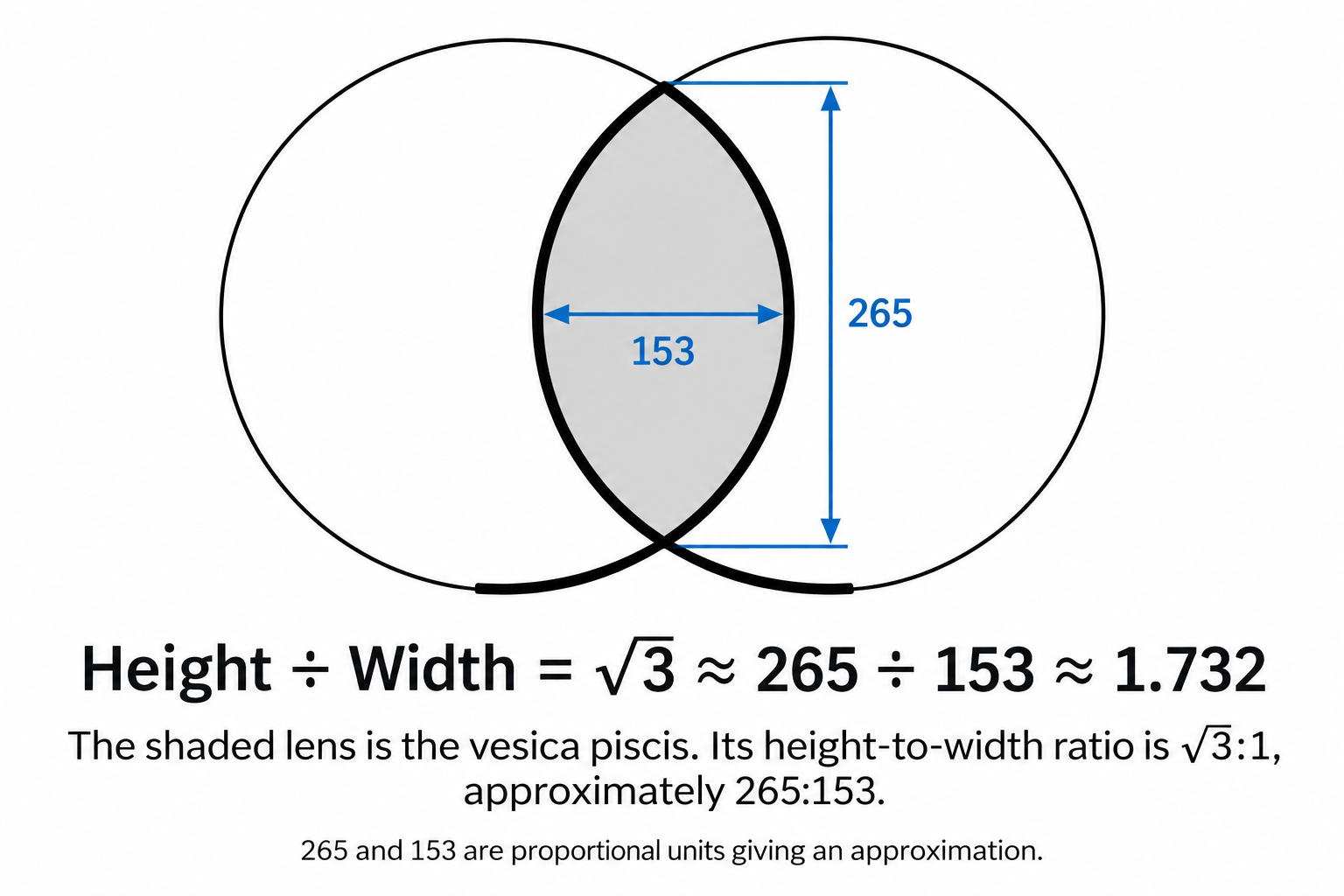
Look closely at these overlapping circles. Their shared area forms a fish-shaped lens called the vesica piscis. A similar overlap appears between the disks of the Sun and Moon during a partial solar eclipse. The vesica piscis has proportions of √3:1, closely approximated by 265:153—the ratio Archimedes used to approximate √3. Here, eclipse imagery, the fish shape, and the number 153 form a striking mathematical correspondence.
A separate eclipse connection brings us back to Yeshua’s crucifixion.
The eclipsed moon that rose over Jerusalem on April 3, AD 33—one proposed date of Yeshua’s crucifixion—was a Passover moon. Unlike a solar eclipse, whose visibility is geographically restricted, a lunar eclipse can be witnessed across much of Earth’s nighttime side. For me, that broad visibility offers a striking parallel: through Yeshua’s death and resurrection, the message rooted in Israel’s Tanakh would reach far beyond Israel, carrying the knowledge of Israel’s God to the nations.
The familiar Jesus fish can be drawn using the lens-shaped geometry of the vesica piscis. David Fideler explores this correspondence under the heading “153 as the Measure of ‘the Fish’ in Archimedes.” The “Jesus Fish” was actually the more accepted symbol of Jesus centuries before the cross was. Some astrological interpretations place Yeshua’s birth near the beginning of the Age of Pisces.
John describes the large fish using megalōn, a form of the Greek adjective megas, meaning “great” or “large.” The Septuagint—the ancient Greek translation of the Hebrew Scriptures—likewise describes Jonah’s sea creature using mega, another form of that same word. In the New Testament, it also describes “great” faith in Matthew 15:28 and the “great” commandment in Matthew 22:38. The shared word connects these passages linguistically, while their contexts invite reflection on physical and spiritual greatness.
One more coincidence: The Jewish calendar joins lunar months with the solar year, keeping Passover in its appointed spring season. The Gregorian calendar used throughout much of the world follows the solar year.
153 is an amazing number for other reasons. 153 is the 17th triangular number. A triangular number is a number that can be arranged to form an equilateral triangle of dots. You can find a triangular number by starting with 1, and then continually adding the next consecutive integer. The sequence looks like this: 1, 3, 6, 10, 15, 21, 28, 36, 45, 55, …so on. 153 is also the sum of the first 17 integers (1+2+3+4+5+6+7+8+9+10 +11+12+13+14+15+16+17=153). St. Augustine viewed 17 as the combination of 10 (representing the Law) and 7 (representing grace or the Spirit), making 153 a symbol of complete spiritual unity.
The great fish of Jonah, Peter’s catch of 153 large fish, and the Jesus fish form a striking correspondence that invites reflection on deliverance and resurrection.