Study of Central Area by National Capital Park and Planning Commission.
You should notice the shape of a cross is laid out in Washington, but is there something “fishy” about Washington D.C.? There most certainly is. See if you can spot it on the image at the top of the blog. Do you see how there is a fish? Here’s a hint: The eye is the Lincoln Memorial and the tail is Capital. There is more.
Notice the area created by the overlapping shapes of the eclipse in Ellipse Park.
The words on the “Great Seal” on the dollar above the monument read “Annuit Coeptis” which is Latin for “He favors our undertakings.” The words below “novus ordo seclorum” translates to “a new order of the ages.”
Did you know that the original Washington Monument project ran out of money and stood unfinished for a period of time. It stood unfinished at 153 feet! I will explain why that number 153 is significant.
Once the funds were available the entire 555′ 5″ with the pyramid and the capstone were completed. (5 has great biblical significance.)
On the east face of that 9-inch aluminum cap on top of the Washington Monument is inscribed the Latin phrase “Laus Deo” which translates to “Praise be to God.” Thanksgiving!
(The
number 9 is significant. I blogged about this the other day.) The Washington moment is set such the first thing the Easterm morning sun hits in the Capital is the cap of the monument, the highest point. Everyone the sun shines on a nation praising God from the highest point in our nation’s capital.
The capstone was placed on December 6, 1884. That date fell in the Hebrew month of Kislev which is the 9th month of the Hebrew calendar.
The month of Kislev is best known for two holidays — Hanukkah and Christmas. (Hanukkah is on the 25th of Kislev. Christmas is on the 25th of December.)
36 is a special number in Hebrew known as “double chai” or “double life.” The monument is built with 36,000 stones. The captone was placed to mark the completion of the 36th year of construction of the monument.
But I have digressed and I want to get back to the fishy shape. Did you know that the fish shape which is formed by the overlapping shapes of an eclipse has specific geometric name and measurement? Yes, it is called the Vesica Piscis. It is a geometric shape derived from an actual eclipse. The sign may remind you of “Pisces” the last sign of the Zodiac, a water sign. Below is a diagram which illustrates this. See if you can spot the fish.
John 21.11 — So Simon Peter went aboard and hauled the net ashore, full of large fish, 153 of them. And although there were so many, the net was not torn.
So Simon Peter went aboard and hauled the net ashore, full of large fish, 153 of them to be exact!
Are all these associations just coincidences? If you think not, then the obvious conclusion is that Yeshua determined the number of fish that would fill Simon/Peter’s nets. In other words, the 153 big fish were appointed by Yeshua.
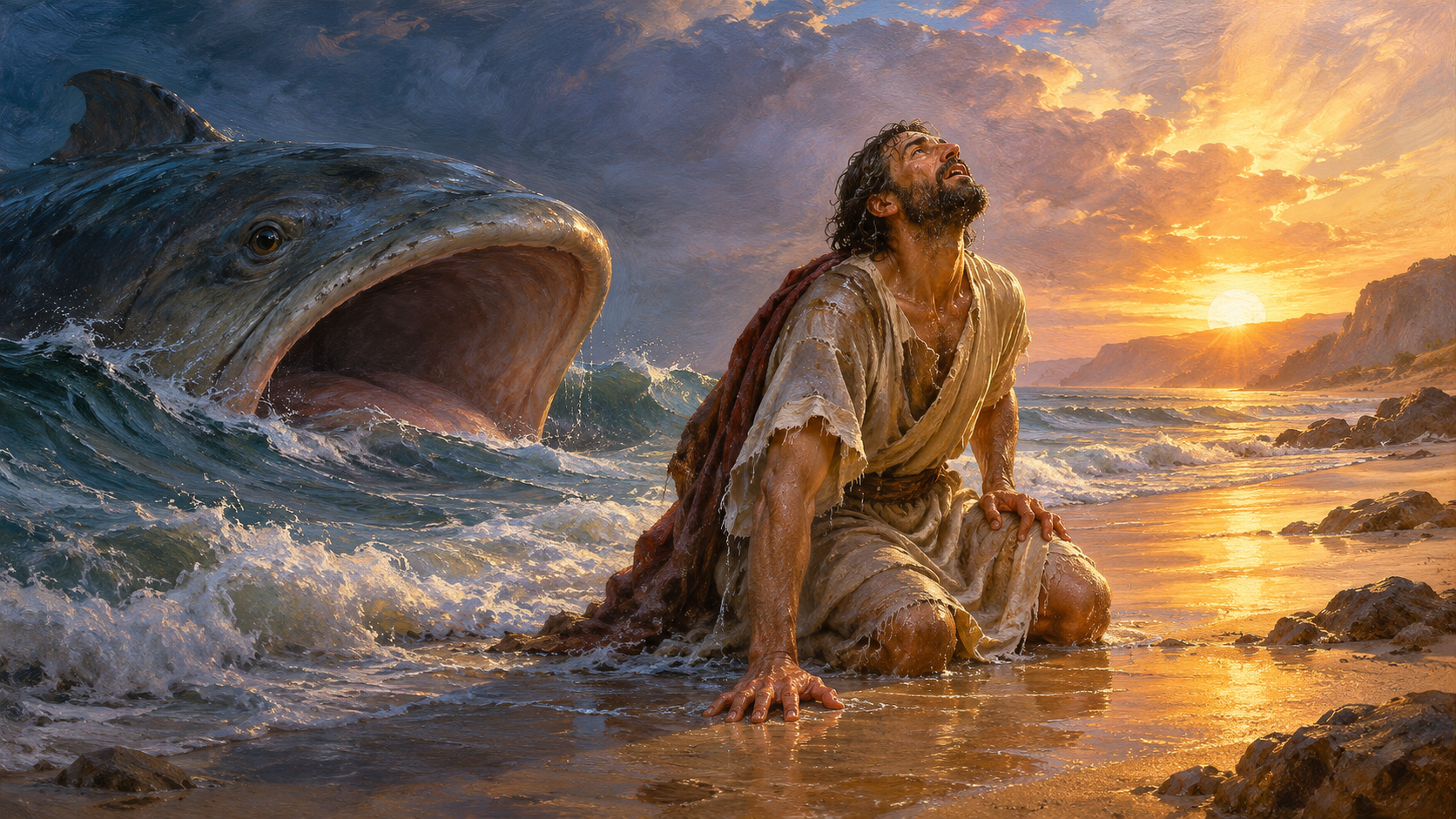
Is there a time in the Hebrew Bible that God appointed/prepared a big fish? The answer is YES. That is exactly what happened in the Book of Jonah.
Jonah 2.17 — And the Lord appointed a great* fish to swallow up Jonah. And Jonah was in the belly of the fish three days and three nights.
* The Hebrew word gadol can be translated as big, large, great or high.
Isn’t it interesting that Yeshua said:
John 12:38-40 — Then some of the scribes and Pharisees told Jesus, “Teacher, we want to see a sign from you.” But he replied to them, “An evil and adulterous generation craves a sign. Yet no sign will be given to it except the sign of the prophet Jonah, because just as Jonah was in the stomach of the sea creature for three days and three nights, so the Son of Man will be in the heart of the earth for three days and three nights.
What would Moses have to say about all of this? Of course we know that Moses died long before Yeshua. Moses worked a lot with numbers in the Hebrew Bible known as the Tenach. Numbers are big in Judaism for finding deeper meaning. Moses taught us about Creation using numbers. Need I even mention 1, 2, 3, 4, 5, 6, 7, 8, 10, 13, 40, etc?
Moses used “factorials.” Factorals are big in creation! Moses died on a factoral number:
5! = 5×4!=5×4×3×2×1=120.
Moses death, 120, is the 5th Factoral. If we add up the first 5 factorals guess what we get:
(1st – 1) + (2nd – 2) + (3rd – 6) + (4th – 24) + (5th – 120) = 153.
I’ve pointed out significant relationships with the number 17 and the number 153 and related then to ” shape of the fish.” You can see why we get the “Jesus Fish.”
Here is one more mathmatical coincidence. If we add up the first 17 integers what do we get? Here is the answer:
1+2+3+4+5+6+7+8+9+10+11+12+13+14+15+16+17=153!
In John 2, Yeshua famously declares he is God’s “temple.” There is one other connection to 153 that I’d like to point out. Adonia appointed Bezalel to build the Tabernacle. His name has a gematria of 153.
ב2צ90ל30א1ל30
So the man who built the Tabernacle, the “Jesus Fish” and the number of fish in Peter’s catch all just happen to relate to 153. “Sounds fishy” to me. But who am I to say …
Psalm 107:23-25 —
Some went down to the sea in ships,
doing business on the great waters;
they saw the deeds of the Lord,
his wondrous works in the deep.
For he commanded and raised the stormy wind, which lifted up the waves of the sea.
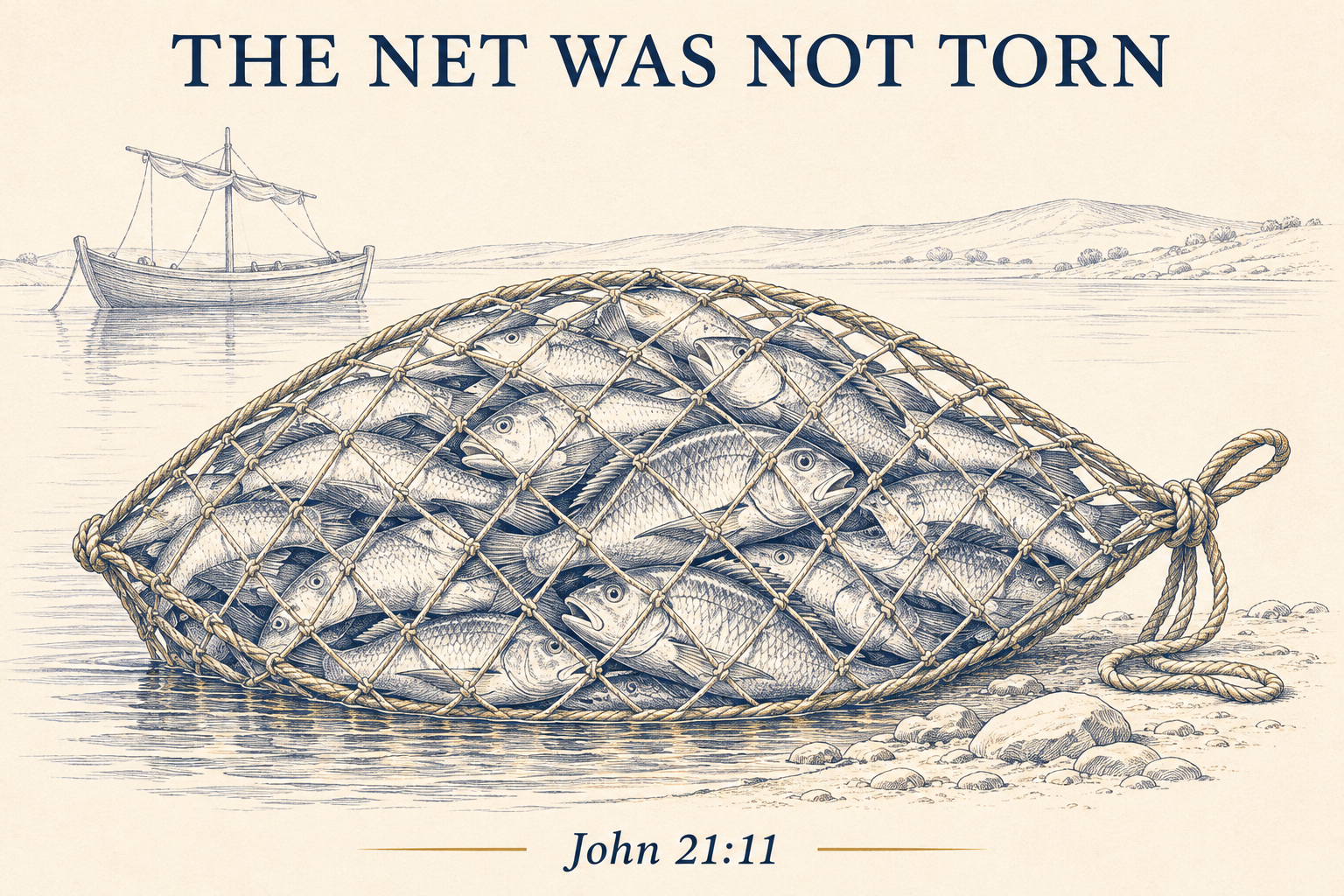
THE NET WAS NOT TORN
We have considered the significance of the 153 fish. But what about the net—and the One who commanded the disciples to cast it?
In Luke 5, Yeshua directs Peter to let down the nets after a fruitless night. The resulting catch is so abundant that the nets begin to break. Peter falls before Him, overwhelmed by his own sinfulness, and asks Him to depart.
In John 21, after the resurrection, the disciples again spend a night catching nothing. Then Yeshua speaks from the shore, directing them to cast the net on the right side of the boat. They obey, and the catch exceeds their ability to haul it aboard. Yet John emphasizes that the net does not tear.
The authority behind the instruction matters. The risen Yeshua directs the gathering, and the net holds the abundance that follows.
Peter has not earned this gift through an unblemished record of faithfulness. He denied Yeshua three times. Yet the risen Lord meets him with provision, a prepared meal, and, soon, a renewed calling.
The catch is grace: abundance Peter could not produce and restoration he could not earn.
Who brings the net ashore? John specifically names Simon Peter. The other disciples have towed it toward land. Then Yeshua asks them to bring some of the fish they have caught, and Peter responds by drawing the full net ashore (John 21:8–11). Yeshua does not specifically command Peter to pull in the net; Peter takes that action in response to His request.
There is another connection in the names. In Matthew 16:17, Yeshua calls Peter Simon Bar-Jonah—Simon, son of Jonah. The prophet Jonah is introduced as Yonah ben Amittai—Jonah, son of Amittai in Jonah 1:1. Bar is Aramaic for “son”; ben is Hebrew. Amittai is related to emet, meaning “truth,” and is commonly understood as “my truth” or “truthful.”
This is an echo between names and callings, not a genealogical relationship between Peter and the prophet. In John 21 itself, the KJV reads “son of Jonas,” while many modern translations read “son of John,” reflecting a difference in the Greek manuscripts.
One great fish holds Jonah. Simon Bar-Jonah draws ashore one net holding 153 great fish.
Jonah receives mercy after fleeing his calling. Nineveh receives mercy when its people repent. Yet Jonah struggles to welcome God’s compassion for that great city. His story challenges the boundaries a messenger might place around divine mercy.
Peter, too, has failed. But when he recognizes Yeshua on the shore, he throws himself into the water to reach Him. The man who once asked Yeshua to depart now rushes toward Him.
Mercy and grace run through both stories, but the comparison brings a particular movement into focus: Jonah receives mercy and struggles to welcome it for others. Peter receives grace and is commissioned to care for others.
Read together, the stories also invite us to consider the boundary formed by the net. The gathering is abundant, yet everything remains held together. The assurance is not merely that many can be gathered. It is that the net can hold them. This is a theological reading of the stories together; John does not explicitly explain the net’s symbolism.
The Hebrew word רֶשֶׁת—reshet, meaning “net” or “meshwork”—has a gematria of 900: Resh (200), Shin (300), and Tav (400). In Exodus 27:4–5, it describes the bronze network surrounding the altar, which Rashi explains marked the boundary between the upper and lower areas for applying sacrificial blood. Here, netting marks a boundary at the place of sacrifice.
Read alongside Jonah and Peter, it invites reflection on boundaries widening under God’s direction. The casting of the net parallels the sending of Jonah: God sends Jonah to Nineveh, and the risen Yeshua directs His disciples to cast their net where He chooses. Both commands lead toward a gathering beyond what the messengers themselves could accomplish. Jonah struggles with the reach of divine mercy; Peter receives an abundant catch through grace.
The Great Commission makes the widening mission explicit: “make disciples of all nations” (Matthew 28:19). John uses the Greek word diktyon for net, so the connection with the altar’s Hebrew reshet is a theological reflection rather than an explicit identification.
Read this way, the unbroken net offers assurance for the expanding mission: the gathering may exceed the messengers’ expectations, but it does not exceed the provision of the One who sends them. Jonah is sent. The net is cast. The boundaries widen—and the net is strong enough to hold.
Then, after breakfast, the imagery changes. Yeshua asks Peter three times about his love and entrusts His lambs and sheep to his care.
The movement is from net to flock, from gathering to tending. Those brought in must also be fed.
Peter receives the catch before receiving this commission. The abundance is a gift, not payment for the work ahead. Having received grace, he is called to serve.
The grace Peter receives becomes the care he is called to give.
Jonah’s Conclusion. Its all a gadol (great/big) dawg (fish) story. The Bible is filled with them. Creation, the sea parting, manna, a man swallowed by a large fish, fire coming down, men walking on water, people rising from the dead … there are literally hundreds of “great fish stories” in the Bible. Truth? If you are seeking “truth” you are a lot less likely to find it on the evening news than in the Bible. The bible is two stories in one book about one God.
Here is a good video on the significance of the story in John about the great catch.