I have to give myself a shot. It got me thinking. That’s when I research and write.
We Have an Amazing Creator. It is astonishing to consider what happens when medicine is delivered through a simple injection.
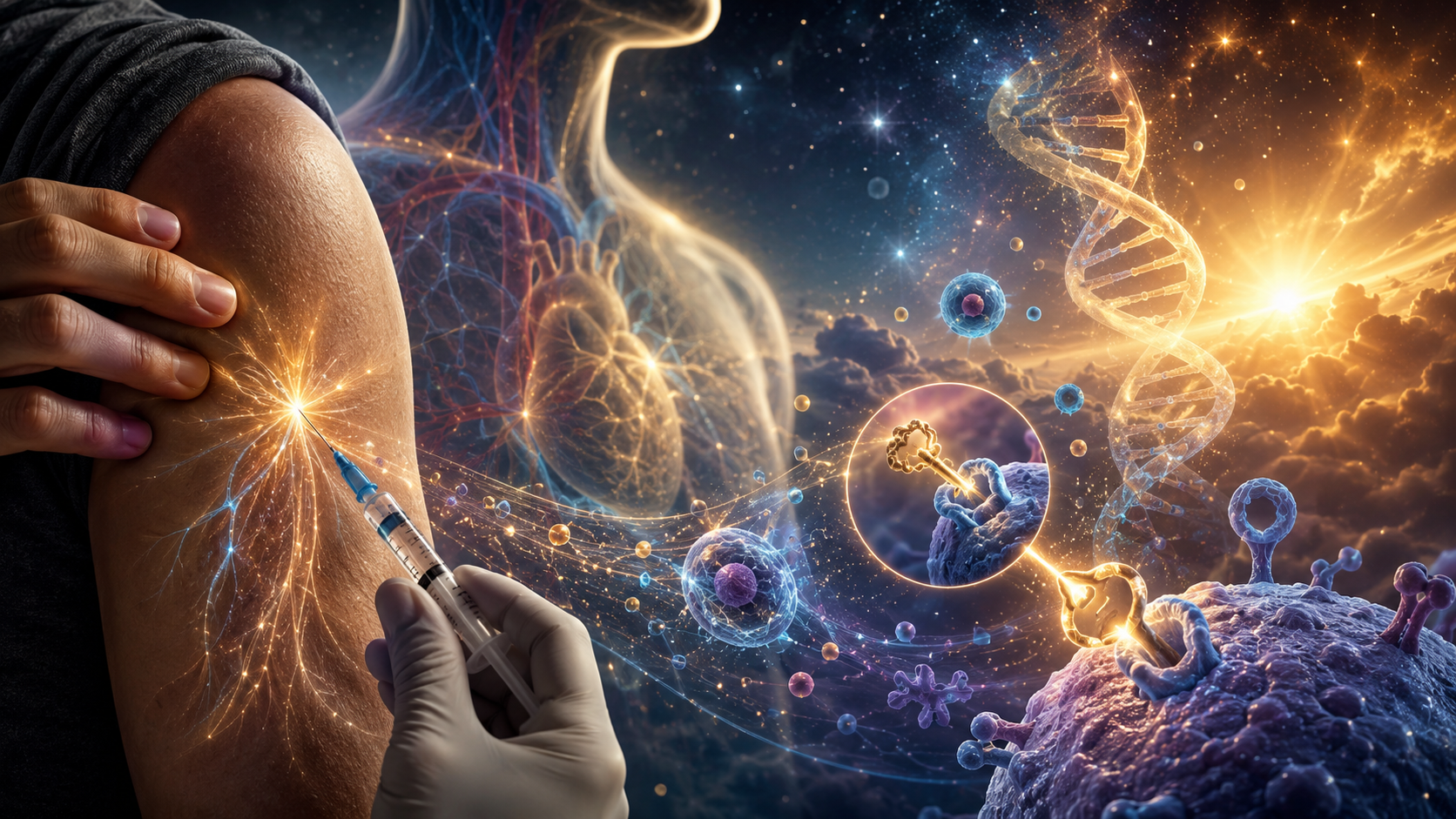
A small amount of substance enters the body through a needle. From there, it may move into the bloodstream, circulate through tissues, interact with cells, and produce a particular effect. A vaccine may train the immune system to recognize a threat. A hormone may bind to a receptor. A medication may block an enzyme, reduce inflammation, control pain, or correct a chemical imbalance.
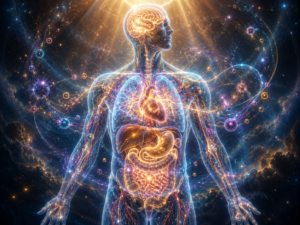 How does something introduced into the arm accomplish such a specific purpose somewhere else in the body?
The answer leads us into one of the most remarkable features of creation: the biological “lock and key” system.
Many medicines work because their molecular structures fit particular receptors, enzymes, or proteins within the body. The medicine acts like a key, while the biological target functions like a lock. When the match is sufficiently precise, the medicine can activate, block, strengthen, or alter a natural process.
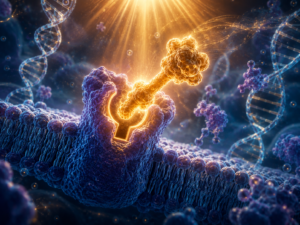 Among trillions of cells and countless molecular pathways, the right key must reach and recognize the right lock—a microscopic journey of astonishing precision. Yet the lock itself did not appear from nowhere. The instructions for constructing many of these receptors and proteins are encoded within DNA.
DNA is not merely biological material. It is an information-bearing system. Within nearly every cell is a vast library of instructions directing the production of proteins that help give the body its structure and enable it to function.
A gene is read. A corresponding message is produced. That message is used to assemble a protein. The protein then folds into a specific three-dimensional form. Its shape, electrical charge, and chemical properties determine what it can interact with.
In simplified form, the process is:
DNA → RNA → protein → biological function
The depth of this system is difficult to comprehend.
Nearly every cell in the body contains essentially the same DNA, yet cells do not all behave the same way. A heart cell does not perform the work of a liver cell. A nerve cell does not function like a white blood cell. Different cells activate different portions of the same genetic library.
It is as though every cell possesses the same enormous instruction manual but has been directed to open only the chapters necessary for its particular assignment.
The result is specialization without separation and diversity without chaos.
The body contains trillions of cells, each carrying out its own work while participating in something far greater than itself. Cells communicate, respond, repair, divide, defend, transport, and adapt. The heart pumps. The lungs exchange gases. The kidneys filter. The immune system identifies threats. The nervous system carries signals with extraordinary speed.
All these systems must operate together.
But the wonder does not stop at the level of organs, cells, or even DNA. It reaches down into the molecular and atomic structure of the body.
Medicines bind to receptorsl atoms are arranged in particular shapes. Positive and negative charges attract. Other atomic arrangements repel. Hydrogen bonds form. Electrons are shared or transferred. Molecules bend, rotate, and fold according to the properties built into their atomic structures.
The effectiveness of a medication may depend upon the position of only a few atoms. A slight alteration in molecular shape may determine whether a drug binds strongly, weakly, or not at all.
DNA itself depends upon these same principles. Its bases pair according to their chemical structures. Proteins fold because different portions of the molecule attract or repel one another. Nerve signals depend upon charged particles moving across cell membranes. Energy production depends upon carefully controlled transfers of electrons.
- At the visible level, a person lifts a hand.
- At the cellular level, nerve cells send signals and muscle fibers contract.
- At the molecular level, proteins change shape and chemical energy is released.
- At the atomic level, ions move and electrons participate in reactions.
What appears to us as one simple movement rests upon countless coordinated events occurring at scales we cannot see.
The deeper we look, the more astonishing creation becomes.
Scripture declares:
“I will praise thee; for I am fearfully and wonderfully made: marvellous are thy works; and that my soul knoweth right well.”
—Psalm 139:14»
The psalmist did not possess microscopes, genetic sequencing, molecular imaging, or modern pharmacology. Yet he understood something fundamental: the human person bears the unmistakable marks of wonder.
Modern science has not diminished that wonder. It has magnified it.
Science allows us to observe mechanisms, identify patterns, test treatments, and understand physical processes. Theology asks what those processes reveal about the nature of reality and the One who gave reality its order.
To describe how something works is not necessarily to explain why there is such an intricate system capable of working at all.
A person may describe the notes of a symphony, measure their frequency, study the construction of the instruments, and explain how sound waves travel through the air. None of that makes the music less meaningful. Greater understanding may actually deepen appreciation for the composer.
In the same way, learning about genetics, receptors, proteins, atoms, and medicine need not move us away from belief in God. It may move us toward reverence.
Order Out of Chaos
The biblical vision of creation is not of a disordered universe abandoned to meaninglessness. It is a world established with patterns, distinctions, boundaries, and fruitfulness.
Genesis repeatedly declares that God spoke and order emerged.
Light was separated from darkness. Waters were divided. Land appeared. Living creatures reproduced according to their kinds. Humanity was formed with unique dignity and responsibility.
The opening chapter of Scripture presents creation as intelligible because it proceeds from intelligence.
This does not mean that every scientific mystery has an immediate theological explanation. Nor should God be used merely to fill temporary gaps in human knowledge. The theological claim is deeper than that.
God is not only the explanation for what we have not yet discovered. He is the foundation of everything that can be discovered.
The laws of chemistry, the reliability of physical forces, the information contained in DNA, and the ability of the human mind to investigate nature all exist within a universe marked by consistency and order.
The apostle Paul wrote:
“For the invisible things of him from the creation of the world are clearly seen, being understood by the things that are made.” —Romans 1:20
Creation does not reveal everything about the Creator, but it bears witness to His wisdom.
A receptor positioned on the surface of a cell may be unimaginably small, yet it participates in a system extending through the entire body. DNA is microscopic, yet it carries instructions essential to life. Atoms are beyond ordinary sight, yet their organization allows us to think, feel, remember, pray, love, and worship.
From the largest organ to the smallest molecular interaction, we encounter layers of order nested within other layers of order.
The body is not merely assembled. It is coordinated.
It is not merely complex. It is communicative.
It is not merely alive. It continually receives information, processes it, and responds.
Medicine itself becomes possible because the created world is ordered. Scientists can develop treatments because chemical reactions are dependable, biological structures can be studied, and cause-and-effect relationships can be discovered.
The physician, researcher, and pharmacist work within a creation whose patterns can be understood and applied for healing.
This should produce humility.
For all that humanity has discovered, we did not invent the cell. We did not create DNA. We did not establish the laws governing atoms. We learned to observe, describe, and work with realities already present.
Human medicine is extraordinary, but it operates within an even greater miracle: the created body’s ability to receive, transport, recognize, and respond to treatment.
Every successful medicine quietly testifies that the body possesses pathways capable of being reached.
There are receptors to bind, enzymes to influence, signals to alter, defenses to awaken, and systems to restore.
Even healing is often a partnership between medical intervention and the body’s own created capacity to repair itself.
We should therefore be grateful for medicine and grateful for the minds able to develop it. Scientific discovery is not a rival to faith. It can be understood as part of humanity’s calling to explore, cultivate, and responsibly use the world God has made.
The more we uncover, the more reason we have to say with the psalmist:
“O LORD, how manifold are thy works! in wisdom hast thou made them all.” —Psalm 104:24
The design runs through the whole of life.
It is present in the beating heart. It is present in the immune cell recognizing an invader. It is present in the receptor receiving a chemical signal. It is present in DNA preserving and transmitting biological information. It is present in the atomic forces that allow molecules to form and life to function.
The same Creator who formed the stars established the laws governing the atoms within our bodies. The God of the vast is also the God of the minute.
He is Lord over galaxies and genes, over planets and proteins, over oceans and oxygen, over the visible and the invisible.
We live every moment surrounded by wonders we rarely notice.
- A breath is a wonder.
- A heartbeat is a wonder.
- A wound closing is a wonder.
- A memory forming is a wonder.
- A medicine reaching its target is a wonder.
What is even more amazing is that this same basic design—DNA—is used throughout nearly all living life on Earth. From human beings to animals, plants, fungi, and the smallest microorganisms, life is built upon the same genetic language. The instructions differ, producing an astonishing variety of creatures, yet the underlying system remains remarkably unified. To me, that shared language of life points not only to common structure, but to the wisdom and consistency of one Creator.
The deeper we look, the more the created world invites not only investigation, but worship. We have an amazing body. We inhabit an amazing universe. Above all, we have an amazing Creator.
46 Chromosomes
אֵלִ֣י אֵ֖לִי לָמָ֣ה עֲזַבְתָּ֑נִי רָח֥וֹק מִ֜ישֽׁוּעָתִ֗י דִּבְרֵ֥י שַֽׁאֲגָתִֽי
My God, my God, why have You forsaken me? Psalm 22.2
In Hebrew gematria, Elohai—“my God” (אלהי)—equals 46, the same number of chromosomes found in a typical human cell. Psalm 22 opens with the deeply personal cry, “Eli, Eli—my God, my God”: not a distant or abstract God, but my God, the One to whom the psalmist belongs even in anguish. Although Eli and Elohai are different Hebrew forms and do not share the same numerical value, they express the same intimate truth. For me, the number 46 becomes a beautiful reminder that the human body itself bears an echo of that confession: my God.
In closing, that is why I wear two symbols together on one necklace: a silver section of a DNA strand and a Magen David. The DNA represents the extraordinary information, precision, and order woven into every living cell. The Magen David represents my faith, my Jewish identity, and the God of Israel. Together, they express a truth I carry close to my heart: the deeper I look into the design of life, the more clearly I see the hand of an amazing Creator.