Ha’azinu. Listen to the Song. Speak to the Rock.
How can a song save? Moses’ song preserves words Israel needs to hear and return to.
Preface
This week’s Torah portion is Ha’azinu (Deuteronomy 32), Moses’ final song to Israel. We read it on Shabbat Shuvah, the Sabbath of Return, between Rosh Hashanah and Yom Kippur. The timing makes the song’s call to listen, remember, and turn back especially immediate. Moses teaches it as Israel stands at the edge of the promised land, knowing he will not enter with them.
The rock in this article’s subtitle takes us to an earlier moment. Adonai told Moses to speak to a rock so that water would flow, but Moses struck it instead (Numbers 20:7–12). I hear that event alongside the opening of his final song: “Give ear, O heavens, and I will speak” (Deuteronomy 32:1). Why does Moses leave Israel with a song about listening and speaking as they prepare to cross into the land—and as we prepare for Yom Kippur?
A Jewish friend shared a reflection on Ha’azinu, drawing on the words of Rabbi Jonathan Sacks, of blessed memory. Both are Orthodox Jews. My friend begins with an image I cannot shake: Moses knows his life is nearing its end, yet he leaves Israel a song. Long after his own voice is gone, its words can still be heard.
My friend urges us to listen with more than our ears. Torah, like music, must enter the heart. He compares its teaching to rain that soaks into the ground and continues to nourish what grows after the rain has stopped. Rabbi Sacks makes a related point: physical things may be lost, but a song we have learned remains with us. He also recalls a rabbinic tradition of songs at turning points in Israel’s story—and a final song of the Messiah still to be sung.
10 Songs at 10 Turning Points
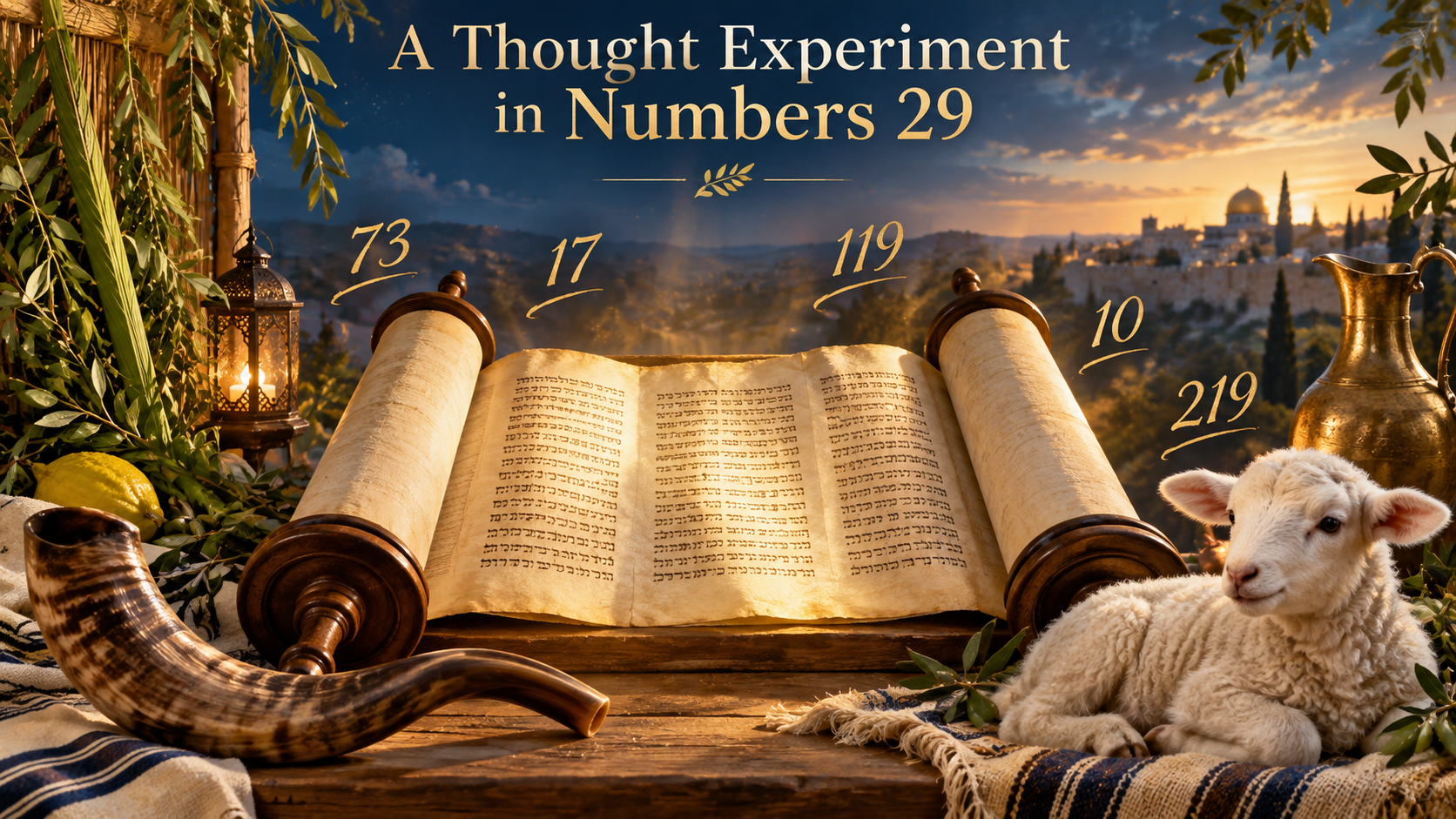
The image below traces the traditional sequence of the 10 Songs. Its lists have some variations, but all place Moses’ final song within a story that continues after him.
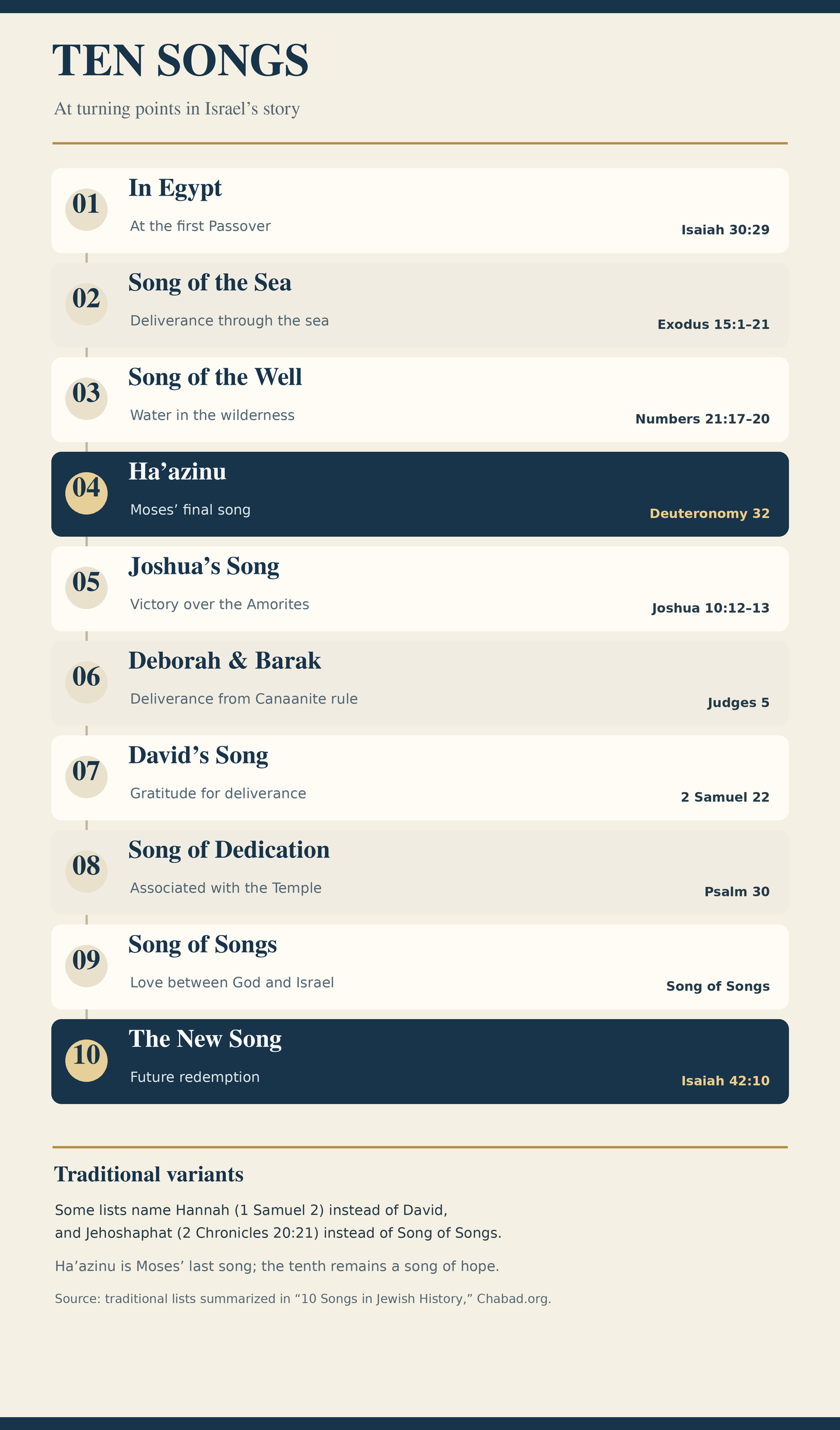
Rabbi Sacks (Z”l) points to a Jewish tradition that counts ten great songs across Israel’s story. It is not a claim that Scripture contains only ten songs. Rather, the tradition listens for songs at moments when something changes: Israel’s deliverance, water in the wilderness, a leader’s final words, victory after danger, and the dedication of a place to worship God.
The Song of the Sea rises after Israel crosses out of Egypt (Exodus 15). The Song of the Well answers the gift of water in the wilderness (Numbers 21:17–20).
Notice that Ha’azinu is the fourth song. Dalet (ד), the fourth Hebrew letter, has the numerical value four and is associated with a door. That image fits Moses’ final moment. Adonai allows him to see the land promised to Abraham, Isaac, and Jacob, but tells Moses he will not cross into it (Deuteronomy 34:4). Moses brings Israel to the threshold, but Joshua will lead them across.
Joshua in Hebrew is Yehoshua (יְהוֹשֻׁעַ), which means “Yahweh is salvation.” The name adds another layer to my reflection on who leads the people through.
About* thirteen centuries after Moses’ final song, Yeshua says, “I am the door” (John 10:9). In Hebrew, ahavah—love—has a numerical value of thirteen. I cannot help seeing the resonance: Moses stands at the threshold of the promised land, and Yeshua speaks of a door opened through love**.
* Using the traditional date of Moses’ death, 1273 BCE, and an estimated date of 27–30 CE for Yeshua’s words: 1273 + 27–30 − 1 (because there is no year zero) = approximately 1,299–1,302 years.
** Ahavah (“love”) is spelled alef–heh–vet–heh. Its gematria is 1 + 5 + 2 + 5 = 13.
Moses cannot enter the land with Israel, so he gives the people a song they can carry across without him (Deuteronomy 32). Later, Deborah and Barak sing after deliverance (Judges 5), and David sings in gratitude for God’s rescue (2 Samuel 22). Each song helps a people remember what God has done at a key turning point.
The sequence moves from songs of deliverance to the Song of Songs. In ninth place is a song of profound love that Jewish tradition also reads as an image of the bond between God and Israel. It then looks ahead to a tenth song: Isaiah’s call for a new song reaching “from the end of the earth” (Isaiah 42:10). In the tradition Rabbi Sacks describes, this is the song of future redemption—the song of the Messiah.
That movement from love to a song still awaited makes me pause. A song can remember a rescue already received, but it can also keep hope alive for what has yet to come. Ha’azinu does both: Moses speaks of Israel’s failures and God’s faithfulness, leaving words for generations he will never meet.
As I listened to Ha’azinu, I began to hear another part of Moses’ life within it.
“Give ear, O heavens, and I will speak; let the earth hear the words of my mouth.”
—Deuteronomy 32:1
Moses asks that his teaching fall like rain, his speech like dew. Then Moses names God “the Rock” (Deuteronomy 32:2–4). Hearing. Rain. Rock. These are the words Moses wants Israel to carry forward—words to remember when they need to return.
First, Strike. Later On, Speak.
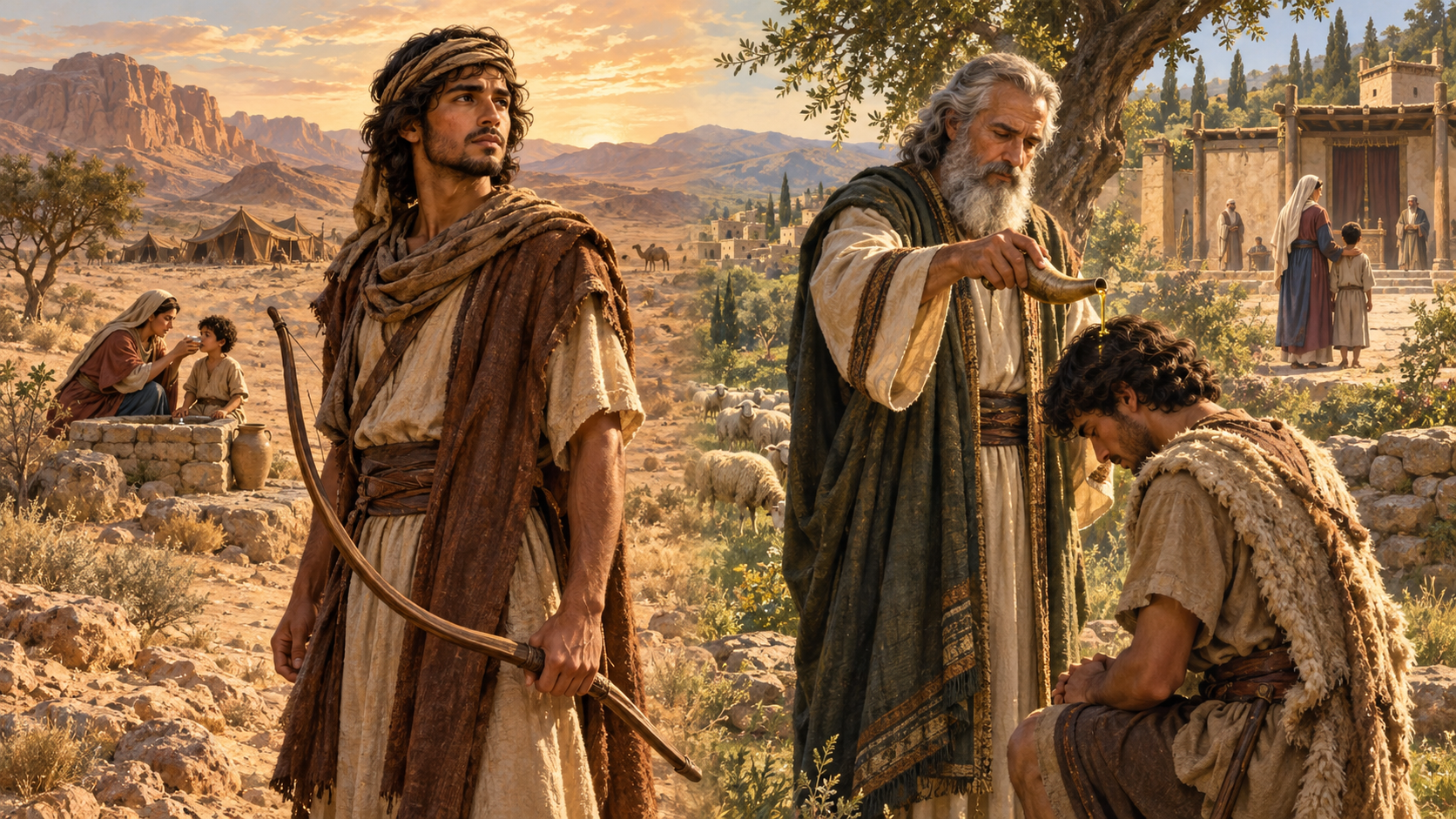
Early in the wilderness journey, when the people needed water, God told Moses to strike a rock. Moses obeyed, and water came out (Exodus 17:5–7).
Years later, when the people again needed water, God gave Moses a different instruction:
“Speak to the rock before their eyes, and it will yield its water.”
—Numbers 20:8
Moses was supposed to listen to God and speak to the rock. Instead, he struck it twice. That repetition gives the action weight.
Water still came, but God said Moses would not lead the people into the land (Numbers 20:9–12). First, God said to strike. Later, God said to speak. That change is in the text.
I wonder whether Moses reflected on it as he composed his final song. Scripture does not tell us what was in his mind. But Ha’azinu places us beside a man who cannot enter the land, hearing him say “I will speak,” ask that his words fall like rain, and call God the Rock.
At the end of the portion, God again recalls why Moses may see the land but not enter it (Deuteronomy 32:48–52). Moses could not cross over with Israel. His song could.
Between the Shofar Calls
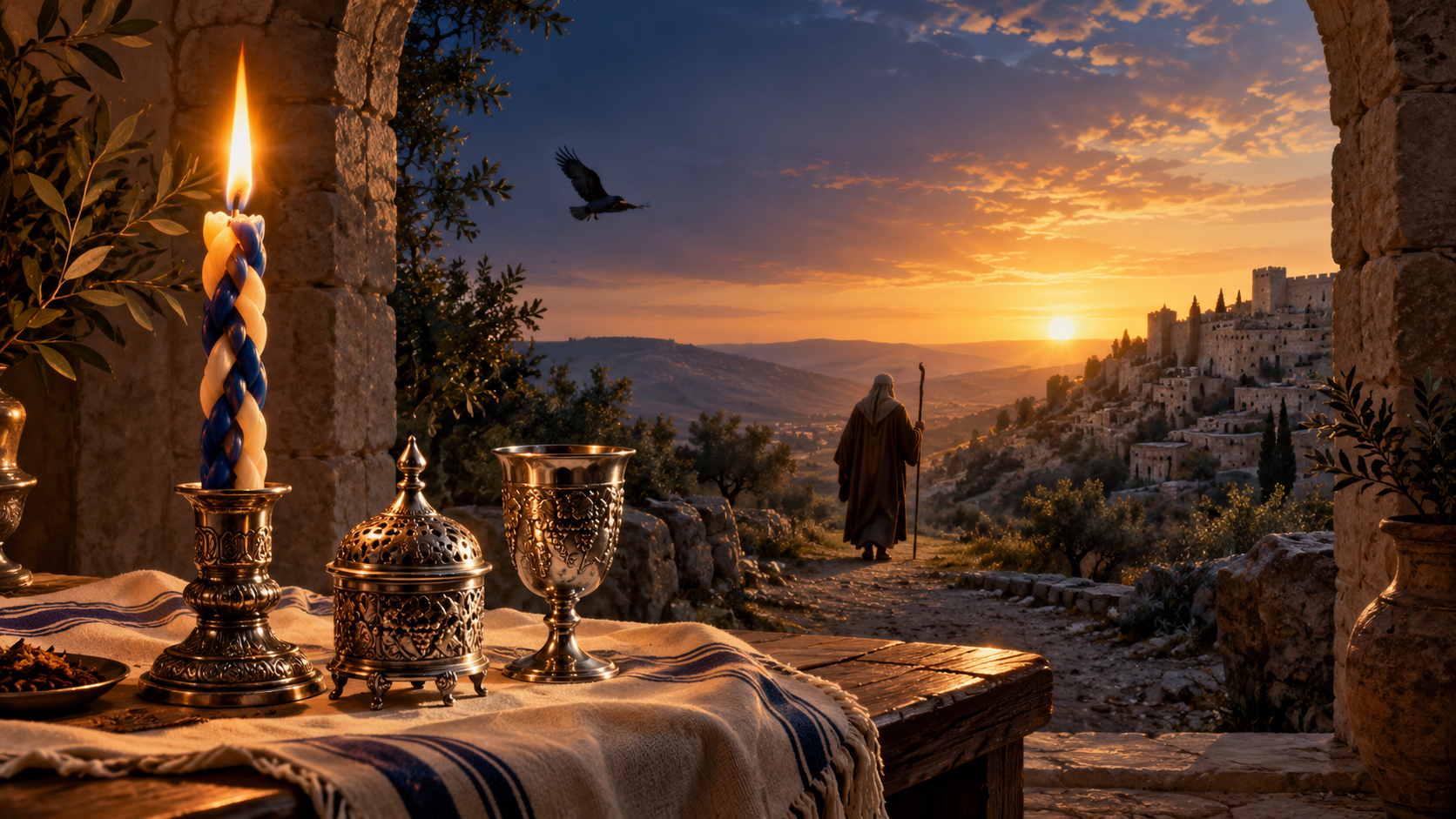
In 2026, Ha’azinu is read on September 19, during Shabbat Shuvah, between Rosh Hashanah and Yom Kippur. The shofar has sounded at the beginning of the new year. It will sound again at the close of Yom Kippur. Between those calls, Moses says, “Listen.”
The Haftarah answers, “Return.” Hosea calls Israel back to God and promises healing. Then God says He will be like dew to Israel (Hosea 14:2–6).
Depending on a community’s custom, the reading continues with Joel, Micah, or both. Joel calls for a shofar blast, a fast, and an assembly of the people. The passage moves toward restoration and rain (Joel 2:15–27). Micah asks who is like the God who pardons wrongdoing and delights in mercy. He pictures God casting sins into the depths of the sea (Micah 7:18–20).
The images do different work, yet they form a sequence I find beautiful. Moses’ teaching falls like rain and dew. Hosea promises dew to a returning people. Joel speaks of rain that restores the land. Micah pictures forgiven sins disappearing beneath the sea. We are invited to listen, turn, and trust God’s mercy.
Dew and Bread from Heaven
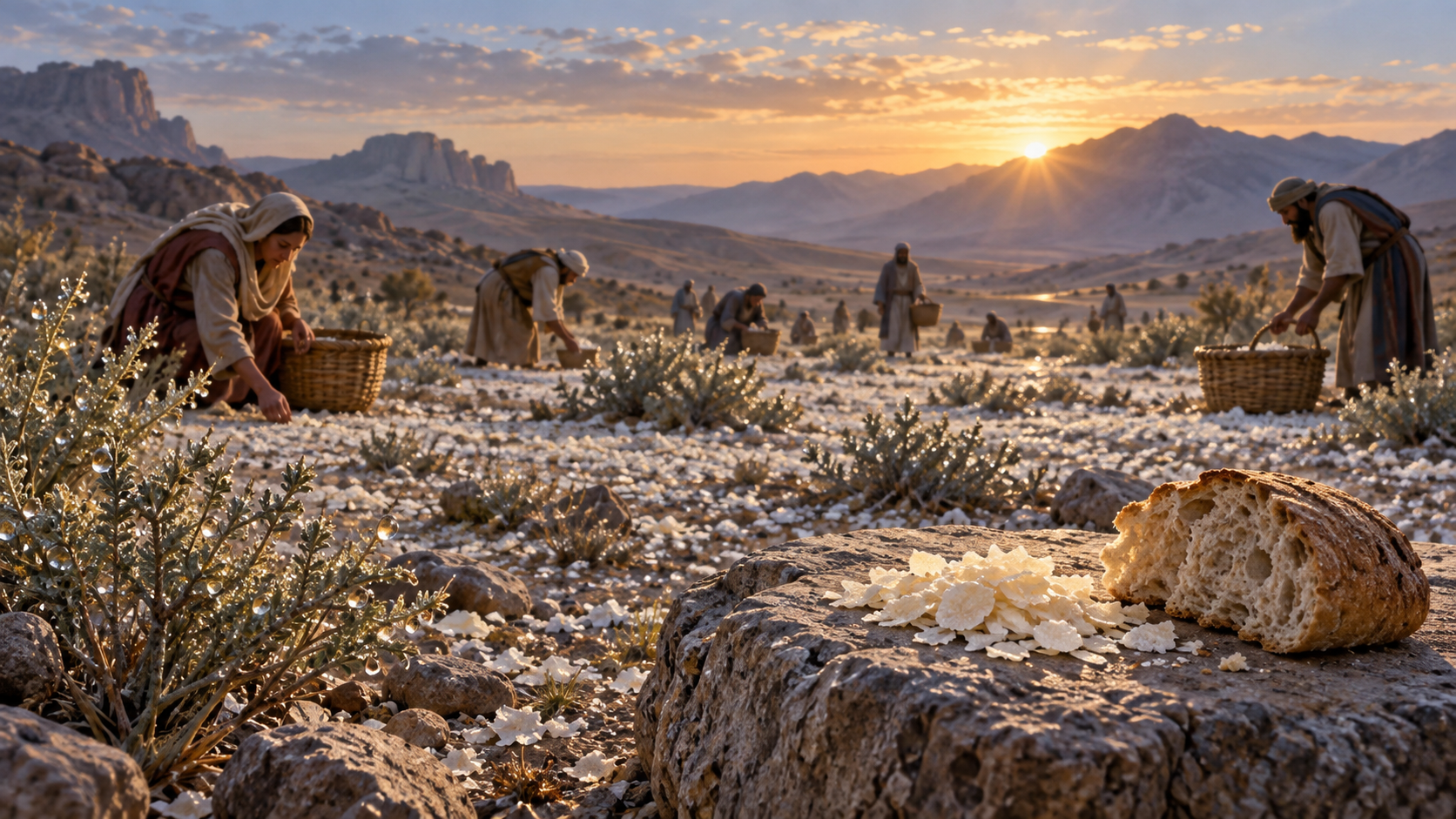
Hosea’s promise—“I will be like dew to Israel”—also takes me back to the wilderness. Exodus describes dew around the appearance of manna, and Numbers says that when dew fell on the camp, manna fell with it (Exodus 16:13–15; Numbers 11:9). I cannot say Hosea meant to identify the dew with manna. But the image recalls a God who provided food for Israel day by day.
Proverbs says that a person with a good eye shares bread with the poor (Proverbs 22:9). The point is beautifully practical: seeing another person’s need should move us to feed them. When Yeshua saw the crowd with compassion, he taught them and then gave them bread (Mark 6:34–44). He met their hunger before speaking of himself as the bread from heaven.
In John 6:30–35, the people themselves bring up the manna their ancestors ate. Yeshua answers by speaking of the true bread from heaven and says that whoever comes to him will neither hunger nor thirst. Dew, manna, bread, and water meet in a conversation Yeshua has with people who know the wilderness story. Later in the same chapter, he says his words are spirit and life. Some listeners stay; others leave (John 6:60–68). Once again, the invitation is to listen—and the choice of how to respond remains theirs.
From Heaven To Earth
There is another way I picture that movement. In a Jewish mystical reading, the Hebrew letter Alef (א) can be seen as an upper yud, a lower yud, and a vav joining them. Their numerical values—10, 10, and 6—add to 26, the value of the divine name יהוה. The vav draws what is above toward what is below (Chabad’s discussion of Alef).
This is a meditation on a letter, not a translation of Ha’azinu. Still, it helps me picture Moses’ opening: heaven is called to listen, earth is called to hear, and life-giving words descend like rain.
The name vav also means hook. Hooks held the veil of the Tabernacle (Exodus 26:31–33). Its form also brings a nail to my mind. As a Jewish believer in Yeshua, I see a symbolic connection to the nails of the cross and the Gospel account of the Temple veil tearing at his death (Matthew 27:50–51). I offer that as an image for reflection, not as proof hidden in the shape of a letter.
When the Rock Spoke
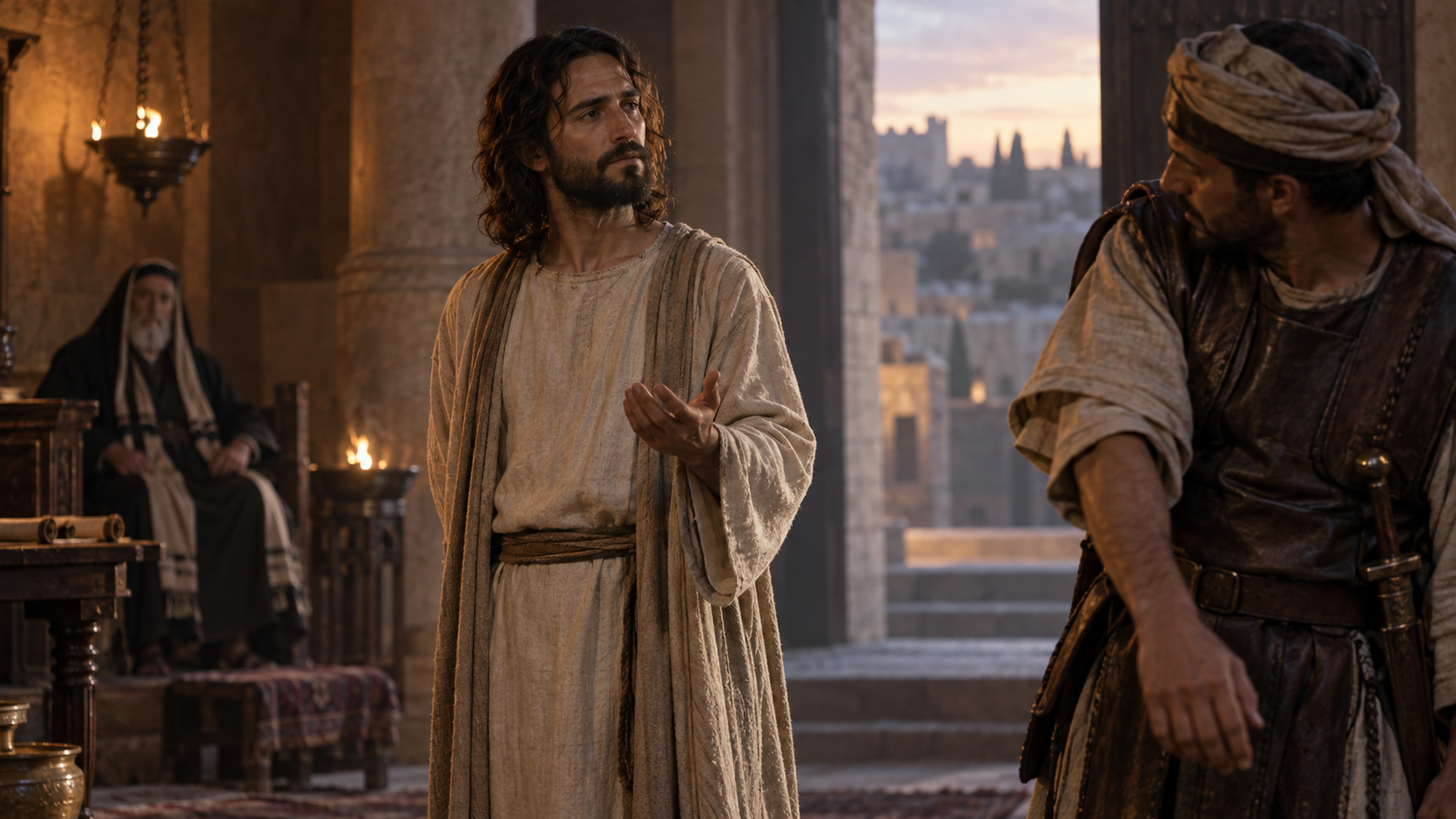
I believe Scripture teaches Scripture. I follow the d’var—the word—through its own stories, letting one passage illuminate another.
The connection between the wilderness rock and Yeshua is made explicitly by Paul. Recalling how Israel drank in the wilderness, he writes:
“The rock was the Christ.”
—1 Corinthians 10:4
Paul gives the wilderness account a spiritual reading. With his words in mind, I return to what happened when Yeshua stood before the priestly authorities.
While being questioned, Yeshua spoke. An officer struck him. Yeshua responded:
“If I spoke the truth, why did you strike me?”
—John 18:23
Matthew describes another scene before the high priest Caiaphas. After Yeshua answered him, people present struck and slapped Yeshua (Matthew 26:62–68).
Here is the parallel I cannot help wondering about: God told Moses to speak to the rock, but Moses struck it. When the one Paul calls the Rock came speaking, an officer struck him. Yeshua’s question—Why did you strike me?—sends me back to the first word of Ha’azinu: Listen.
Exodus tells us when Moses was commanded to strike. Numbers tells us when he was commanded to speak. Ha’azinu gives us his song of speech, rain, and the Rock. Paul identifies the spiritual rock with Messiah. John records Yeshua’s question after he was struck. I can read each passage in its setting and then consider what becomes visible when they are held together.
I cannot say Moses consciously wrote his song for those at Yeshua’s hearing. Scripture does not say that, and John identifies the person who struck Yeshua as an officer, not the high priest himself. The passages give us the words and actions. The prophetic connection is the question I bring to them, not a claim that every writer states it outright.
The Water He Offered
Yeshua spoke of water in a way that brings me back to Moses’ song. To a woman at a well, he offered water that would become within a person a spring (John 4:13–14). During the Festival of Tabernacles, he called the thirsty to come and drink. John connects those rivers of living water with the Spirit (John 7:37–39).
And immediately before the words “For God so loved the world,” Yeshua spoke of the Son of Man being lifted up (John 3:14–16). The one who was struck and lifted up is also the one who offers water that satisfies.
Yeshua shows us how to walk in his ways. He calls himself ‘the way, the truth, and the life’ (John 14:6). He taught, and he gave his life for others. As he told his disciples, “Greater love has no one than this: to lay down one’s life for one’s friends” (John 15:13).
A reader does not have to accept that Yeshua is the Messiah before reading what this Jewish teacher said. Read his words first. Consider what they mean.
The Sign of Jonah and the 8th Day
Before Sukkot, we reach Yom Kippur and its afternoon reading of Sefer Jonah. Jonah speaks to Nineveh. The people of Nineveh hear his warning and choose to turn back; God shows mercy (Jonah 3:1–10).
Yeshua later calls Jonah the sign. Luke emphasizes Nineveh’s response to Jonah’s preaching. Matthew also draws a parallel between Jonah’s three days in the fish and Yeshua’s coming death and rising (Luke 11:29–32; Matthew 12:38–41). At Yom Kippur, we read the story Yeshua himself asks his listeners to consider. Even a foreign city is given a message to hear and a chance to change.
Then comes Sukkot. In an earlier reflection on its offerings, I considered the traditional association of the festival’s seventy bulls with the nations and the single bull of the eighth-day assembly with Israel (Numbers 29:12–38; Sukkah 55b). I also noted a tradition in the Jerusalem Talmud linking Jonah’s reception of the Spirit to Sukkot’s water-drawing celebration. Israel, the nations, Jonah, water, and Spirit meet again in these traditions. On Shemini Atzeret, the eighth-day assembly, Jewish prayer turns toward rain.
I began with my Orthodox friend’s message because I want to honor its invitation. Listen to the song. Let the words enter. I hear Moses’ life in Ha’azinu, and I hear connections to Yeshua. Another reader may hear the song differently. That freedom matters.
Studying a book does not require surrendering your judgment. Whether its words reach your heart, mind, and soul must be your own decision. Love cannot be forced, and neither can faith. Even Nineveh was given a message to hear and a choice about how to respond.
So I return to Moses’ opening line: “Give ear, O heavens, and I will speak.” Listen to Moses. Listen to the prophets. Listen to Jonah. Listen to Yeshua. Read the words, and decide what you hear.
That is how I have come to understand Two Stories, One Book, One God.
Epilogue: Thirteen Centuries
One more interval caught my attention. By the traditional chronology, about thirteen centuries separate Moses’ final song from Yeshua’s words, “I am the door.” In Hebrew, ahavah—love—has a gematria of thirteen. I hear those details alongside the song, the threshold, and the invitation to enter.
The Shroud of Turin brings another interval to mind. Its documented history begins in the mid-fourteenth century, roughly thirteen centuries after Yeshua’s crucifixion. I cannot fill the centuries before its appearance in the records. Still, the length of that silence catches my attention. Shroud history.
Moses could not cross into the land, but his song did. Yeshua’s words have crossed the centuries too: “Greater love has no one than this: to lay down one’s life for one’s friends” (John 15:13). That is the love I hear when I return to the song, the door, and the number thirteen.