The claim that today’s Jews are not the “real Jews” is not a serious historical argument. It is an impostor theory built by ignoring nearly two thousand years of documented Jewish continuity, exile, migration, persecution, prayer, language, tradition, and return. It asks us to believe that Jewish communities scattered across Europe, North Africa, the Middle East, Ethiopia, and beyond somehow invented the same ancestral memory, preserved the same Torah, mourned the same destroyed Temple, prayed toward the same Jerusalem, and maintained the same hope of return—all while having no genuine connection to the ancient people of Israel. That is not critical thinking. It is historical denial dressed up as discovery.
The impostor argument does not uncover history; it erases it.
The Real History of the Jewish Diaspora
For nearly 2,000 years, Spain was home to one of the greatest Jewish civilizations in history.
Jewish communities existed across the Iberian Peninsula from at least Roman times until the expulsion of 1492. Their story is more than a chapter in Spanish history. It is part of the larger, well-documented story of the Jewish people: a people driven from place to place, divided by geography, shaped by different cultures, yet never separated from their shared identity, traditions, Scriptures, and ancestral homeland.
That history presents a serious problem for those who claim that today’s Jews are somehow not the “real Jews.”
🔵 From Judea to the Diaspora
The Jewish diaspora did not begin with a single event. Jewish communities already existed outside the Land of Israel before the Roman period. But the Roman destruction of Jerusalem and the Second Temple in 70 CE, followed by the crushing of the Bar Kokhba revolt in 135 CE, greatly accelerated Jewish displacement.
Large numbers were killed, enslaved, displaced, or driven into migration. After the revolt, Jews were barred from Jerusalem except on limited occasions. Yet Jewish life never disappeared from the land itself, and Jewish communities also spread throughout the Roman world.
Some traveled westward into Italy, Gaul, North Africa, and the Iberian Peninsula. Others remained throughout the Middle East—in Babylon, Persia, Syria, Egypt, Yemen, and the Land of Israel.
This is the beginning of the diverse Jewish world we recognize today.
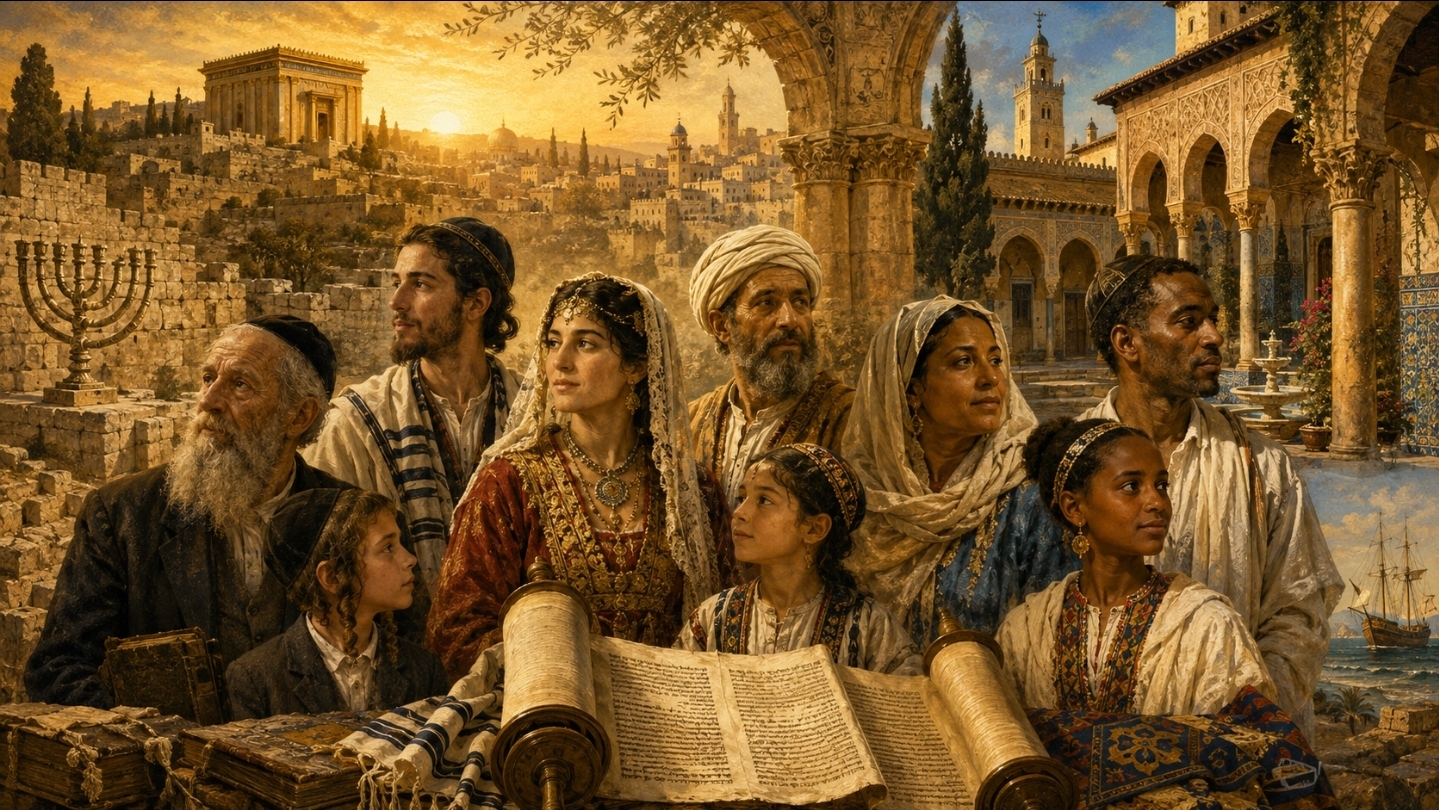
The descendants of Jews who settled in Central and Eastern Europe became known as Ashkenazim. Those associated with Spain and Portugal became known as Sephardim. Communities rooted in Iraq, Iran, Syria, Yemen, North Africa, and other parts of the Middle East became broadly known as Mizrahim. Other ancient communities developed in Ethiopia, India, Central Asia, the Caucasus, and elsewhere.
These were not unrelated peoples who independently adopted the same identity. They were branches of a scattered civilization—communities shaped by different host countries while retaining a shared memory of Israel, Jerusalem, Torah, Hebrew, covenant, and exile.
🔵 The Arrival of Jews in Spain
Jews were already living in Roman Hispania during the first centuries CE, and some traditions place their arrival even earlier.
Communities eventually became established in cities such as:
- Toledo
- Córdoba
- Seville
- Barcelona
- Girona
- Zaragoza
- Tarragona
- Mérida
- Lucena
- Valencia
They did not arrive in Spain as people pretending to be Jews. They arrived as members of an already ancient people whose homeland, Scriptures, festivals, language, and collective identity were rooted in the Land of Israel.
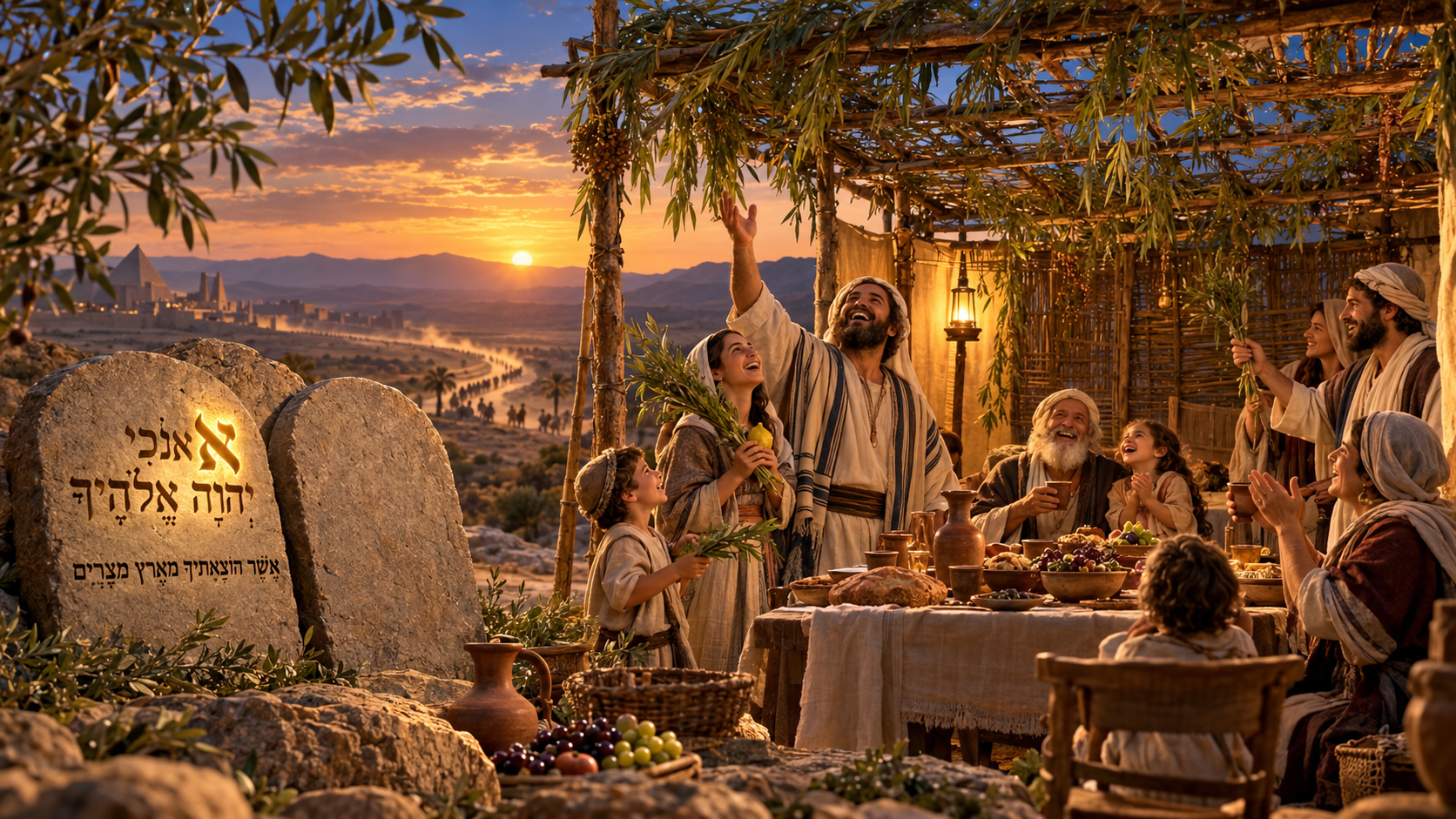
They brought the Torah. They prayed toward Jerusalem. They observed Passover as the story of their ancestors. They mourned the destruction of the Temple. They used Hebrew in worship and gave their children biblical names.
These practices were not invented in medieval Europe. They were inherited from antiquity.
🔵 The Golden Age
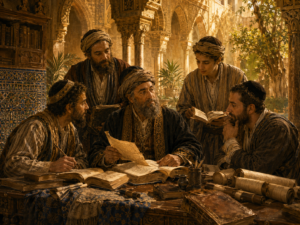
Under Muslim rule, particularly during portions of the period known as Al-Andalus, Jewish communities experienced an extraordinary cultural flourishing.
Jewish scholars, poets, physicians, merchants, diplomats, grammarians, and philosophers made lasting contributions to both Jewish and wider civilization.
Among the most famous was Moses Maimonides, or Rambam, born in Córdoba in 1138. He became one of the greatest legal scholars and philosophers in Jewish history.
Other towering figures included Judah Halevi, Solomon ibn Gabirol, Samuel ibn Naghrillah, Abraham ibn Ezra, and Hasdai ibn Shaprut.
Their writings demonstrate continuity, not reinvention. They studied the same Torah, argued over the same commandments, wrote in Hebrew, looked toward Jerusalem, and understood themselves as part of the same people described in the Bible.
🔵 Life Under Christian Rule
As Christian kingdoms expanded during the Reconquista, many Jewish communities continued for a time to thrive.
Jews served as merchants, translators, physicians, financiers, administrators, diplomats, and royal advisers. Cities such as Toledo became centers where Hebrew, Arabic, Greek, and Latin learning met.
Jewish translators played an important role in transmitting philosophy, medicine, mathematics, and classical knowledge into Christian Europe.
Yet prosperity did not guarantee security. Jews remained vulnerable to rulers, religious authorities, accusations, forced conversions, and mob violence.
🔵 Persecution and Forced Conversion
In 1391, anti-Jewish violence swept through much of Spain.
Jewish communities were attacked, thousands were killed, and many others were forced to accept baptism. These converts became known as Conversos, New Christians, or, in Hebrew, Anusim—“forced ones.”
Some became sincere Christians. Others continued practicing elements of Judaism secretly, often at great personal risk. The Spanish Inquisition later investigated and punished people suspected of returning to Jewish practices.
The massacres of 1391 marked a turning point. They weakened Jewish communal life and helped create the conditions that culminated in the expulsion approximately a century later.
🔵 The Expulsion of 1492
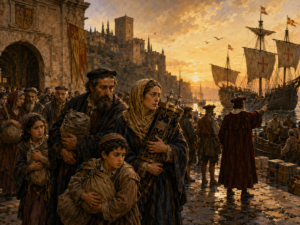
On March 31, 1492, Ferdinand II of Aragon and Isabella I of Castile issued the Alhambra Decree.
Practicing Jews were ordered to accept Christianity or leave the Spanish kingdoms. Estimates of the number who departed vary considerably, but tens of thousands—and possibly more than 100,000—went into exile. Many others converted under pressure.
Families were forced to sell homes, farms, businesses, and possessions under desperate conditions. Communities that had existed for many centuries were dismantled within months.
Some refugees crossed into Portugal, where many later faced forced conversion. Others traveled to North Africa, Italy, the Netherlands, the Balkans, the Ottoman Empire, the Middle East, and eventually the Americas.
The expulsion ended one of history’s greatest Jewish civilizations—but it did not end the Jewish people.
🔵 Sephardic Survival
The Sephardic exiles carried more than personal possessions. They carried their prayers, customs, melodies, family names, rabbinic traditions, food, literature, and language.
They preserved forms of Judeo-Spanish commonly called Ladino, maintaining a cultural connection to Spain for centuries after Spain had expelled them.
Sephardic communities arose in places such as Morocco, Amsterdam, Livorno, Istanbul, Salonica, Sarajevo, Jerusalem, Safed, and many other cities.
Their descendants remembered Spain because families preserve the memory of where they have lived. But they remembered Jerusalem because a people preserves the memory of where it came from.
That distinction matters.
Spain was a beloved home of the Sephardim, but it was never the birthplace of Jewish identity. Jewish identity was already ancient when Jews arrived there.
🔵 The Same Pattern Across the Jewish World
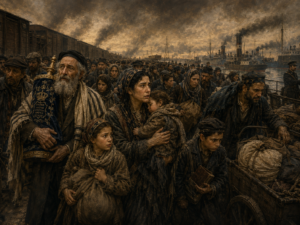
The Sephardic story is not an isolated story. It follows the same pattern found throughout the Jewish diaspora.
Ashkenazi Jews lived in Germany, France, Poland, Lithuania, Russia, and surrounding regions—but continued praying toward Jerusalem and saying, “Next year in Jerusalem.”
Mizrahi Jews lived for centuries in Iraq, Iran, Syria, Yemen, and elsewhere—often in communities older than many European nations.
North African Jews lived in Morocco, Algeria, Tunisia, Libya, and Egypt, some tracing their presence there to antiquity.
Ethiopian Jews preserved a distinctive form of Jewish life over many centuries.
Every community developed local languages, foods, clothing, customs, and physical characteristics. That is what happens when populations live across different continents for hundreds or thousands of years. Cultural variation does not erase common origin or shared identity.
A family scattered across many countries does not cease to be a family simply because its branches acquire different accents.
🔵 Jewish Languages of the Diaspora
As Jewish communities settled in different lands, they often developed distinct Jewish languages shaped by the speech of their surrounding cultures. These were not simply “variations of Hebrew,” but local languages infused with Hebrew and Aramaic vocabulary, Jewish expressions, religious concepts, and often the Hebrew alphabet. Yiddish developed primarily from medieval German dialects blended with Hebrew, Aramaic, and later Slavic influences. Ladino preserved an older form of Spanish enriched by Hebrew and the languages of the Mediterranean. Other communities developed Judeo-Arabic, Judeo-Persian, Judeo-Italian, and additional regional forms. Their differences reveal how widely the Jewish people were scattered; their shared Hebrew elements reveal the cultural and spiritual bond they never lost.
🔵 What History, Culture, and Genetics Show
Modern population-genetic studies do not support the simplistic claim that European Jews are merely Europeans who falsely adopted Jewish identity. Research generally finds that many Jewish diaspora populations are genetically distinguishable from neighboring populations and preserve varying degrees of shared Middle Eastern or Levantine ancestry, together with ancestry acquired from the regions in which they lived.
That is exactly what the historical record would lead us to expect: ancient Middle Eastern populations migrating into Europe, North Africa, and Asia, forming communities, experiencing some local intermarriage and conversion, and developing partly distinct regional identities over many centuries.
While many if not most, including myself, have the DNA to prove our identy, genetics should not be used as a racial purity test. Judaism has always included converts, and Jewish identity cannot be reduced to a laboratory result. Nevertheless, the genetic evidence broadly complements the documentary, archaeological, linguistic, religious, and cultural evidence of Jewish continuity.
The argument does not depend on DNA alone. It rests on an extraordinary convergence of evidence:
Jewish communities across distant lands preserved related religious texts, legal traditions, calendars, festivals, prayers, dietary practices, naming traditions, historical memories, and liturgical Hebrew.
- They remembered the destruction of the same Temple.
- They fasted on the same day for Jerusalem.
- They celebrated the same Exodus.
- They read the same Torah.
- They expressed the same hope of return.
No plausible historical explanation shows unrelated populations across Europe, Africa, and Asia simultaneously inventing this shared identity and then maintaining the same national memory for centuries.
🔵 The “European Impostor” Argument Fails
Calling Ashkenazi Jews merely “Europeans” while ignoring Sephardic, Mizrahi, North African, Ethiopian, Indian, and other Jewish communities reveals how incomplete the argument is.
A Jew from Poland may look different from a Jew from Yemen. A Jew from Morocco may have different customs from a Jew from Lithuania. A Jew from Ethiopia may possess traditions unfamiliar to a Jew from Spain.
But diversity within an ancient people does not invalidate that people.
The English do not cease to be English because they have varied ancestry. African peoples do not lose their identities because populations migrated, intermarried, or developed regional differences. No responsible historian demands complete genetic isolation as the price of authentic peoplehood.
Applying such a standard only to Jews is not serious historical analysis. It is a selective demand for racial purity that would disqualify nearly every nation and ethnic group on earth.
🔵 Israel Is the Reunion of the Diaspora
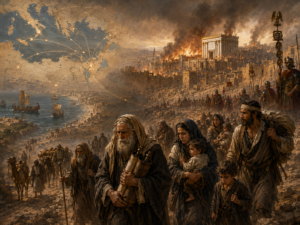
By the time we reach the modern era, the long history of exile and migration has produced Jewish communities of every complexion and from nearly every region of the world—white, Black, Asian, Middle Eastern, North African, Ethiopian, European, Indian, and more. This diversity does not weaken Jewish identity; it is the visible legacy of the diaspora itself.
Modern Israel is not populated solely by descendants of European Jews. Its Jewish population includes families from Morocco, Algeria, Tunisia, Libya, Egypt, Iraq, Iran, Syria, Lebanon, Yemen, Turkey, Greece, Spain, Portugal, Ethiopia, India, Central Asia, the Caucasus, Europe, the Americas, and the ancient Jewish communities that never entirely left the land.
They did not all become Jewish in Europe. Many never lived in Europe at all.
They arrived in Israel speaking Arabic, Persian, Yiddish, Ladino, Russian, Amharic, French, English, Georgian, Bukharian, Malayalam, and many other languages. Yet they recognized one another as branches of the same people.
The return to Israel is therefore not the story of a foreign European population suddenly inventing a connection to the Middle East. It is the gathering of communities whose dispersal across Europe, Africa, and Asia is documented throughout history.
The Roman wars help explain why Jews were scattered.
The medieval expulsions explain why they repeatedly moved.
The persistence of Hebrew, Torah, Jerusalem, and the hope of return explains why they remained a people.
The State of Israel represents not the creation of a new Jewish identity, but the political restoration of an ancient one.
🔵 A Lasting Legacy
Many descendants of Sephardic Jews and forced converts still live throughout Latin America and the Mediterranean world. Some families have rediscovered Jewish customs preserved quietly for generations—lighting candles, avoiding certain foods, observing unusual family traditions, or remembering that their ancestors came from Jewish families.
The story of Spanish Jewry is one of extraordinary achievement, profound tragedy, exile, and remarkable survival.
It is also evidence.
The existence of Sephardic Jews, together with Ashkenazi, Mizrahi, North African, Ethiopian, and other Jewish communities, demonstrates what diaspora looks like. A people scattered into many lands naturally develops regional differences while preserving a common core.
Today’s Jews are not disqualified from being the Jewish people because their ancestors lived in Spain, Poland, Morocco, Iraq, Ethiopia, or Yemen.
That geographical diversity is not evidence against Jewish continuity.
It is the evidence of the diaspora itself.
For nearly two thousand years, empires conquered them, kingdoms expelled them, mobs attacked them, governments restricted them, and inquisitions attempted to absorb them.
Yet they preserved their name, their covenant, their Scriptures, their language, their traditions, and their memory of Jerusalem.
The more remarkable question is not how Jews could still be the Jewish people after living among so many nations.
The remarkable fact is that, after everything done to erase them, they still are.
עַם יִשְׂרָאֵל חַי — Am Yisrael Chai.
Aliyah
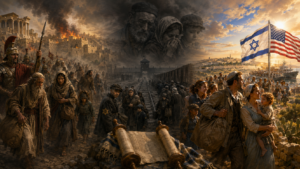 The Romans drove us from our land, scattering the Jewish people across the nations. Nearly two thousand years later, the Nazis demonstrated with horrifying clarity that exile could never guarantee our safety. Rome sent us out; the Holocaust helped drive us home. Not because Europe graciously returned what it had taken, but because Jewish survivors understood that a people without a homeland would forever remain dependent upon the mercy of others. Israel arose as the answer to exile: the ancient Jewish people returning to the ancient Jewish land—not as impostors, but as survivors coming home.
Aliyah—the return or “ascent” of the Jewish people to the Land of Israel—is the final movement in this long history of exile, persecution, survival, and homecoming.
Rome made us wanderers; Auschwitz made return a necessity.
🔵 The Jewish Identity Jesus Preserved
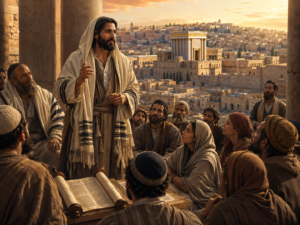
That may also explain why the New Testament opens not with a philosophical argument, but with a Jewish genealogy. Matthew begins by identifying Jesus as “the son of David, the son of Abraham,” anchoring him immediately in Israel’s covenant history and royal lineage. Before the New Testament tells us what Jesus taught or what he did, it tells us who his people were. His Jewish ancestry is not a minor detail added to the story; it is the foundation upon which the story begins.
For Christians who embrace replacement theology or successionism, there is an uncomfortable truth that must be faced: the person most central to the Christian faith never treated Jewish identity as meaningless, disposable, or replaced. Jesus was born a Jew, circumcised as a Jew, raised within Jewish life, taught from the Torah and the Prophets, celebrated the Jewish feasts, worshiped in the synagogue and Temple, and was publicly identified as the King of the Jews. His apostles were Jews, the earliest believers were Jews, and the gospel itself emerged from the story, promises, and Scriptures of Israel.
Christian belief also looks forward not to Jesus returning to Rome, London, or Washington, but to Jerusalem. The city remains central to the biblical drama because the Jewish people, the Land of Israel, and Jerusalem were never incidental details waiting to be discarded. They are woven into the story from beginning to end. It is therefore difficult to claim that Jewish identity has been erased when the Messiah Christians worship preserved that identity in his own life—and, according to Christian expectation, will return to the very city at the heart of Jewish hope.
The Messiah did not erase the Jewish story. He entered it, carried it, and promised to return at its center.
Christian prophecy does not portray Jesus returning merely as a spiritual symbol, but as Israel’s Messiah and the judge of the nations. He returns to Jerusalem, the city of his people, and the nations are judged in relation to the King who reigns from Zion. That future scene makes little sense if Jewish identity, Israel, and Jerusalem have all been erased or replaced. The same Messiah who entered history as a Jew will return as King, restore justice, and judge the nations from the very land to which God bound his name and promises.A sharper concluding sentence:
He came first as the Jewish Messiah; he returns as the Judge of the nations—and Jerusalem remains at the center of both.
That would give the article a meaningful symmetry: it begins by defending Jewish identity against those who would erase it, then ends by inviting Jews to consider whether Yeshua belongs within that identity rather than outside it.
🔵 A Final Word to My Jewish Brothers and Sisters
There is an irony in where this journey has brought us. This article began as a defense of the Jewish people against those who would deny our identity, erase our ancestry, or claim our covenantal story for themselves. Yet perhaps it should end with a challenge directed toward us: Have we sometimes allowed centuries of persecution carried out in the name of Christianity to close our minds to Yeshua before hearing him in his own Jewish setting?
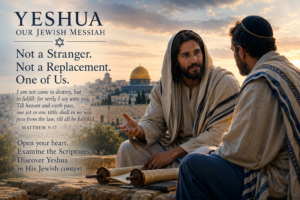
Yeshua was not a European Christian seeking to convert Jews away from Judaism. He was born into the family of Israel, descended from Abraham and David, circumcised on the eighth day, raised in the Torah, present at the Jewish festivals, and devoted to the God of Israel. His first followers were Jews. His Scriptures were Jewish. His teachings were spoken within Jewish debates, and the New Testament begins by establishing his Jewish lineage.
None of this requires us to ignore the terrible suffering inflicted upon Jews by people who claimed his name. That history must never be minimized. But the sins committed in Yeshua’s name should not prevent us from examining Yeshua himself. The question is not whether Christians have always represented him faithfully. Clearly, many have not. The deeper question is whether this Jewish teacher from Galilee—the son of David whose followers believe will return to Jerusalem as Messiah and Judge of the nations—deserves to be reconsidered within the Jewish story from which he came.
After defending the right of Jews to be recognized as the authentic descendants of Israel, intellectual honesty asks us to extend the same fairness to Yeshua: to examine him as he was, rather than only through the conduct of those who later misused his name. Perhaps the most Jewish thing we can do is ask questions, examine the Scriptures, wrestle with the evidence, and remain open to where the God of Israel may lead.
Do not judge Yeshua solely by those who persecuted us in his name. Judge him by his life, his words, his Jewish identity, and the Scriptures to which he pointed.
EPILOGUE:
Here is an example of history story that fits right in with what I’ve written about. There are countless others, check out this article:
Saudi Arabia’s Forgotten Jewish History