What Pentecost Might Reveal
By Jonah
DRAFT — WORK IN PROGRESS
Two Stories, One Book, One God
Preface
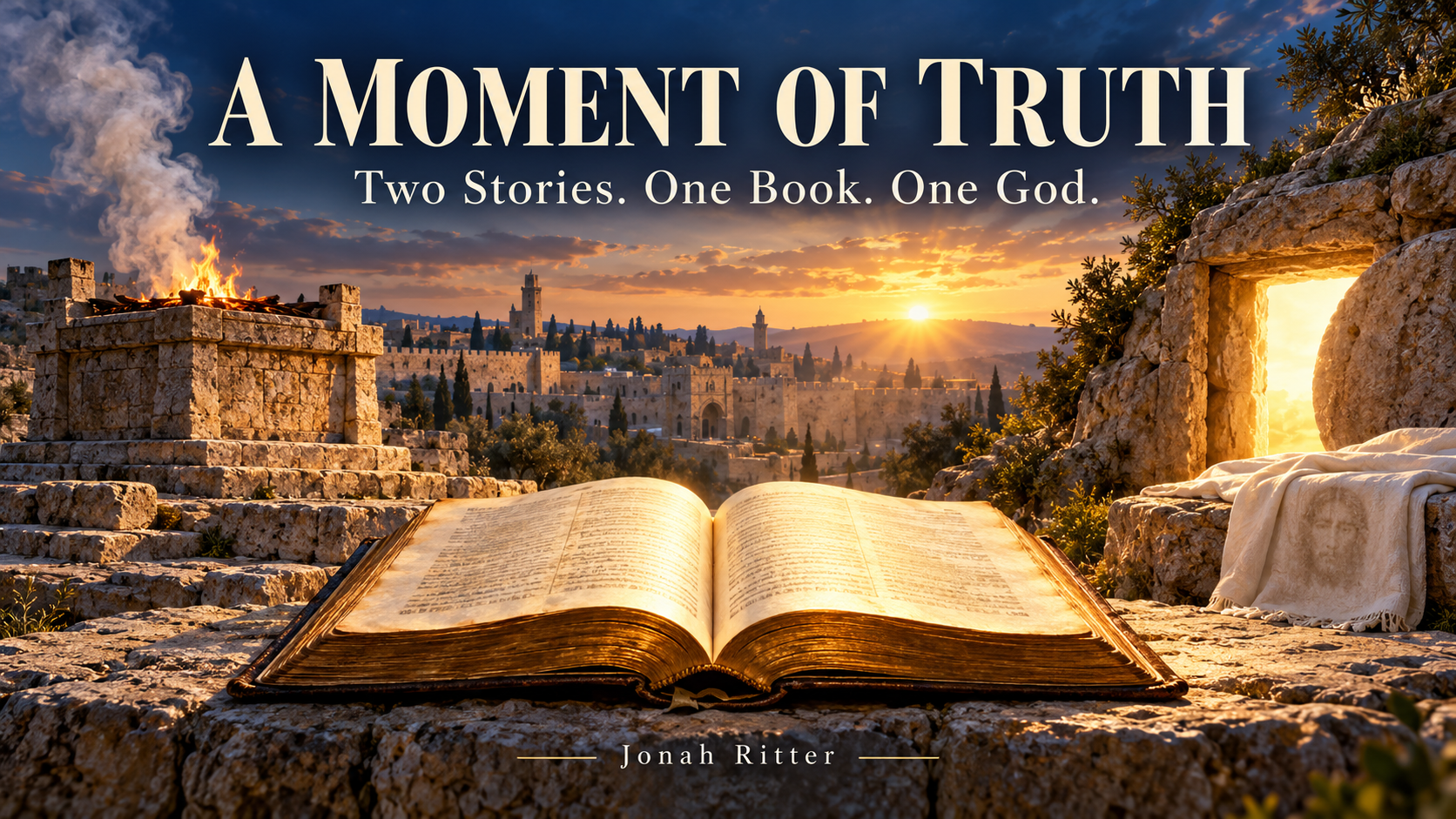
Imagine animal sacrifices beginning again on the Temple Mount: priests attending an altar, blood collected, smoke rising—and the images spreading around the world. Animal-rights advocates could protest fiercely. Many Reform, Conservative, and secular Jews could question whether this represents their faith or its future. Others would celebrate it as sacred restoration. Christians would confront the question of what these offerings mean in light of Yeshua’s sacrifice. The debate could reach hundreds of millions of people, including many who have never seriously considered biblical atonement. A ceremony in Jerusalem could become a worldwide confrontation with questions of sacrifice, forgiveness, and Messiah. That is why I see its beginning as a potential moment of truth: the images would demand attention, even from people who had never opened the passages.
In my blog post “A Moment of Truth,” I explored the question that renewed sacrifices would place before us: What do we believe about Yeshua and the atonement He accomplished?
When the sacrifices begin again on the Temple Mount in Jerusalem, Jews will be confronted with questions concerning the meaning of the scriptures and Israel’s Messiah. This sister article approaches this topic in the context of Acts 5 in the New Testament bible.
I see a prophetic pattern—earlier stories that illuminate a confrontation still to come.
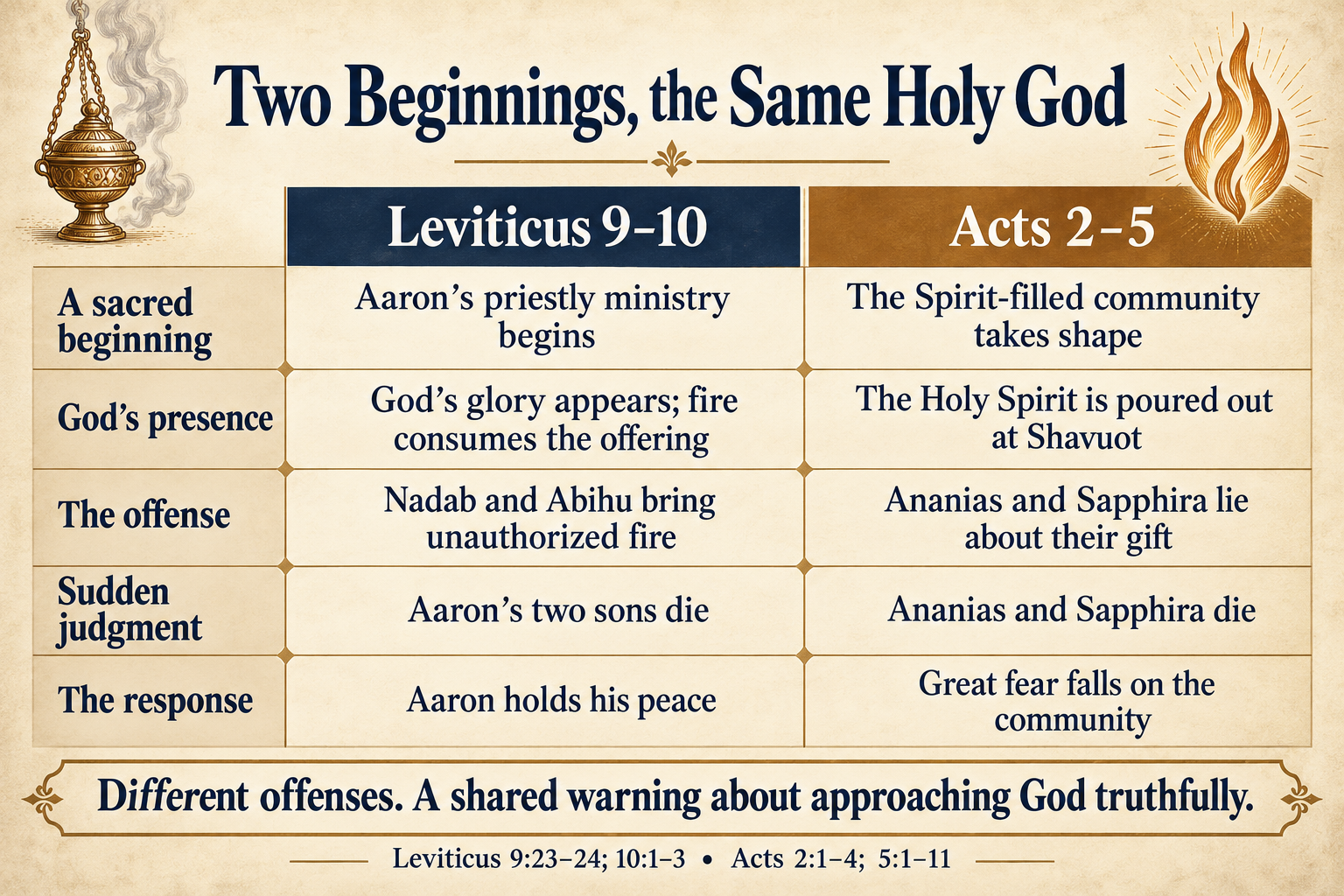
I have drawn a parallel between two sacred beginnings: one in the Torah and the other in the New Testament. In the Torah we read of the inauguration of Aaron’s priestly ministry. In the latter, there is the formation of the Spirit-filled community in Acts on Pentecost. In both stories, God makes His presence known. In both an act that dishonors Him meets sudden very harsh judgment. That comparison is the foundation of this article. From there, I explore what it might teach us about discerning renewed sacrifices and future claims of divine authority.
Two Beginnings and the Same Holy God
The accounts of Aaron’s sons in Leviticus 10 and the story of Ananias and Sapphira in the book of Acts chapter 5 came into focus together. What had seemed like two startling accounts of severe judgment became a window into the continuity of God’s holiness.
The deaths of Aaron’s sons occur at an exceptionally significant moment. After seven days of ordination, Aaron begins his priestly ministry on the eighth day (Leviticus 8:33–35; 9:1). The prescribed offerings are presented. God’s glory appears, and fire from before the LORD consumes the sacrifice. The people shout and fall facedown (Lev 9:23–24). The shout is commonly understood as a cry of joy or praise at God’s revealed glory, followed by reverence.
Then Aaron’s sons Nadab and Abihu bring fire and incense that God had not commanded. Fire from before the LORD consumes them (Lev 10:1–2). Acceptance and judgment stand side by side. It feels harsh because it is harsh: a father loses two sons at the inauguration of the priestly ministry.
There is no permanent Temple yet. There is the Tabernacle that was constructed during the Exodus, with its courtyard altar and its sanctuary. The judgment does not depend on a monumental building. It concerns how people approach the God whose presence has been revealed.
A New Testament Parallel
Acts 5 unfolds in the community formed after Pentecost—the Jewish pilgrimage festival of Shavuot—when the Holy Spirit was poured out in Acts 2. A community proclaiming Yeshua’s resurrection and identifying Him as Israel’s Messiah takes shape.
As with Aaron’s sons, a shocking judgment follows near this sacred beginning. Ananias and Sapphira misrepresent a gift and die suddenly. Great fear falls upon the community (Acts 5:1–11).
The offenses differ: unauthorized fire in Leviticus, deception against the Holy Spirit in Acts. Yet both stories place sudden and severe judgment near a beginning marked by God’s presence. His gracious nearness does not make His holiness less serious.
I checked for precedent and found three credible commentaries recognizing this same parallel. That supports the foundation of my inquiry; its application to renewed sacrifices and future claims of divine authority is the further connection I am exploring.
Testimony on stone and testimony through the Spirit
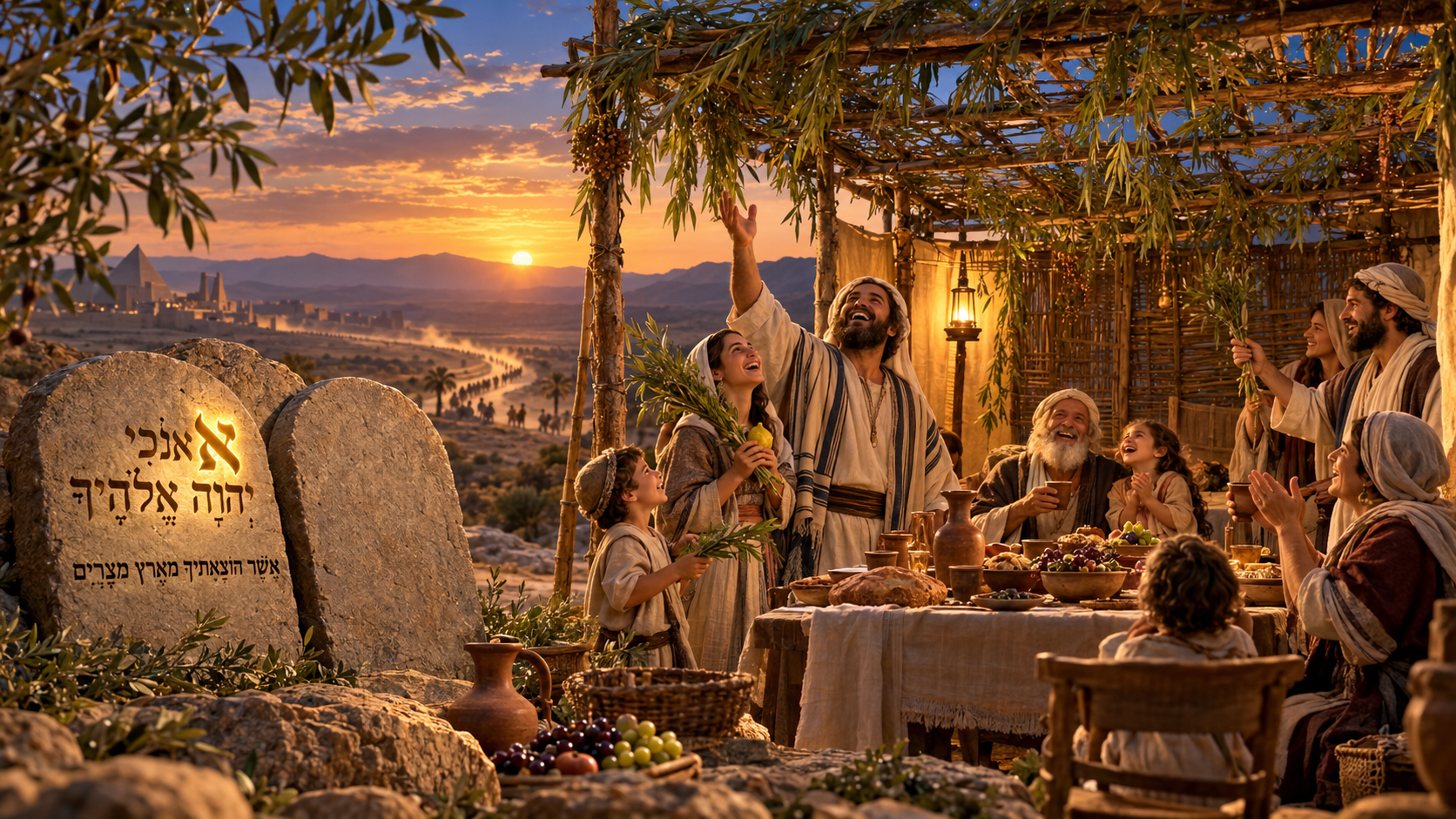
Inside the Ark were the tablets of the testimony, written with the finger of God (Exodus 25:16; 31:18). God’s instruction bore witness to His covenant with Israel.
Acts 5 does not describe the Ark. It does identify the Holy Spirit as a witness. The apostle Peter declares that the apostles testify to what God has done through Yeshua, and so does the Holy Spirit (Acts 5:30–32).
The apostle Paul supplies an explicit bridge: a letter written by the Spirit of the living God, not on tablets of stone but on human hearts (2 Corinthians 3:3). Jeremiah speaks of God’s Torah written on the heart; Ezekiel promises a new heart and God’s Spirit within His people (Jeremiah 31:31–33; Ezekiel 36:26–27).
The continuity matters. It is the God of Israel making Himself known. The arrival of His Spirit calls for the truthfulness and reverence His presence has always required.
Before the confrontation, a harvest
Acts 5 grows out of what happened at Shavuot in Acts 2. Pentecost is the Greek name associated with this Jewish festival, the Feast of Weeks. Jews from many lands were in Jerusalem for the pilgrimage of Shavuot when the Holy Spirit was poured out.
The Jewish holiday of Shavuot celebrates the wheat harvest and its firstfruits. Leviticus 23:17 commands two loaves made from fine flour and explicitly baked with leaven. They are presented before the LORD as part of the festival’s offering. Notice the striking contrast with the twelve unleavened loaves of showbread, the Bread of the Presence, kept in the sanctuary according to Jewish tradition.
Consider the movement between the festivals. Passover brings the lamb, deliverance, and unleavened bread. Shavuot brings the firstfruits of a harvest. Deliverance leads toward a gathering offered before God.
The contrast invites reflection. God commands the removal of leaven at one festival and its inclusion in the offering at another.
The harvest connection is also striking. In Leviticus, Shavuot brings the firstfruits of the wheat harvest before God: two loaves presented as “the firstfruits unto the LORD” (Leviticus 23:17). On that same festival in Acts, about three thousand people receive Peter’s message and are baptized (Acts 2:41). By Acts 5:14, multitudes of men and women are being added to the Lord. I see a spiritual echo of the agricultural offering: the first gathering anticipates a greater harvest.
What Leviticus pictures through grain, Acts brings into focus through people. The account describes a gathering of people responding to the risen Messiah. Firstfruits suggest a beginning with more to come. James uses that language for those brought forth through the word of truth (James 1:18).
Satan appears at the beginning
Acts 5 opens with a disturbing event inside the believing community. Ananias and Sapphira sell property, retain some of the proceeds, and misrepresent their gift. Peter makes clear that keeping the property or some of its price was within their freedom (Acts 5:4). The offense is the lie.
“Why hath Satan filled thine heart to lie to the Holy Ghost?” Peter asks (Acts 5:3).
Here is the first warning: deception can enter a community experiencing God’s power. It can dress itself in the appearance of devotion.
That matters to the future pattern I see. A sacred setting does not authenticate every claim made within it. The presence of an altar, an offering, or a religious title cannot replace discernment.
A partial price and a complete offering
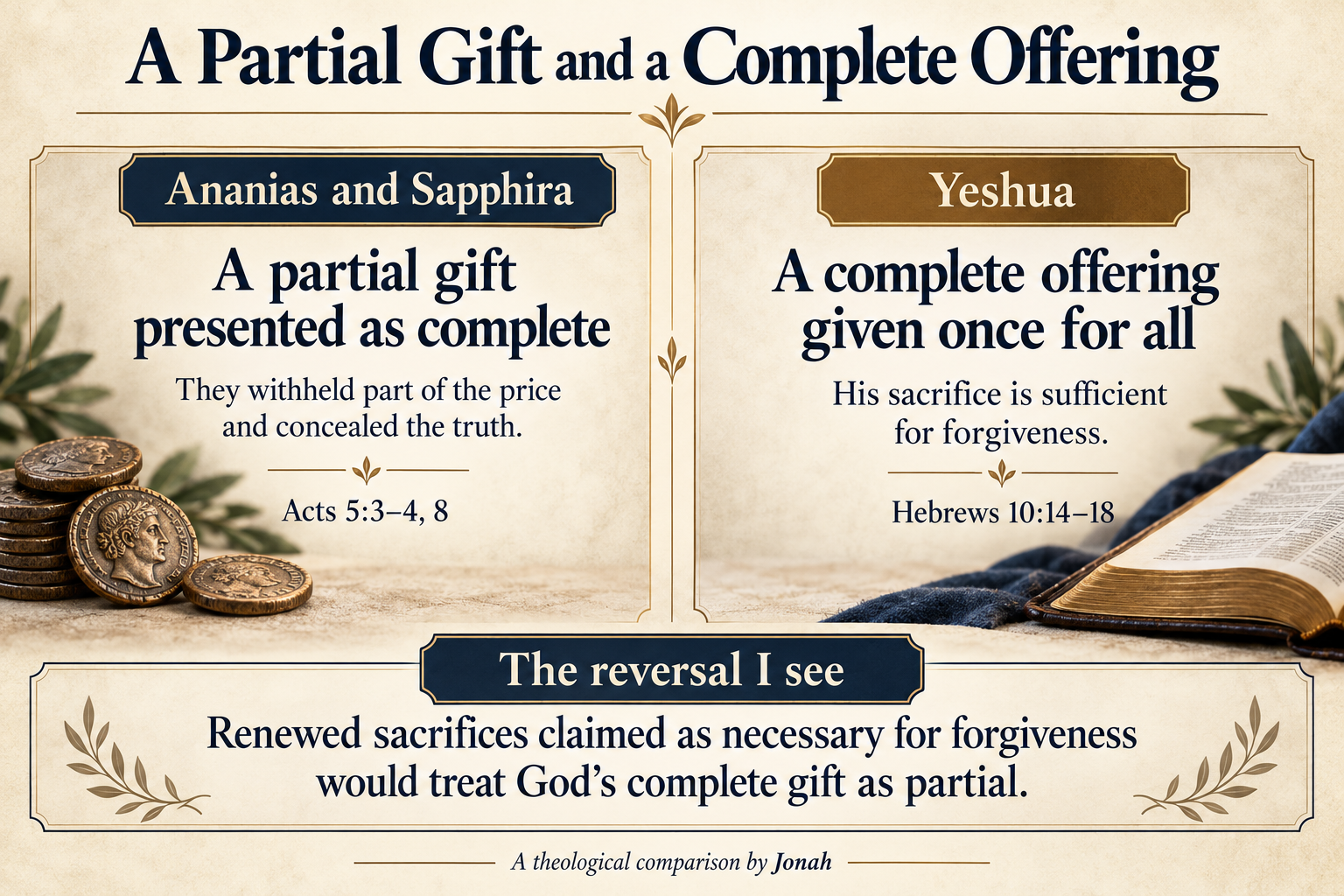
Ananias and Sapphira sold land. That word reminds me of God’s covenant promises to Abraham, Isaac, and Jacob (Genesis 15:18; 26:3; 28:13). Luke does not explain their property as a symbol of that covenant, so I offer this as a thematic association. For me, land recalls the faithfulness of the God who made the covenant, while their deception raises the question running through both stories: are we responding truthfully to the God whose promises we profess to trust? The land promise and the Messiah’s atoning sacrifice must retain their distinct meanings.
The price of their property supplies a closer connection. They retained part while presenting their gift as the whole. Peter says the property was theirs and the proceeds remained under their control. God had not demanded that they surrender every coin. Their sin was the lie (Acts 5:3–4, 8).
Yeshua, however, gave Himself fully. Hebrews describes one offering sufficient to accomplish what repeated sacrifices could not: “For by one offering he hath perfected for ever them that are sanctified” (Hebrews 10:14, KJV). Then comes the conclusion: where forgiveness has been granted, “there is no more offering for sin” (10:18).
Here is the reversal I see. Ananias and Sapphira represented a partial gift as complete. Sacrifices offered as necessary to secure forgiveness after Yeshua’s completed offering would treat God’s complete gift as partial.
This is an interpretive connection, but it brings the question of sufficiency into focus. Has God given enough? Do we trust what He has provided?
What the mouth confesses
Sapphira’s spoken declaration confirms the deception. Asked whether the land sold for the stated amount, she says yes (Acts 5:8). Her words conceal what she knows.
Romans 10:9–10 joins confession with belief: acknowledge Yeshua as Lord with the mouth and believe in the heart that God raised Him from the dead. Yeshua also speaks of acknowledging Him before others (Matthew 10:32).
The contrast concerns the integrity of our response. Does our declaration express the truth of our heart? Religious gestures can appear generous while hiding a reservation. When renewed sacrifices at the future Temple location bring the question of atonement before us, our actions will give meaning to what our mouths confess.
Open doors and the words of life
In the book of Acts, the high priest and his associates become jealous and imprison the apostles. During the night, an angel opens the doors and tells them to stand in the Temple and proclaim “all the words of this life” (Acts 5:20).
Their freedom has a purpose. They return to the place where opposition awaits them and continue their testimony.
The opened prison doors also provide a picture of spiritual release. Later in the same chapter, Peter declares that God exalted Yeshua to give repentance to Israel and forgiveness of sins (Acts 5:31).
The physical rescue and the proclamation of forgiveness belong to the same story. God releases His messengers to announce the life found in His Messiah.
The Temple raised in three days
Earlier, Yeshua had said, “Destroy this temple, and in three days I will raise it up” (John 2:19). John explains that He was speaking about the temple of His body. After His resurrection, His disciples remembered and understood (John 2:21–22).
Now the apostles stand before the authorities declaring that the God of their fathers raised the Yeshua whom those authorities had killed (Acts 5:30).
The claim challenges their judgment. The One they condemned is the One God vindicated. Peter’s message also offers Israel repentance and forgiveness. Even in this confrontation, the door to mercy remains open.
Yet the council responds with anger. Acts does not identify the earlier Temple saying as the cause of that anger. It does show the collision between their demand for silence and the apostles’ obligation to testify.
“We ought to obey God rather than men” (Acts 5:29).
A warning From Inside the Story
“Lest haply ye be found even to fight against God.”
Those are Gamaliel’s words in Acts 5:39. A respected teacher of the Torah spoke them to a council deciding what to do with men proclaiming Yeshua’s resurrection.
The warning deserves our attention. People can believe they are protecting their faith and still fail to recognize what God is doing. Familiar institutions, religious authority, and sincere conviction do not make that danger disappear.
When sacrifices begin again, I believe that warning will acquire a renewed urgency. An altar can be restored. Offerings can be presented. But what will those standing before it believe about the One whom God raised from the dead? That is the “moment of truth” I wrote about on my blog.
Aaron held his peace
Moses does not intercede to prevent the deaths of Aaron’s sons in the account. Afterward, he speaks of God being sanctified among those who approach Him and glorified before the people. “And Aaron held his peace” (Leviticus 10:3, KJV).
The phrase means Aaron was silent. We cannot claim to know whether that silence expressed shock, grief, submission, or all three. Nor does the text say that he or Moses foresaw Acts 5. But his restraint invites comparison with Gamaliel’s counsel: “Refrain from these men, and let them alone” (Acts 5:38).
Aaron holds back before judgment already given. Gamaliel urges the council to hold back lest it oppose God’s work. The situations differ, but both confront human authority with its limits. The high priest in Acts 5 seeks to silence the witnesses; Gamaliel recognizes the danger of interference.
Unauthorized fire and the Spirit of grace
Aaron’s sons brought something God had not commanded. That makes “unauthorized fire” a searching image for renewed sacrifices offered to obtain forgiveness that Yeshua has already secured.
Would such offerings honor God, or presume to supplement His sufficient gift? The purpose attributed to the sacrifices is essential here.
The question to be considered concerns sacrifices claimed as necessary for atonement. Christians differ over how to interpret future sacrificial passages, including Ezekiel 40–48; those passages deserve their own careful examination.
Hebrews 10:29 connects contempt for the Son, dishonoring covenant blood, and insulting the Spirit of grace. Acts 2:33 describes the exalted Yeshua receiving the promised Spirit from the Father and pouring Him out. The Spirit is God’s promised gift through the risen Messiah, not a payment exchanged for His death.
That gives my concern its strongest wording: would a return to sacrifices for forgiveness deny the sufficiency of the Son’s offering and insult the Spirit of grace?
I distinguish that question from the specific blasphemy against the Holy Spirit described in Mark 3:22–30, where Yeshua’s work is attributed to an unclean spirit. Scripture does not expressly classify restarted sacrifices as that same offense.
When the sacrifices begin
This is where I see Acts 5 reaching forward.
The restoration of sacrifices also carries messianic significance within traditional Judaism. Maimonides describes the coming Messiah as rebuilding the Temple, gathering Israel’s dispersed people, and restoring sacrificial worship (Mishneh Torah, Laws of Kings and Wars 11:1). This helps explain why renewed sacrifices could awaken profound hopes of redemption. Their resumption alone would not establish that Messiah had arrived, but it would bring competing expectations into sharper focus: are we awaiting the fulfillment of atonement, or recognizing what Yeshua has already accomplished?
I see the restart of sacrifices as the beginning of a runway toward a greater Temple confrontation. This is my reading of the prophetic pattern, rather than a timetable explicitly supplied by Acts 5.
If sacrifices begin again, many will celebrate their return as obedience and restoration. But sacrifices presented as necessary for forgiveness would make a public claim that atonement still requires animal blood—a claim that confronts Hebrews’ declaration that there is “no more offering for sin” after forgiveness has been accomplished (Hebrews 10:18). Their prophetic significance also deserves attention because Daniel 9:27 describes sacrifice and offering being stopped in connection with desolation. Their cessation presupposes their practice. Restarting sacrifices would therefore give concrete expression to the question explored here: what has God accomplished through Yeshua, and have we recognized it?
Revelation 11 opens with the temple, the altar, and the worshipers. It then introduces two witnesses who prophesy for 1,260 days (Revelation 11:1–3). Their testimony is opposed, and their story culminates in death, restored life, and vindication before their enemies (11:7–12).
Could their testimony confront people at the very moment renewed worship raises the question of Messiah and atonement? I believe the connection deserves examination. Revelation does not explicitly say they arrive on the day sacrifices restart, or give us a full account of their message.
The larger danger appears in 2 Thessalonians 2:3–4: the man of lawlessness takes his place in the temple of God, presenting himself as God. Verse 9 associates his coming with Satan’s activity and deceptive signs.
The progression is sobering: religious expectation can become the setting for counterfeit authority. Acts 5 has already taught us to watch for deception within sacred surroundings.
Testimony and counterfeit authority
These comparisons illuminate recurring themes; they do not establish an identical prophetic sequence.
The fire connection deserves particular attention. Unauthorized fire brings judgment on Aaron’s sons. Fire protects the two witnesses in Revelation 11:5. In Revelation 13:13–14, a deceptive sign of fire from heaven helps persuade people to honor the beast. A spectacular manifestation alone cannot settle whose authority stands behind it.
There is also a contrast involving two people and the Spirit. Ananias and Sapphira die after agreeing to test the Spirit of the Lord (Acts 5:9). Revelation’s two faithful witnesses receive the breath of life from God and stand again (Revelation 11:11). Deception is judged; faithful testimony is vindicated. I see a meaningful contrast, without identifying the two pairs as direct prophetic counterparts.
The temple claimant who presents himself as God is explicitly described in 2 Thessalonians 2:4. Revelation contributes the related scenes of witnesses, opposition, deceptive signs, and coerced worship. Together they sharpen the question Peter raises: whom will we obey?
A harvest amid opposition
Opposition does not stop the gathering in Acts. The apostles continue teaching, and people continue believing.
That gives me another reason to see a prophetic pattern. Might a future confrontation also become a time of recognition—a gathering of people who understand who Yeshua is? Could such a gathering be connected with what Paul calls “the fulness of the Gentiles,” followed by his declaration that “all Israel shall be saved” (Romans 11:25–26)? Paul does not identify renewed sacrifices or the two witnesses as the occasion. Yet his words invite me to consider whether this moment of decision might also become a moment of extraordinary mercy, as Gentiles are gathered and Israel recognizes her Messiah.
Revelation 7:9–14 describes a great multitude from every nation coming out of the great tribulation. It does not attribute that multitude specifically to the two witnesses. Still, the picture invites us to remember that suffering and opposition do not prevent God from gathering His people.
The first harvest need not be the last.
Whom are we resisting?
Gamaliel did not resolve every question about Yeshua. He warned the council about the consequences of its certainty: if this work was from God, they could not overthrow it.
That warning belongs beside any future altar.
We do not have to stop being Jews to examine the claims of Israel’s Messiah. Peter proclaimed repentance and forgiveness to Israel in the name of the God of their fathers. The question concerns recognition, faith, and what God has done.
Acts 5 holds together deception, deliverance, forgiveness, harvest, and resistance. I see those same matters gathering around a future moment when sacrifices begin again.
Two Stories, One Book, One God.
When Messiah stands before us, one of history’s longest-running debates will finally be settled: is this His first coming—or His return? What will matter then is whether we recognize Him. That is the real moment of truth.
Before we decide that we are defending God, we must ask whether we have recognized His work.