A note to the reader: This article is a theological reflection inspired in part by The Chosen. The series dramatizes the Scriptures. Thus there are moments, conversations and reactions that are depictions. By the same token, my observations in this article are grounded in the actual chapters from Isaiah.
Two Stories, One Book, One God: The Scroll and the Prisoner
The arcs between the Old Testament and the New Testament hold the two stories together. Continuing in this theme — two stories, one book, one God — here is a clear arc showing that same continuity: two moments, one in the Old Testament as prophecy and one in the New Testament as its fulfillment. What is not said in the New Testament by Jesus cuts to the heart of a fundamental difference in the perception of the Messiah between Jews and Christians. The Chosen powerfully dramatizes the actual verses from Isaiah in the scriptures where Jesus stopped short of completing.
Again, The Chosen is a dramatization, but the observations in this piece are drawn from the actual scripture, not the show’s creative liberties.
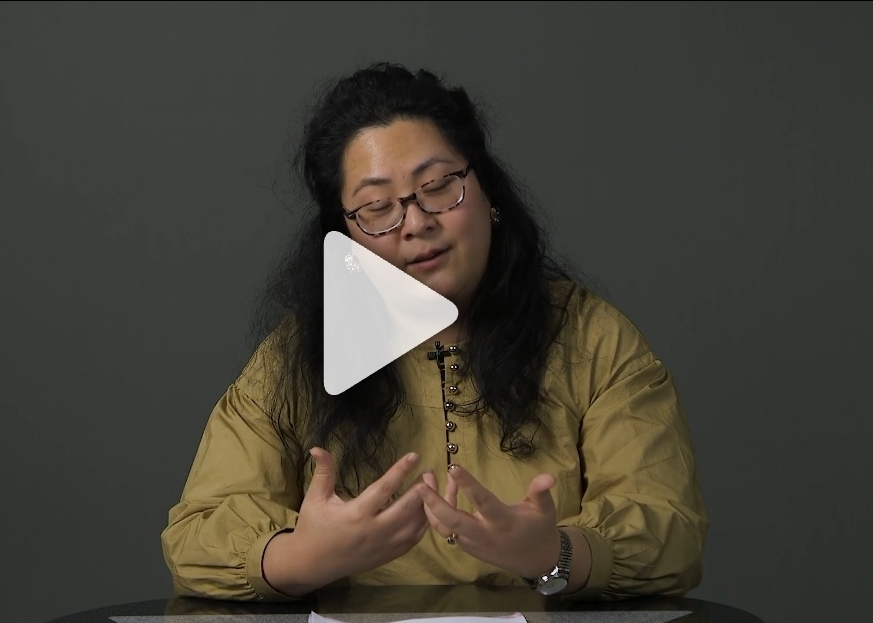
This scene from The Chosen dramatizes a defining moment in the story of Jesus when the Old Testament prophet Isaiah’s words are read by the very one he spoke of.
You can practically feel the tension in the weight of the moment. It’s worth watching first, because my article speaks to what happens in this scene as well as another episode of the Chosen when Jesus is asked by John the Baptist’s messengers if he is the Messiah. These exact moments are depicted in the Chosen series about the life of Jesus.
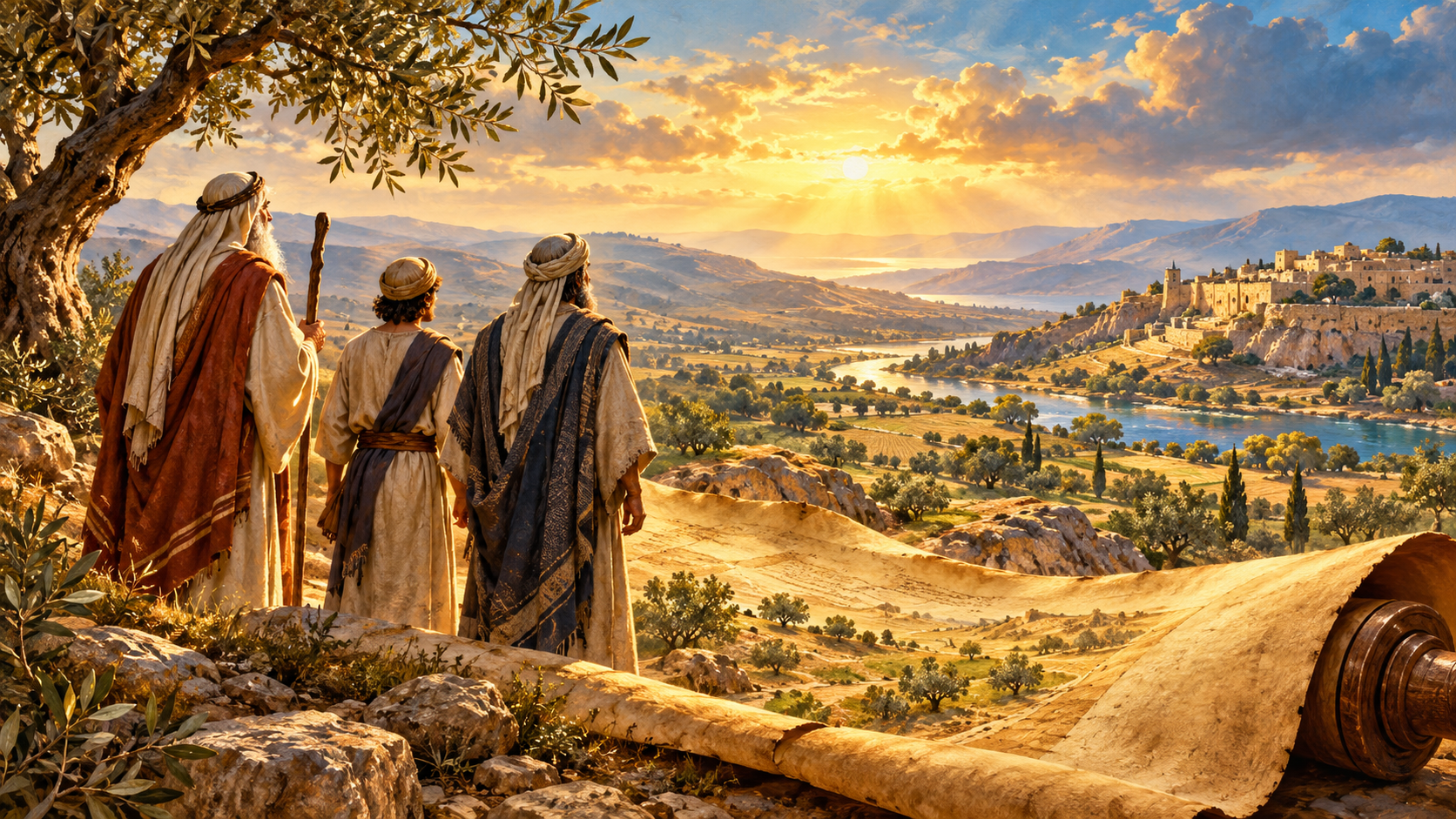
Yeshua is home in Nazareth, standing up in his own synagogue to read from the scroll of Isaiah. His hometown crowd is watching a man they’d known his whole life, hearing him read a centuries-old promise of a coming deliverer and then calmly declare that the promise in the Scriptures is being fulfilled right in front of them, in him.
What The Chosen presents especially well in the scene above is the image of an imagined rabbi listening closely enough to notice the exact place where Jesus starts and stops reading Isaiah chapter 61. The show dramatizes the rabbi’s reaction when he realizes that Jesus has left out “the day of vengeance.” The exchange draws attention to a textual detail that carries enormous theological weight.
“Day of vengeance” is a phrase Isaiah uses only three times in the entire book: once describing the destruction of Edom for its violence against Zion (Isaiah 34:8), once in the terrifying image of the Lord alone treading a winepress of judgment, garments stained with blood (Isaiah 63:4), and once inside the very verse Jesus is reading, promising “the year of the LORD’s favor, and the day of vengeance of our God” together, in the same breath (Isaiah 61:2). Jesus reads up to “favor” and stops. Of the three times Isaiah names that day, this was the one moment it was handed directly to the Messiah to proclaim — and he leaves it out.
A Longer and Deeper Arc
“The day of vengeance” wasn’t an abstract or minor phrase to a first-century Jewish audience. The phrase echoes all the way back to Leviticus 25:10 and the “Jubilee.” It is tied to some of Isaiah’s most vivid images of God personally, violently settling scores with Israel’s oppressors. According to Leviticus 25:8-11, the Year of Jubilee occurs after seven cycles of seven years (7 × 7 = 49), making the 50th year as the sacred Jubilee.
(The Year of Jubilee is a special time described in the Bible when slaves and prisoners go free, debts are forgiven, and land goes back to its original owners.)
Interestingly, Jesus never uses the actual word “Jubilee.” In fact, the specific word “Jubilee” (from the Hebrew יּוֹבֵל yovel) does not appear anywhere in the New Testament. The Jubilee year (Yovel) is directly tied to a sequence of seven Shmita (sabbatical) cycles, occurring as the special year that follows seven sets of seven years (49 years total), making it the 50th year.
Even though Jubilee (50) is never specifically named in the New Testament, Jesus communicates the concept using different phrasing and translations.
In Jewish mysticism and the commentary of the Sages, the gap between the gematria of Yovel (48) and its calendar value (50) is considered an intentional “divine hint” rather than a coincidence. (See my Epilogue for further explanation.)
Luke wrote the script
It is as though the Apostle Luke wrote the script for the Chosen scene and Isaiah provided the story. Jesus is handed the scroll of Isaiah and reads:
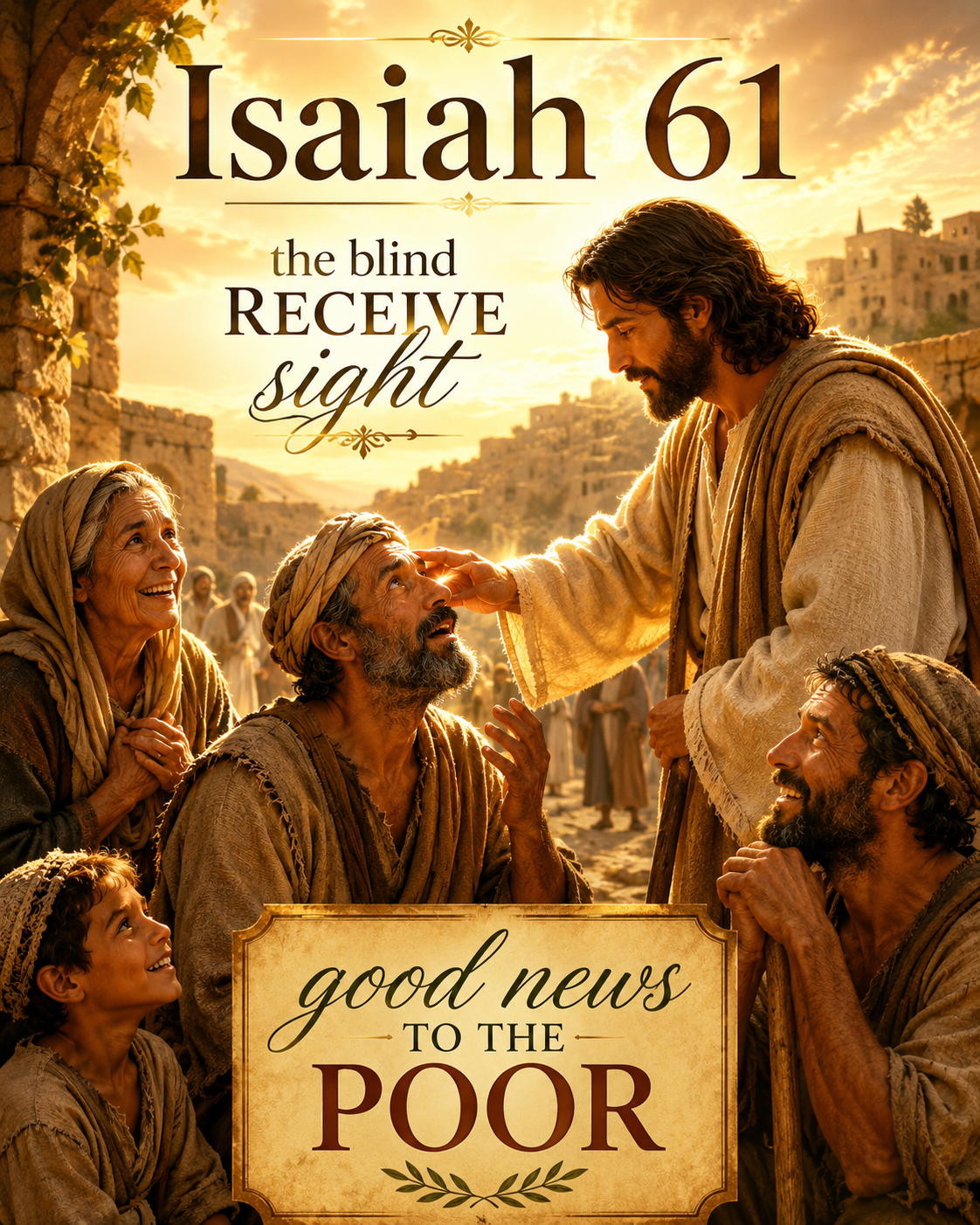
“The Spirit of the Lord is on me, because he has anointed me to proclaim good news to the poor. He has sent me to proclaim freedom for the prisoners and recovery of sight for the blind, to set the oppressed free, to proclaim the year of the Lord’s favor” (Isaiah 61:1–2, blended with a line from Isaiah 58:6).
Jesus rolls up the scroll, hands it back, and says the line that detonates the whole scene:
“Today this scripture is fulfilled in your hearing” (Luke 4:16–21).
That is a claim of identity made in the synagogue, in his own town, among people who watched him grow up — and it is, at its root, are Old Testament words being spoken as a New Testament fact.
The second scene is private and desperate.
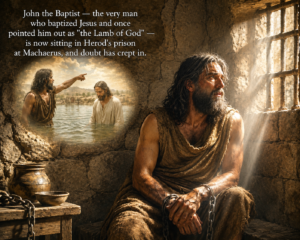
John the Baptist — the very man who baptized Jesus and once pointed him out as “the Lamb of God” — is now sitting in captivity in Herod’s prison at Machaerus, and doubt has crept in. He sends two disciples with a question that echoes the scene in Nazareth. John the Baptizer asks:
“Are you the one who is to come, or should we expect someone else?” (Matthew 11:2–3).
Jesus doesn’t answer yes or no. He tells them:
“Jesus answered and said to them, “Go and tell John the things you have seen and heard: that the blind see, the lame walk, the lepers are cleansed, the deaf hear, the dead are raised, the poor have the gospel preached to them. And blessed is he who is not offended because of Me.” (Luke 7:22–23 NKJ).
The overlap is real — “the blind receive sight” and “good news to the poor” are lifted almost verbatim from the very Isaiah 61 passage he read aloud at Nazareth. But the answer to John is not a rerun. It’s a new composite, pulling in language Isaiah used elsewhere — “the lame walk,” “the deaf hear,” even “the dead are raised” — echoing Isaiah 35:5–6 and, some argue, Isaiah 26:19. Jesus is not quoting a text; he is fulfilling a whole prophetic tradition and letting the fulfillment speak for itself. It is the same single story, told twice, once as promise and once as proof.
A key distinction
Here is the detail worth sitting with: the one line from the Nazareth reading that Jesus pointedly does not repeat to John is “proclaim freedom for the prisoners.” John is, at that exact moment, a prisoner. If ever there were an occasion to invoke that phrase, this was it — and yet, Jesus lets it pass unspoken. He does not promise John an earthly deliverance from Herod’s dungeon. He offers instead a beatitude that reads almost like a gentle warning to John to not lose faith:
“blessed is anyone who does not stumble on account of me.” (Matthew 11:6/Luke 7:23, NIV)
Its as if Jesus is telling John, through his own messengers, that the “year of the Lord’s favor” he announced in Nazareth is real and present — sight is being restored, the poor are hearing good news — but it is not going to look like the total, immediate reversal of every injustice, including his own. The prisoner is not released. The prophecy is fulfilled in a different register than the reader might expect.
That’s the theological hinge of the whole arc:
Isaiah’s words function as one unbroken current running from a synagogue reading to a prison cell, but the fulfillment resists a literal one-to-one mapping. In Nazareth, Jesus announces the prophecy fulfilled to people who have every earthly comfort of home and familiarity. In the prison exchange, he answers with the same prophecy to a man in chains — and the very phrase about freed prisoners goes quietly missing. It’s less a repetition than a refinement: the Messiah Isaiah promised is present and active, but the “favor” he proclaims is not, in the end, a straightforward political or physical liberation.
John, greatest of the prophets by Jesus’s own words just verses later (Matthew 11:11), will not walk out of that prison. He will be beheaded in it. And yet Jesus calls him blessed for not stumbling over exactly that gap between expectation and fulfillment — which may be the real message threading Isaiah’s ancient words through both scenes.
Two readings of Isaiah, separated by a synagogue and a prison wall, and what stands between them is the whole distance between a promise and its fulfillment — two stories, one book, one God.
Expectations
To a Jewish audience, “the year of the Lord’s favor” and “the day of vengeance” weren’t two separate events; in the Hebrew prophetic imagination they were two halves of one single, imminent act of God — deliverance for Israel arriving in the same breath as judgment on her oppressors. The traditional Jewish sense is that Messiah will be one coming bringing justice and peace together at the same time. When the rabbi in the Chosen scene realizes Jesus has stopped short of quoting Isaiah’s words on vengeance, his reaction is the reaction of someone watching a unified expectation come apart in real time. Jesus’s answer to that realization — that vengeance and judgment belong to a future he fractures Jewish expectations. He announces “today this scripture is fulfilled in your hearing,” and then declines to fulfill all of it. He is claiming to be Isaiah’s anointed one while quietly redrawing the shape of the promise itself, splitting into two what many in that synagogue would naturally have understood as one.
That split is, in a real sense, the seam between Jewish and Christian messianic theology. Jewish tradition, reading Isaiah on its own terms, generally holds to a single, unified coming of the Messiah — one figure, one arrival, bringing national restoration and the judgment of Israel’s enemies together, not staggered across two separate advents. Christian theology, growing directly out of this moment in the Nazareth synagogue, reads Jesus’s pause as the founding of a “two comings” framework: a first coming of grace, atonement, and favor, and a second, still-awaited coming of judgment and vengeance. It’s not a peripheral disagreement — it’s arguably the central doctrinal fork between the two traditions, and Jesus plants it, wordlessly, by simply declining to read half a sentence.
It’s worth asking why a man who once recognized Jesus as Messiah would waver. If John, like his contemporaries, was still expecting the single, unified coming — deliverance and vengeance together, Rome judged, the righteous vindicated, himself included — then Jesus’s ministry so far would look, to him, like only half the promise. The blind see, the lame walk, the poor hear good news — but no vengeance has fallen on Herod, and John is still in chains about to lose his head.
Blessed are they that have not seen, and yet have believed.
John the Baptist didn’t need to see the resurection to believe.
Perhaps John understood what Jesus meant when his disciples brought the response back to him. Perhaps he did not stumble over the unexpected form that fulfillment had taken. John may have grasped that, even while he remained behind iron bars, a deeper captivity—the captivity of sin—was already being confronted.”
This reminds me of the apostles Peter and John understanding when they saw the empty tomb with the linen wrappings still lying in their folded shape, undisturbed, as described in the Gospel of John chapter 20.
The true captivity that was being undone in front of John the Baptist, the prophet who had proclaimed freedom himself at the Jordan, while he was behind iron prison bars, was sin. The irony is stunning.
Epilogue:
The gematria (numerical vale) of יּוֹבֵל yovel is 48 whereas its calendar value is 50. This is considered an intentional “divine hint” rather than a coincidence. The Sages and Mystics provide three distinct reasons for why the word does not equal 50:
The first one is the human limit:
In Jewish theology, the number 50 represents the Nun Sha’arei Binah (The 50 Gates of Understanding), which is the ultimate level of divine wisdom. The Sages teach that no human being can fully master all 50 gates on their own. It is said Reaching Only the 48th Level
Moses, the greatest of the prophets, only managed to ascend to the 49th gate through human effort.
The Sages’ Limit: The Torah Sages can reach the 48th gate through rigorous study. Because Yovel equals 48, it hints that the Jubilee’s deepest secrets can be partially understood by human wisdom, but the final 50th gate is entirely a supernatural gift from God.
There are two other reasons Yovel (Jubilee) has a numerical value of 48, rather than 50. One is based on Halakhic Law concerning a legal way to count the calendar years. The third correlates it to the “48 Cities of the Levites.”
But whichever way you look at it, it doesn’t add up to true Pentecost (50). As I see it, the gap is a “divine hint.”
Perhaps there are clues in verses (situations) when Jesus uses the #50. Here are verses where Jesus directly uses the number 50:
- Mark 6:40 — In the feeding of the five thousand, Jesus has the crowd “sit down in groups, by hundreds and by fifties.”
- Luke 9:14 — The parallel account of the same miracle: “Have them sit down in groups of about fifty each.”
- Luke 7:41 — The parable of the two debtors: “A certain moneylender had two debtors. One owed five hundred denarii, and the other fifty.”
- Luke 16:6 — The parable of the dishonest manager: a debtor owes “a hundred measures of oil,” and is told to “sit down quickly and write fifty.”
- John 8:57 — The Jews say to Jesus, “You are not yet fifty years old, and have you seen Abraham?”
- Acts 19:19 — After new believers in Ephesus burn their books of magic, the value of what was destroyed “came to fifty thousand pieces of silver.”
The trumpet is the same trumpet
Scholars widely connect both of these debt-forgiveness parables to the Jubilee.
The Jubilee is proclaimed by a specific ritual act: “You shall sound the trumpet abroad on the tenth day of the seventh month; on the Day of Atonement you shall sound the trumpet throughout all your land” (Leviticus 25:9). That day, Yom Kippur, is the single most solemn day of judgment in the Hebrew calendar — the day Israel’s sins were atoned for or exposed. The Jubilee doesn’t begin on a random date; it begins on the day of judgment itself. Scholars call this “no accident”.
Pairing of the Jubilee release with the Day of Atonement… the physical release from debt and slavery is paralleled by a greater spiritual release from the debt and slavery of sin”. Do you think John the Baptist made this connection from his prison cell?
What Jesus Said About John, After the Messengers Left
As John’s messengers turned to leave, carrying his answer back to a prison cell, Jesus didn’t let the moment pass in silence. He turned to the crowd and delivered one of the strongest tributes found anywhere in the Gospels (Matthew 11:7-15; Luke 7:24-28).
I notice he opens by correcting the crowd, not John. “What did you go out into the wilderness to see? A reed swayed by the wind? A man dressed in fine clothes? A prophet? Yes, I tell you, and more than a prophet” (Matthew 11:7-9). He’s making sure John’s momentary question from prison doesn’t get mistaken for weakness in the public’s eyes.
Then he names John outright as the fulfillment of Malachi’s messenger prophecy (Matthew 11:10), and delivers the line I keep coming back to: “Truly I tell you, among those born of women there has not risen anyone greater than John the Baptist; yet whoever is least in the kingdom of heaven is greater than he” (Matthew 11:11; Luke 7:28). He closes by calling John the promised Elijah (Matthew 11:14) and the hinge point of prophecy itself: “For all the Prophets and the Law prophesied until John” (Matthew 11:13).
What strikes me is the timing. John has just sent a question that could read, on the surface, like doubt — “Are you the one who was to come?” And instead of rebuking him, Jesus elevates him higher than anyone born of woman. That’s the same pattern I see running through this whole arc: Jesus protects and reframes John rather than diminishing him, all the way through to the empty tomb, where John’s own “namesake disciple” is the one who “saw the linen cloths lying there… and believed” (John 20:8).
One more thread worth pulling: this same passage carries the grace-now, judgment-later split I keep finding throughout Jesus’s teaching. As one commentator puts it, here “the Kingdom of God had come and was beginning to take hold, and the Day of the LORD was beginning. But these great events would not fully come until the second coming” (Bible.org). Two stories. One book. One God.
The Day of the Lord uses the same trumpet imagery.
Elsewhere in the prophets, that same trumpet motif announces the Day of the Lord specifically as a day of judgment: “Blow the trumpet in Zion… let all the inhabitants of the land tremble, for the day of the LORD is coming” (Joel 2:1), and “the day of the LORD is near… a day of trumpet blast and battle cry” (Zephaniah 1:14–16). One source notes plainly: “the sound of the shofar announces the coming of the Day of the Lord, a time when God intervenes in human affairs to judge the nations” (graceandknowledge.faithweb.com). The New Testament carries the same image into Christ’s return — “he will send his angels with a great sound of a trumpet” (Matthew 24:31), and “the last trumpet” at the resurrection (1 Corinthians 15:52; 1 Thessalonians 4:16). Scholars connect these directly: “the Jubilee horn is blown at Jesus’s Second Coming because the Second Coming ushers in the eschatological Jubilee”.
Isaiah already fused them, in the very verse Jesus reads
This is the piece that ties straight back into my article. Isaiah 61:2 places “the year of the LORD’s favor” (Jubilee) and “the day of vengeance of our God” (Day of the Lord judgment) inside a single sentence, because Isaiah is drawing on the Leviticus 25 pattern where the Jubilee is announced on a day of judgment. The two were never meant to be separated — they were bound together liturgically before Isaiah ever wrote them, and Isaiah’s prophecy simply preserves that bond. Which means when Jesus reads the “favor” half and omits the “vengeance” half at Nazareth, he isn’t just skipping an unrelated clause — he’s pulling apart two things that Israel’s own calendar had always fused into one single day
I should note that I’m not citing specific primary sources for these three explanations — they reflect themes that recur across Kabbalistic and rabbinic teaching on the Jubilee, passed down and taught rather than drawn from one traceable text. Readers interested in the primary sources (Talmud Rosh Hashanah 21b on the fifty gates, and related midrashic material) are encouraged to explore further on their own.