Love & Devotion: Leviticus 1 and the Hebrew Path of Mesirut
As a young Jew, I grew up trying to understand how Leviticus 1 could possibly make sense in a modern world. The Temple had been destroyed. The sacrifices had stopped. There was no altar in Jerusalem upon which these commands could be carried out. How was I supposed to understand a ritual that seemed so primitive and brutal to me?
And yet, even as a child, I could appreciate that this sacred story had sustained my “chosen” nation through centuries of exile, suffering, and return. The rebirth of Israel was still fresh in Jewish memory. I attended religious school during years when Israel was fighting for its very existence. Sixty years later, it still is.
Leviticus was therefore never merely an ancient book to me. It belonged to the story of my people. But Leviticus 1 remained difficult. If the sacrifices had ceased, what enduring truth was I meant to find within them? What could an offering that ascended upon an altar teach me about approaching God now?
I have come to see one answer in the word devotion—a word we often place beside love: Love & Devotion. The pairing is natural because love names the affection of the heart, while devotion gives that love direction, endurance, and form. Love feels; devotion follows. Love draws the heart; devotion entrusts the life.
Love without devotion may remain only a feeling. Devotion without love may become only duty. But holy love and holy devotion belong together. Love says, “You are precious to me.” Devotion answers, “Therefore, I set myself apart for You—my time, my strength, my will, and my life.” Love recognizes His worth; devotion answers by setting apart what we value most—ultimately, the dedication of our own lives.
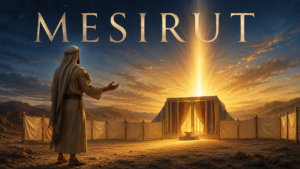
The Hebrew word מְסִירוּת (mesirut) means devotion, dedication, or wholehearted commitment. Its root is מ־ס־ר, meaning “to hand over,” “to entrust,” or “to transmit.” Hebrew devotion is therefore more than emotion, admiration, or religious enthusiasm. Mesirut is love acted upon—the entrusting of one’s life, purpose, and will.
No life is truly without devotion. Each of us gives time, thought, strength, love, and attention to something. We entrust ourselves to ambitions, appetites, relationships, fears, possessions, causes, or comforts. The question is not whether I will be devoted, but to whom or to what I will give my devotion. Without holy devotion, my life does not remain neutral; it becomes devoted to lesser things.
This leads me to a demanding truth: A life without holy devotion is an unholy life.
Seen through this word, Leviticus 1 begins to open. It gives devoted love a visible form through the עֹלָה (olah), the offering that ascends wholly to God. The chapter does not merely tell me to feel something toward God. It traces the movement of devotion: God calls, a person draws near, the hand is placed upon the head, and the offering ascends.
The ancient sacrifice now confronts me with a living question hidden within all true love and devotion: What does it mean for me to entrust myself wholly to God?
The Call
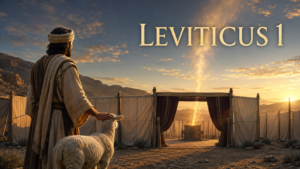 Leviticus begins with one remarkable word: וַיִּקְרָא (Vayikra)—“And He called.”
Holy devotion does not begin with human striving. It begins when God calls and a person responds. Before there is an offering, an altar, or an ascent, there is a Voice. The Holy One invites a person to draw near.
The text continues:
“When a person from among you brings an offering to the LORD…”
The word translated “offering” is קָרְבָּן (korban), from the root ק־ר־ב, meaning “to come near” or “draw close.” The purpose of the korban is not a cold religious transaction. Its movement is nearness. God calls, and the worshiper draws near.
The phrase מִכֶּם (mikem), “from among you” or “from you,” invites a deeper meditation. The worshiper brings something from what belongs to him, but devotion asks an even deeper question: What of myself am I bringing? The offering represents more than property. It represents the person who approaches.
The Hand upon the Head
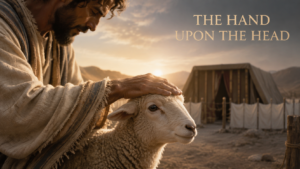 Leviticus 1:4 says that the worshiper places his hand upon the head of the offering:
וְסָמַךְ יָדוֹ עַל רֹאשׁ
Vesamakh yado al rosh
“He shall lay his hand upon the head.”
This is a gesture of identification and entrusting. The offering is not sent forward impersonally. The worshiper draws near, reaches out, and places his own hand upon its head.
Here the Hebrew letters of מְסִירוּת offer a striking path for meditation. Within the word, י (Yod), traditionally associated with the hand, stands immediately before ר (Resh), associated with the head:
מְסִי־רוּת — י־ר — hand and head
The word’s actual meaning comes from its language and root; the letter images do not replace that meaning. Yet because the Hebrew letters are holy vessels of the words of Scripture, their shapes, names, sounds, and values can help us meditate upon the meaning already present. In Leviticus 1, the symbolic picture within the letters becomes an action: the יָד (yad), the hand, is placed upon the רֹאשׁ (rosh), the head.
The hand represents action, strength, and what one does. The head represents thought, direction, authority, and will. Holy devotion brings both to God. It places our actions and our intentions, our strength and our direction, into His hands.
“One life that soon has passed, only what is done with love will last.”
Sixty years later, I am still that young Jewish boy trying to understand Leviticus 1. What once seemed to me only primitive and brutal has begun to reveal a holy invitation: not merely to bring something to God, but to entrust myself wholly to Him. The Temple is gone and the sacrifices have ceased, yet the call to Love & Devotion remains. In the Epilogue, I will follow that call deeper into the Hebrew word מְסִירוּת (mesirut)—through its root, its holy letters, its numbers, the hand, the door, David, and the quiet hint of the line of Messiah.
One moment please: I see a connection.
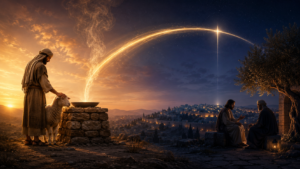 I hear an echo of Leviticus 1 in John 3. In the Gospel of John (3.16), Yeshua says to Nicodemus at night, “For God so loved the world that He gave His only Son…” And immediately before John 3:16, Yeshua speaks of the Son of Man being “lifted up.”
“So loved.” “Given.” “Lifted up.” “Nothing withheld.” I am simply placing the stories beside one another and making an observation. There seems to be an arc connecting them: Two stories. One Book. One God.
Do you see what I see?
Epilogue:
The central reflection is complete. What follows is an optional meditation for readers who enjoy exploring Hebrew letters, numbers, and symbolic echoes. These are not offered as definitions or doctrinal proofs, but as paths of contemplation. Continue with me—or rest here with the truth already discovered: holy devotion is a life willingly entrusted to God.
 The Number of the Hand
The standard value of devotion (mesirut מְסִירוּת) is 716. Its first reduction, 14, echoes both יָד (yad), “hand,” and דָּוִד (David). The hand of devotion leads toward David, and through the house of David, Messiah is revealed.
Reduced once more, 1 + 4 becomes 5—the value of ה (Heh), a letter traditionally associated in pictographic meditation with beholding or revelation. The number first led to the hand, then to David, and finally to a meditation upon what is revealed through David’s house.
This is not the dictionary definition of mesirut, nor should such a numerical echo be treated as proof of a doctrine. It is a path of meditation. The root of mesirut means “to hand over,” its number leads meditatively to yad, “hand,” and Leviticus 1 shows the worshiper extending his hand. The word, number, and action converge around a single holy thought: devotion is what I willingly entrust to God’s hand.
14 opens another path. The name דָּוִד (David) also equals 14:
ד 4 + ו 6 + ד 4 = 14
Thus 14 holds both יָד (yad), “hand,” and דָּוִד (David). The hand of devotion leads meditatively toward David—the king whose house carries the promise of an enduring throne and quietly hints at the line of Messiah.
The letters of David’s name deepen the meditation. In traditional letter imagery, ד (Dalet) evokes a door, while ו (Vav) evokes a hook, connector, or nail. David’s name, ד־ו־ד, may therefore be contemplated as:
Door — Nail/Connector — Door
This is not the linguistic derivation of David’s name, but it is a meaningful Messianic picture. The Vav stands between two doors, joining what had been separated. David stands within the promised royal line, connecting covenant promise to Messianic fulfillment. Through the house of David, the way opens toward Messiah.
Now the meditation within 14 becomes fuller. י־ד (Yod-Dalet) is the hand at the door. ד־ו־ד (Dalet-Vav-Dalet) is David: door, connector, door. The number discovered in mesirut points both to the hand that entrusts and to the Davidic line through which Messiah comes. Holy devotion places the hand upon the door and responds to God’s call to draw near.
Using the reduced values of the individual letters gives another possible echo:
4 + 6 + 1 + 2 + 6 + 4 = 23
The Hebrew word חַיָּה (chayah), “living being” or “life,” also equals 23:
ח 8 + י 10 + ה 5 = 23
Again, this is meditation rather than lexical proof, but the thought is fitting: mesirut is the handing over of one’s life. This is expressed even more strongly in the phrase מְסִירוּת נֶפֶשׁ (mesirut nefesh)—wholehearted devotion, literally the entrusting of one’s soul or life.
The Offering That Ascends
The offering in Leviticus 1 is called an עֹלָה (olah), from the root ע־ל־ה, “to go up” or “ascend.” It is the offering that rises wholly toward God. Other offerings may emphasize fellowship, thanksgiving, purification, or restoration. The olah uniquely pictures total consecration.
It says, in effect, “Nothing is withheld.”
That is the heart of holy devotion. It is not giving God one religious corner of life while reserving the rest for ourselves. It is allowing the whole life to ascend: work and rest, thought and action, strength and weakness, public worship and private choices. Holiness is not escape from ordinary life. It is ordinary life set apart for God.
The word קֹדֶשׁ (kodesh), holiness, carries the idea of being set apart. Mesirut is the entrusting; קְדֻשָּׁה (kedushah) is the life made holy through that entrusting. Devotion places the life into God’s hand so that every part of it may be ordered toward Him.
One Devotion, Different Gifts
Leviticus 1 makes provision for offerings from the herd, from the flock, or from the birds. The material gift differs according to the worshiper’s means, but the spiritual movement remains the same. God does not reserve nearness for the wealthy. Every person is given a way to draw near.
The gifts are different; the devotion is one.
One person may have much to place before God and another very little, but God is not measuring the spectacle of the gift. He is calling for the heart that comes near, the hand that reaches forward, and the life willing to ascend.
The chapter repeatedly describes the offering as רֵיחַ נִיחוֹחַ (re’ach nichoach), a pleasing or restful aroma before the LORD. Holy devotion rises toward God, and God receives it with favor. What is placed into His hand is not lost. It is made holy.
The Path of Mesirut
Leviticus 1 reveals a progression:
> God calls.
> The person draws near.
> The hand is placed upon the head.
> The offering is entrusted wholly to God.
> The offering ascends.
> God receives it as pleasing.
This is the path of מְסִירוּת.
The word establishes the meaning. The root reveals the movement of entrusting. The letters open paths of contemplation. The numbers uncover echoes. Leviticus gives the concept visible form. But the final meaning must be written in the life of the worshiper.
A life without holy devotion is an unholy life because every life will be given to something. Holy devotion is the continual choice to answer God’s call, draw near, and place the whole self into His hand.
Not merely: “I give God something.”
But: “I entrust myself.”
From the depths of the heart, upheld by God, I place my actions and my will into His hand. I join myself to His covenant. I allow the whole life to ascend.
מְסִירוּת — holy devotion—is the life willingly placed into the hand of God.