When the Great Yovel Sounds
A meditation by Jonah
A friend’s question began this study. He asked if I had I ever written about the trumpet in the Old Testament? I sent him some previous blog posts, but I knew there was more.
Part One of this essay followed the sound of trumpets from the silent ram’s horn at Moriah to Sinai, the silver trumpets in the wilderness and the seven Yovel horns at Jericho. This second part goes deeper into what that sound may be pointing toward.
In each scene, the blast (teruah) marked a turning point. God provided. God spoke. Israel gathered. A boundary opened.
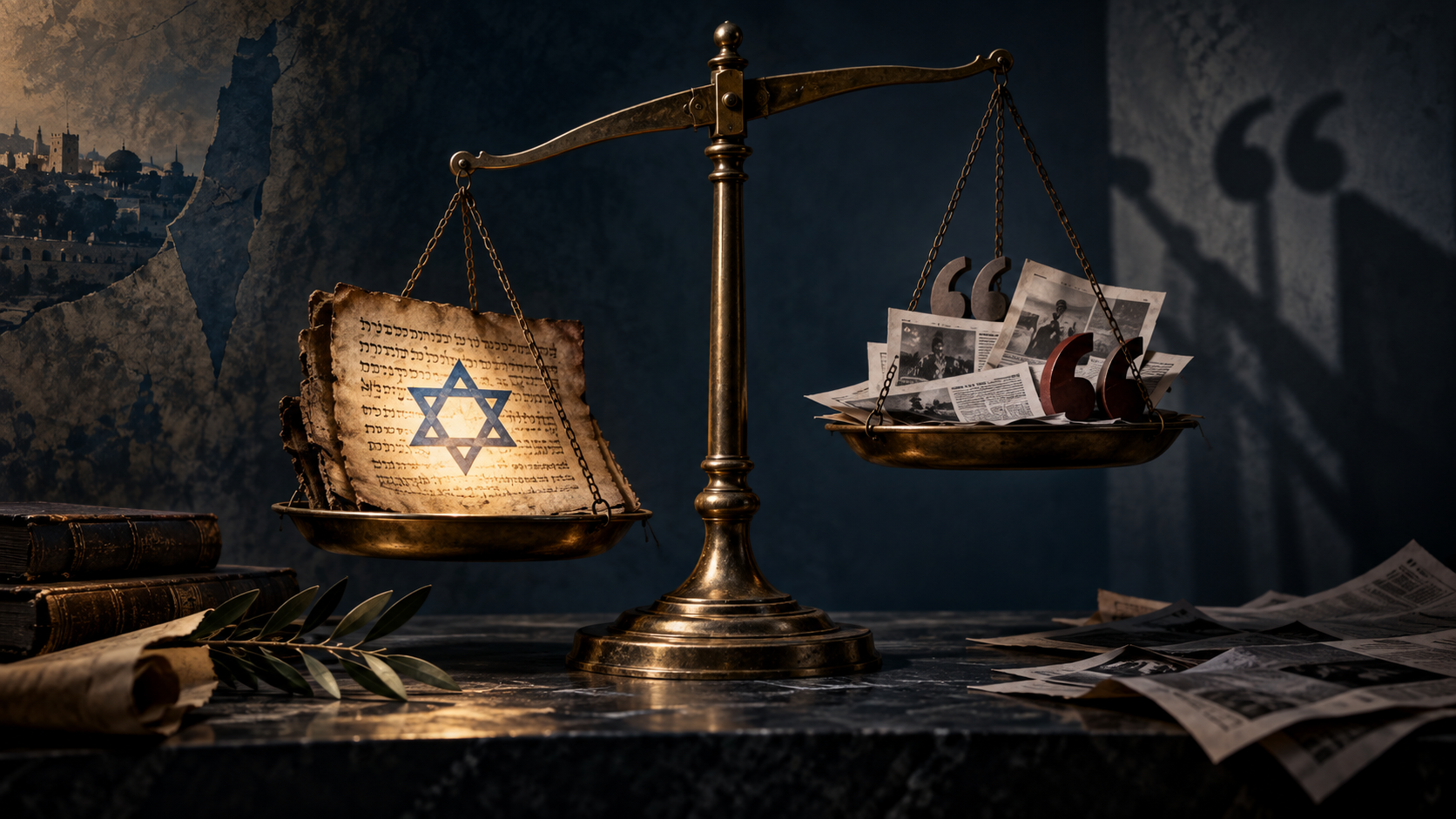
But Yovel did not remain only the name of a horn. It became the name of a year, and the year became a prophecy of liberty, return and restoration.
A Sound Becomes a Year
God tells Israel to count seven cycles of seven years—forty-nine years in all.
“Then shalt thou cause the trumpet of the jubile to sound… in the day of atonement shall ye make the trumpet sound throughout all your land.”
—Leviticus 25:9
The sound announces:
“And ye shall hallow the fiftieth year, and proclaim liberty throughout all the land unto all the inhabitants thereof… and ye shall return every man unto his possession, and ye shall return every man unto his family.”
—Leviticus 25:10
The important word is דְּרוֹר—deror, liberty. The blast is not ceremonial background. It changes the condition of the people and the land.
- Servants are released.
- Families are reunited.
- Ancestral property is restored.
- The land is allowed to rest.
- Each person returns to his inheritance.
The repeated idea is return:
וְשַׁבְתֶּם אִישׁ אֶל־אֲחֻזָּתוֹ
“You shall return every man to his possession.”
וְאִישׁ אֶל־מִשְׁפַּחְתּוֹ תָּשֻׁבוּ
“You shall return every man to his family.”
Jubilee is not simply the cancellation of a debt. It is a return to the place from which someone has become separated.
Scripture also gives the reason:
“The land shall not be sold for ever: for the land is Mine.”
—Leviticus 25:23
Israel could possess the land, but Israel did not own it without limit. The same was true of the people:
“For unto Me the children of Israel are servants; they are My servants whom I brought forth out of the land of Egypt.”
—Leviticus 25:55
The land belonged to God, and the people belonged to God. Jubilee prevented one generation’s poverty from permanently erasing a family’s inheritance.
The standard gematria of יובל—Yovel is 48:
[ י(10)+ו(6)+ב(2)+ל(30)=48 ]
At first, that may seem two numbers short. Jubilee is the fiftieth year, so why does Yovel equal 48? Jewish mystical tradition gives us a reason not to dismiss the difference.
Pirkei Avot says that Torah is acquired through forty-eight ways. These are the disciplines available to a person who seeks wisdom: study, attentive listening, humility, understanding of the heart and the other qualities listed by the sages. Forty-eight therefore stands at the height of what a person may pursue through faithful effort.
The Talmud then speaks of fifty gates of understanding—חמישים שערי בינה. It says that Moses received all but one. Moses reached forty-nine, the completed pattern of seven times seven, but the fiftieth remained beyond him during his life:
“Fifty gates of understanding were created in the world, and all of them were given to Moses, except for one.”
—Rosh Hashanah 21b
In Jewish mystical teaching, the forty-nine gates belong to the created order. They can be pictured as seven qualities, each containing all seven, producing seven times seven. The fiftieth gate stands beyond what a created person can reach by effort alone. It must be given from above.
We see the same movement in the counting of the Omer. Israel counts forty-nine days from the Passover, but Shavuot (Pentecost) arrives on the fiftieth. We count what we can count; the fiftieth comes as a gift.
Jubilee follows the same pattern. Israel counts seven cycles of seven years. Forty-nine is brought to completion. Then the fiftieth year is not quietly entered as though it were merely the next number. It is announced by the shofar. Liberty is proclaimed, what was bound is released, and the inheritance is restored.
This makes the value of Yovel—48—especially interesting to me. Forty-eight describes the human path of acquiring Torah. Moses reaches forty-nine, the highest gate within the completed order. Fifty belongs to what comes from beyond that order.
The numbers form a progression:
- 48: the ways through which Torah is acquired.
- 49: seven times seven, the completed count and the gates given to Moses.
- 50: the gate beyond ordinary human attainment, received as a gift from God.
Later Jewish teaching associates the revelation of that fiftieth gate with the Messianic age. For those who believe in Yeshua, Jubilee gains another dimension: the One who is to come brings the release that human effort could never reach on its own.
Perhaps Yovel equals 48 because it begins where human attainment ends. We walk the forty-eight ways. Moses reaches the forty-ninth gate. But fifty is the Yovel. It is the day human striving gives way to divine release. When the appointed count is complete, God sounds the trumpet, opens the fiftieth gate, proclaims liberty and restores the inheritance.
The Tanakh never clearly records Israel observing a complete Jubilee. We find the command and echoes of it, but no historical passage tells us that servants, land and inheritances were all restored in a fiftieth year.
Instead, the prophets show what happened when Israel refused the principles behind it. Jeremiah describes a time when the people proclaimed deror to their Hebrew servants and then forced them back into bondage. God answers:
“Ye have not hearkened unto Me, in proclaiming liberty, every one to his brother… behold, I proclaim a liberty for you… to the sword, to the pestilence, and to the famine.”
—Jeremiah 34:17
Because they would not release others, God released them to judgment.
Second Chronicles later explains that the exile allowed the land to receive the rest Israel had withheld:
“Until the land had enjoyed her sabbaths.”
—2 Chronicles 36:21
Jubilee had promised that people would return to their land. Exile was the reversal: the people were removed from it. Jubilee released servants; exile took away Israel’s liberty. Jubilee restored inheritance; exile separated Israel from its inheritance.
Yet the prophets did not abandon the sound.
The Great Shofar and Jerusalem
Isaiah looks ahead to another gathering:
“It shall come to pass in that day, that the great trumpet shall be blown, and they shall come… and shall worship the LORD in the holy mount at Jerusalem.”
—Isaiah 27:13
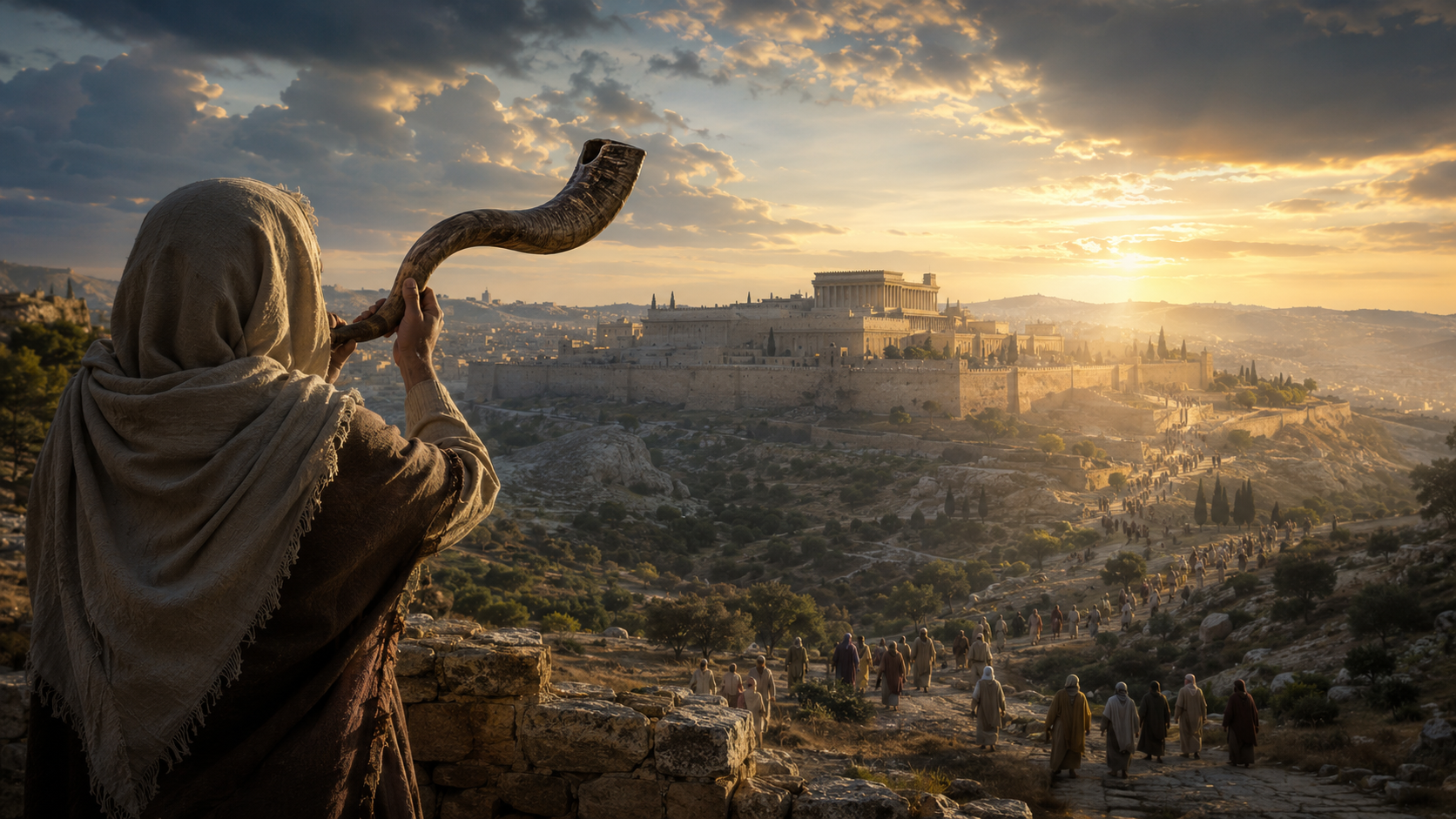
The Yovel began as a sound at Sinai. It opened the way into the inheritance at Jericho. It was commanded to proclaim liberty throughout the land. Then Isaiah heard a Great Shofar—שופר גדול calling the scattered back to Jerusalem.
There is another strong numerical connection here. Shofar—שופר equals 586:
[ ש(300)+ו(6)+פ(80)+ר(200)=586 ]
The common biblical spelling of Jerusalem without the second yod is ירושלם, which also equals 586:
[ י(10)+ר(200)+ו(6)+ש(300)+ל(30)+ם(40)=586 ]
[ \boxed{שופר=ירושלם=586} ]
Again, gematria does not create the connection. Scripture already connects the shofar with Jerusalem. David brings the Ark into the city “with shouting, and with the sound of the trumpet” (2 Samuel 6:15). Solomon is anointed king, the shofar sounds, and the people say, “God save king Solomon” (1 Kings 1:39). Isaiah’s Great Shofar gathers the scattered to worship in Jerusalem.
The sound accompanies the Presence, announces the king and calls the people home.
Warning Before Judgment
The shofar does not always announce something comfortable. It can warn that judgment is approaching.
“Shall a trumpet be blown in the city, and the people not be afraid?”
—Amos 3:6
Ezekiel compares the prophet to a watchman. If the watchman sees danger coming, he must sound the shofar. Joel gives the command directly:
“Blow ye the trumpet in Zion, and sound an alarm in My holy mountain.”
—Joel 2:1
The warning is still an act of mercy because it gives people time to hear and turn.
Hosea places both instruments beside one another:
“Blow ye the cornet in Gibeah, and the trumpet in Ramah.”
—Hosea 5:8
The Hebrew names the shofar in Gibeah and the chatzotzerah in Ramah. The same instruments that gather, order and announce salvation can also warn of approaching judgment. What changes is not the instrument, but the condition of those hearing it.
Jubilee Gains Another Dimension
For those of us who believe Yeshua will return, Jubilee carries an added dimension. The Torah speaks of servants being released, families returning home and land being restored. The New Testament does not discard that pattern. It follows it toward a greater release.
Yeshua brings Jubilee language into the synagogue at Nazareth. He reads from Isaiah:
“The Spirit of the Lord is upon Me… He hath sent Me… to preach deliverance to the captives… to set at liberty them that are bruised, to preach the acceptable year of the Lord.”
—Luke 4:18–19
Then He says:
“This day is this scripture fulfilled in your ears.”
—Luke 4:21
The word Yovel is not used in the Greek text, and no horn is sounded in the synagogue. Yet the language is unmistakably connected to Jubilee: liberty, release and the acceptable year of the Lord.
Notice again that it is fulfilled “in your ears.” At Sinai, Israel heard the Yovel. In Nazareth, the people heard Yeshua announce what the Yovel had always represented.
Yeshua then speaks of His return:
“He shall send His angels with a great sound of a trumpet, and they shall gather together His elect from the four winds.”
—Matthew 24:31
That sounds very much like Isaiah’s Great Shofar. Matthew does not begin a separate trumpet story. It continues the one Isaiah had already heard. The Great Shofar gathers those who have been scattered.
Paul adds another part:
“The Lord Himself shall descend from heaven with a shout, with the voice of the archangel, and with the trump of God.”
—1 Thessalonians 4:16
The language brings us back to Sinai. The Lord descends, a trumpet is heard, and God’s people are gathered. But this time the boundary being crossed is greater than a mountain or a city wall:
“The dead in Messiah shall rise first.”
—1 Thessalonians 4:16
Paul describes the same hope elsewhere:
“In a moment, in the twinkling of an eye, at the last trump: for the trumpet shall sound, and the dead shall be raised incorruptible.”
—1 Corinthians 15:52
Here Jubilee gains its fullest dimension. The Torah’s Jubilee released servants from bondage. The final trumpet releases the dead from mortality. Jubilee returned people to their families. The final trumpet gathers God’s people. Jubilee restored an inheritance that had been lost. The final trumpet brings an inheritance that death can no longer take away.
This does not make the original Jubilee unimportant. The physical return to family, land and inheritance established the pattern. The later story reveals another dimension already contained within it:
- Release from servitude becomes release from sin.
- Return from exile becomes the gathering of God’s people.
- Restoration of land becomes restoration of the inheritance.
- Return to family becomes resurrection and reunion.
- The announcement of a king becomes the return of the King.
At the seventh trumpet in Revelation, heaven declares:
“The kingdoms of this world are become the kingdoms of our Lord, and of His Messiah; and He shall reign for ever and ever.”
—Revelation 11:15
The trumpet that announced kings in Israel now announces the reign of God and His Messiah.
I do not see two unrelated trumpet stories. I see one sound moving through both Testaments. The Torah gives us the pattern. The Prophets enlarge the promise. Yeshua proclaims its arrival. The final trumpet brings it to completion.
This is two stories, one book, one God.
Six Thousand Years and the Seventh Day
There is an old Jewish teaching that places this pattern on an even larger scale. It did not begin with Hasidism, although Kabbalistic and Hasidic teachers developed it. In Sanhedrin 97a, Rav Ketina speaks of six thousand years of the world followed by a seventh millennium compared to Shabbat. The teaching draws upon the words of Psalm 90:
“For a thousand years in Thy sight are but as yesterday when it is past.”
—Psalm 90:4
Six days are followed by Shabbat. In the traditional pattern, six millennia of ordinary human history are followed by a great Sabbath associated with the Messianic age.
I do not take this as permission to set a date. The same rabbinic discussion warns against trying to calculate the exact time of Messiah’s arrival. I see it instead as another biblical pattern of labor followed by rest, bondage followed by release, and ordinary time followed by sanctified time.
The Torah gives a smaller picture of it in the law of the Hebrew servant:
“Six years he shall serve: and in the seventh he shall go out free for nothing.”
—Exodus 21:2
That sounds very much like the language of Jubilee. Six is followed by seven. Service is followed by freedom. Time reaches its appointed boundary, and a new condition begins.
There is also a Hebrew letter that makes the number interesting to me. Vav—ו has a value of six. When six is extended into the thousands, it becomes six thousand. I have written before about taking the value of a Hebrew letter into the thousands—not as a mathematical exponent, but as the same value expressed on a greater scale.
The ancient pictograph image of Vav is a hook, connecting peg or nail. The Torah uses vavim—ווים for the hooks of the Tabernacle, and the letter commonly functions as the word “and,” joining one thing to another.
From a Jewish perspective, the seventh millennium points toward the age of Messiah and the great Sabbath. For those who believe Yeshua will return, the final trumpet brings resurrection, gathering and the reign of Messiah into the same pattern. The two understandings are not identical, but both hear time moving toward release.
That is what makes Yovel so important. Jubilee is not merely a law about one fiftieth year. It gives us a language for the end of bondage and the restoration of what belongs to God. When the appointed count is complete, the trumpet sounds, freedom is proclaimed and the inheritance is restored.
When the Yovel Sounds Long
There is one more part of the Sinai scene that I had read many times without fully noticing:
“When the trumpet soundeth long, they shall come up to the mount.”
—Exodus 19:13
The Hebrew does not simply say trumpet. It says Yovel: “When the Yovel sounds long, they shall come up to the mountain.”
In its immediate setting, this instruction concerns the boundary around Sinai. The people have been warned not to touch the mountain or break through. The chapter continues to place restrictions upon their approach, so I do not want to claim that this one verse explains every later prophecy.
Still, it is difficult for me not to hear a pattern.
The LORD descends. Fire and cloud cover the mountain. The earth shakes. The people assemble. The voice of the shofar grows louder and louder. A boundary separates the people from God’s presence. Then the Yovel sounds long, and the words are heard: “They shall come up.”
Joel later uses much of the same language when he describes the approaching Day of the LORD:
“Blow ye the trumpet in Zion, and sound an alarm in My holy mountain: let all the inhabitants of the land tremble: for the day of the LORD cometh.”
—Joel 2:1
Joel describes trembling, darkness, fire and the voice of the LORD. Later in the same prophecy, he calls it “the great and terrible day of the LORD” (Joel 2:31). Once again, a trumpet sounds on God’s holy mountain as the Day approaches.
Isaiah then hears the Great Shofar gathering the scattered:
“The great trumpet shall be blown… and they shall worship the LORD in the holy mount at Jerusalem.”
—Isaiah 27:13
Yeshua says His angels will gather His chosen “with a great sound of a trumpet” (Matthew 24:31). Paul says the Lord Himself will descend “with the trump of God,” and the dead in Messiah will rise (1 Thessalonians 4:16). The scenes are not identical, but their shared movement is hard to overlook:
- The LORD descends.
- The trumpet is heard.
- The earth or mountain is shaken.
- God’s people are assembled.
- A boundary stands before them.
- They are called to come up.
Hebrews makes the connection even clearer by returning directly to Sinai. It recalls the fire, darkness, shaking, boundary, voice and trumpet. Then it says:
“But ye are come unto mount Sion, and unto the city of the living God, the heavenly Jerusalem.”
—Hebrews 12:22
At Sinai, the people could not cross the boundary on their own. At Jericho, the Yovel sounded and a boundary opened. In Jubilee, the shofar released those who had become bound and returned them to their inheritance. At the final trumpet, even the boundary of death gives way as the dead are raised.
Perhaps the final trumpet call is also the final Yovel—the sound announcing that the time of separation is over. The King has come. The scattered are gathered. The dead are raised. The inheritance is restored. Those who were kept at a distance are called to come up.
The words spoken at Sinai continue to echo:
“When the Yovel sounds long, they shall come up to the mountain.”
Listening for the Final Call
As I followed the trumpet through Scripture, I began to see that these were not isolated scenes. The ram’s horn appears at Moriah when Isaac is spared. It is heard at Sinai when God speaks. The silver trumpets gather Israel, move the camps and sound when the people need to be remembered before God. The Yovel opens Jericho and later proclaims liberty throughout the land. Kings are announced, the people are warned, and Isaiah promises that a Great Shofar will call the scattered home.
Even the Hebrew seems to preserve two of the connections. Shofar and the biblical spelling of Jerusalem both equal 586. The biblical spelling of chatzotzerah, the silver trumpet, equals 393, as do freedom and in salvation. Gematria does not prove the meaning of these passages, but the numbers follow a story already present in the text.
The final trumpet is not a new idea added at the end of the Bible. It is the completion of a sound we have been hearing from the beginning.
This Yom Teruah, when the shofar sounds at Congregation Mickve Israel, I will be listening a little differently. I will hear Moriah, Sinai, Jericho, Jerusalem and the promise of the Great Shofar calling the scattered home. I will remember that my people have listened to this sound for thousands of years. And I will remember that all these sounds point forward.
Two stories, one book, one God—and one trumpet call sounding through it all.
The final trumpet has not yet sounded.
But every Yom Teruah, we are reminded to listen for it.
Source notes:
Congregation Mickve Israel, “About Us”: https://www.mickveisrael.org/about-us
Genesis 22:13; Exodus 19:13, 19; 21:2; Leviticus 23:24; 25:8–13, 23, 55; Numbers 10:1–10; 29:1; Joshua 6; 2 Samuel 6:15; 1 Kings 1:39; 2 Chronicles 36:21; Psalm 90:4; Isaiah 27:13; Jeremiah 34:8–22; Hosea 5:8; Joel 2:1; Amos 3:6.
Luke 4:16–21; Matthew 24:31; 1 Thessalonians 4:16; 1 Corinthians 15:52; Revelation 11:15.
Pirkei Avot 6:6 for the forty-eight ways of acquiring Torah; Mishnah Rosh Hashanah 1:1 and 4:9; Babylonian Talmud, Rosh Hashanah 21b for the fifty gates of understanding and Rosh Hashanah 33b–34a for the traditional shofar sequences; and Sanhedrin 97a for the six-thousand-year and seventh-millennium pattern.