
Tisha B’Av, Menachem, and the Promise of Consolation
Tisha B’Av is the 9th day of the month of Av. The day commemorates the destruction of both the First and Second Temples.
 Tisha B’Av gathers together some of the deepest themes in Jewish memory: destruction, exile, lament, and yet the stubborn refusal to let grief have the final word. Its liturgy places the community “inside” the sorrow of Jerusalem rather than at a safe distance from it. Yet within Jewish tradition, the same day is also bound to the language of consolation, especially through the Jewish tradition that the Messiah is born on the very day the Temple was destroyed.
Hold your horses Christians. There is a way to see this that has ironic relevance. The force of the tradition is not merely chronological but theological: the moment of catastrophe is also presented as the hidden beginning of redemption. Destruction is not denied, softened, or spiritualized away; rather, redemption is said to arise precisely there, in the ashes of ruin.
“And when he was come near, he beheld the city, and wept over it,” — Luke 19:41
The Talmudic paradox
A striking rabbinic tradition preserved in the Jerusalem Talmud Berakhot 2:4. says that on the day the Temple was destroyed the Messiah was born and the sources associate this figure with the name “Menahem.” The name Menachem means “comforter” or “consoler.”
The name Menachem is derived from the Hebrew root נחם (nacham). That root has a rich semantic range in the Tanakh, including the ideas of comforting, consoling, relenting, regretting, or changing course in response to sorrow or judgment. In many passages, the root describes consolation after grief; in others, it describes relenting from announced judgment.
This dual sense is especially important. The same root that can describe God’s relenting from destruction can also describe the comfort that follows devastation. In that sense, Menachem is not simply a pleasant religious title; it names the one who embodies divine consolation after judgment.
This is why the tradition feels so provocative. It insists that the day of deepest absence is also the day of concealed arrival. Tisha B’Av therefore becomes more than a memorial of loss; it becomes a paradoxical sign that Israel’s future is already gestating in the place of its greatest wound.
Lamentations and the missing comforter
 The irony of Tisha B’Av deepens when Lamentations 1:16 is read in Hebrew: “far from me is a comforter,” where the word used is מְנַחֵם (menachem). On the very day when Jewish tradition reads Lamentations aloud, Jerusalem’s lament is that the comforter is absent, that the one who restores the soul is far away. The cry of the ruined city is therefore not merely for relief, but for the missing Menachem.
That gives the liturgy an extraordinary tension. The lament names the absence of the comforter, while later tradition answers with the claim that the Messiah, the comforter, is somehow already bound to that same day. The wound and the cure are placed beside each other, not as contradiction but as theological mystery.
From Tisha B’Av to Shabbat Nachamu
 The calendar itself reinforces this movement. The month of Tisha B’Av is also called Menachem Av. The Shabbat immediately after Tisha B’Av is Shabbat Nachamu, named for the opening words of Isaiah 40:1, “Comfort, comfort My people,” the designated haftarah portion for Shabbat Nachamu.
Jewish tradition understands this Sabbath as the turn from mourning toward consolation, the first of seven haftarot of comfort leading toward the High Holy Days.
This means that the Jewish liturgical year does not leave Israel inside the ruins. It leads the mourner out of devastation toward promise, and it does so with the doubled language of consolation: “Comfort, comfort.” The movement from Tisha B’Av to Shabbat Nachamu therefore reinforces the hope that lament is answered not by denial, but by divine consolation.
The traditional designation Menachem Av expresses the same idea. Av is the month most associated with sorrow because of the destruction of the Temples, yet Jewish sources also attach to it the name “Menachem,” the comforter, as though consolation were hidden inside the month itself. Mourning and comfort are therefore not opposites in the calendar; they are paired realities held together in one sacred season.
Jonah, relenting, and the deeper sign
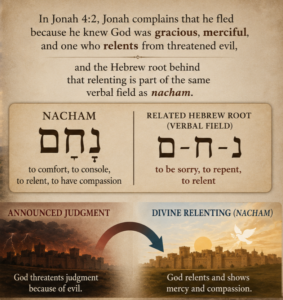 The root nacham also sheds light on the book of Jonah—“relenting from announced judgment.” In Jonah 4:2, Jonah complains that he fled because he knew God was gracious, merciful, and one who relents from threatened evil, and the Hebrew root behind that relenting is part of the same verbal field as nacham. Jonah resents a God who turns from announced judgment toward mercy.
This matters because Jesus later speaks of the “sign of Jonah” as the sign given to a generation that demanded proof. In Matthew, that sign is explicitly connected to Jesus’ own death, burial, and resurrection after three days. Jonah therefore becomes not only a prophet of repentance, but a figure whose story points beyond judgment toward mercy and life beyond the abyss.
John 2:19 and the true temple
John 2:19 enters this pattern with remarkable force. Jesus says, “Destroy this temple, and in three days I will raise it up,” and John later explains that he was also speaking of the temple of his body. The misunderstanding in the passage is that the hearers think only of the stone building, while the Gospel points to a deeper reality: the true dwelling place of God will pass through destruction and emerge restored.
This creates a powerful arc when placed beside Tisha B’Av. Tisha B’Av laments the destruction of the Temple and the apparent absence of the comforter; John 2:19 presents the true temple as destroyed and raised again. One text cries out from desolation, the other announces restoration through death and resurrection.
In that sense, the two texts stand in a kind of theological correspondence. The arc from destruction to restoration that shapes Tisha B’Av is mirrored in John’s portrayal of Jesus as the true temple. The same movement is also paralleled in rabbinic and liturgical patterns that move from lament to consolation, from Lamentations to Shabbat Nachamu, from absence to promise.
The Comforter and John 14:16
“And I will pray the Father, and he shall give you another Comforter, that he may abide with you for ever; — John 14:16
The connection grows even stronger in John 14:16, where Jesus promises that the Father will give “another Comforter” who will abide forever. In the KJV, the word “Comforter” is capitalized, signaling a personal divine figure rather than an abstract feeling. For a reader attentive to the Hebrew background, the resonance with Menachem is difficult to miss: comfort is no longer merely desired; it is promised as abiding presence.
This does not mean that John is directly quoting the Talmud. It means that the same deep structure is present: loss answered by consolation, judgment answered by mercy, absence answered by indwelling presence. The promise of “another Comforter” can therefore be heard as fitting naturally into the same world of meaning as Menachem Av, Shabbat Nachamu, and the cry for the missing comforter in Lamentations.
A Christian reading of the paradox
“O Jerusalem, Jerusalem, thou that killest the prophets, and stonest them which are sent unto thee, how often would I have gathered thy children together, even as a hen gathereth her chickens under her wings, and ye would not!”
— Matthew 23:37
A Christian reading of these themes will surely state the matter differently from the rabbinic legend. The point need not be that the Messiah as a man was literally born on Tisha B’Av in the flesh. Rather, those who understand what Yeshua meant in John 2:19 can see that the Father answered the devastation of the “temple’s destruction” by sending “another Comforter.” Consolation is no longer awaited but given as abiding divine presence.
In that reading, the irony of Lamentations 1:16 becomes even sharper. Jerusalem weeps because the menachem (comforter) is far away, yet the Gospel answer is that destruction itself becomes the place where the “true temple” is revealed and where the promise of the Comforter is made.
The Road to Emmaus and Rabbi Akiva: Two Stories of Consolation
 The story of the two disciples on the road to Emmaus in Luke 24 and the Talmudic story of Rabbi Akiva and the sages at the ruins of the Temple in Jerusalem are striking parallels. In both narratives, people begin in grief, move through confusion, and end with consolation that comes through interpretation of Scripture.
In Luke, two disciples are walking away from Jerusalem after the crucifixion. They are burdened by disappointment, unable to understand how the death of Jesus could possibly fit the hope they had placed in him. Then Jesus himself draws near, but they do not recognize him at first. He opens the Scriptures, shows them how the Messiah had to suffer before entering glory, and only later is recognized in the breaking of bread. The movement is from sorrow to understanding to recognition.
The Talmudic story follows a similar pattern. Rabbi Akiva and other sages stand among the ruins of the Second Temple. Three of them weep when they see the devastation, but Rabbi Akiva laughs. He explains that if the prophecy of destruction has been fulfilled, then the prophecy of restoration will also be fulfilled. His reading of Scripture turns despair into hope, and the sages respond, “You have comforted us.” Here too, the movement is from sorrow to interpretation to consolation.
That is why these stories work so well together. Both say that ruins are not the final word. Both insist that Scripture must be read through the lens of hope, and both show that comfort comes when hidden meaning is revealed. In Luke, the risen Messiah interprets the Scriptures and makes himself known. In the Talmud, Rabbi Akiva interprets the prophecies and makes future redemption visible in present destruction.
This parallel fits naturally with the larger arc of Tisha B’Av, Lamentations, Menachem, and Shabbat Nachamu. Tisha B’Av names the destruction; Lamentations names the missing comforter; Shabbat Nachamu announces consolation; and both Emmaus and Rabbi Akiva show what consolation looks like when it arrives through interpretation. The message is consistent: grief is real, but it is not the end. The road out of ruin runs through Scripture, and Scripture leads to hope.
Conclusion
The scriptures for Tisha B’Av, John 2:19, and John 14:16 thus form a parallel arc that stretches from the First Temple in Jerusalem to today: Taken together, these texts form a remarkable theological pattern that encompasses destruction, lamentation, restoration and abiding consolation.
Tisha B’Av gives voice to the destruction of the Temple and the absence of the menachem. The Talmudic tradition answers that on that very day the Messiah, linked with the name Menachem, is born. Shabbat Nachamu then reinforces the divine promise of consolation through Isaiah 40:1: “Comfort, comfort My people.”
 Within the New Testament, the same arc appears in a different but related key. The sign of Jonah points to descent and deliverance, John 2:19 presents Jesus as the true temple raised after destruction, and John 14:16 promises abiding consolation in the Comforter. Read together, these themes suggest a single movement running through lament, temple, Messiah, and consolation: destruction is real, but it is not final; the comforter belongs to the very place of sorrow, and hope emerges from within the wound itself.
Lamentations, the Temple, and Shared Sorrow
Yeshua described himself in temple terms, and his early followers would have understood how weighty that claim was. They were Jews who knew what it meant to the children of Israel to lose the First Temple, and they were familiar with Eicha, the book Christians call Lamentations, written after the destruction of Jerusalem in 586 B.C. Once Yeshua was crucified, they must have reread that Scripture in a new light. Eicha gave them a language for sacred loss, for the collapse of what had seemed to stand at the center of God’s presence among his people.
If Yeshua was understood as the living Temple, then his death would have felt like more than the execution of a beloved teacher. It would have felt like a temple-destruction moment in the life of his followers. The grief of the disciples after the crucifixion was not only personal bereavement. It was also the shock of watching their hope appear to fall into ruin. In that sense, Lamentations becomes more than an ancient text about Jerusalem’s past. It becomes a scriptural pattern for how faithful people mourn when what is holy seems broken before their eyes.
That is why Eicha can be read not only as the voice of grief, but also as the voice of hope. The book never denies the reality of devastation. Jerusalem is ruined, the people are scattered, and the poet gives full expression to loss, shame, and bewilderment. Yet the book also refuses to let sorrow have the final word. In the middle of its anguish, it remembers mercy. At its close, it turns toward restoration. Eicha teaches that hope does not come by escaping lament, but by passing through it.
For Christians, reading Lamentations in the light of the crucifixion can deepen empathy for Jewish suffering. The book reminds Christian readers that the language of sorrow surrounding the cross did not arise in a vacuum. It comes from Israel’s own history of destruction, exile, and longing for renewal. To pray Eicha as a Christian is therefore to enter, however imperfectly, into the historical and spiritual pain of Jerusalem. It is to realize that the suffering associated with Jesus cannot be detached from the suffering of the Jewish people among whom those Scriptures were first given and first prayed.
By the same token, Jews who consider this same pattern may find a deeper way to understand the anguish of Yeshua on the cross and the devastation experienced by his followers. When he cried out the opening words of Psalm 22, he stood within the long Jewish tradition of lament. His suffering was expressed in the language of Israel’s own sacred grief. His followers, too, experienced a kind of shattered world, one in which expectation, covenant hope, and love seemed suddenly to stand under judgment and loss. The traditions do not become identical here, but they do come close enough to hear one another’s sorrow with greater sympathy.
This is what makes Lamentations such an important meeting place between Jews and Christians. It does not erase difference, and it should not be used to flatten the distinct claims of either tradition. But it does create a space where each can better understand the other’s tears. Christians can read Eicha and feel more deeply the wound of Jewish history. Jews can look at the cross and better understand why the followers of Yeshua experienced it as a catastrophe of faith as well as love. In both cases, lament is not the opposite of faith. It is one of faith’s deepest languages.
 Israel’s national anthem, Hatikvah (The Hope) put it, “Our hope is not yet lost, the hope of two thousand years. To be a free nation in our land, The Land of Zion, Jerusalem.”
Epilogue: