Arcs and Parallels: From Genesis and Exodus to Cana, the Last Supper, and Passover Hope
This article is another in a study I’ve themed “Two stories. One book. One God.”
The strongest way to read the Last Supper in the New Testament is against the Passover in the Tenach or Old Testament. Not only against the later Passover seder which is a telling, but also against the original Exodus event itself: a night of judgment, blood, meal, protection, departure, and the birth of a redeemed people.
Read that way, the bread and cup in the Gospels stand inside a much longer biblical arc that begins with creation rest, deepens through Passover, and reaches forward into covenant, praise, and final redemption.
Genesis 2 and the first holy pattern
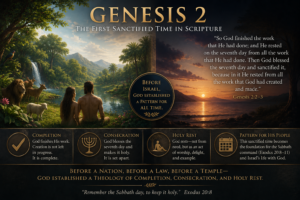 The first cup of Passover is the “The cup of Sanctification” and Genesis 2 presents the first sanctified time in Scripture: God finishes his work, rests on the seventh day, blesses it, and makes it holy. That pattern matters because it establishes a theology of completion, consecration, and holy rest before Israel ever appears as a nation.
Later Sabbath practice in Exodus does not invent that pattern, but invites Israel to participate in the divine rhythm first seen in creation. This creates a useful theological bridge to Passover.
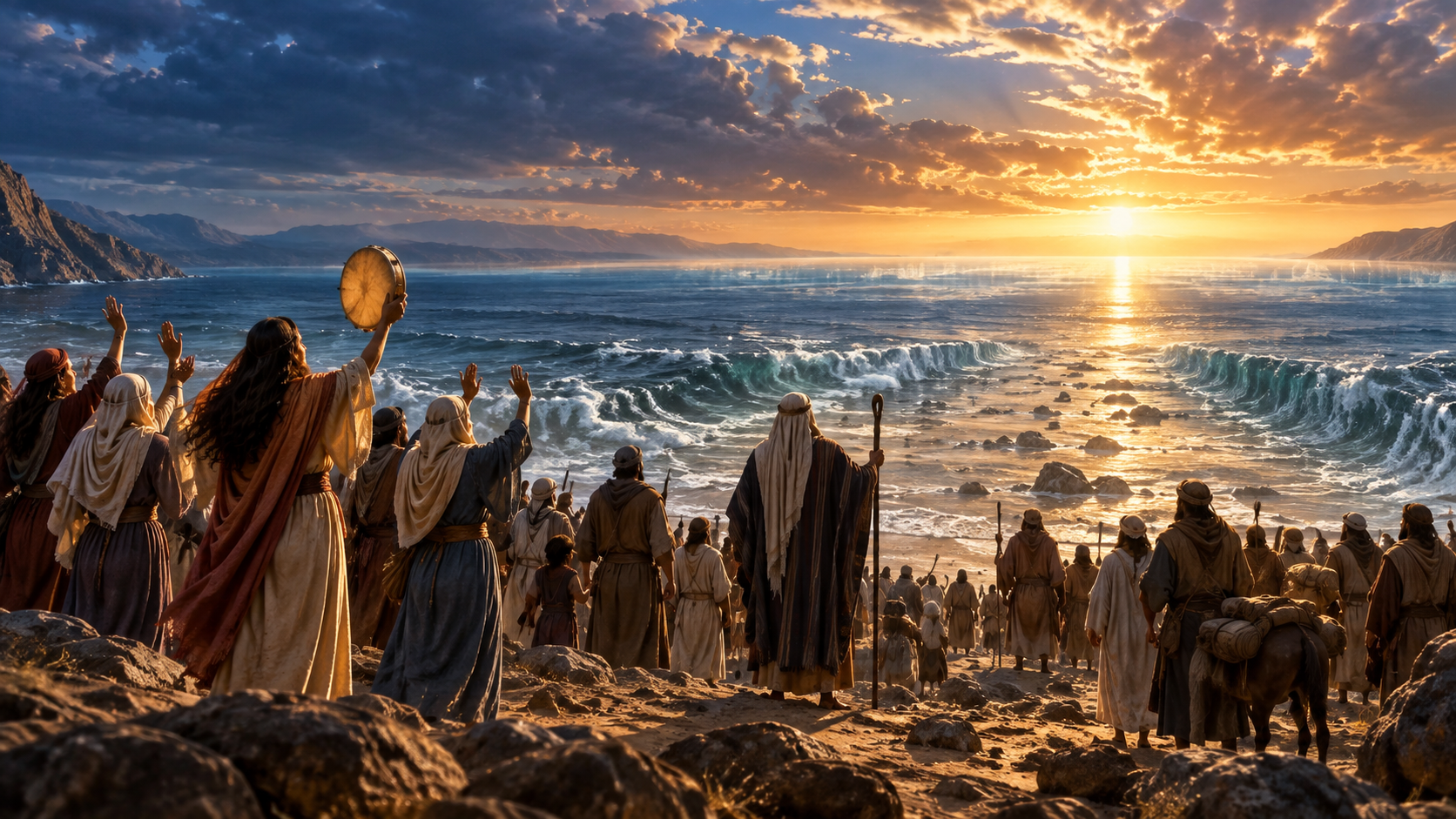
The second cup the Passover is the cup of Deliverance (“I will set you free”). If Genesis 2 is creation-rest, then Exodus can be read as redemption-rest: a new beginning in sacred time, where God sets apart not only a day but a people.The second cup can be read into Exodus as the cup of deliverance, the moment when God’s judgment falls on Egypt and Israel is brought out from bondage. The plagues, the blood on the doorposts, and the release from slavery all belong to that deliverance movement.
Key Verses
“And on the seventh day God ended his work which he had made; and he rested on the seventh day from all his work which he had made. And God blessed the seventh day, and sanctified it.” — Genesis 2:2–3
“I will free you from being slaves to them, and I will redeem you with an outstretched arm and with mighty acts of judgment.” — Exodus 6:6
The original Passover in Exodus
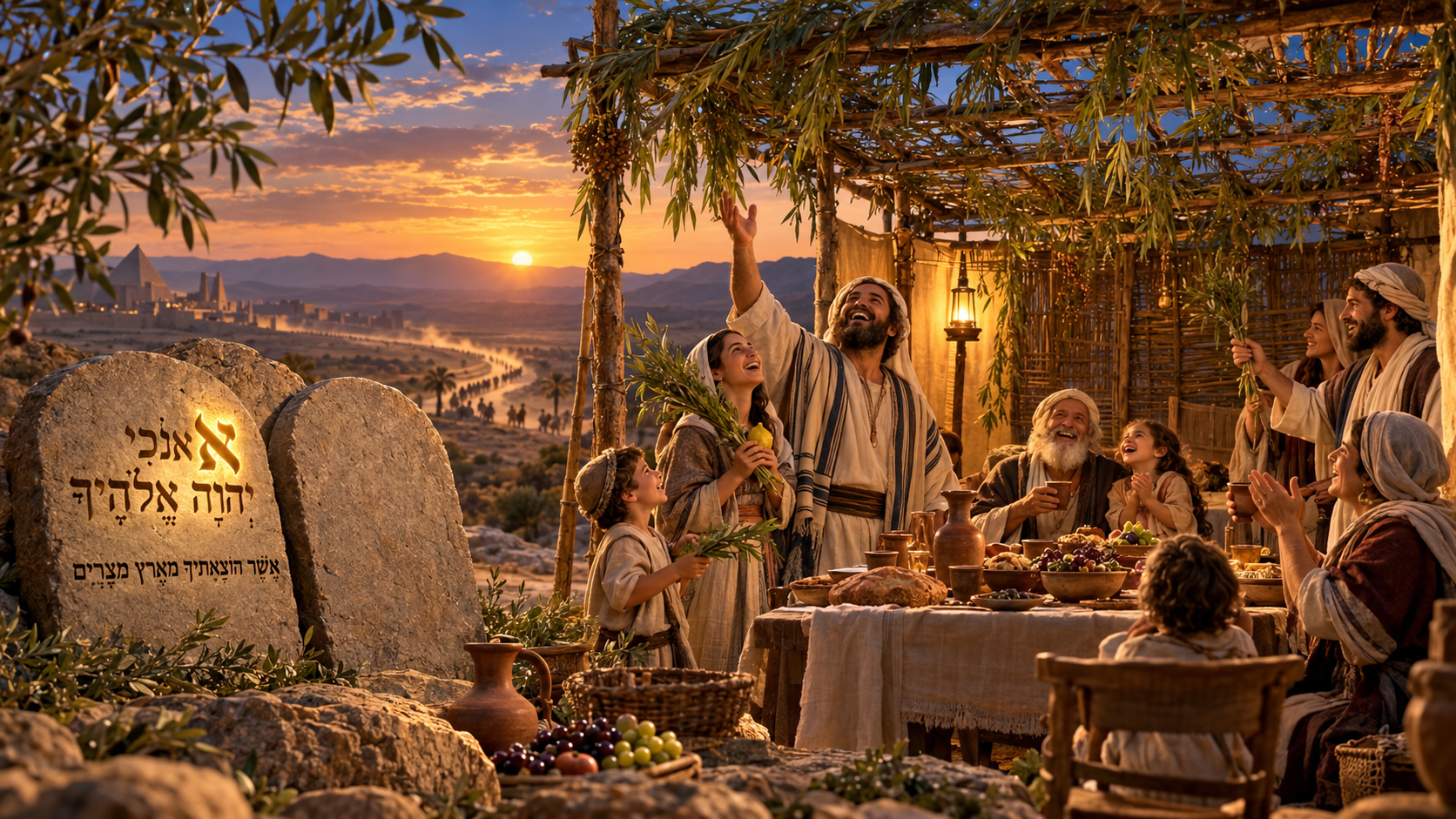
 Exodus 11–12 builds toward the final plague and the first Passover night. Pharaoh resists release, judgment is announced, and Israel is instructed to take an unblemished lamb, apply its blood to the doorposts, and eat the meal in haste with unleavened bread and bitter herbs.
The blood marks the households to be spared, while the meal prepares the people for immediate departure. That sequence is crucial: oppression, warning, lamb, blood, meal, deliverance, exodus.
Later Jewish observance remembers this event, but the original Passover is itself the saving act rather than a ritual retelling of it. This distinction sharpens the comparison with the Last Supper, because the Gospel scene can then be read not only as Passover remembrance but as participation in a new Exodus-shaped turning point.
Key verses
“And the blood shall be to you for a token upon the houses where ye are: and when I see the blood, I will pass over you.” — Exodus 12:13
“It is the sacrifice of the Lord’s passover, who passed over the houses of the children of Israel in Egypt.” — Exodus 12:27
Bread, wine, and Jewish meal structure
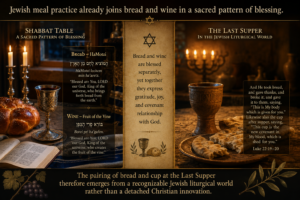
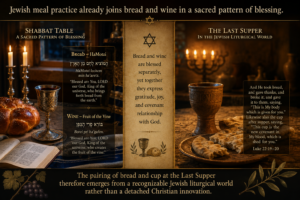 Jewish meal practice already joins bread and wine in a sacred pattern of blessing. On Shabbat, bread is blessed with HaMotzi, and wine is blessed as the fruit of the vine. The pairing of bread and cup at the Last Supper therefore emerges from a recognizable Jewish liturgical world rather than a detached Christian innovation.
That background matters because Jesus does not choose arbitrary elements. Bread already carries associations of provision, fellowship, and sanctified meal, while wine carries associations of joy, blessing, and festal hope. When Jesus takes bread and cup and gives them covenantal meaning, he intensifies symbols that were already richly layered in Jewish life.
Cana as an opening sign
John’s Cana narrative belongs in this arc because it is a feast scene structured around transformation. Jesus takes water intended for Jewish purification and turns it into wine, revealing glory through abundance at a wedding.
The master of the feast does not draw the water himself; the servants fill the jars, draw from them, and take the transformed wine to him for tasting. Cana therefore anticipates later themes. Purification gives way to festal wine, hidden action gives way to revelation, and an ordinary human celebration becomes the setting for a sign of messianic abundance.
Key verses
“This beginning of miracles did Jesus in Cana of Galilee, and manifested forth his glory.” — John 2:11
The Last Supper as new Exodus
The Synoptic tradition frames the Last Supper in Passover terms, and Jesus’ words over bread and cup give the meal covenantal depth. The strongest Old Testament verbal echo is Exodus 24:8, where Moses sprinkles blood on the people and says, “This is the blood of the covenant.”
When Jesus speaks of “my blood of the covenant,” the Last Supper sounds like both Passover and Sinai: deliverance and covenant ratification are fused together.
Read this way, the Last Supper is not merely parallel to later seder custom. It stands in continuity with the original Passover logic of blood, meal, judgment, and deliverance.
Key verses
“And Moses took the blood, and sprinkled it on the people, and said, Behold the blood of the covenant.” — Exodus 24:8
“And he said unto them, This is my blood of the new testament, which is shed for many.” — Mark 14:24
“Verily I say unto you, I will drink no more of the fruit of the vine, until that day that I drink it new in the kingdom of God.” — Mark 14:25
“And when they had sung an hymn, they went out into the mount of Olives.” — Mark 14:26
Jeremiah, Jesus, and the sorrow of missed redemption
The cups point backward to Exodus, but they also open outward toward the prophets’ hope for Jerusalem’s future. That is where Jeremiah becomes important, because his promises of restoration give a language of longing that later generations could hear as unfinished redemption.
One of the deepest emotional threads in this whole arc is the sadness Jesus expresses over Jerusalem. The city had lived for centuries inside the prophetic longing for restoration, peace, return, and the renewal of Zion. Jeremiah had spoken of healing, rebuilding, forgiveness, joy in Jerusalem, and the coming of a righteous Branch from David’s line. In Jeremiah 33, God says, “I will bring health and healing to it; I will heal my people and will let them enjoy abundant peace and security,” and then promises that Judah and Israel will be brought back and rebuilt as they were before. Those promises form the background of Jewish hope.
Jesus would have known that longing in full. He would have known Jeremiah’s promises of return and restoration, and he would also have known that many in Jerusalem were waiting for the consolation of Israel and the coming of the Messiah. That is what makes Luke 19 so poignant. As Jesus approaches the city, he does not celebrate its blindness; he weeps over it: “If you, even you, had known on this day what would bring you peace—but now it is hidden from your eyes.” His sorrow is the sorrow of presence without recognition, visitation without reception, redemption standing at the gates and yet not embraced.
This is where Jeremiah and Jesus meet with tragic force. Jeremiah announced that Jerusalem would one day be healed, restored, cleansed, and made glad again. Jesus arrives as the one in whom those promises are gathering, yet he sees that the city does not know the time of its visitation. Matthew gives the same sorrow in the lament, “O Jerusalem, Jerusalem… how often would I have gathered your children together… and you were not willing.” The grief is not only that judgment is coming. The grief is that the peace long sought is already present, and still missed.
Jesus also places before his disciples the warning of what lies ahead. In Luke 21, as people admire the beauty of the temple, he says, “The days will come in which not one stone shall be left upon another.” He goes on to warn that Jerusalem will be surrounded by armies and desolated. Within roughly forty years, in 70 AD, the temple would in fact be destroyed by the Romans. That future catastrophe makes Jesus’ tears even heavier: the rejected visitation gives way to historical judgment.
So this section of the story carries both tenderness and severity. Jeremiah’s restoration hope is real. Jesus’ messianic presence is real. But so too is the danger of missing the moment of redemption. That is why the sorrow matters so much. Jesus is not merely pronouncing doom over Jerusalem; he is grieving a city formed by promise, longing, and prophecy, yet unable to recognize the fulfillment standing before it.
Key verses
“Nevertheless, I will bring health and healing to it; I will heal my people and will let them enjoy abundant peace and security.” — Jeremiah 33:6
“I will bring Judah and Israel back from captivity and will rebuild them as they were before.” — Jeremiah 33:7
“In those days and at that time I will make a righteous Branch sprout from David’s line.” — Jeremiah 33:15
“And when he drew near and saw the city, he wept over it, saying, ‘Would that you, even you, had known on this day the things that make for peace! But now they are hidden from your eyes.’” — Luke 19:41–42
“Because you did not know the time of your visitation.” — Luke 19:44
“These things which you see—the days will come in which not one stone shall be left upon another that shall be thrown down.” — Luke 21:6
The unfinished cup
 The four cups of Passover come from the four promises of redemption in Exodus 6:6–7. Each cup marks a stage in Israel’s deliverance: separation, freedom, redemption, and covenant belonging.
The Four Cups:
- Cup of Sanctification — “I will bring you out.”
- Cup of Deliverance — “I will free you.”
- Cup of Redemption — “I will redeem you.”
- Cup of Praise or Acceptance — “I will take you as My people.”
The four cups of Passover are often interpreted as corresponding to the four divine promises of redemption in Exodus 6. In 7 Christian readings of the Last Supper, Jesus’ statement that he will not drink again of the fruit of the vine has often been understood as a deliberate postponement of the meal’s final consummation.
That reading should be presented as interpretation, but it is a powerful one. The meal ends with a future horizon still open, as though redemption has been inaugurated but not yet fully completed. In that framework, the final cup belongs to consummation, kingdom, and the praise that accompanies full deliverance.
Hymn, praise, and Passover hope
The Gospels say that after the meal Jesus and the disciples sang a hymn and went out to the Mount of Olives. Many scholars connect that hymn with the Hallel psalms traditionally associated with Passover praise.
This also illuminates the closing energies of Jewish Passover tradition itself. Traditional seders often conclude with songs such as Adir Hu, Echad Mi Yodea, and especially Chad Gadya, followed by the hope-filled refrain, “Next year in Jerusalem.” Passover therefore ends not with closure but with expectation.
Chad Gadya:
Vehi She’amdah and Chad Gadya
Vehi She’amdah states one of the Haggadah’s deepest claims: in every generation enemies rise against Israel, but the Holy One saves them from their hand. It transforms the Exodus from a single past rescue into an ongoing pattern of preservation and covenant endurance.
Chad Gadya does something similar in narrative form. Though a later medieval appendage to the Haggadah, it has become a standard closing song and is often interpreted as an allegory of Jewish survival through successive historical aggressors, ending with God’s triumph even over the angel of death.
The goat is commonly read as Israel itself: small, vulnerable, purchased or claimed, and repeatedly attacked through history until divine justice ends the chain. This is why the song feels so fitting at the end of Passover. Like the Haggadah, it tells the story of survival and redemption, but it does so in compact poetic form.
Key Verses:
“And this is what has stood by our fathers and us: for not only one has risen up against us to destroy us, but in every generation they rise up against us to destroy us, and the Holy One, blessed be He, saves us from their hand.”
The cross and the sour wine
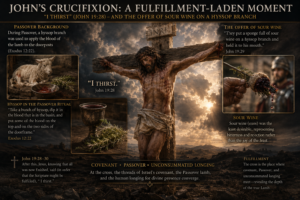
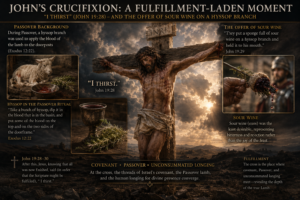 John’s crucifixion scene can be read against this whole framework. Jesus says, “I thirst,” and John presents this as a fulfillment-laden moment, after which sour wine is offered to him on a hyssop branch.
The hyssop detail strongly recalls Passover imagery, while the sour wine evokes the bitterness of rejection rather than the joy of festal completion. A careful reading can therefore say that the cross becomes the place where covenant, Passover, and unconsummated longing converge.
Jesus’ thirst can be read as bodily suffering, scriptural fulfillment, and a sign that redemption is being completed through pain rather than received in triumph. Within a typological reading of the cups, the sour wine sharpens the irony: the redeemer receives bitterness where a festal cup might have signaled consummation.
Key verses:
“After this, Jesus knowing that all things were now accomplished, that the scripture might be fulfilled, saith, I thirst.”
— John 19:28
“Now there was set a vessel full of vinegar: and they filled a spunge with vinegar, and put it upon hyssop, and put it to his mouth.”
— John 19:29
A unifying arc
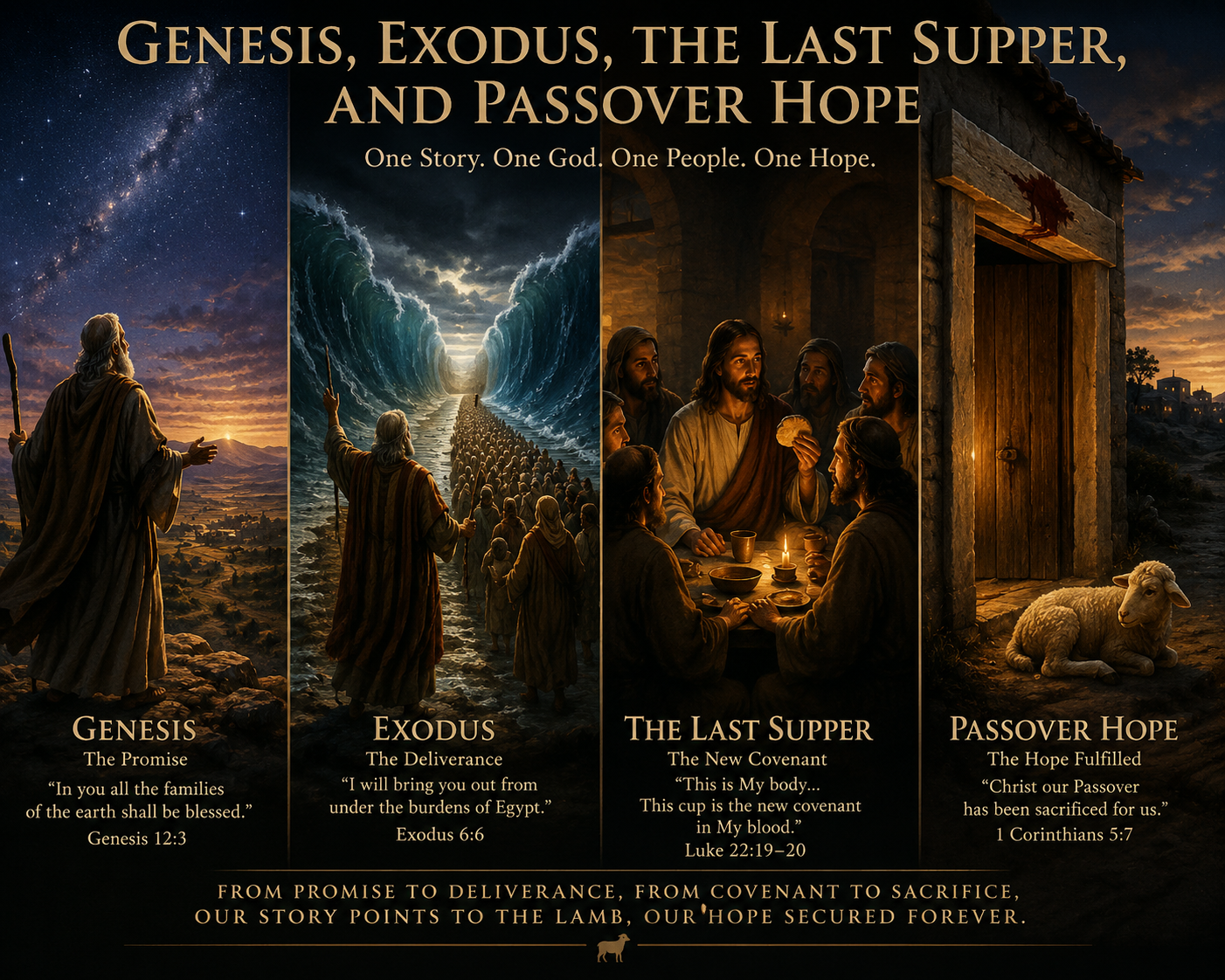
Taken together, these passages trace a remarkable sequence. Genesis 2 establishes creation rest and holy completion. Exodus 12 establishes redemption through blood, meal, and departure. Cana opens Jesus’ signs with transformed wine in the setting of feast and purification. The Last Supper gathers bread, cup, covenant, hymn, and kingdom hope into a new Exodus-shaped meal.
Passover’s own closing songs then preserve the same logic in Jewish liturgical memory: Israel survives, God remembers, and redemption is still awaited. This makes the arc especially compelling: creation, covenant, deliverance, transformed feast, unfinished cup, praise, suffering, and final hope all belong to one long biblical pattern.
Closing line
“Next year in Jerusalem” sums up the whole movement. It is the language of unfinished redemption, and that is precisely why Jesus’ departure to the Mount of Olives after the supper feels so fitting: the meal ends in hope, in tension, and in the expectation that God’s redemptive work is not yet complete.