A Speculative Reading of John’s Seven Signs as a Historical Trajectory
Overview:
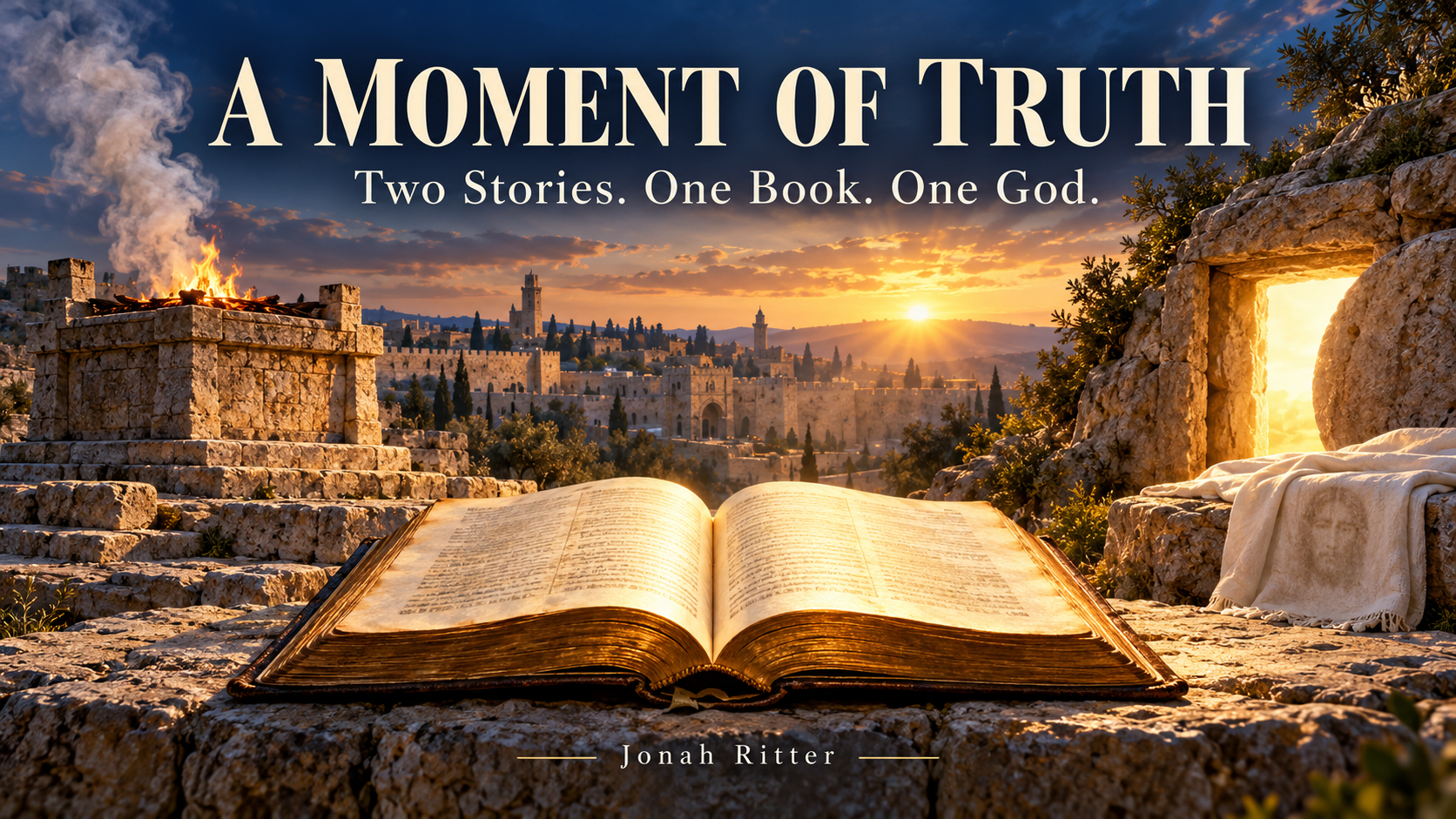
The story of Israel and the story of the Yesuah Hamashiach come together in one book. The bible is comprised of interwoven arcs and typological parallels. It is famously said that “The new is in the old concealed; the old is in the new revealed.”
Across Jewish and Christian traditions, the Bible is widely regarded as containing prophecy about the future and God’s interpretive word about history and covenant. Many Old Testament books (E.G. Isaiah, Jeremiah, Ezekiel, Daniel, etc.) are explicitly prophetic, mixing future-oriented oracles with calls to repentance, promises, and warnings. In the New Testament, almost every book includes some prophetic element, with Revelation being almost entirely devoted to a future prophetic vision that draws heavily from the Old Testament prophets.
There are prophetic patterns and meanings in the text that only become visible when history, the Spirit’s work, and the maturity of the community bring them into focus. In that sense, there is prophecy waiting to be identified, not because it was absent before, but because its relevance or fullness was not yet recognized. This essay explores such a case. I must say that my idea is highly speculative.
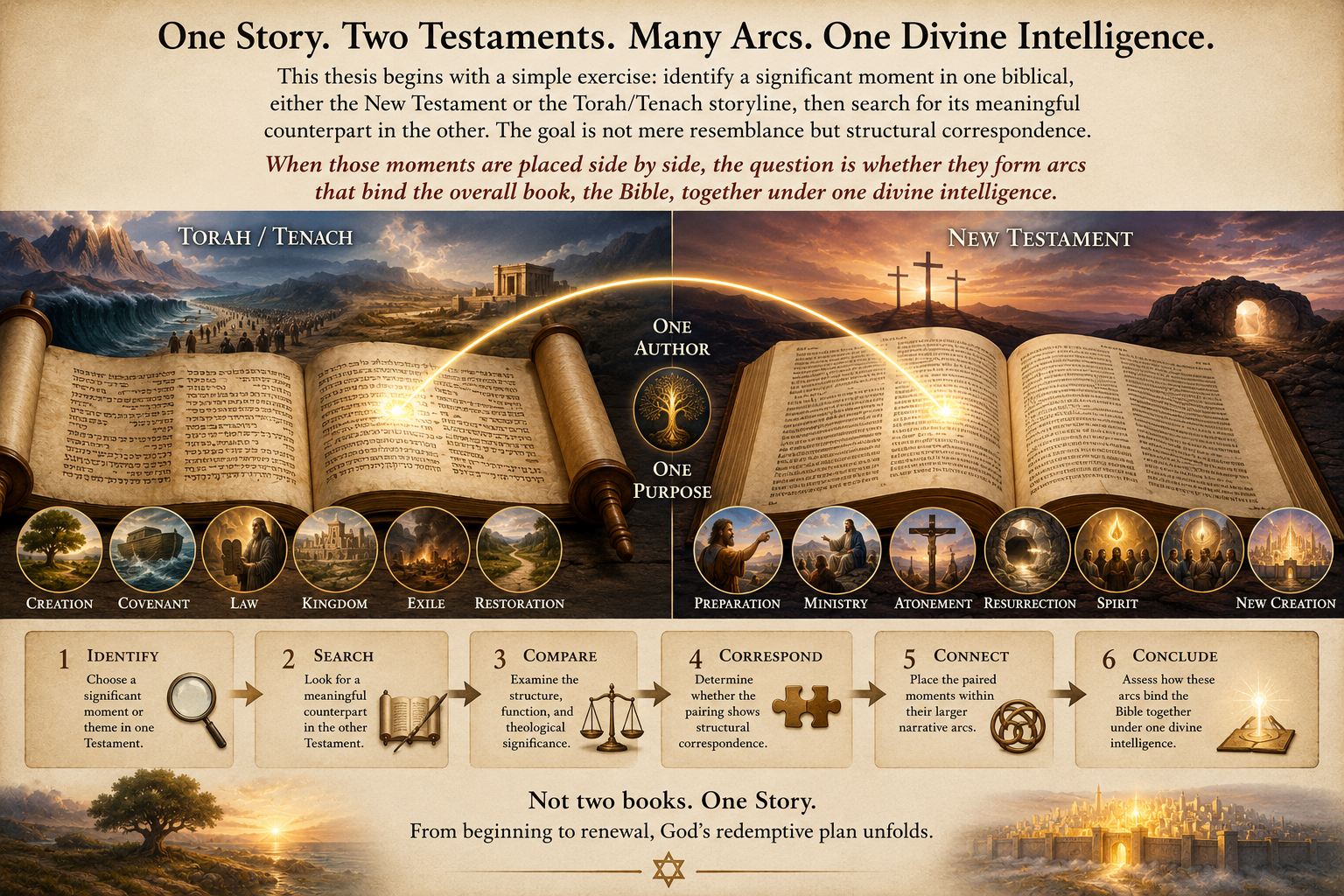
This type of study pursuit begins with a simple exercise: identify a significant moment in either the New Testament or the Torah/Tenach storyline, then searching for its meaningful counterpart in the other. The goal is not mere resemblance but structural correspondence. When those moments are placed side by side, the question is whether they form arcs that bind the overall book, the bible, together under one divine intelligence.
The premise I want to delve into in this blog, is that the “Seven Signs” (miracles) of Yeshua in The Gospel of John is a runway to the future, both in biblical times and beyond. Scholars widely recognize that the ordered sequence of the miracles is not random. The miracles are deliberately selected acts that reveal Yeshua’s identify and invite belief.
John’s Gospel highlights seven major miracles—“signs”—that he arranges in a deliberate sequence to reveal who Yeshua is:
- Water into wine at Cana – John 2:1–11.
- Healing the royal official’s son – John 4:46–54.
- Healing the paralytic at Bethesda – John 5:1–15.
- Feeding the 5,000 – John 6:1–14.
- Walking on the water – John 6:16–24.
- Healing the man born blind – John 9:1–41.
- Raising Lazarus from the dead – John 11:1–44. These are the seven “signs” around which John builds his Book of Signs, leading up to Jesus’ death and resurrection.
The proposal I am exploring here is that these Seven Signs may do more than reveal Messiah in the first century. Held humbly and without dogmatism, I propose that they may also sketch a symbolic trajectory of future events—a patterned lead‑up to the end‑times signs Yeshua explicitly names in his eschatological teaching. In other words, John’s signs are read here as a prelude: they unveil who he is and, at the same time, trace the contours of the road that runs toward the later, more direct signs of his return.
This does not replace passages like Matthew 24, Mark 13, Luke 21, or Revelation’s seals, trumpets, and bowls; rather, it suggests that John’s carefully chosen signs may form the earlier movement of the same symphony, preparing readers to hear and interpret the later end‑times signs in light of the One they reveal.
This is not a claim of certainty. It is not an attempt to produce a secret code, a date chart, or a new doctrine. It is a typological meditation: a way of laying significant moments side by side and then testing whether the pattern is really there. I don’t think the sort of layered structure I will describe would be out of character for Yeshua. Given the way he taught in parables, acted through signs, and tied his works to feasts and scriptural patterns, it would not be surprising if his signs revealed future events.
Matching the Two Stories
John’s Gospel provides particularly fertile testing ground because the evangelist himself insists that Yeshua’s mighty works are “signs.” In Johannine scholarship, signs are understood as revelatory acts that point beyond themselves to deeper theological realities, often drawing on Exodus imagery, Isaiah’s signs theology, creation patterns, and resurrection hope. This means that reading them typologically is not alien to the text. The speculative step is simply to ask whether their ordered sequence might echo more of the future than is widely accepted.
The mainstream scholarly answer stops short of that question. Most commentators say the signs form a Christological and new-creation arc, culminating in the cross and resurrection, not a chart of post-biblical events. That caution should be respected. Yet the very fact that the signs are arranged, cumulative, and symbolic leaves open the possibility of a secondary horizon of meaning, provided it remains subordinate to the plain sense of the Gospel. The exception is, of course, the Book of Revelation, which is clearly a revelation about the future. By the same token, Jews also anticipate the Messiah.
Trajectory Reading Is Thinkable
Several strands in the literature make this kind of proposal at least imaginable. The idea that the Seven Signs sketch a trajectory is not eccentric. What is unusual is extending that trajectory into later history. The argument here is not that John explicitly predicts the Enlightenment, America, the Holocaust, the Shroud of Turin, or current debates over Judea and Samaria. The argument is that the signs may establish symbolic contours that later history repeatedly echoes.
The Shroud as a Timepiece
Before turning to the Seven Signs themselves, one further idea needs to be named. In this reading, the Shroud of Turin functions not only as a relic or icon, but as a kind of timepiece within Christian history.
Its story begins at the crucifixion and resurrection. The Shroud’s clear historical appearance is in the mid-fourteenth century, when it is displayed in Lirey, France, and then contested in late medieval documents. It later moves through Savoy custody to Turin, where it becomes one of Christianity’s most famous and disputed relics.
Its re-emergence in the 1,300’s marks a new period of Light and reason coming into the world. Its renewed global visibility in the 1900’s in the modern age through photography, scientific controversy, and mass media, make it look less like a static artifact and more like a recurring marker in the long timeline of the Gospel’s unfolding reception. Whether one judges it authentic, medieval, or permanently unresolved, its appearances seem to punctuate history at moments when the world is being forced again to reckon with the crucified and risen Messiah.
The Seven Signs as a Historical Sketch
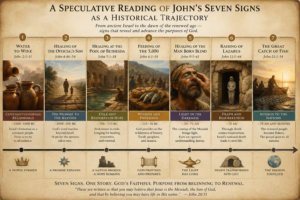
[Note: The signs 2-7 are in reverse historical order. They begin at 1 and return to 1.]
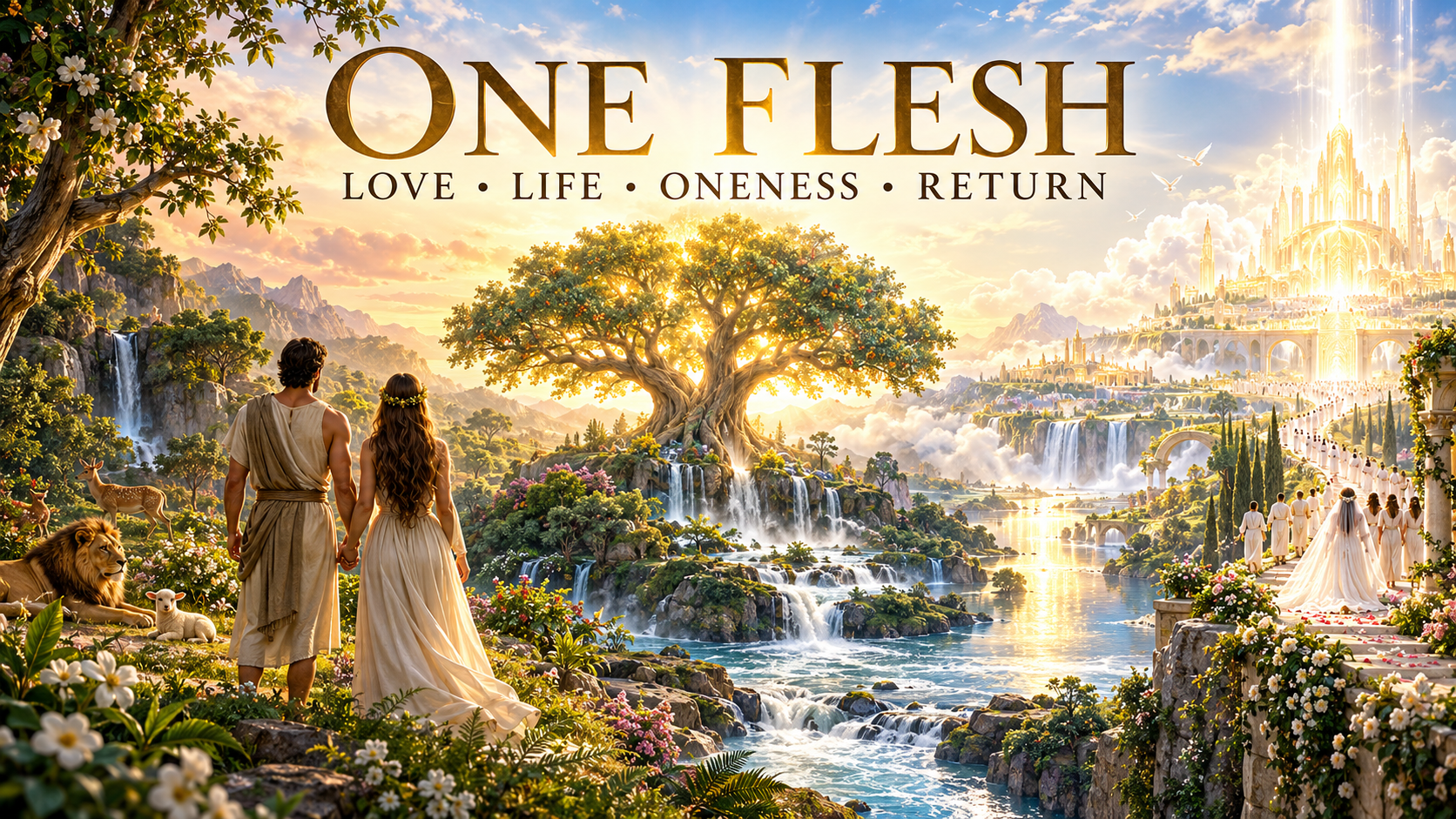
1. Cana: New Covenant Joy as the Horizon
The first sign in John is the changing of water into wine at Cana. Interpreters widely note the significance of the stone jars used for Jewish purification, the wedding setting, and the abundance of excellent wine, all of which point to messianic fulfillment, covenantal joy, and the replacement or transformation of older ritual structures.
As a historical trajectory, Cana functions as the governing horizon. If the signs are a roadmap, they begin by declaring what the entire journey is for: a wedding, a feast, and the arrival of the Bridegroom. The “new wine” appears first within Israel’s own world, suggesting that whatever unfolds later among the nations remains ordered toward a covenantal consummation rooted in Israel’s story.
This starting point matters because it keeps every later parallel from becoming merely political or sociological. The destination is not power, nationhood, or intellectual achievement. The destination is communion, joy, and fulfilled covenant.
2. The Royal Official’s Son: Faith at a Distance and the Gentile World
The second sign is the healing of the royal official’s son at a distance in John 4. Commentators note the father’s movement from sign-seeking need to trust in Yeshua’s spoken word, the distance over which the healing takes place, and the resulting belief of his whole household.
Typologically, this sign can be read as a sketch of a wider world learning to trust a Jewish Messiah without bodily sight. The official’s social location near royal or imperial structures and the household’s responsive faith make this event especially resonant with the growth of non-Jewish belief in Yeshua across time. In that respect, the sign has a suggestive kinship with later evangelical Christianity: trust in the word of Israel’s Messiah, received at a distance through proclamation, Scripture, and testimony rather than direct physical encounter.
This does not prove that John foresaw particular denominations or revival movements. It does suggest that the second sign naturally lends itself to a Gentile-expansion reading. It also speaks to world believing in a Messiah they never saw in a far away land.
3. Bethesda: Long Paralysis and Contested Healing
The third sign is the healing of the paralytic at Bethesda in Jerusalem. The scene presents a man disabled for thirty-eight years in a setting saturated with sickness, waiting, and religious regulation, only to be healed in a way that ignites conflict with the authorities.
Within a trajectory reading, this sign offers language for deep, long-term Jewish woundedness in the very heartland of the biblical story. The motifs are striking: paralysis, waiting for help that never comes, sudden rising, and immediate controversy over the legitimacy of restoration. These features invite a cautious comparison with the long trauma of Jewish history and, more specifically, with the devastation of the Holocaust and the complex, incomplete “standing up again” of the Jewish people in its aftermath.
Such a parallel must be handled reverently. No New Testament healing story “explains” the Shoah. Yet the sign’s pattern provides a vocabulary for thinking about severe corporate wounding and contentious restoration in ways that are hard to ignore.
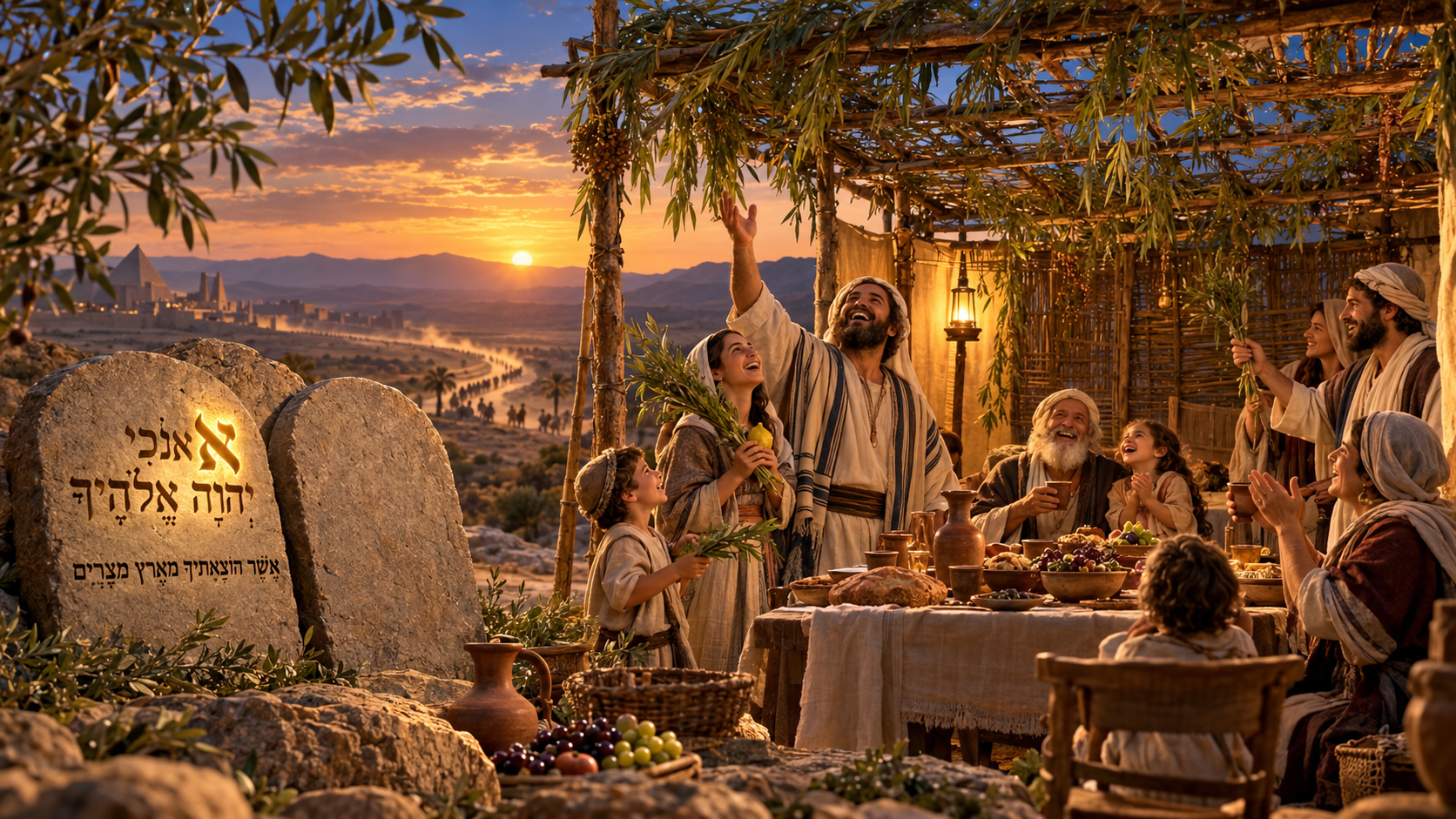
4. Feeding the Five Thousand: Wilderness Formation and Frontier Peoples
The fourth sign is the feeding of the five thousand in a remote place. In all four Gospels this miracle is central, and in them John feeds directly into the Bread of Life discourse, making it about far more than temporary hunger.
The main biblical themes are wilderness provision, a new Exodus, and the formation of a people around divinely supplied bread. As a historical echo, this sign can be seen as a pattern for frontier and founding communities, especially those that understand themselves as living in a remote or desolate place, dependent on providence, and shaped by newly emphasized doctrine.
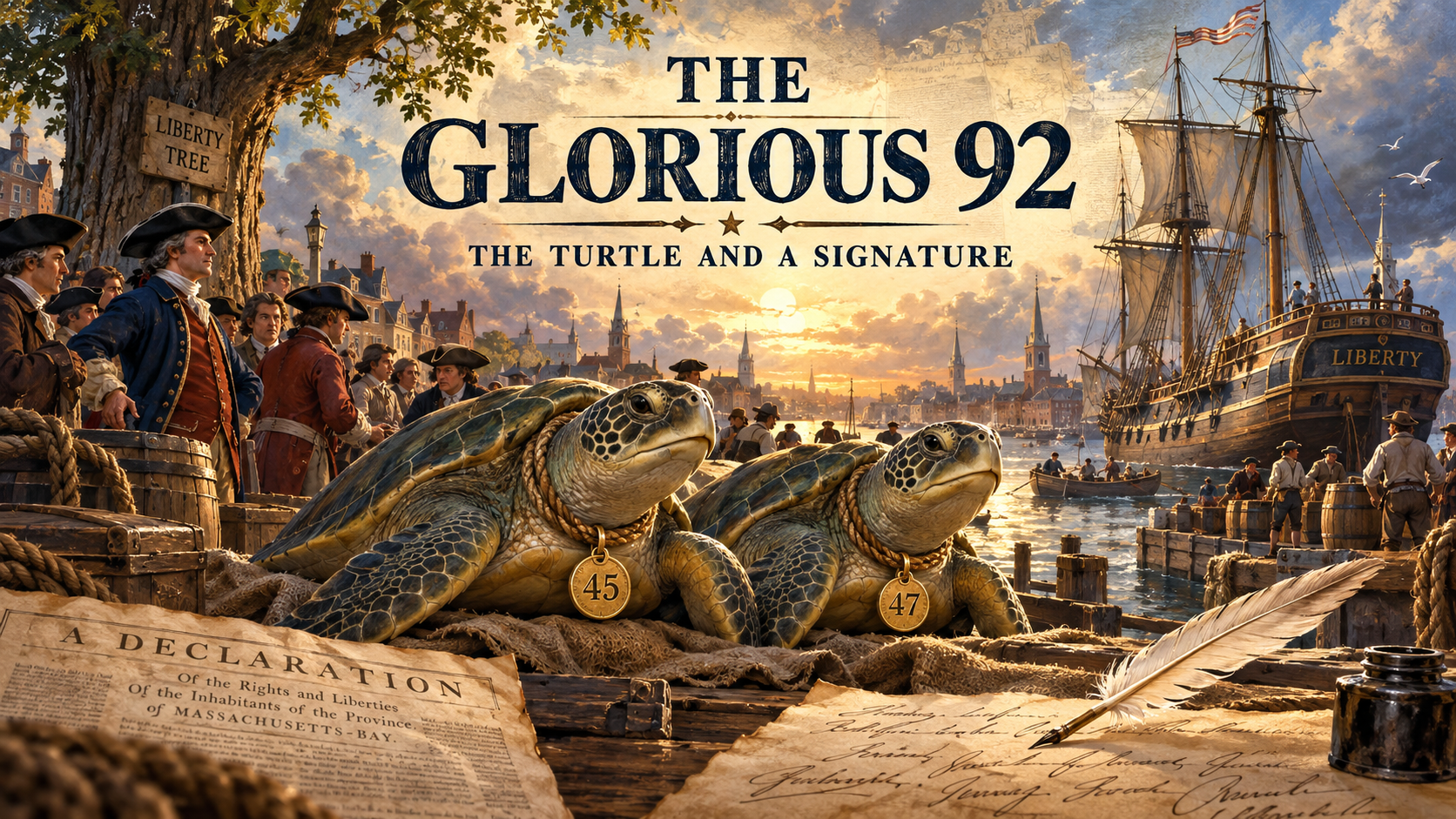
This is one place where early American self-understanding becomes suggestive. Colonial and revival-era preaching often interpreted the American setting through wilderness and providence motifs, and the feeding sign offers a structure that such communities could easily inhabit: a large crowd, sparse resources, a remote place, and a new communal identity built around divine provision. The parallel should remain broad. Many peoples, not only Americans, have imagined themselves under similar signs. But the echo is real enough to merit attention.
(This so happens to coincide with the start of the Mormon Church.)
5. Walking on the Water: Ocean Crossings and Global Expansion
The fifth sign in the usual Johannine sequence is Jesus walking on the water to his disciples. This event directly follows the wilderness feeding and places a small, fearful community amid rough waters before Yeshua’s sovereign presence carries them through.
Biblically, sea crossings are often associated with transition, danger, and the confrontation of chaos, from the Red Sea to the Jordan. In that symbolic world, the walking-on-water sign readily lends itself to a reading about long historical crossings: the movement of the Gospel and the Bible across literal oceans during centuries of maritime mission, trade, colonization, and translation.
This is especially powerful when read after the feeding sign. A people formed in the wilderness now faces the sea. The image of a fragile boat on dangerous waters, accompanied by a Lord who appears unexpectedly yet decisively, mirrors the long and morally complex global expansion of Christian faith. It does not endorse every form that expansion took. It gives it a theological image.
(This coincides with the Pilgrims and the early founding of the “New World.)
6. The Man Born Blind: Enlightenment and the Crisis of Seeing
The sixth sign is the healing of the man born blind in John 9. The narrative is remarkable because it is about more than physical sight. It stages an extended dispute over sin, knowledge, truth, and the difference between genuine sight and confident blindness.
That pattern resonates strongly with the emergence of the modern age. The movement from a long state of blindness to a dramatic opening of the eyes naturally suggests an Enlightenment-like moment, a stage of increased visibility, rationality, and inquiry after a perceived era of obscurity. Just as importantly, John 9 insists that new sight immediately produces conflict over authority and interpretation. Those who claim to see may in fact be blind, while the newly illumined may understand more truly than the experts.
This makes the sign a useful theological lens on “the age of reason.” It avoids the simplistic story that pre-modernity was all darkness and modernity all light. Instead, it suggests that every new seeing also introduces a fresh danger of blindness.
7. Lazarus: Death, Resurrection, and the Return of Paschal Signs
The final sign in John’s sequence is the raising of Lazarus. John presents this event as climactic. It reveals Yeshua as “the resurrection and the life,” draws many to belief, and directly precipitates the plot against him.
As a trajectory marker, Lazarus corresponds naturally to epochs dominated by death and rebirth: plague, war, genocide, and revival. It is the sign that says history will repeatedly be brought to the edge of the tomb and forced to ask whether resurrection is real.
In modern times, photography, scientific study, media coverage, and digital exhibition have made it globally visible again.
The Shroud begins its existence as a powerful icon of the a paschal mystery. Its medieval surfacing and modern re-emerg fit strikingly within a Lazarus-shaped stage of history: renewed attention to death, burial, resurrection, and the person of the crucified-risen Messiah.
The Shroud as a Timeline Marker
The Shroud introduces a further possibility. If it belongs to the original paschal event, then it “starts the clock” at the crucifixion. Its historical surfacing in the 1300s becomes a kind of mid-course runway, handing back to Christian civilization a visual focus on the wounds and burial of Christ during a period marked by plague and upheaval. Its contemporary re-emergence through photography, television, internet access, and recurring scientific debate makes it newly global in an age increasingly preoccupied with apocalypse, authenticity, and visible proof.
This does not justify a rigid prophetic clock. But it does suggest that the Shroud may have a providential timeline role. It anchors the beginning, reappears at a major hinge in Christian history, and then re-emerges in a final global phase in which the world is again confronted with the image of a crucified man whose wounds correspond to the Gospel narratives.
That sequence also creates an intriguing arc back to Cana. If Lazarus and the Shroud bring the world’s attention to death and resurrection, then the return to the first sign would imply final fulfillment in the direction Cana always pointed: the Bridegroom, the feast, and the consummation of covenant joy.
Judea, Samaria, and the Heartland Question
One of the most charged implications of this thesis concerns Judea and Samaria. John 4 places the Samaritan woman in a region marked by tension, memory, and disputed worship. The story does not erase geography, but it relativizes its ultimate power by locating true worship in spirit and truth. Still, when the seven-sign trajectory and the Shroud arc are brought into relation with modern history, the ancient heartland comes back into focus.
Recent Israeli government actions sharpen that observation. In July 2026, reports described a 1.3 billion shekel plan to establish and develop dozens of Jewish communities in Judea and Samaria, alongside more than a billion shekels for roads, access routes, and security infrastructure tied to settlement growth.
Additional plans involve new communities, legal recognition measures, expanded housing, and regional development in strategic corridors.
Within this essay’s speculative framework, such developments look symbolically significant. They suggest that the heartland where Yeshua spoke with a Samaritan woman, healed in Jerusalem, and moved toward Lazarus’s tomb is again becoming a focal point of world attention, infrastructure, and sovereignty debates. That does not prove the theory, nor does it settle modern policy or moral questions. It simply means that the geography of the signs and the geography of current events are converging in ways that feel theologically weighty.
Are Their Similar Thinkers?
No major theologian appears to lay out this precise theory. The mainstream Johannine tradition does not map the seven signs onto medieval, modern, and contemporary epochs in the way proposed here. Yet there are nearby instincts worth noting.
N. T. Wright treats the signs as a deliberate new-creation pattern. Scholars of Johannine sign theology emphasize that the miracles are ordered, symbolic, and indebted to biblical sign traditions, especially Exodus and Isaiah. Recent preaching and devotional work on the Seven Signs often presents them as a cumulative witness moving from wedding joy to resurrection power.
So while the historical-roadmap dimension seems novel or at least uncommon, it is not built on a rejection of serious Johannine work. It is an imaginative extension of widely recognized sign logic.
Humility, Guardrails, and Why This Still Feels Plausible:
- A theory like this needs strong guardrails. It must remain subordinate to the primary meaning of the text: the revelation of Yeshua as Messiah.
- It must avoid date-setting, chart-making, and over-precision.
- It must respect trauma, especially when invoking Jewish suffering and the Holocaust.
- It must not treat modern political decisions as self-evident divine endorsement.
Yet with those cautions in place, the theory still feels plausible for one simple reason: it is exactly the sort of thing Yeshua often does. He teaches in layers. He speaks in parables that operate at multiple scales. He turns feasts, healings, and crossings into windows on the kingdom. John deliberately uses the language of “signs” because these acts point beyond themselves.
That is why the proposal should not be dismissed merely because it is speculative. The right response is not credulity, but testing. Lay the moments side by side. Look for the arcs. Ask whether the pattern is forced or whether it emerges with surprising coherence.
Conclusion
My basic thesis is of Two stories, one book, one God begins with the conviction that the Bible’s great narratives are bound together by one divine mind. The exercise of matching significant moments and setting them side by side is one way of testing that conviction. John’s Seven Signs provide a striking case study because they are already arranged as revelatory acts, already rooted in Israel’s scriptural world, and already oriented toward the climax of death and resurrection.
Read in their primary sense, the signs reveal Yeshua. Read secondarily and more tentatively, they may also sketch a historical trajectory: from covenant joy, through Gentile faith, Jewish woundedness, wilderness formation, oceanic expansion, contested sight, and resurrection focus, finally curving back toward the Bridegroom and the feast.
Nothing here should be treated as settled doctrine. But neither should the possibility be dismissed too quickly. It would be entirely like Yeshua to weave a long trajectory into the very signs by which he first manifested his glory.