Two Stories, One Book, One God
A little midrash by Jonah Ritter
How many connections do we pass over because we already think we know the bible story?
People say there are no coincidences in the Bible. As I look back over my own life, I do not believe it was a coincidence that my parents named me Jonah.
For years, I sat in temple on Yom Kippur studying the book that bears my name. Its meaning became clearer to me with each reading. Then my son was born on Yom Kippur. A son born on the Day of Atonement. That was 40 years ago.
It was the first time I could remember missing temple on that holy day. The rabbi announced to the congregation why I was absent: my son was being born.
These connections are part of my life. They help explain why I keep returning to Jonah and why I believe this small book has so much more to tell us.
We remember the fish. We remember Nineveh. But what about the Holy Spirit, the booth, the plant, and the worm? Why does the story end with God asking a question?
For years, I have seen these details as threads in one unfolding story. What follows is my interpretation—a little midrash rooted in Scripture and informed by rabbinic tradition.
It belongs to the theme I have been developing: Two Stories, One Book, One God.
Let me call your attention to Matthew 12:39-40 in order to pose a question to you.
But he answered and said unto them, An evil and adulterous generation seeketh after a sign; and there shall no sign be given to it, but the sign of the prophet Jonas: for as Jonas was three days and three nights in the whale’s belly; so shall the Son of man be three days and three nights in the heart of the earth.
Did God know that Jonah would be the sign?
From the Presence of the Lord
The Jerusalem Talmud preserves a remarkable claim. Jonah son of Amittai was among the pilgrims who attended the Sukkot water-drawing celebration, and there the Holy Spirit rested upon him (Jerusalem Talmud, Sukkah 5:1).
The passage connects the celebration with Isaiah’s words:
“With joy shall ye draw water out of the wells of salvation.” —Isaiah 12:3
Picture Jonah in Jerusalem, rejoicing before God with his people. The Holy Spirit rests upon him.
Now consider what John the Baptist witnesses at Yeshua’s baptism: the Spirit descends from heaven “like a dove” and remains upon Him (John 1:32–33). Dove in Hebrew is yonah—Jonah’s name. Water, the Spirit, and yonah meet in both accounts: the prophet in the rabbinic tradition, and the dove in the Gospel. I see a meaningful parallel here, while recognizing that the Talmudic account was recorded centuries after Jonah’s lifetime.
Now place that rabbinic tradition beside the commission recorded at the beginning of his biblical story:
“Arise, go to Nineveh, that great city, and cry against it.” —Jonah 1:2
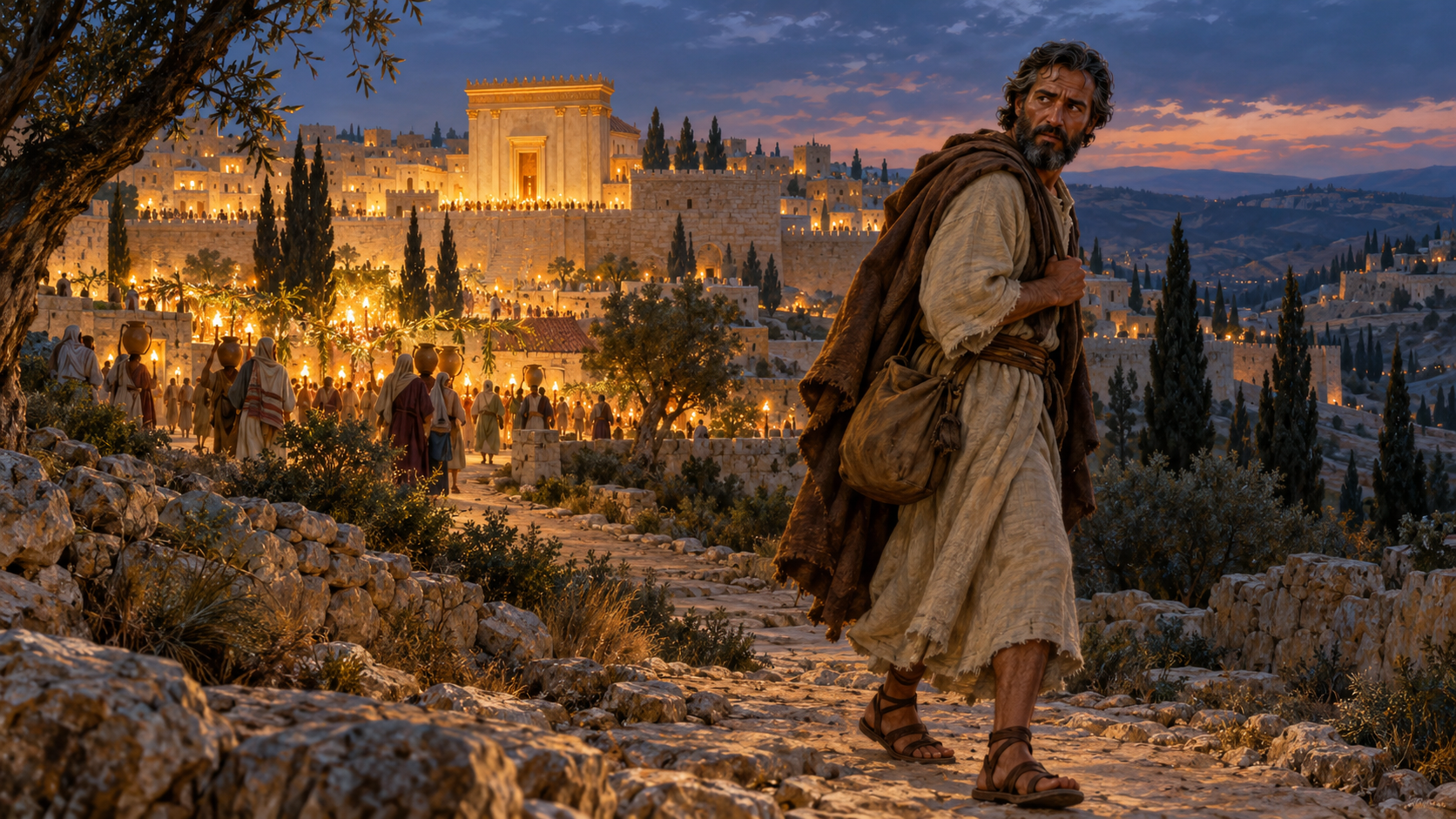
Jonah rises, but he heads for Joppa. He finds a ship bound for Tarshish, pays his fare, and boards it to flee “from the presence of the LORD” (Jonah 1:3).
But why Joppa? Jonah’s home was Gath-hepher in Galilee. The Jerusalem Talmud asks why he went to Joppa rather than Acre, a port closer to home. Its explanation takes us back to Jerusalem: Jonah was among the pilgrims at the water-drawing celebration when the Holy Spirit rested upon him (Jerusalem Talmud, Sukkah 5:1).
In this rabbinic reading, Jonah leaves Jerusalem for Joppa. He does not turn north toward home. He turns toward the sea. That gives “from the presence of the LORD” a more immediate meaning. He is leaving the place where he has just encountered God’s Spirit. He knows who has spoken. He simply does not want to do what God has asked.
Later, Jonah tells us why he fled. He knew God was gracious and merciful, slow to anger, and abundant in kindness (Jonah 4:2). He understood that Nineveh might repent and God might spare it. Jonah knew God’s character. God knew Jonah’s character, too.
The prophet who would bring a message to Nineveh would become the message himself.
Salvation Belongs to the Lord
Jonah boards the ship, but the sea belongs to God. A storm rises. The sailors struggle to survive. Eventually, at Jonah’s direction, they throw him into the water. God appoints a great fish to swallow him (Jonah 1:17). Even in the depths, Jonah is heard. He prays toward God’s holy Temple, gives thanks, and declares: “Salvation is of the LORD.” —Jonah 2:9
Jonah cries “out of the belly of Sheol” and declares, “thou hast brought up my life from the pit” (Jonah 2:2, 6). Sheol is the realm of the dead. These words draw my attention to Yeshua, who dies and is raised, whom Peter says was not abandoned to Hades (Acts 2:27–32). Yeshua Himself connects Jonah’s experience with His coming burial (Matthew 12:40). Whether we understand Jonah’s prayer as deliverance from the brink of death or a literal return from death, the movement is striking: down into the depths, then brought up by God. I see resurrection written into the sign.
Soon he will have to consider what that same salvation means for people he would rather see judged. The word of the Lord comes to Jonah “the second time” (Jonah 3:1). The first time, he fled. This time, he goes. His feet have changed direction before his heart has changed. He obeys the commission while still struggling with the compassion behind it. God is working through Jonah to reach Nineveh—and working on Jonah at the same time.
Before Jonah carries a warning to people who will receive mercy, he has received mercy himself. God has preserved his life and renewed his commission.
40 Days
He enters Nineveh and announces: “Yet forty days, and Nineveh shall be overthrown” (Jonah 3:4). “So the people of Nineveh believed God.”
—Jonah 3:5
They fast and humble themselves. Their king calls upon them to turn from evil and violence. He asks whether God might relent and spare them (Jonah 3:9). They seek mercy without presuming they are entitled to it. God sees their changed conduct and spares the city (Jonah 3:10).
The Apostle Paul later calls God’s word “the sword of the Spirit” (Ephesians 6:17). Reading these passages together, I see that sword entering Nineveh through the prophet’s mouth. The warning cuts the people to the heart. They repent, and God spares their lives.
Jonah waits for judgment to fall upon the city, but God’s word has already accomplished something within it.
Jonah, representing Israel and entrusted with God’s word, is sent to people who need to humble themselves to hear it.
Israel’s calling runs through Scripture. God tells Abraham that through him all the families of the earth will be blessed (Genesis 12:3). Moses tells Israel that obedience to Torah will display wisdom and understanding before the nations (Deuteronomy 4:5–8). Isaiah looks toward a day when the nations will seek God’s instruction:
“For out of Zion shall go forth the law, and the word of the LORD from Jerusalem.” (Isaiah 2:3)
God chose to give the Jewish people Torah. That gift carried a responsibility extending beyond the chosen people. Jonah’s mission bears fruit. But their deliverance makes him angry.
Beneath the Sukkah
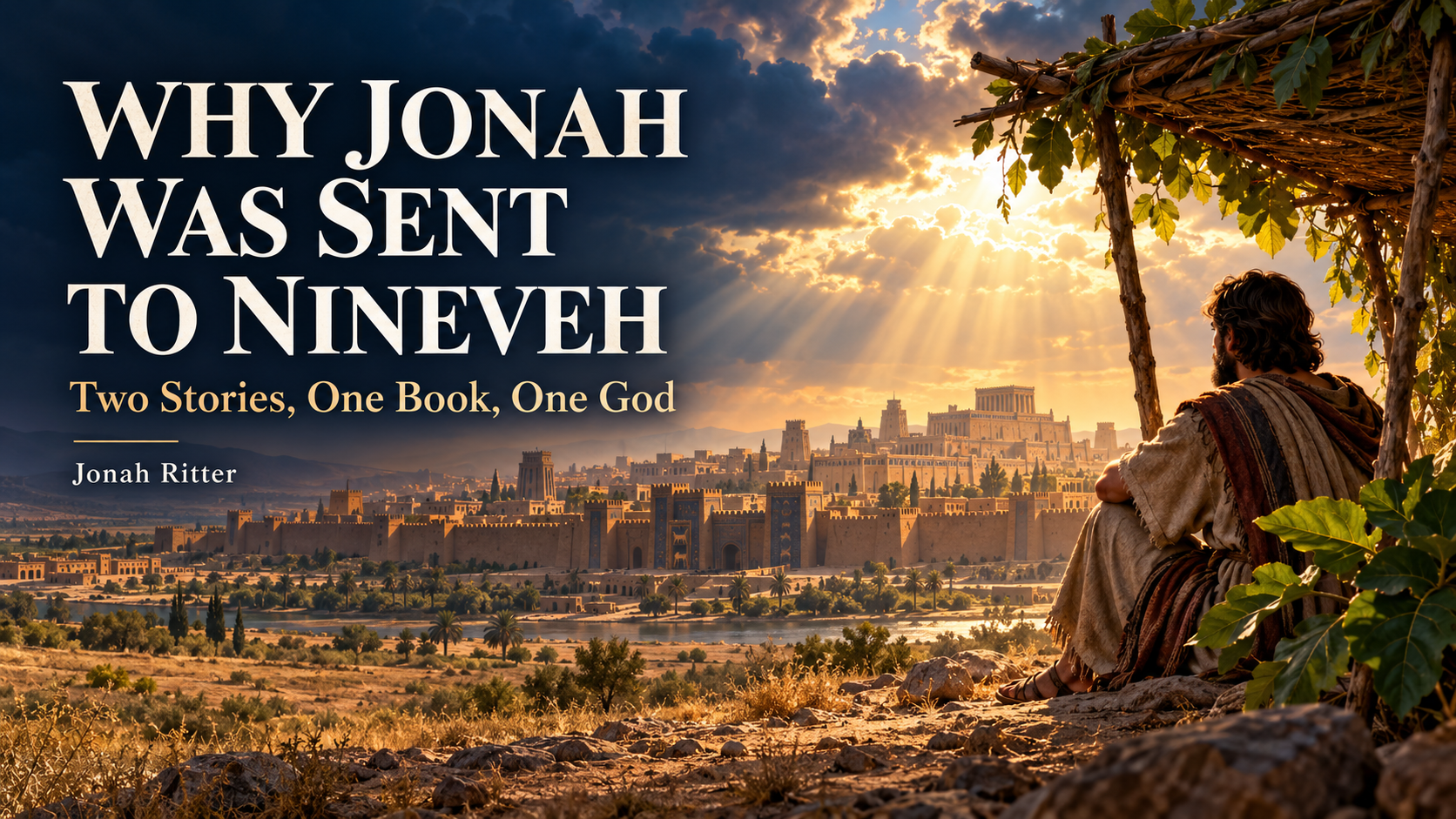
Jonah goes outside Nineveh and sits east of the city. He builds himself a booth and waits to see what will happen (Jonah 4:5). The Hebrew calls that booth a sukkah. We return to the Sukkot connection.
The sages place Jonah at the Sukkot celebration when the Holy Spirit rests upon him. Later, Scripture places him beneath a sukkah outside Nineveh. We are not told that his vigil occurs during the festival, but Matthew 12:39-40 invites us to look closer.
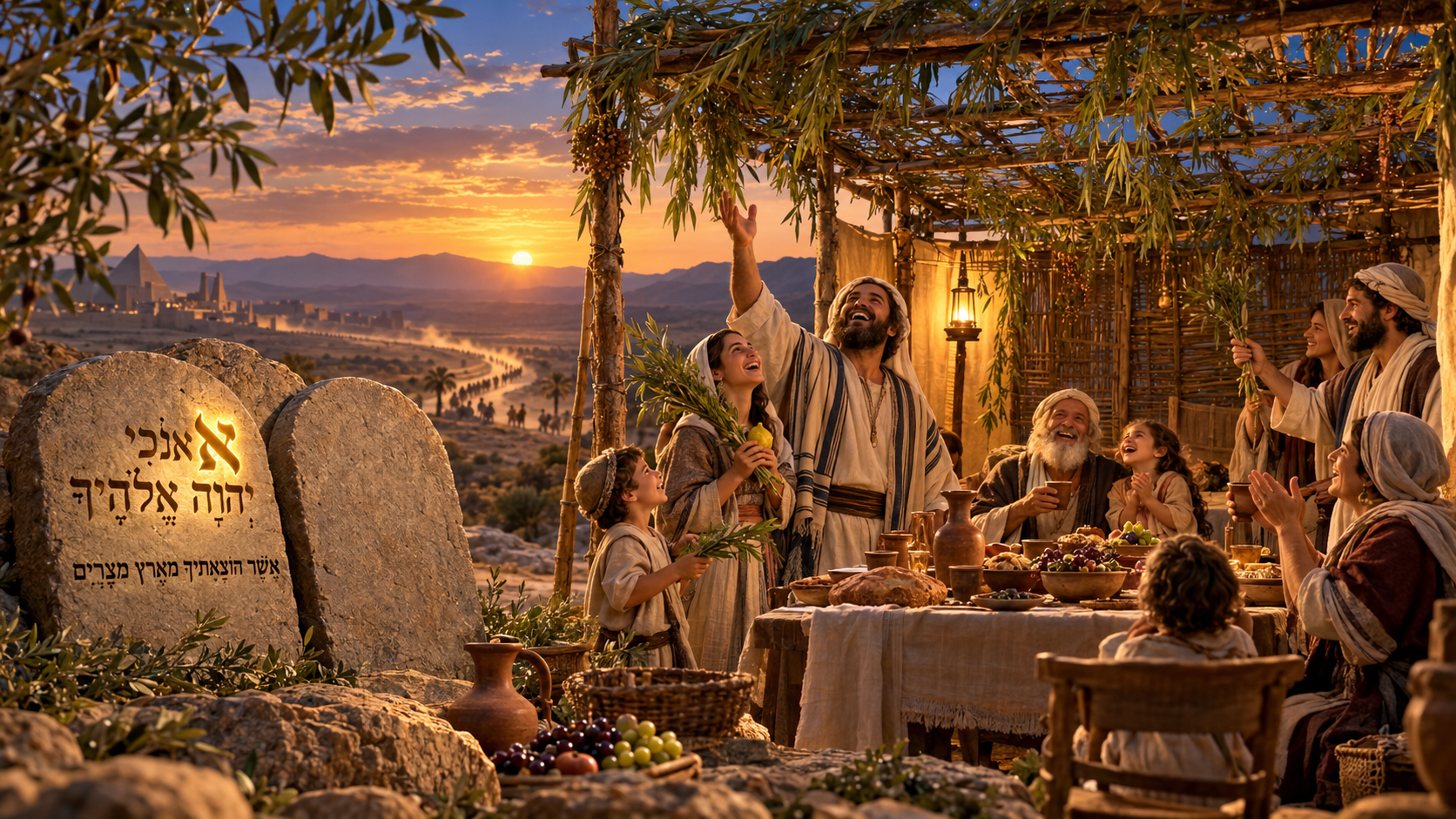
Sukkot recalls the booths in which Israel dwelt after God brought the people out of Egypt (Leviticus 23:42–43). It reminds us that our lives depend upon His provision. Now notice what happens outside Nineveh. Jonah builds the booth. God provides the plant. The shade that brings Jonah such joy is a gift he did not grow or earn (Jonah 4:6).
I see the plant as Torah—God’s gracious provision for His people.
There is a biblical foundation for connecting this plant with God’s gifts to Israel. In his BibleProject study of Jonah, Dr. Tim Mackie connects the plant Jonah did not cultivate with the land, cities, vineyards, and olive trees Israel received without producing them (Deuteronomy 6:10–11; Joshua 24:13). He also connects Jonah’s sukkah with Sukkot’s reminder of God’s provision. My reading takes that pattern a step further: I see Torah among the gifts whose purpose Jonah must learn to embrace. The instruction that shelters Israel also teaches us to love the stranger.
Jonah delights in its shelter. Before him stands a city filled with people who need the God whose gifts he enjoys.
Torah teaches Israel to love the stranger, remembering that we were strangers in Egypt (Deuteronomy 10:18–19). God’s instruction should shape how we regard those outside our own community.
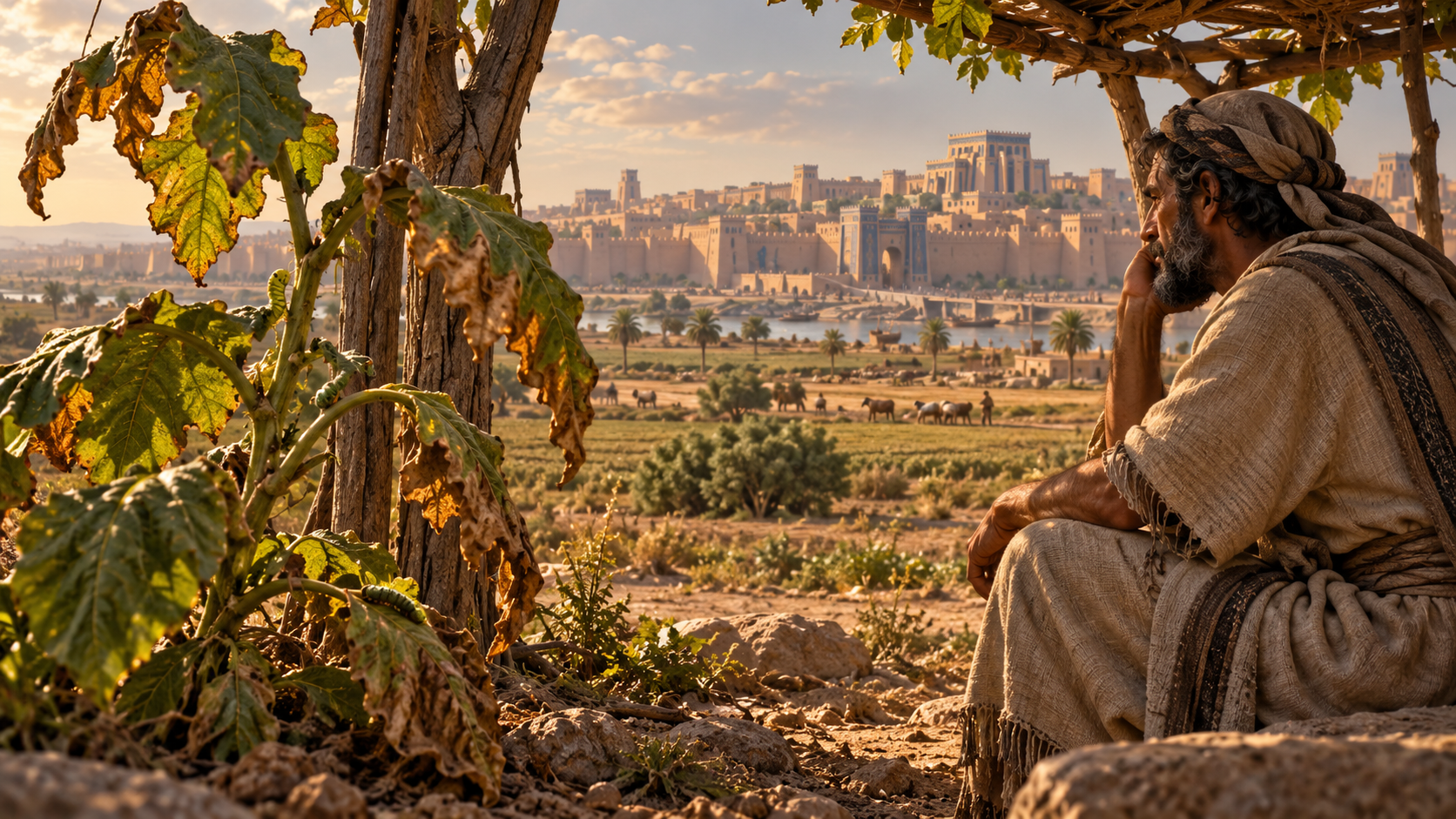 Then God Appoints a Worm
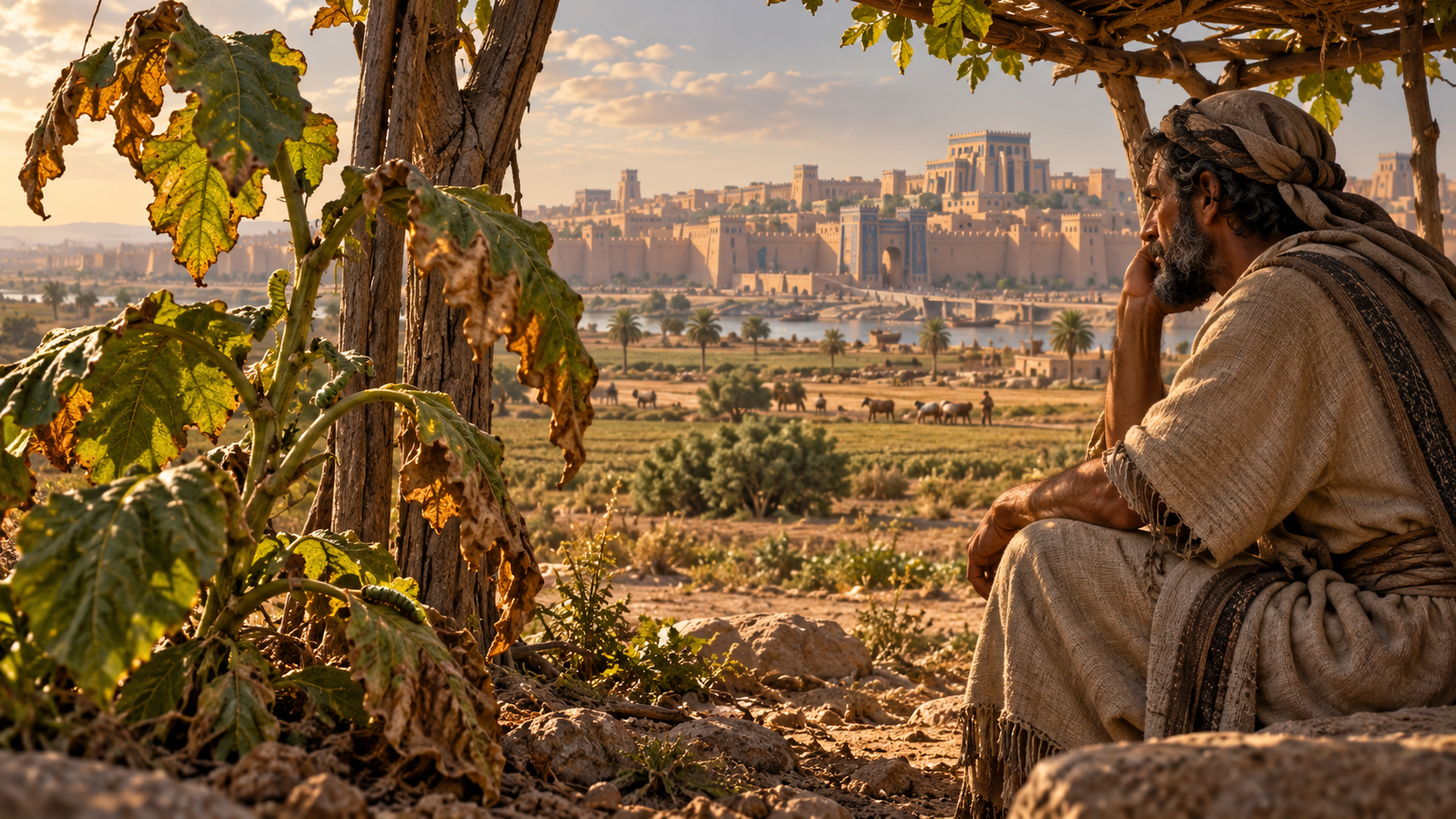
“But God prepared a worm when the morning rose the next day, and it smote the gourd that it withered.” —Jonah 4:7
Notice the repeated Hebrew verb, manah: God appoints the fish, the plant, the worm, and the wind (Jonah 1:17; 4:6–8). English translations may alternate between “appointed,” “prepared,” and “provided,” but the Hebrew connects them. God is directing every part of the prophet’s lesson. Jonah sees one event at a time. God knows the whole story.
The Hebrew word used for worm in the verse is tolaʿat. Related biblical language, tolaʿat shani, refers to scarlet associated with insect-derived dye. Researchers identified Kermes vermilio dye in a roughly 3,800-year-old textile discovered in the Judean Desert. Jonah’s verse does not identify the creature’s species, but the association adds another layer to my reflection.
“The same Hebrew word appears in Psalm 22:
“But I am a worm, and no man; a reproach of men, and despised of the people.” —Psalm 22:6, (verse 7 in Hebrew numbering), the psalm whose opening cry Yeshua speaks from the cross (Matthew 27:46).
In my reading, the lesson concerns God’s gift of Torah to His chosen people and what God expected the Children of Israel to do with it.
Yeshua says He came to fulfill Torah and the Prophets (Matthew 5:17). To fulfill the reason God gave us the gift of the Torah. In the story of Jonah, the loss of shelter forces the prophet to confront the responsibility that comes with receiving God’s provision.
Can Jonah (Israel) enjoy its comfort while refusing its lesson in compassion?
The sun rises. God appoints a scorching east wind. Jonah grows faint and asks to die. Survival without the plant, without God’s provision, is unbearable.
The prophet who was so pleased with his shade must now consider lives beyond his own.
Why Do You Think I Sent You?
God questions Jonah about his anger over the plant. Jonah insists that his anger is justified (Jonah 4:8–9). Then God places Jonah’s concern for the plant beside His own concern for Nineveh. Jonah grieves over something he neither cultivated nor caused to grow. Should God have no compassion for a city containing more than 120,000 people who cannot distinguish their right hand from their left—and many animals as well? (Jonah 4:10–11).
I hear a question within that question:
Why do you think I sent you here?
Their lack of discernment helps explain the mission. They need warning. They need instruction. They need the opportunity to turn.
If Jonah represents Israel, the question reaches Israel, too. What responsibility accompanies being entrusted with God’s revelation? Can we celebrate His mercy toward us while objecting when others receive it?
Jonah has already answered the commission through his actions. He entered Nineveh and preached. His obedience bore fruit, even while his heart struggled with the result. The book records no response after God’s final question. It leaves the reader to consider what Jonah should do next—and what we should do with that same question.
From Atonement to the Sukkah
There is another connection sitting right in the Jewish calendar. We read Jonah in the afternoon service on Yom Kippur. While we are fasting, praying, and seeking God’s mercy, we hear about a foreign city that repents—and a Jewish prophet who struggles to accept that God spares it.
What is the message to the Jew listening? The Jewish emphasis is on obedience to the law. But there is another message. We are asking God to forgive us. Can we welcome His forgiveness of others? We are seeking His compassion. Are we willing to carry His word to people who need that same compassion?
Five days after Yom Kippur, Sukkot begins. We leave the security of our homes to sit beneath a temporary shelter, remembering our dependence upon God. And the Jerusalem Talmud places Jonah at that festival’s water-drawing celebration when the Holy Spirit rests upon him.
Consider the sequence: atonement, then the sukkah; mercy received, then the reminder that we live by God’s provision. Having asked God to spare us, what responsibility do we have toward the people God wants to spare?
The God whose mercy we seek on Yom Kippur is the God who had compassion on Nineveh.
Something Greater Than Jonah
Centuries later, Yeshua brings Jonah and Nineveh before His hearers again. This time the people of Nineveh will rise in judgment because they heard God and repented at Jonah’s preaching.
Then Yeshua declares:
“Behold, a greater than Jonas is here.” —Matthew 12:41
The people of Nineveh responded to the revelation they received. What responsibility rests upon those who receive something greater?
In the same passage, Yeshua identifies Jonah’s three days and nights in the fish with His own coming burial (Matthew 12:39–40). Yeshua Himself directs us back to Jonah as the only sign he will give to a certain generation.
John gives us another reason to consider the messenger and his message together: “In the beginning was the Word,” and “the Word was made flesh” (John 1:1, 14). Jonah receives God’s word and carries it to the nations. Yeshua is revealed as the Word made flesh. Now hear His declaration again: “a greater than Jonas is here.”
The fish is where many readers stop. I believe it is where we should begin looking more closely.
Jonah sets up the New Testament.
An Israelite messenger carries God’s word to Gentiles. They believe and repent. God extends mercy. And woven into the story is a deliverance through three days in the depths.
Centuries later, Yeshua points back to Jonah to explain what is coming. The connection reaches across the pages because the same God is at work throughout them. His compassion for Nineveh already reveals His concern for the nations.
Two Stories, One Book, One God.
For years, I have seen these threads as parts of one unfolding purpose. Jonah understands the mission well enough to resist it, but he cannot yet see everything God will accomplish through his story. God knows Jonah will be the sign before Jonah does, before Israel does.
Which leaves us with one final question:
When God appointed the fish, did God already have Matthew 12 in mind?
In my follow-up, I will explore further connections through Noah’s dove and Nahum’s Nineveh—where the sword returns as judgment.