The Pendulum of Reform and Renewal
One of the more fascinating patterns in Jewish history is the way religious movements can swing between structure and spiritual freedom, between institutions created to protect faith and reform movements calling people back to the heart of faith.
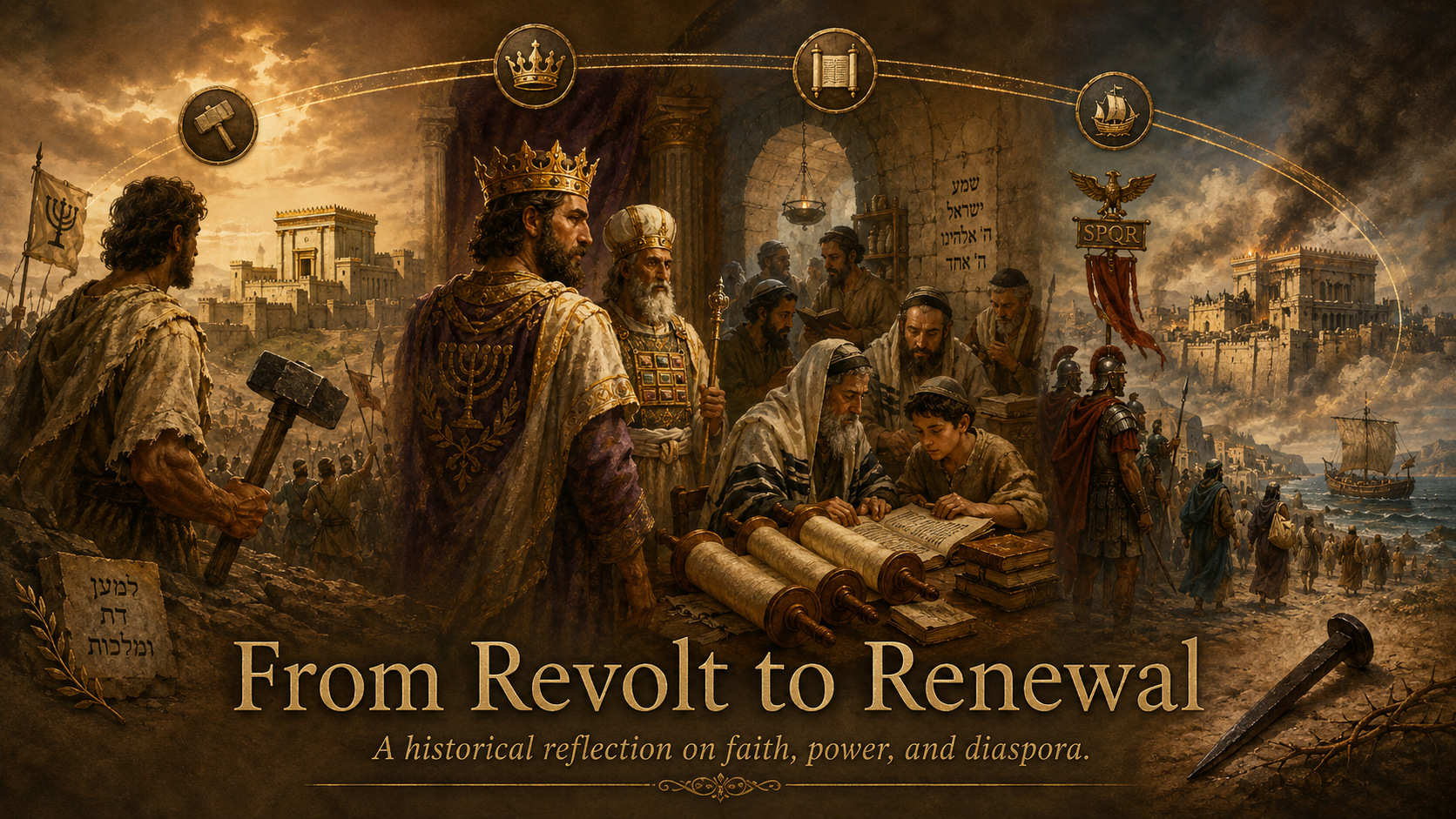
Around 167 BCE, the Maccabean Revolt began in response to the Seleucid ruler Antiochus IV and his attempts to suppress Jewish religious practices and impose Hellenistic worship. Mattathias, a Jewish priest, and his sons resisted. His son Judah Maccabee became the great military leader of the revolt. The movement began as an effort to preserve Torah, Jewish identity, and the sanctity of the Temple.
But successful revolutions eventually have to govern.
From that victory emerged the Hasmonean dynasty, which ruled Judea from roughly 140 to 63 BCE. What had begun as religious resistance became a political establishment. Hasmonean rulers accumulated military, political, and priestly power, and the dynasty itself became troubled by questions of legitimacy, internal rivalry, and corruption.
Within this changing environment, the Pharisees emerged as a recognizable Jewish movement during the second century BCE. They represented, in part, another response to the concentration of religious authority. Their emphasis increasingly placed Torah into everyday life through study, interpretation, inherited tradition, prayer, and personal holiness. The movement was not a rejection of Judaism but another attempt to preserve and renew it.
The Pharisees occupied only a brief chapter in the long history of Judaism, though their influence endured through the rabbinic tradition that followed. Judaism as a whole should not be viewed through the narrow lens of one movement, one period, or the conflicts recorded in the New Testament.
Then the pendulum moved again.
In 63 BCE, Roman general Pompey intervened in a Hasmonean civil struggle and entered Jerusalem. Judea increasingly came under Roman domination. By the time of Yeshua in the early first century CE, Jewish society was wrestling simultaneously with Roman occupation, political compromise, Temple leadership, priestly authority, and competing understandings of Torah.
Concerns about corruption in the Temple establishment are not simply Christian criticisms looking backward. Jewish historical and rabbinic sources themselves preserve memories of political interference, abuses of power, and corruption surrounding the high priesthood during the Second Temple period. Yeshua’s criticism of religious leadership therefore took place within an already existing Jewish conversation about the integrity of its institutions.
Yeshua entered that argument as a Jew speaking largely to other Jews. His disagreements with Pharisees should not be reduced to Christianity against Judaism. He repeatedly called people toward what he understood as the heart of Torah: mercy, justice, faithfulness, love of God, love of neighbor, and inward transformation.
Yet Yeshua did not advocate armed revolution against Rome.
Others eventually did. The Great Jewish Revolt began in 66 CE, and Jerusalem and the Second Temple were destroyed in 70 CE. Another conflict followed in 115–117 CE, and the catastrophic Bar Kokhba Revolt of 132–136 CE brought another devastating confrontation with Rome.
These events profoundly reshaped both Judaism and the emerging Christian movement. Jewish communities had already existed throughout the Mediterranean and Middle East for centuries, but the destruction and displacement of this period further shifted Jewish life away from Jerusalem and the Temple. Rabbinic Judaism would increasingly center Jewish continuity around Torah, synagogue, study, prayer, and community.
At the same time, the followers of Yeshua were carrying their message outward through those same Mediterranean cities and roads. Christianity had begun as a Jewish movement, but during the first and second centuries it increasingly spread among Gentiles and gradually developed an identity distinct from Judaism.
And so there is another remarkable irony. Out of war, destruction, displacement, and tremendous suffering came an extraordinary dispersal of Scripture and ideas. Jews carried the Hebrew Scriptures and Jewish faith throughout the world, while followers of Yeshua carried those same Hebrew Scriptures together with the developing Christian writings.
I would never suggest that the suffering itself was good. But I cannot help noticing the biblical pattern: God can work even through what human beings intend or experience as calamity and turn history toward purposes no one living through those events could have imagined.
There is even a striking image at the beginning and end of this progression. Judah Maccabee was traditionally remembered as “the Hammer.” His struggle eventually produced the Hasmonean dynasty, whose internal conflicts helped open the door to Roman intervention. Nearly a century later, under Roman authority, Yeshua was crucified.
The story that began with “the Hammer” eventually arrived at a Roman nail.
It took a hammer to drive the nail—though no one holding that first hammer could possibly have imagined where history would lead.
Yeshua did not present himself as the founder of a new religion detached from Israel, Torah, and the God of Abraham, Isaac, and Jacob.
That alone begs a question worth all of us considering.