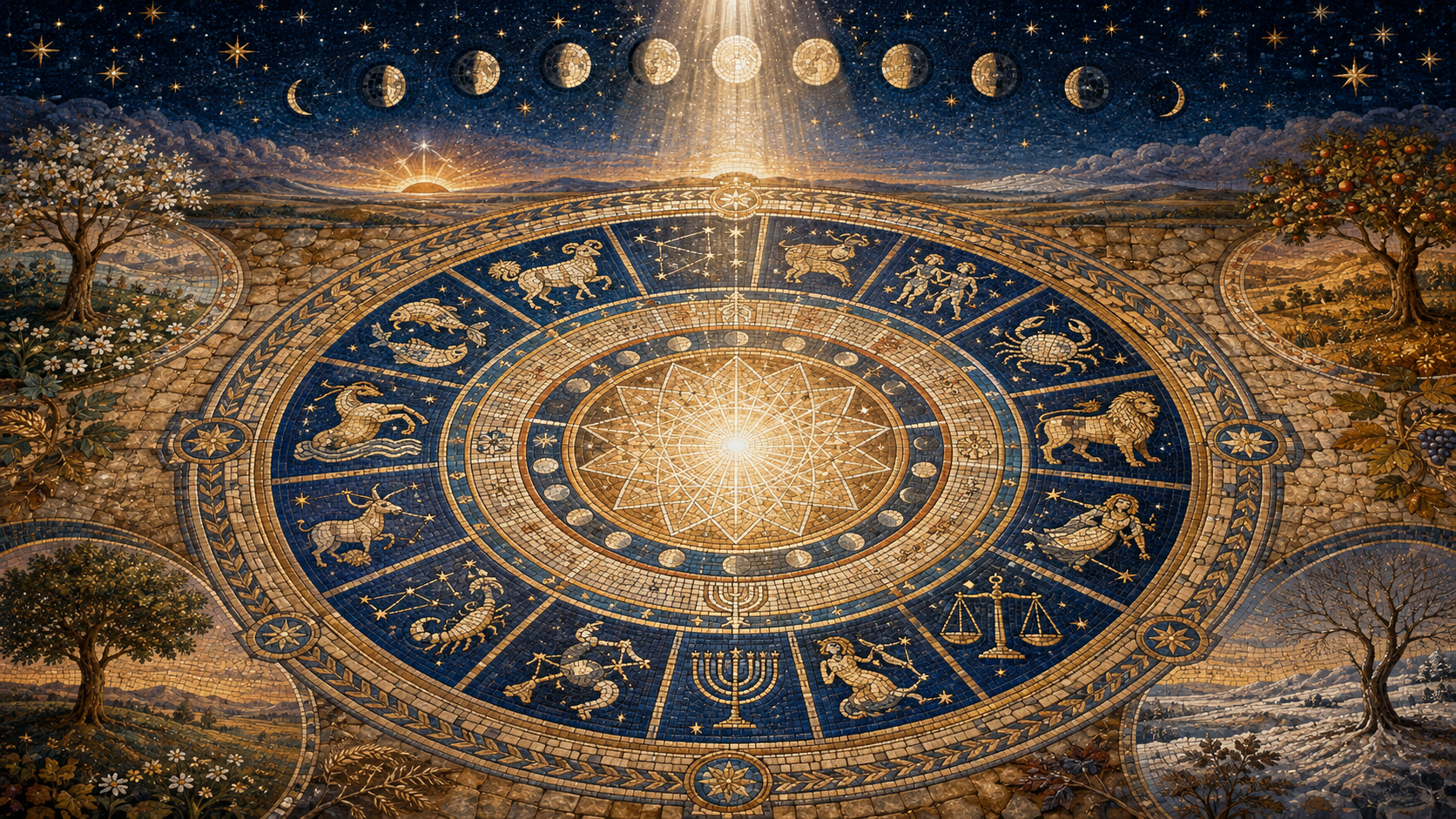
How the Creator Wrote Order into the Heavens—and Invited Us to Enter It
“Canst thou bind the sweet influences of Pleiades, or loose the bands of Orion? Canst thou bring forth Mazzaroth in his season? … Knowest thou the ordinances of heaven? canst thou set the dominion thereof in the earth?”
—Job 38:31–33, KJV
Mazzaroth is commonly understood as the constellations or zodiac. God brings forth the constellations in their appointed seasons, establishes the mathematical order of heaven, and extends that order over the earth.
Preface:
God built time mathematically into creation, gave Israel a calendar for recognizing it, placed sacred meetings within it, wrote its rhythm into our bodies, and showed through Yeshua what it means to live entirely within it.
Time is mathematics, and astronomy is mathematics written across the heavens.
That may sound like a modern scientific observation, but it begins on the first page of the Torah. Before there was a clock on a wall or a calendar on a desk, God placed the measurement of time into creation itself:
“Let there be lights in the firmament of the heaven to divide the day from the night; and let them be for signs, and for seasons, and for days, and years.” —Genesis 1:14
The word translated “seasons” is mo’adim: appointed times. The sun, moon, and stars were not merely lights. They gave visible order to days, months, seasons, years, and sacred appointments. God created time, set it in motion, and gave humanity a way to recognize where we stood within it.
The heavens were the first clock.
Time Made Visible
Ancient people did not experience time primarily as numbers changing on a screen. They looked up.
The rising and setting sun divided light from darkness. Its changing position along the horizon revealed the movement of the seasons. The moon waxed and waned, marking the month. Familiar constellations appeared, disappeared, and returned at predictable points in the year. The relatively fixed stars supplied the markings; the sun, moon, and wandering planets supplied the movement.
The constellations were the clock face, and the lights of heaven were its moving hands.
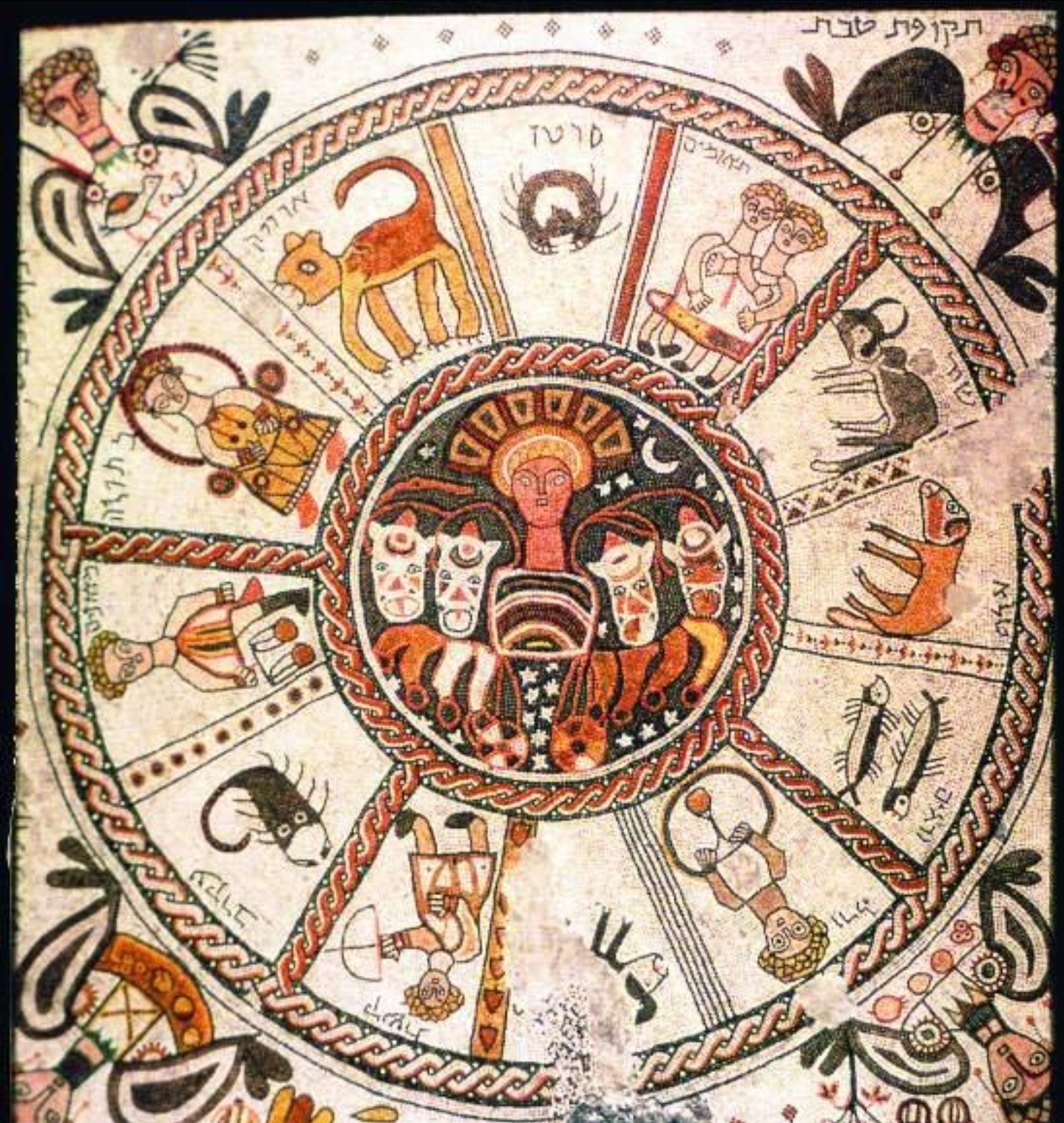
This is why a zodiac could be understood as a timepiece. Its twelve divisions pictured the annual course of the heavens. In later ancient synagogues—including those at Hammat Tiberias, Sepphoris, and Beit Alpha—zodiac wheels appeared with the seasons and, in some examples, the Hebrew months. These surviving mosaics date from late antiquity rather than the biblical period, but they preserve a thoroughly Jewish way of seeing time as visible, cyclical, and ordered.
I do not think we should automatically dismiss these images as pagan. A visual form can be borrowed without its pagan theology being accepted. Within a synagogue, the zodiac could declare something very different from astrology. It did not have to say that the stars controlled Israel. It could say that the God of Israel controlled the stars.
Astrology asks what power the stars exercise over us. The Jewish calendar asks what time the stars announce to us.
The God who ordered the heavens also governed everything synchronized with them: light and darkness, rain and drought, planting and harvest, animal migrations, pilgrimages, festivals, offerings, work, and rest. The celestial cycle was the visible face of a much larger created order.
At the center of its meaning was God, who remained above the heavens. He was not one power among the sun, moon, and stars. He was the unseen Creator who appointed their courses.
Time Is Math
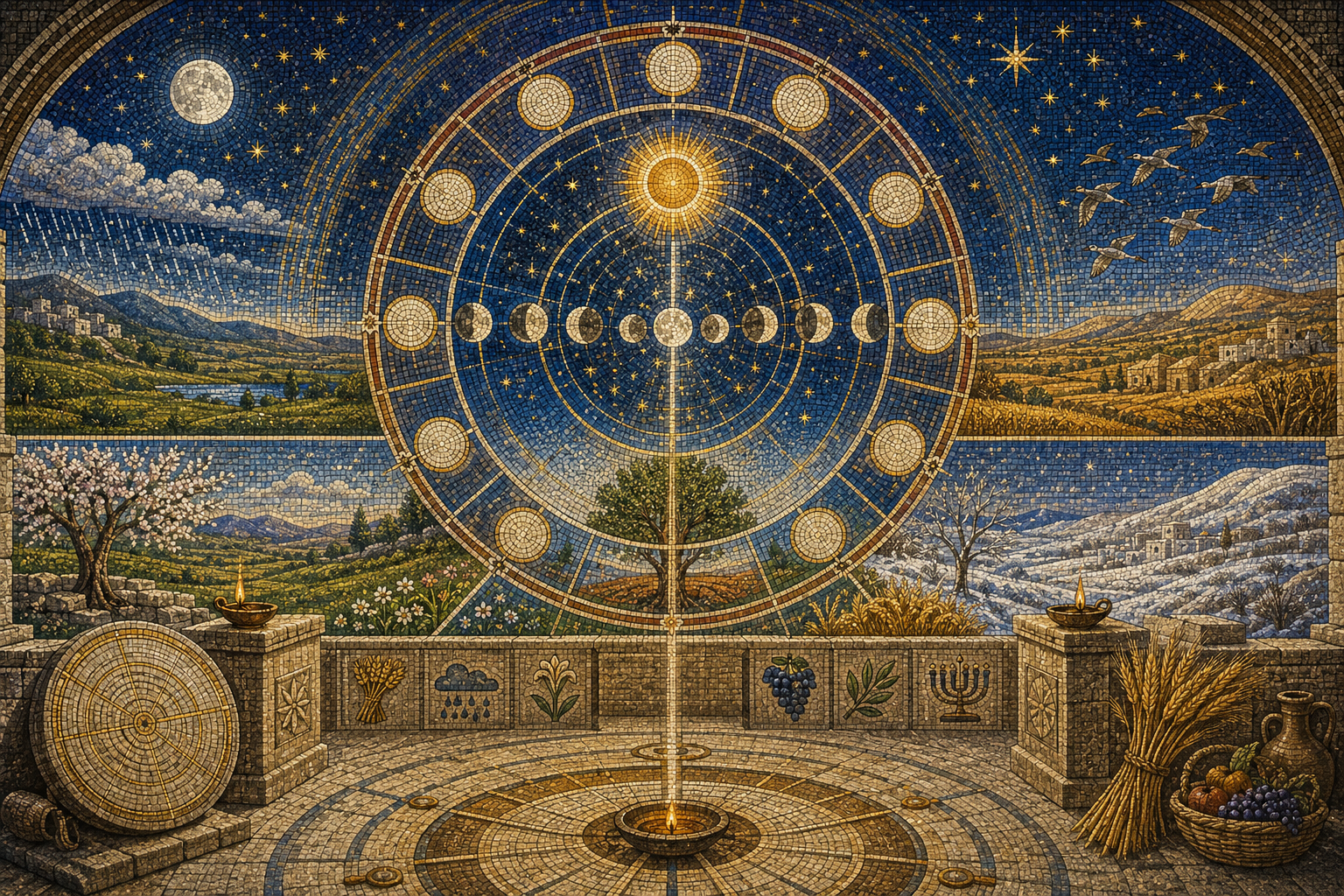
Time becomes useful because it is ordered and measurable. Twenty-four hours complete our familiar day. Seven days establish the Sabbath week. Approximately thirty days form a lunar month. Twelve idealized months of thirty days produce the 360-day year used in some biblical and prophetic calculations. A circle likewise contains 360 degrees.
The actual heavens are not quite that simple. A lunar year is about 354 days, while a solar year is about 365¼ days. A lunisolar calendar must therefore be adjusted periodically so that its months remain aligned with the seasons. That does not weaken the pattern. It demonstrates how closely the heavens had to be observed and how much mathematics was required to keep sacred time.
Time is math. Astronomy is math. The calendar translates that heavenly mathematics into human life.
The Torah then translates it into worship. Numbers 28 and 29 arrange offerings according to a nested rhythm: morning and evening, Sabbath, new moon, Passover, Shavuot, Yom Teruah, Yom Kippur, and Sukkot. Daily time rests within weekly time; weekly time rests within monthly time; monthly time rests within the sacred year.
The heavens display the mathematics. The calendar names the appointments. The offerings bring those appointments into worship.
Months with Meaning
In Jewish tradition, months are not spiritually empty containers. Each month acquires a nature through its season, agriculture, biblical history, and appointed observances.
Nisan carries liberation and new beginning through Passover. Sivan carries revelation through Shavuot. Tammuz and Av bring constriction, mourning, and then consolation. Elul calls us toward return. Tishrei leads through trumpets, judgment, repentance, forgiveness, and finally the joy of Sukkot. Kislev brings light during darkness. Adar carries joy and reversal.
Rabbinic tradition places the birth of Yitzchak at Passover. That is wonderfully appropriate. Sarah conceived after hope appeared humanly exhausted, and Genesis says that she bore her son “at the appointed time”—la-mo’ed—of which God had spoken (Genesis 21:2). The child whose name means “he will laugh” arrived in Nisan, the season when an impossible promise becomes deliverance. Laughter itself was born on God’s time.
The connection continues through the imagery of provision. Yitzchak, the promised son, is later spared when God provides a ram on Moriah. At Passover, God appoints the lamb through which Israel’s firstborn are preserved. Nisan therefore gathers promise, birth, liberation, the ram, the lamb, and mo’ed within one sacred season.
Later Jewish mystical tradition develops these associations through Hebrew letters, tribes, human faculties, and constellations. We should not project every later association backward into the biblical period. Yet the underlying idea is deeply Jewish: sacred time has texture. Each season prepares the community to remember, to feel, to act, and to expect differently.
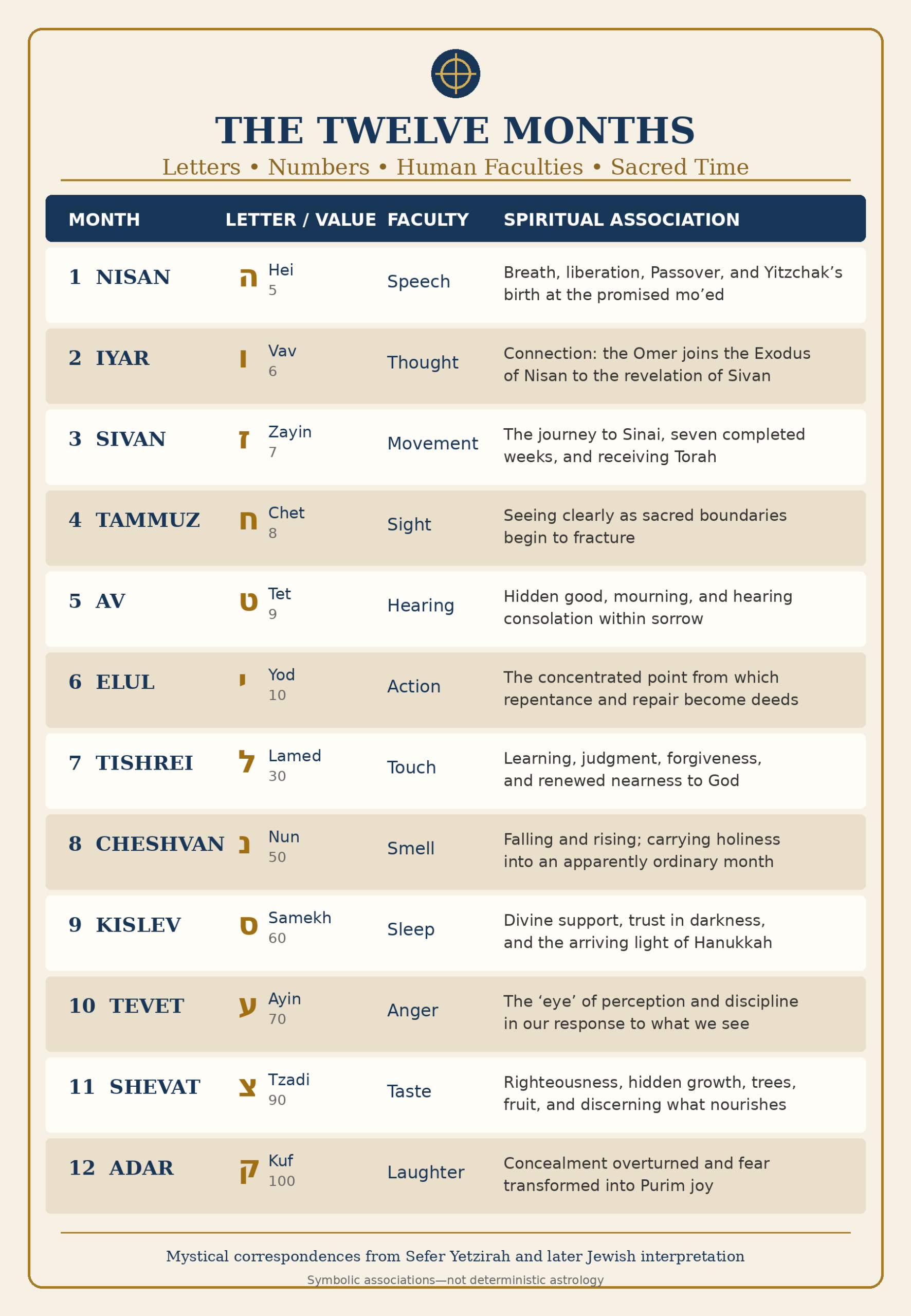
Sefer Yetzirah, an early and enigmatic Jewish mystical work known as the Book of Formation, connects the twelve months with the twelve “simple” Hebrew letters.
In this vision, letters, numbers, time, the heavens, and the human person participate in a single created order. Nisan corresponds to Hei, Iyar to Vav, Sivan to Zayin, and the sequence continues through Kuf for Adar. The associations do not mean that letters or constellations dictate our fate. They provide a spiritual vocabulary for recognizing the character of appointed time.
The arithmetic contains an intriguing pattern in the Hebrew letters assigned to the months of a year. The first six month letters assigned to Nisan through Elul total 45—the gematria of Adam (אדם).
The Hebrew month of Elul is known as a time of spiritual preparation, introspection, and repentance leading up to the High Holidays of Rosh Hashanah and Yom Kippur.
The other half of the year’s assigned six letters are Tishrei through Adar total 400—the value of Tav (ת), the final Hebrew letter and a sign or mark, the letter pictured as a cross.
The full sequence therefore totals 445: 45 plus 400, Adam plus Tav. I do not offer this as a doctrine stated by Sefer Yetzirah. It is a mathematical observation: humanity appears within the cycle of time, moving toward its appointed completion.
Sivan offers another example. It is the third biblical month, but its associated letter is Zayin, valued at seven. Shavuot arrives in Sivan after seven counted weeks, on the fiftieth day. Letter, number, movement, month, and revelation gather around the same appointed season.
To be born in a particular month could therefore be received as meaningful—not because a constellation controlled the child, but because God controlled the time of the child’s arrival. Birth entered an already meaningful moment within God’s calendar.
The same system also allowed people to look forward. The returning moon, constellations, rains, migrations, and agricultural conditions announced what was approaching. Families could prepare for planting, harvest, pilgrimage, offerings, and festivals. This was not fortune-telling. It was confidence that the Creator’s order was dependable enough to prepare for what came next.
The calendar formed the expectations of the people.
God Allots Time
God does not merely measure time. He allots it.
Scripture speaks of numbered days, appointed seasons, generations, and times placed in God’s hands. Moses prays, “Teach us to number our days, that we may apply our hearts unto wisdom” (Psalm 90:12). Daniel says that God “changes the times and the seasons” and raises and removes kings (Daniel 2:21). Ecclesiastes tells us that there is a time for every purpose under heaven.
History is measured in years and generations. A life is measured in days. Yet beneath both is the same truth: time is received, not possessed.
Even the Hebrew word mo’ed—appointed time or appointed meeting—invites reflection. Its standard gematria is 120:
מ (mem) = 40
ו (vav) = 6
ע (ayin) = 70
ד (dalet) = 4
Together they equal 120, the age of Moses when his life reached its completion and the number associated with the human span in Genesis 6:3. I would not offer that correspondence as proof of a hidden code. I simply find it remarkable that the word for an appointed time and meeting carries a number associated with an allotted human lifetime.
God gives us time, numbers our days, and places appointments within them.
The Clock Within Us
The measurement of time is written not only above us but within us.
Our bodies move with creation. Light and darkness regulate sleep, hormones, temperature, and daily rhythms. The years are recorded in growth and aging. Matter decays at measurable rates. Light travels at a fixed speed. Change reveals duration, while the laws governing that change remain mathematically intelligible.
As living souls, we are as bound to God’s time as we are bound to life on this planet. Our bodies belong to the earth, and our days belong to the order God set in motion.
Our heart provides the most personal reminder. We do not consciously command each beat, yet each one measures another interval of the life we have been given.
To hear our heart is to hear time. The heavens mark time above us, the seasons mark it around us, and the heart marks it within us. Every beat is a reminder of the Creator and of His gift: time.
Stopping Ordinary Time
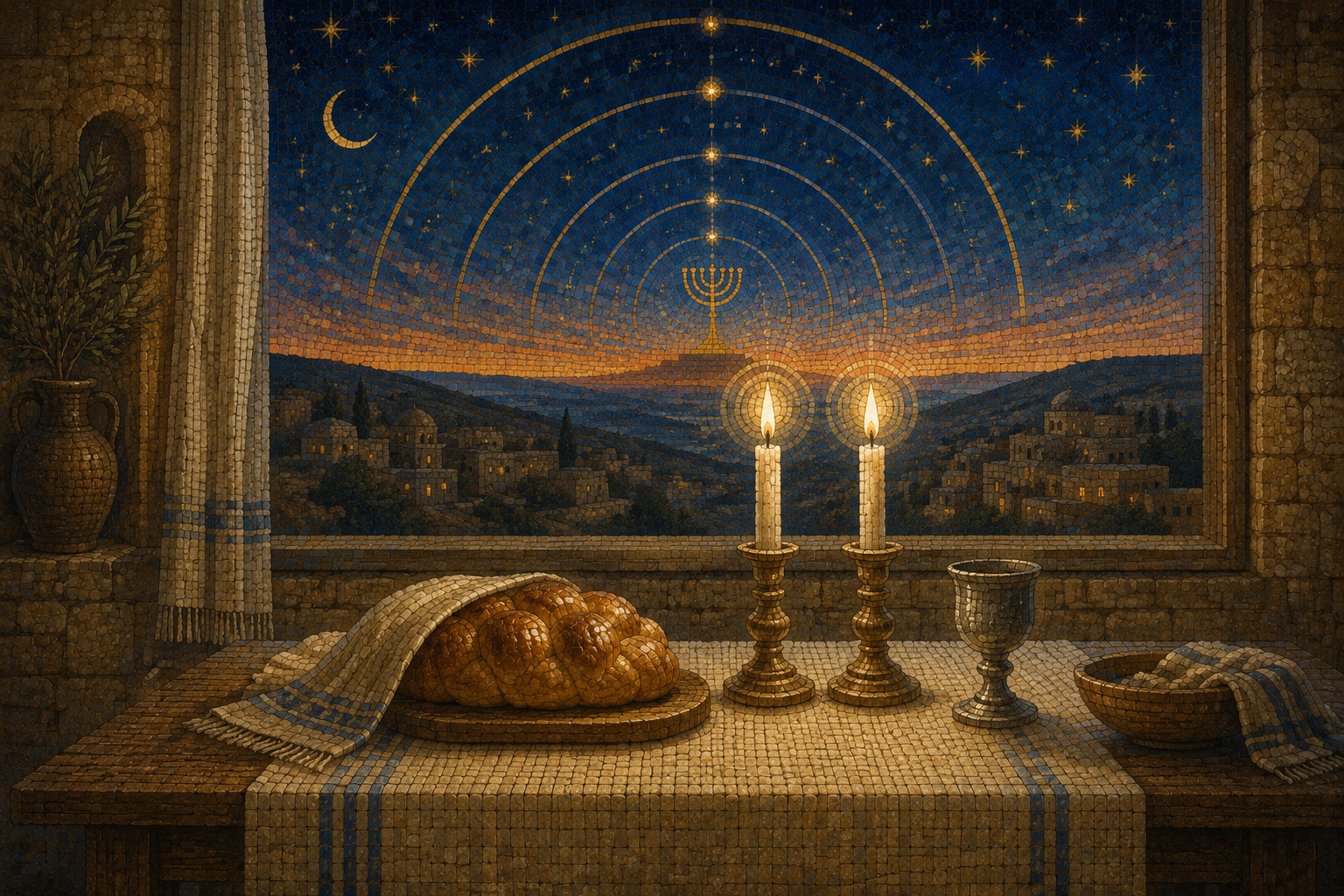
We experience time through context. A clock measures every minute equally, but the heart does not. A moment of wonder can seem suspended. Waiting can make a minute feel long. Absorbing work can make hours disappear. The clock measures duration; the heart experiences meaning.
Perhaps this helps explain the Sabbath.
For six days, time is commonly measured through labor, schedules, production, and accomplishment. On the seventh day, God commands us to stop. Shabbat does not stop chronological time. It interrupts ordinary time so that we can recognize sacred time.
God rested, and we rest. We stop creating and enter the rhythm of the Creator.
God commanded us to keep His time as a way of synchronizing our clocks with His. It is like making a date with someone we love. The time is chosen, ordinary obligations are set aside, and we become present. God established the appointment. By keeping it, we say that being with Him matters enough to reserve the time.
This is contained in the meaning of mo’ed: an appointed time that is also an appointed meeting.
We observe the Sabbath, and through the Sabbath we observe the Creator. For that sacred interval, we are no longer living only by schedules and productivity. We are on God’s time.
Yeshua on God’s Time
This is where the New Testament enters the story—not to begin a different subject, but to continue the biblical story of time.
Yeshua said, “The Sabbath was made for man” (Mark 2:27). Sacred time was created as a gift. God made a day in which humanity could cease ordinary labor, become attentive to His presence, and delight in being with Him. The Shabbat candles of later Jewish tradition welcome that time with light; the Havdalah flame marks its departure. In the Temple, the menorah was tended according to an appointed daily rhythm. Light, worship, and sacred time belong together.
The Gospels present Yeshua’s life through unusually precise markers of time. He is circumcised and named on the eighth day. At twelve years old, He is found in Jerusalem at Passover. His public ministry begins when He is about thirty, within the fifteenth year of Tiberius. He spends forty days in the wilderness. John introduces His first sign at Cana with the words “on the third day.” The Transfiguration follows a specifically numbered interval. Yeshua waits two days before going to Lazarus, arriving when Lazarus has been in the tomb four days.
John organizes much of Yeshua’s ministry around the Jewish festival calendar: Passover, Sukkot, Hanukkah, and the final Passover. Yeshua does not float above Jewish time. He enters its Sabbaths, pilgrimages, festivals, and expectations.
Most strikingly, He repeatedly speaks of “My hour.” At first, His hour has not yet come. His opponents cannot seize Him because the hour has not come. Then, approaching the final Passover, He declares that the hour has come. Human beings appear to be driving events, but the Gospel insists that the decisive time belongs to God.
The heavens also frame His life. Matthew records a celestial sign announcing His birth, and Herod asks the Magi when the star appeared. At His death, the Gospel writers mark the hours and report darkness from the sixth to the ninth hour. They do not call that darkness a solar eclipse, and a normal solar eclipse would not occur at Passover’s full moon. The point does not require an astronomical claim the text does not make. The heavens that Genesis assigns to signs and appointed times mark the Gospel story at its beginning and its climax.
The Passover setting adds another layer. Nisan became associated in Jewish zodiac tradition with Aries, the Ram. In Genesis, God provides a ram on Moriah at precisely the necessary moment. Later, He establishes Passover as an appointed time centered upon a lamb. In the New Testament, Yeshua enters that same Passover season as the Lamb of God.
The ram, the lamb, the month, the festival, and the hour converge. The stars do not cause the event. God appoints the time.
Yeshua’s final days continue the numerical pattern. John places Him near Jerusalem six days before Passover. Mark records the third, sixth, and ninth hours. He rises on the first day of the week and, according to repeated New Testament testimony, on the third day. Acts records appearances over forty days, followed by the outpouring of the Spirit at Shavuot—Pentecost, the fiftieth day.
Yeshua lived on God’s time: 24/7/360.
Twenty-four hours signify the complete day. Seven days establish the Sabbath rhythm. Three hundred sixty degrees complete the circle and recall the idealized ancient year. Every hour, every day, every festival, the entire way around—Yeshua moved according to the Father’s time.
In becoming flesh, He entered the same created limits that bind us. He experienced days and nights, waiting and weariness, Sabbaths and festivals. Yet within those boundaries, He lived entirely within God’s appointed order. He waited when His hour had not come, acted when it arrived, and completed His work at the appointed time.
On God’s Time
The Tanakh gives us a world ordered by time. The heavens mark it. Mathematics measures it. The calendar interprets it. The seasons embody it. The offerings sanctify it. The body records it. The heart beats within it. History carries it from one generation to the next.
Then Yeshua enters that same time—not as a rejection of the calendar God gave Israel, but as one who recognizes its Sabbaths, festivals, hours, and appointed meanings. His life shows what it looks like for a human being to move entirely on God’s time.
That is the connection I keep seeing: Two stories, one Book, one God.
God set time in motion. He wrote its order into the heavens and its rhythm into our bodies. He numbers our days and appoints our meetings. Then, on Shabbat, He asks us to stop—to loosen our grip on ordinary time and enter the time He set apart.
The heavens measure time. Our hearts experience it. The Sabbath sanctifies it. And God allots its measure.
Appendix: The Twelve Months and Their Letters
The following chart presents the commonly used Sefer Yetzirah sequence together with spiritual interpretations developed in later Jewish teaching. Versions and commentators sometimes differ in their secondary associations. These should therefore be understood as mystical correspondences, not as explicit teachings of the Torah and not as a system of deterministic astrology.
The Numerical Pattern:
The first six letters produce:
5 + 6 + 7 + 8 + 9 + 10 = 45 = אדם (Adam)
The final six produce:
30 + 50 + 60 + 70 + 90 + 100 = 400 = ת (Tav)
The entire cycle produces:
45 + 400 = 445
The calculation is exact. Its interpretation remains contemplative: Adam lives inside appointed time, while Tav, the final letter and mark, suggests the boundary and completion toward which allotted time moves.
Sources for further study:
- Sefer Yetzirah, chapter 5
- Babylonian Talmud, Rosh Hashanah 10b–11a
- Zeev Weiss, “The Zodiac in Ancient Synagogue Art”
- Genesis 1:14; Genesis 21:2; Numbers 28–29