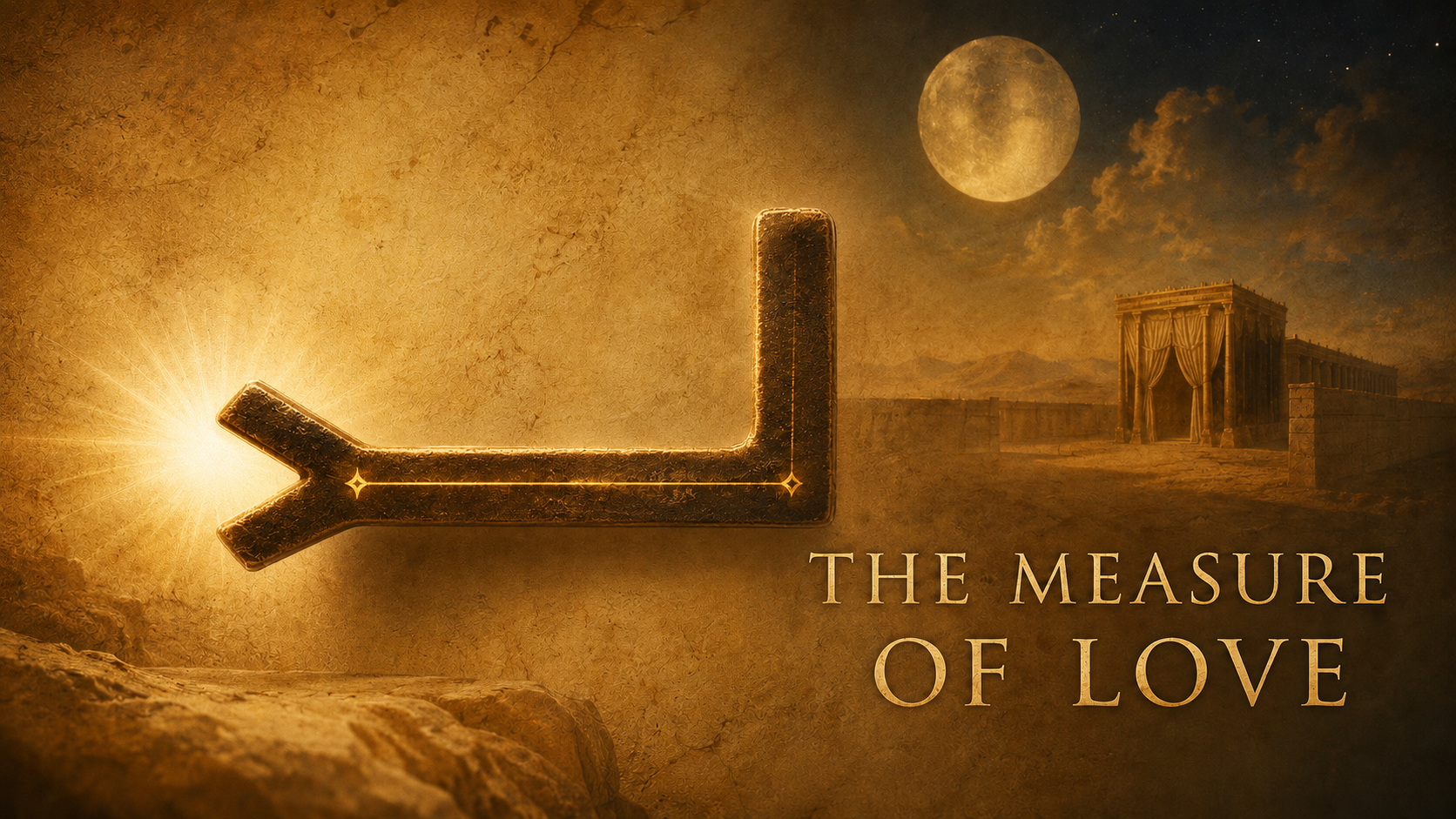
THE MEASURE OF LOVE
The Hand, the Cubit, and Life
A Meditation By Jonah
My recent article, Love & Devotion, was an opinion. This is different. This is a meditation.
I am not trying to prove that the ancient Hebrews created the cubit as a numerical symbol for life. I am not building a doctrine around inches, and I know that more than one cubit was used in the ancient world. I am simply following an association that I believe the Holy Spirit placed upon my heart. I write to think, and sometimes a small thought opens a much larger door.
It began with the smallest Hebrew letter. Yod: The Arm and the Hand
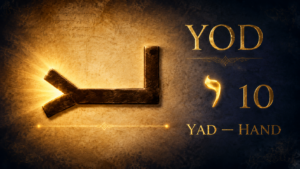 Yod—י—is the tenth letter of the Hebrew alphabet. Its numerical value is ten. The ancient form is commonly associated with an arm and hand, and the Hebrew word yad means hand.
We have ten fingers upon our two hands—the instruments through which thought becomes action. With our hands we build, give, bless, serve, and sometimes destroy. The hand reveals what the heart has chosen.
God gave Israel the Ten Commandments, traditionally called the Ten Words. They established a divine measure for loving God and loving one another. Their number invites me to see the commandments as belonging not only upon tablets of stone, but upon the whole hand—carried into the things we touch and the deeds we perform.
As I looked at that early shape, it reminded me of a cubit. A cubit is a bodily measure extending from the elbow toward the fingertips. The arm supplies the length, and the hand completes it.
A common biblical cubit is often approximated at eighteen inches, although ancient cubits were not all identical and some were longer. That number caught my attention because eighteen is the numerical value of chai—חַי—life: Chet is eight and Yod is ten.
Chet, 8 + Yod, 10 = Chai, 18: Life.
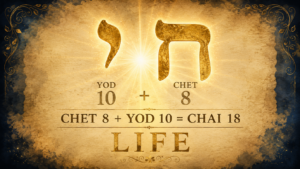 Again, I am not offering that as historical proof. I am receiving it as a picture: the arm extending to the hand, a measure associated with eighteen, and chai—life. Once I saw that picture, I began looking at the places where cubits matter in the Hebrew Scriptures.
I found that God often measures the very things through which He preserves life, reveals His presence, receives devotion, and promises restoration.
The Ark: A Measured Place of Life
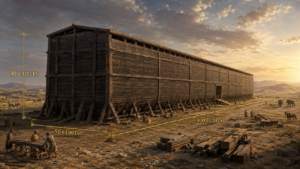 The first great structure in Scripture described by cubits is Noah’s ark. God did not simply tell Noah to build something large. He gave him measurements: three hundred cubits long, fifty cubits wide, and thirty cubits high (Genesis 6:15).
Those measurements formed a vessel of preservation. Inside that measured space, a family and living creatures passed through the flood. Before the waters came, God measured a place where life would be carried forward.
What God measured according to His wisdom became a vessel for life.
Noah still had to build it. The pattern came from God, but human arms lifted the timbers and human hands did the work. The hand received a measure, and then the hand acted upon it. Perhaps this is our first glimpse of love measured in deeds. God provided a way of preservation, and Noah responded through obedient work.
The Tabernacle: A Measured Dwelling
 Cubits become even more significant in Exodus. The ark of the covenant, the table, the altar, the curtains, the boards, and the courtyard were all given dimensions. God was not describing an ordinary tent. He was revealing a dwelling place.
And let them make me a sanctuary; that I may dwell among them.
—Exodus 25:8
That verse changes the measurements for me. The dimensions are not cold calculations. They prepare a place of meeting. God gives the pattern because He desires to dwell among His people.
The Tabernacle was measured in cubits, but it was fashioned by hands. God filled Bezalel with wisdom, understanding, knowledge, and skill for the work (Exodus 31:1–5). The Spirit-inspired design moved through Spirit-equipped human hands.
The boards stood ten cubits high. The number ten brings Yod—the hand—back into the meditation. I do not insist that this is an encoded message. I simply notice the harmony: the measured dwelling, the ten-cubit boards, and the hands faithfully making what God had shown.
God gives the measure. The Spirit gives the wisdom. The hand performs the work. God fills the dwelling.
The Altar: Where Devotion Takes Form
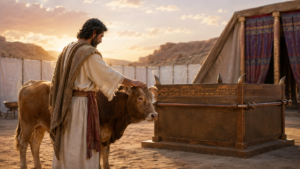 The altar was also measured in cubits. This is where the meditation touches my last article, Love & Devotion.
In Leviticus 1, the worshiper placed a hand upon the offering. Love and devotion were not left as invisible feelings. The hand moved. The offering was brought. Trust and surrender took visible form.
Perhaps love is always moving in that direction. It begins within us, but it does not remain hidden. It reaches the arm, arrives at the hand, and becomes an act. Love gives, carries, builds, serves, shelters, and lifts.
The cubit measures the altar. Devotion reveals the measure of the heart.
The Temple: Love Prepares a House
 Solomon’s Temple is also presented through careful measurements in cubits. Its length, width, height, porch, inner sanctuary, courts, and furnishings were not left to chance. David desired to prepare a house for the LORD, and Solomon brought that work to completion.
Here love becomes preparation. Materials are gathered. Craftsmen are appointed. Stone, wood, and gold are shaped. A desire in the heart becomes labor in the hands.
The inner sanctuary was a cube—twenty cubits long, twenty cubits wide, and twenty cubits high (1 Kings 6:20). Centuries earlier, God had measured a vessel to preserve life. Then He measured a sanctuary in the wilderness. Now a measured house stood in Jerusalem, and the glory of the LORD filled it.
The measurements did not contain God. Solomon himself confessed that even heaven and the heaven of heavens could not contain Him (1 Kings 8:27). Yet the God whom the heavens cannot contain chose to meet His people in a place prepared according to His word.
That, too, looks like love to me: the limitless God drawing near.
Ezekiel: God Measures Again For The New Millennium Temple
Near the end of Ezekiel, after judgment, exile, and loss, the prophet sees a man with a measuring reed. Gates, courts, chambers, walls, and the sanctuary are measured in detail (Ezekiel 40–42).
Israel had lost the Temple, but God had not abandoned His purpose. He was measuring again.
That may be one of the most hopeful images in this meditation. Measurement is not only about beginning something new. God also measures when He restores. What appeared ruined was not beyond His design.
The book of Ezekiel is an excellent example. In the prophetic vision of the millennial temple found in Ezekiel 40, the measurement of 25 cubits (and its multiples, like 50 or 25,000) serves as a fundamental architectural blueprint.
In ancient Israel, a standard cubit was roughly 18 inches, but Ezekiel’s vision explicitly uses a “long cubit” (a regular cubit plus a handbreadth, or about 21 inches).
The number 25 appears in two primary ways throughout Ezekiel’s vision:
1. The Gateway Structural Dimensions (Ezekiel 40)
When the angelic guide measures the massive, highly symmetrical gates leading into the temple courts, 25 cubits is the structural standard for their width:
* Gate Width: Every major gateway complex (the outer east, north, and south gates, as well as the inner gates) measures exactly 50 cubits long and 25 cubits wide.
* The Roof-to-Roof Span: In Ezekiel 40:13, the guide measures the gate from the roof of one guardroom to the roof of the opposite guardroom, totaling 25 cubits.
* The Porticoes: The covered porches or porticoes surrounding the inner court are measured at 25 cubits wide.
2. The Sacred District / Holy Allotment (Ezekiel 45 & 48)
When the vision expands from the temple building to the surrounding land allocations for a restored Israel, the number 25 scales up dramatically into multiples of thousands.
* The Foursquare Allotment: God commands that a massive square portion of land—called the holy district—be set apart. It measures 25,000 cubits by 25,000 cubits (roughly 8.3 miles by 8.3 miles).
* The Priests & Levites: The land is divided into sections measuring 25,000 cubits long and 10,000 cubits wide for the priests and Levites who minister before the Lord.
Theologians and Hebraic scholars view the overwhelming repetition of 25 cubits in these chapters as highly deliberate rather than random:
* The Year of the Vision: Ezekiel explicitly notes in Ezekiel 40:1 that this vision was given to him in the 25th year of the Babylonian exile. The dimensions of the temple echo the very year of his calling.
* The Jubilee Connection: The number 25 is exactly half of 50, directly tying it to the Jubilee cycle (the 50th year of liberty, restoration, and return of inherited land found in Leviticus 25). The 50×25 cubit gates represent an entrance into divine liberty and spiritual restoration.
* Perfect Symmetry: The extensive use of 25, 50, 500, and 25,000 creates a perfectly proportional, harmonious layout. Symbolically, it demonstrates that God’s future dwelling place is perfectly ordered, balanced, and deliberately designed without chaos.
Then, in Ezekiel 47, water flows from the Temple. It deepens as it travels, and wherever the river goes, life appears. God measures the dwelling. His presence fills it. The water flows. Life follows. The measured dwelling becomes the source of an immeasurable river.
Yah: The God Who Takes Us by the Hand
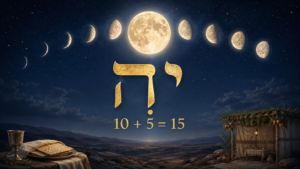 Yod also begins Yah—יָהּ—the shortened form of God’s sacred name. Yod is ten and Heh is five, giving Yah the value fifteen.
Fifteen carries a quiet importance in Jewish thought. The Hebrew month begins with the renewal of the moon, and around the fifteenth day the moon reaches its fullness in the heavens. Pesach begins on the fifteenth of Nisan, and Sukkot on the fifteenth of Tishrei. What begins as a thin light grows until it is openly revealed.
Fifteen also marks ascent. Psalms 120 through 134 are the fifteen Songs of Ascents. The Mishnah describes fifteen steps in the Temple corresponding to those songs, where the Levites stood with their instruments (Sukkah 5:4). Yah—fifteen—brings heaven and earth together in this meditation: fullness above, and worshipers ascending below.
Jewish practice even avoids writing the number fifteen in the expected form of Yod-Heh, because those letters form the sacred name. It is ordinarily written Tet-Vav—ט״ו—nine plus six. Fifteen is a number treated with reverence because it carries the whisper of Yah.
The Talmud reads Isaiah’s words, ‘for in Yah, the LORD, is an everlasting rock,’ as an allusion to the two worlds formed through Yod and Heh—this world and the World to Come (Menachot 29b). In that tradition, the letters of Yah do not point only upward to the heavens. They hold creation itself together.
Fifteen suggests fullness and ascent. Eighteen suggests life. The hand of Yah reaches from heaven and leads us into life.
But the hand is more than a symbol of labor or measurement. The Hebrew Scriptures repeatedly show God taking His people by the hand.
For I the LORD thy God will hold thy right hand, saying unto thee, Fear not; I will help thee.
—Isaiah 41:13
The psalmist says, ‘Thou hast holden me by my right hand. Thou shalt guide me with thy counsel’ (Psalm 73:23–24). Isaiah speaks of the LORD calling His servant in righteousness and holding his hand (Isaiah 42:6). Even in the farthest place the psalmist can imagine, he says, ‘Even there shall thy hand lead me, and thy right hand shall hold me’ (Psalm 139:10).
God does not merely point from a distance. He reaches. He holds. He steadies. He leads.
The same God who gave the measurements of the ark, the Tabernacle, and the Temple takes His people by the hand. His hand establishes the pattern, but it also enters the story personally. He does not only prepare the dwelling. He leads us toward it.
The Measure of Love
So how is love measured? Perhaps not by the strength of an emotion or the beauty of our words. Perhaps love is measured by its reach—by how far the arm will extend and by what the hand is willing to do.
In the Hebrew Scriptures, cubits measure an ark that preserves life, a sanctuary for God’s presence, an altar of devotion, a Temple prepared through costly labor, and a restored dwelling from which living water flows.
The cubit is a measure of an extended arm. The arm ends in Yod, the hand. A commonly estimated cubit points my thoughts toward eighteen, chai, life. And Scripture shows the hand of Yah reaching for ours.
Love reaches. The hand acts. Devotion gives. Life follows.
This does not replace the plain meaning of any passage. It is not a formula, and it is not proof hidden in an inch. It is a meditation—a picture I believe the Holy Spirit placed before me and invited me to follow through the Scriptures.
My last article considered love and devotion: love expressed by giving, surrendering, and withholding nothing. This meditation carries that thought one step farther. Love becomes measurable when it becomes an act. An open hand makes room for another. A working hand builds refuge. A steady hand lifts. A guiding hand leads. And before any of our hands reach for Him, God reaches for us.
A Final Thought
I began with a small letter: Yod, the arm and hand. It led me to the cubit, then to chai—life—and finally through the measured places of the Hebrew Scriptures.
Through them all, one picture remains with me: an arm extended and a hand open.
Perhaps the measure of love is the distance one is willing to reach to take another by the hand.
The God who measures also reaches. The God who gives the pattern also gives His presence. The God who calls us to acts of love first takes us by the hand and leads us into life.
Ezekiel 48:35 — It was round about eighteen thousand measures: and the name of the city from that day shall be, The Lord is there.
The book of Ezekiel ends on 18 (Life) to the thousand!