
The Wisdom of Healing: Refuah
This post is dedicated to Grace, who is not feeling well and whose need for healing inspired this reflection. May the God who formed her, knows her completely, and understands every hidden part grant her רְפוּאָה שְׁלֵמָה (refuah shlemah)—complete healing and restoration. May God bless Grace with the grace of healing received.
Like many others, I am a bit of a hypochondriac. At the slightest symptom, my mind can race toward the worst possible explanation. I have gotten better—pun intended—but those anxious thoughts still remind me how deeply we long for reassurance, restoration, and wholeness.
In this post, I want to explore the Hebrew word for healing as I consider a deeper question: Where does our healing come from?
The vast majority of healing happens quietly, through processes our Creator has already woven into us. Our DNA carries an incredible sequence of instructions for forming, maintaining, and restoring us. A cut closes, a bruise fades, bones mend, and the immune system works without our conscious direction. Medicine can support these processes, and physicians can treat what has gone wrong, but the body’s underlying capacity to recover remains an astonishing gift. We are fearfully and wonderfully made, designed with an extraordinary ability to repair and restore.
Before we ask why some healing appears supernatural, perhaps we should recognize how supernatural ordinary healing already is.
Rafa: To Heal and Restore
The Hebrew root for healing is ר־פ־א (resh–peh–alef). The feminine noun רְפוּאָה (refuah) means “healing,” “recovery” or “restoration.”
Biblical healing is broader than the removal of illness. This root can describe the restoration of a body, a wounded land, unusable water, or a broken spiritual condition. Rafa is not merely about making pain disappear; it is about restoring something to the wholeness for which it was created.
 That is why the familiar blessing רְפוּאָה שְׁלֵמָה (refuah shlemah) means more than “feel better.” It asks for complete healing. The word shlemah belongs to the same word-family as שָׁלוֹם (shalom): completeness, soundness, and peace. We are asking God not only to treat what hurts, but to restore what has been broken.
At the waters of Marah, God reveals himself to Israel with the words:
אֲנִי יְהוָה רֹפְאֶךָ
Ani Adonai rofecha
“I am the LORD, your healer.”
—Exodus 15:26
Healing is not presented merely as something God does. “Healer” is part of how God makes himself known.
The One Who Formed Us Knows How to Restore Us
The God who heals us is the God who formed us. Psalm 103 calls him הָרֹפֵא (ha-rofe)—“the One who heals all your diseases”—and later explains, “For he knows how we are formed” (Psalm 103:3,14).
From the genetic information brought together in an egg and sperm, our Creator weaves an entire human life within the womb. Every organ, system, and healing process develops according to instructions carried within that first cell and every other cell. As Psalm 139 declares, we were woven together in our mother’s womb and are fearfully and wonderfully made.
The One who wrote the body’s design understands how every part is meant to function. Our healing is not entrusted to a distant stranger, but to the Creator who knows precisely how we were made. The One who formed us possesses the wisdom to restore us.
When Healing Becomes Life
The Hebrew word וָחָי (v’chai, meaning “and shall live”) appears in the Book of Numbers (Bamidbar) in chapter 21, verses 8 and 9. God tells Moses to make a bronze serpent on a pole so that anyone bitten by the fiery serpents looks at it וָחָי (“and live”).
The Torah gives us a dramatic picture of supernatural healing in Numbers 21. After Israel sinned in the wilderness, venomous serpents came among the people. When the people confessed and Moses interceded, God instructed him to make a bronze serpent and raise it upon a נֵס (nes), a pole or standard. Anyone who had been bitten could look upon what God had appointed and live.
The bronze object possessed no healing power of its own. The healing came from God and was received through trusting obedience. The afflicted person did not manufacture a cure. God provided the sign; the person looked; and God gave life.
Interestingly, the passage does not use rafa or refuah. Instead, it says:
וְהָיָה כָּל־הַנָּשׁוּךְ וְרָאָה אֹתוֹ וָחָי
Vehayah kol-hanashukh vera’ah oto vachai.
“Everyone who is bitten shall look at it and live.”
—Numbers 21:8
The final word is וָחָי (vachai)—“and live.” The healing is not named; it is revealed by its result. Death had begun its work, but God answered with life.
The raised serpent also forms a striking biblical parallel with the single-serpent staff used as a symbol of medicine. Historically, the modern medical emblem is generally traced to the Greek Rod of Asclepius rather than directly to Numbers. Nevertheless, the Torah’s image is powerful: an afflicted person beholds what has been lifted up and receives life from God.
Through the Nail, Healing Revealed
The gematria of רְפוּאָה (refuah) is:
ר (resh) = 200
פ (peh) = 80
ו (vav) = 6
א (alef) = 1
ה (hey) = 5
Total: 292
The Hebrew noun for healer or physician is rofeh (רוֹפֵא), derived from the verbal root rapha (רָפָא), which means to heal, cure, or restore. The difference between the verb and noun is 11, the combined value of ו (vav, 6) and ה (hey, 5). These are also the final two letters of the divine name יהוה.
Grammatically, the vav helps form the u sound in refuah, while the final hey belongs to the noun’s feminine form. Yet as a Messianic letter meditation, they create a compelling picture. Vav can symbolize a connecting peg or nail; hey can suggest beholding, revelation, or breath. In this symbolic reading, the movement from rafa to refuah whispers:
Through the Vav (nail), healing is revealed.
This is not the linguistic origin of the word, nor is letter symbolism proof of doctrine. It is a devotional echo—one that becomes especially powerful when read alongside the wounded Messiah.
Healing and the Wisdom of 73
The number 292 contains another surprising pattern:
292 = 4 × 73
In Hebrew gematria, 73 is the standard value of חָכְמָה (chochmah), “wisdom”:
ח (chet) = 8
כ (kaf) = 20
מ (mem) = 40
ה (hey) = 5
Total: 73
The ordinal value of those same letters—using their positions in the Hebrew alphabet—is 37: 8 + 11 + 13 + 5. Thus chochmah contains the mirrored numbers 37 and 73 within two systems of gematria.
Those same two numbers appear in the arithmetic of the Bible’s first verse. The standard gematria of Genesis 1:1 is 2,701, which equals 37 × 73. It is also the 73rd triangular number, because the sum of every number from 1 through 73 is 2,701. Both 37 and 73 are prime numbers, and their digits mirror one another.
These mathematical facts do not establish a theological doctrine, but they offer a beautiful meditation. The Bible opens with creation ordered by divine wisdom, and the value of refuah is four measures of the number associated with wisdom. Four frequently directs our attention toward the created world: the four directions, four winds, and four corners of the earth. Healing may be contemplated as the Creator’s wisdom working within creation to restore what has been damaged.
DNA carries instructions. Cells communicate. Wounds close. Bones knit together. Life continually works toward restoration. The wisdom through which God formed the body is also at work in its healing. Refuah is creation’s wisdom moving toward restoration.
The Healer Who Numbers the Stars
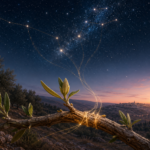 Psalm 147 brings healing, creation, wisdom, and numbers together in one remarkable movement:
“He heals the brokenhearted and binds up their wounds. He counts the number of the stars; he calls them all by name. Great is our Lord and abundant in power; his understanding is beyond number.”
—Psalm 147:3–5
The word translated “heals” is הָרֹפֵא (ha-rofe), another form of ר־פ־א. But notice where the psalmist goes next. The God who heals broken hearts is also the One who counts the stars and calls each one by name.
The Hebrew word מִסְפָּר (mispar), “number,” occurs twice in this short sequence. God assigns a number to the stars, yet no number can measure his understanding. Creation can be counted; the Creator’s understanding cannot.
The same divine wisdom that numbers the stars knows every cell, every strand of DNA, every wound, and every broken place within us. God does not heal impersonally. The One who calls every star by name also knows each of us by name.
The wisdom that ordered the heavens is the wisdom that binds our wounds. The Creator who numbers the stars provides healing whose wisdom is beyond number.
He Sent His Word and Healed Them
Psalm 107 adds another important dimension:
יִשְׁלַח דְּבָרוֹ וְיִרְפָּאֵם
Yishlach devaro veyirpa’em.
“He sent his word and healed them.”
—Psalm 107:20
God’s word is not distant information. It goes forth carrying his will, wisdom, and restoring power. The same God who spoke creation into order sends his word into disorder and brings healing. Creation and restoration flow from the same divine wisdom and the same divine voice.
The Arc of Grace: From the Tanakh to the New Testament
We sometimes speak as though the Tanakh tells a story of law while the New Testament introduces a different story called grace. The bronze serpent shows otherwise. Grace is already present in the wilderness. Israel has sinned and cannot heal itself, yet God hears intercession and provides the means of life. The people do not earn their healing, manufacture their cure, or climb the pole to take hold of it. God provides; they behold what he has provided; and life is received.
Yeshua directly identifies himself with this Torah pattern: “As Moses lifted up the serpent in the wilderness, so must the Son of Man be lifted up” (John 3:14). He does not discard the earlier story; he draws it forward and reveals its greater horizon. In Numbers, the serpent is lifted upon the standard and the afflicted Israelite looks and lives. In John, the Son of Man is lifted up so that the one who trusts in him receives life. The second story does not replace the first. It opens it.
Isaiah had declared that the Servant would be wounded on behalf of others and that through his wound healing would come to us (Isaiah 53:5). The Messiah does not merely point toward healing; he bears our brokenness and becomes the place where God’s healing grace is revealed.
The Torah says the wounded person looked וָחָי—vachai, “and he lived.” Yeshua says that the one who trusts in the Son receives life. The language moves beyond the relief of a symptom. God’s ultimate refuah is life restored through the One lifted up.
This is the arc of grace from the Tanakh to the New Testament: God sees the afflicted, God provides the sign, the sign is lifted up, the afflicted behold, and God gives life. Numbers gives us the pattern; Isaiah gives it prophetic depth; John identifies its Messianic fulfillment. These are two stories, but they bear the signature of one Author: one Book, one God, one unfolding work of grace.
This does not mean that faith and medicine are enemies. If the body, its intelligence, and its capacity to recover are gifts from the Creator, then truthful medical knowledge and wise treatment can also serve his work of restoration. Whether healing comes through the body’s ordinary processes, the skill of a physician, an unexpected recovery, or the resurrection life promised by God, its deepest source remains the Giver of life.
The Grace Received
Healing is not merely the removal of what hurts. It is God restoring what has been broken, reconnecting what has been separated, and imparting life where death has begun its work.
The God who formed us knows our design. The God who numbers the stars understands every hidden part. The God who sent his word still speaks restoration. The God who provided the raised sign in the wilderness is the same God who revealed healing through the Messiah lifted up. The covenant story is continuous because its Author is unchanged.
God provides. We behold. Grace is received. And we live. Two stories. One Book. One God. One grace that gives life.
God’s wisdom is vast enough to order the heavens and gentle enough to bind what is broken.