YAH PRESERVES ADAM
The Ark and the Mathematics of New Creation
A Meditation by Jonah
A Note to the Reader: This meditation is the third article in a developing series. Love & Devotion introduced the hand as the visible expression of love that gives and entrusts. The Measure of Love followed the Yod—the smallest Hebrew letter—from the hand to the cubit and through the measured structures of Scripture. Those two meditations provide the foundation for what follows. Reading them first will make the connections among Yod, Yah, sacred measurement, and Noah’s Ark easier to follow.
Preface: A World Already Measured
Have you ever wondered why God is so specific about numbers and measurements in the Torah? I have. The closer I look, the harder it becomes for me to dismiss them as coincidence. What if the measurements are not merely details surrounding the story, but part of the story God is telling?
What amazes me is the way Torah continues to open on a mathematical level. Hebrew letters do not carry sound alone; they also carry number. The word and its numerical structure inhabit the same letters.
That seems fitting in a universe whose physical order is mathematical. Human beings did not create the relationships governing light, gravity, motion, time, or matter. We discovered them—or, more precisely, developed mathematical language in an attempt to portray what had already been operating from creation. Our formulas are human descriptions. The order they seek to describe preceded us.
Gravity did not begin when a man wrote an equation. Light did not wait for us to calculate its speed. The laws were at work before we learned how to express them.
We formulate the mathematics, but we discover the order.
Perhaps writing began through a similar human impulse. Before letters, people made marks and pictures—attempts to portray what they saw. A line became a shape. A shape became a sign. Signs gradually became letters. Humanity learned to draw the world into meaning.
Jewish mysticism asks me to look in the other direction as well. The letters are not considered only human signs used to describe creation. Sefer Yetzirah, an early Jewish mystical work, speaks of thirty-two paths of wisdom: ten sefirot and twenty-two foundational Hebrew letters. In that meditation, letters and number stand near the foundation of the created world.
Humanity uses letters to portray the world. God speaks, and the world comes into being.
I am not claiming that Hebrew letter forms existed physically before creation or that every numerical resemblance is an encoded message. I am trying to understand the Jewish mystical conviction that creation is intelligible because it comes from divine Wisdom. Word, number, measure, and created order need not be strangers to one another.
The Hebrew alphabet begins with Aleph and ends with Tav. Tav means a mark or sign, and its ancient written form resembled crossed lines—something like an X or a plus sign. Within Jewish thought, Tav can suggest the final mark, completion, or seal. The word אמת—emet, truth, begins with Aleph, passes through Mem, and ends with Tav. The sages call truth the seal of the Holy One.
As a follower of Yeshua, I cannot look at the ancient Tav without also noticing the cross. I do not offer that as the historical definition of Tav, nor do I claim that Jewish mystics intended a messianic conclusion. It is simply an image that meets me at the end of the alphabet: the final letter, the mark, the completion.
The twenty-two letters move from Aleph to Tav. The smallest of them is Yod. And Yeshua said that not even that smallest letter would pass from Torah until all was accomplished.
Where This Meditation Begins
This article continues a thought that began in Love & Devotion and then grew in The Measure of Love. The first was about love that does not remain a feeling. Love gives. Devotion entrusts. The hand makes visible what the heart has chosen.
The second began with the smallest Hebrew letter, Yod—י. Yod has the value ten. Its ancient image is commonly associated with an arm and hand, and the Hebrew word yad means hand. From there I began thinking about the cubit, a measure extending from the elbow toward the fingertips. God gave the measure. Human hands performed the work.
I thought I had followed that meditation as far as it wanted to go.
Then came the quiet.
I need the quiet hours of the night. Nighttime lets the LIGHT shine through, and the quiet helps me hear the SMALL VOICE. I write for a while and then pause. Those gaps are processing time—time to meditate on His Word and allow one passage to sit beside another.
I do not receive the whole picture at once. It begins as a point, like the Yod. Then a line appears. Eventually I begin to see a shape.
What follows is not a formula or a doctrine. I am not claiming that a calculation proves God. These are observations—just me thinking, meditating, and sharing my reward.
The Measurements I Had Passed Over
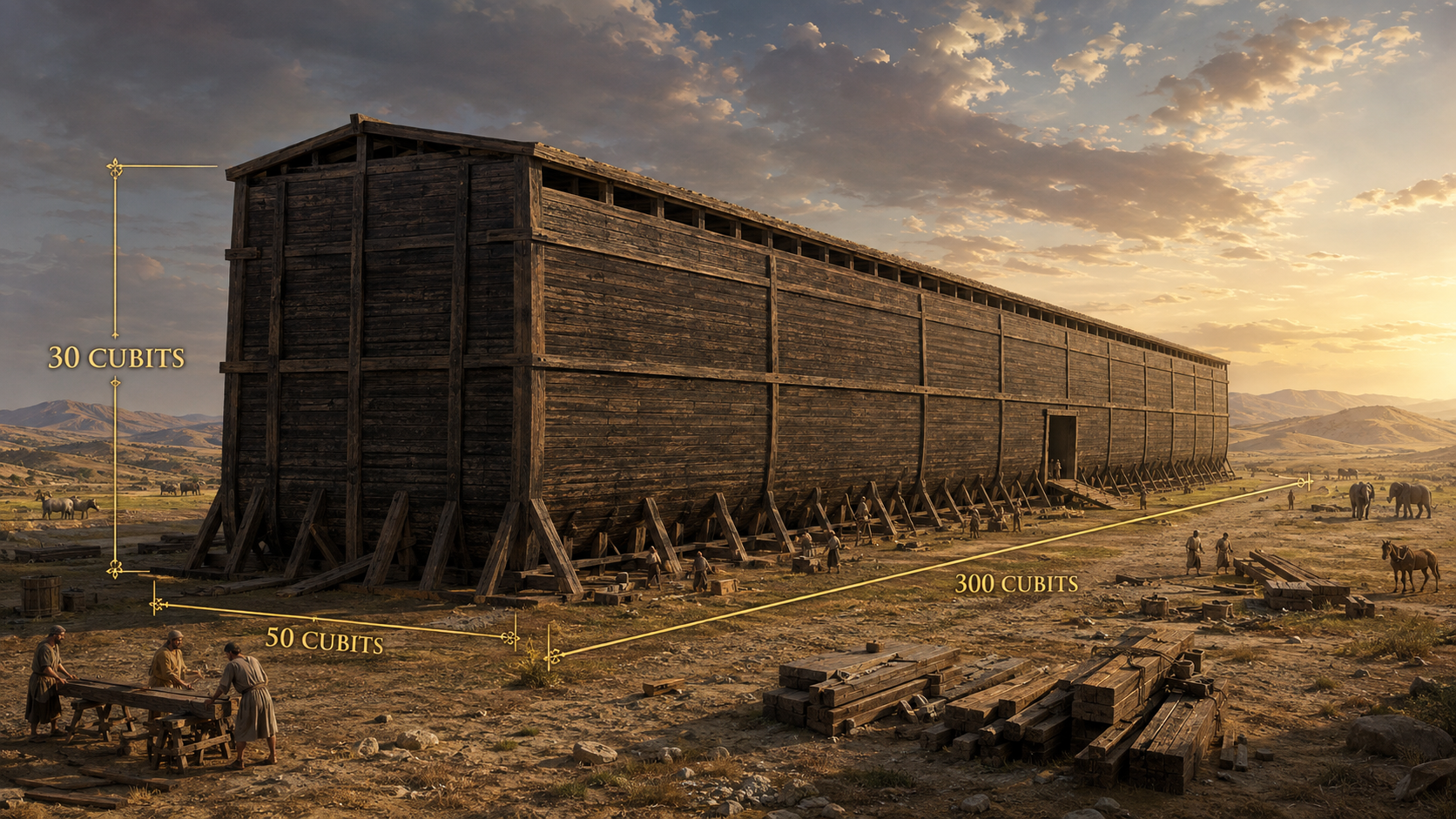
The first great structure in Scripture measured in cubits is Noah’s Ark:
“The length of the ark shall be three hundred cubits, the breadth of it fifty cubits, and the height of it thirty cubits.”
—Genesis 6:15
I had already written about those dimensions as the measured place through which life was preserved. But this time I stopped and did the simplest calculation.
300 × 50 = 15,000 square cubits.
That was the footprint of the Ark: 15,000.
Fifteen immediately brought me back to Yod-Heh—י־ה, Yah. Yod is ten and Heh is five:
YAH = 10 + 5 = 15
Jewish practice normally writes the number fifteen as ט״ו, nine plus six, rather than writing Yod-Heh, because Yod-Heh forms the sacred name. Fifteen is treated carefully because it carries the whisper of Yah.
The sages also found creation within those two letters. Menachot 29b reads Isaiah 26:4—“for in Yah, the LORD, is an everlasting rock”—as an allusion to the worlds formed through Yod and Heh.
Now I was looking at a vessel carrying the living seed of a future world, and its footprint was 15,000 square cubits.
Before I go further, a point needs to be made about elevating a number to the thousands, like 15 and 15,000. The movement into the thousands matters. In one framework found within Jewish mystical teaching, the ascending orders of 1, 10, 100, 1,000, and 10,000 correspond to Nefesh, Ruach, Neshamah, Chayah, and Yechidah.
- 1 — Nefesh (“life-force”): The soul’s basic vitality, connected with the body, physical awareness, action, and the world of Asiyah.
- 10 — Ruach (“spirit”): The emotional and moral dimension of the soul, especially love, awe, character, and the world of Yetzirah.
- 100 — Neshamah (“higher soul”): The soul’s capacity for spiritual understanding and contemplation, associated with the intellect and the world of Beriah.
- 1,000 — Chayah (“living essence”): A transcendent awareness of God beyond ordinary intellectual understanding, associated with Atzilut. This level helps frame the thousands as an order of transcendent life.
- 10,000 — Yechidah (“the singular one”): The soul’s deepest point of absolute unity with God—a level beyond ordinary individual consciousness and associated with the highest divine oneness.
Even the Hebrew words Aleph, the first letter, and elef, one thousand, share the same spelling: אלף. The thousand may therefore be contemplated as the one expanded into a higher order. When fifteen becomes 15,000 or forty-five becomes 45,000, the original number is not erased. Yah remains fifteen, and Adam remains forty-five, but each is expressed within the order of thousands. I do not offer this as a fixed rule for interpreting every biblical number. I simply notice a fitting mystical pattern: the movement into the thousands is not only enlargement, but elevation without loss of identity.
Takeaway: The original number remains itself while being expressed within a higher order—elevation without loss of identity.
Thus, 5 (Hey) provides meaning to 5000, 2 (Bet) provides meaning to 2000, 3 (Gimel) provides meaning to 3009, and so on through the Hebrew aleph-bet.
Again, I am not saying that the number changes the plain meaning of Genesis. The Ark remains an Ark. The measurements remain measurements. I simply notice that the foundation of this measured place of preservation carries fifteen—Yah—into the thousands.
That seems worth sitting with.
Yah Beneath
The Ark did not float upon an idea. Noah had to build it. Trees were cut. Timbers were shaped. Rooms were formed. Pitch was applied within and without. The pattern came from God, but arms lifted the wood and hands performed the work.
This returns me to Yod, the subject of my previous meditation, The Measure of Love. That article provides important background for understanding why this small Hebrew letter carries such significance here.
Yod is small, but a small point may contain the beginning of something much larger. The Ark itself was something like that. Compared with the world outside it, it was a small enclosed place. Yet within that place were Noah and his family, animals according to their kinds, food for the journey, and the living possibility of a world after the Flood. The whole future waited inside.
That is what a seed does. It holds more than its size seems able to contain.
Perhaps this is one reason the number fifteen caught me so strongly. Yah did not merely stand above the Ark as a religious idea. The measurements God gave formed the foundation beneath everything being carried forward.
Yah beneath. Life within.
Adam Within
Genesis tells us that the Ark had three levels—lower, second, and third (Genesis 6:16). If each level followed the stated footprint, the three together give:
15,000 × 3 = 45,000 square cubits.
Forty-five is the value of אָדָם—Adam. For readers unfamiliar with Hebrew gematria, Hebrew is read from right to left, and each letter carries a numerical value: Aleph—א—is 1, Dalet—ד—is 4, and final Mem—ם—is 40. Mem takes a different written form when it appears at the end of a word, but its numerical value remains forty. Therefore: 1 + 4 + 40 = 45.
This forty-five is not obtained by reducing the digits of a larger number. It is the actual numerical value of the three Hebrew letters that spell Adam.
The same forty-five appears again when the stated length, width, and height are multiplied:
300 × 50 × 30 = 450,000 cubic cubits.
That figure describes the rectangular dimensional envelope formed by the measurements; Genesis does not give enough detail to calculate the exact internal volume of the Ark’s shape. But the pattern remains visible:
45,000 = 45 × 1,000.
450,000 = 45 × 10,000.
The footprint gives fifteen—Yah. The levels and dimensions bring forward forty-five—Adam.
Yah beneath. Adam within.
I did not have to reduce a long number until I found something useful. Fifteen and forty-five arise directly from the measurements given in the text. That does not prove an intended code. It does give the meditation a mathematical foundation. The cubits establish that the pattern is actually there.
The mathematics demonstrates the shape. The Hebrew allows me to contemplate what the shape may be saying.
Creation, Uncreation, New Creation
The connection with Adam fits the larger story of the Flood.
Genesis 1 begins with waters covering the deep and the Spirit of God moving over them. God separates, gathers, and orders. Dry land appears. Vegetation grows. Living creatures fill the earth. Humanity is blessed and told to be fruitful and multiply.
In the Flood, much of that order is reversed. The boundaries of the waters break. Dry land disappears. The inhabited world returns toward the deep.
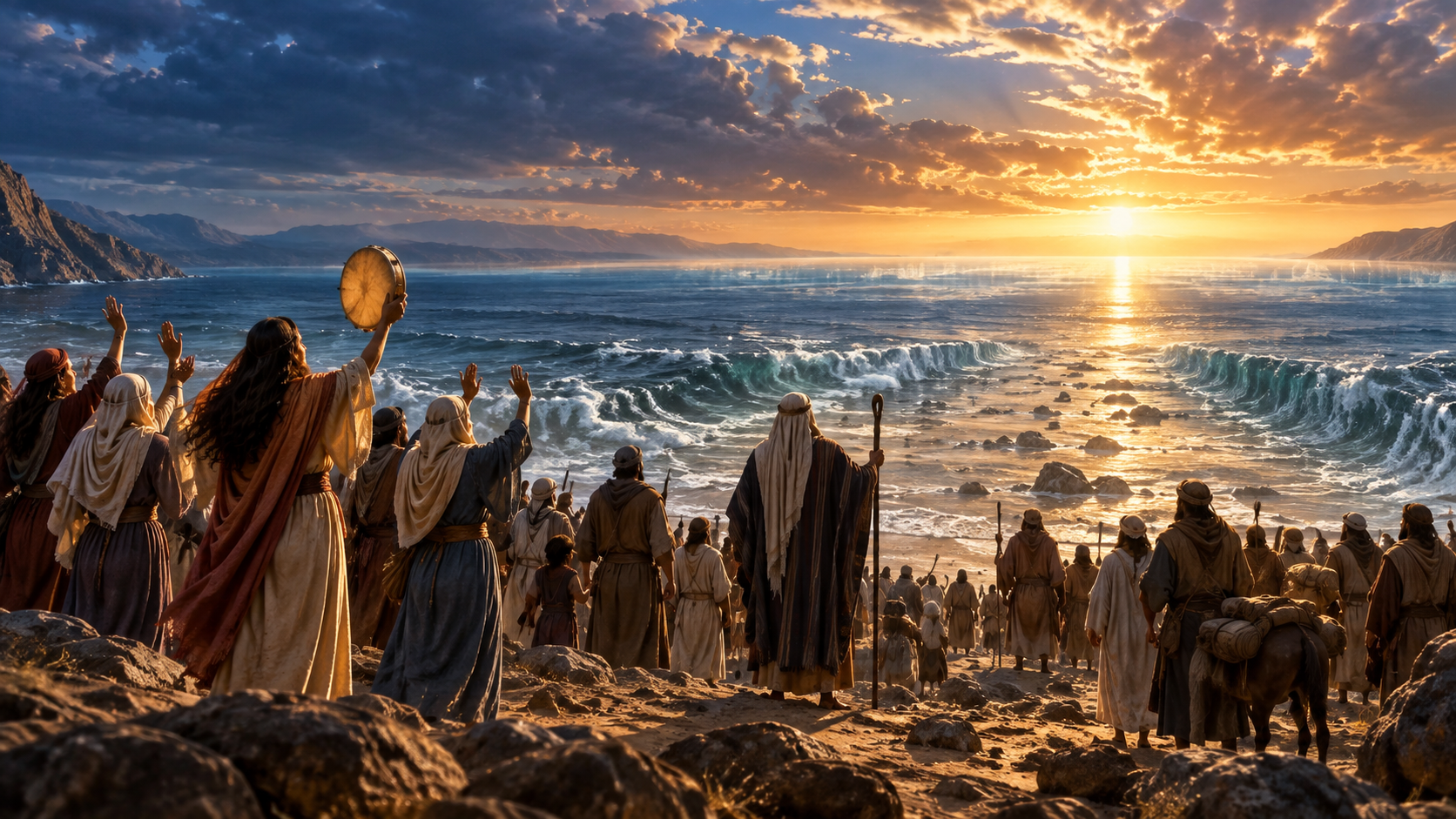
Then, in Genesis 8:1, God causes a ruach—a wind or spirit—to pass over the earth, and the waters begin to recede. Dry ground appears again. The animals emerge. Noah and his family receive the blessing to be fruitful and multiply.
The language sounds like creation beginning again.
The Ark is therefore more than a boat escaping a disaster. It is a chamber of preservation passing through uncreation toward renewed creation. It carries Adam’s family and the living kinds through the waters so life may begin again upon the earth.
That is why forty-five belongs so naturally in the meditation. The Ark carries Adam’s human line through Noah.
God so loved the world that He made Adam. When the world became corrupt, He did not abandon His creation. He measured a place in which Adam’s family would be preserved.
Love measured the refuge. Devotion built it. Life was carried forward.
Noah’s Hand
There is another side to this.
God gave Noah exact dimensions, but measurements alone did not build the Ark. Noah acted upon what he received.
That is devotion.
In my blog post Love & Devotion, I considered the Hebrew word מְסִירוּת—mesirut: devotion, dedication, the handing over or entrusting of oneself. In Leviticus 1, devotion becomes visible when the worshiper places his hand upon the offering.
With Noah, devotion becomes visible when the hand builds according to the word received.
Noah could not control the waters. He could not preserve the world through his own wisdom. But he could respond to the measure God gave him. His hands could shape the place God had designed for life.
God gives the measure. Noah gives his labor. God preserves the life.
Love and devotion meet in the work of the hand.
A Covenant with the World
When Noah leaves the Ark, he builds an altar. God then establishes a covenant not only with Noah but with his descendants and “every living creature.” The sign of that covenant is placed in the heavens, but its promise concerns the earth.
The world has passed through judgment, yet God binds Himself to its future.
That, too, looks like love to me.
The Ark preserves more than eight people. It preserves the promise of generations not yet born, harvests not yet planted, cities not yet built, songs not yet sung, and lives not yet lived. The people inside cannot see any of that. They carry it simply by carrying life.
Perhaps love often works that way. It protects a future it cannot yet see.
The Heart Carried Out of the Ark
Yet the Flood story does not end by telling us that humanity has been made inwardly new.
After Noah leaves the Ark, God says:
“The imagination of man’s heart is evil from his youth.”
—Genesis 8:21
That observation closely echoes the reason judgment came in the first place. The waters have receded. The ground is dry. The world has been given a new beginning. But the human heart carried out of the Ark is still the human heart that entered it.
The Flood cleanses the earth, but it does not recreate Adam from within.
This matters. Noah is a new beginning, but he is not yet a new humanity. He is still a son of the first Adam. The Ark can preserve life through judgment, but it cannot remove what has gone wrong inside the human heart.
The mathematics brings me to Adam. The story leaves me waiting for more.
Sharing My Reward
I began with a cubit and a Yod. I returned to measurements I had already read and noticed what I had passed over:
15,000—Yah.
45,000—Adam.
450,000—Adam carried into a larger order.
I am not asking anyone to make a doctrine from those figures. I am sharing the reward I found by lingering over His Word.
The Ark bore the measure of Yah in its foundation and carried Adam’s human family through Noah.
God gave the pattern. Noah’s hands built according to it. Life passed through judgment into a renewed world.
But the heart of Adam remained.
The Ark answers the waters. It does not yet answer the heart.
From Preservation to Presence
The Ark carried Noah and his family through the waters, preserving through them the human line that began with Adam. Noah was the man inside the vessel, but as a son of Adam he carried humanity forward into a renewed world—making forty-five, the value of אָדָם (Adam), a fitting presence within the Ark’s measurements. Yet the Flood did not change the human heart. Humanity needed more than preservation; we needed God to draw near, dwell among us, and provide atonement.
Takeaway: Yah preserved Adam’s family through Noah—but preservation alone could not change Adam’s heart.
Coming Soon: That leads to my next meditation and another remarkable measurement: the Holy of Holies, a perfect cube of 8,000 cubic cubits. There the story moves from Noah carrying Adam’s family through judgment to the immeasurable God entering measured space—and ultimately toward Yeshua, the last Adam. That will be my focus in the fourth article to come in this series.