A Place Worthy of a Rolled Stone
Observations on Mark 15
A meditation by Jonah
Old and New Testament prophecy converge in Mark 15. Two stories, one Book, one God.
Mark 15 sets the scene. It is a chapter filled with rejection, accusation, mockery, darkness, and death. Yet underneath everything taking place, the words of the prophets are moving toward fulfillment. The people in the story do not seem to know what they are doing, but Scripture knows exactly where the story is going.
Mark does not repeatedly stop and announce, “This fulfilled the prophet.” He simply tells us what happened. But when we know the Tanakh, we begin to hear the earlier Scriptures speaking through every part of the scene.
Isaiah is there. The Psalms are there. Zechariah, Amos, Daniel, and Jeremiah are there. Yeshua’s own predictions are there.
Among the principal connections are:
- Rejected and condemned: Isaiah 53:3–8
- Silent before His accusers: Isaiah 53:7; fulfilled in Mark 15:3–5
- Garments divided by lot: Psalm 22:18; Mark 15:24
- Numbered with transgressors: Isaiah 53:12; Mark 15:27
- Mocked by onlookers: Psalm 22:7–8; Mark 15:29–32
- Darkness over the land: Amos 8:9; Mark 15:33
- The cry from the cross: Psalm 22:1; Mark 15:34
- Given sour wine: Psalm 69:21; Mark 15:36
- New covenant opened: Jeremiah 31:31–34; Mark 15:38
- Buried with the rich: Isaiah 53:9; Mark 15:43–46
- Yeshua’s own predictions fulfilled: Mark 8:31; 9:31; 10:33–34
- Pierced: Zechariah 12:10
- Messiah cut off: Daniel 9:26
The religious leaders, Roman soldiers, criminals, passersby, Pilate, Joseph, and the centurion each step into a scene that Scripture had been preparing since the foundation of the earth.
After all the voices, accusations, cries, and prophecies, Mark places Yeshua in a rich man’s rock carved tomb and closes the chapter with one final action:
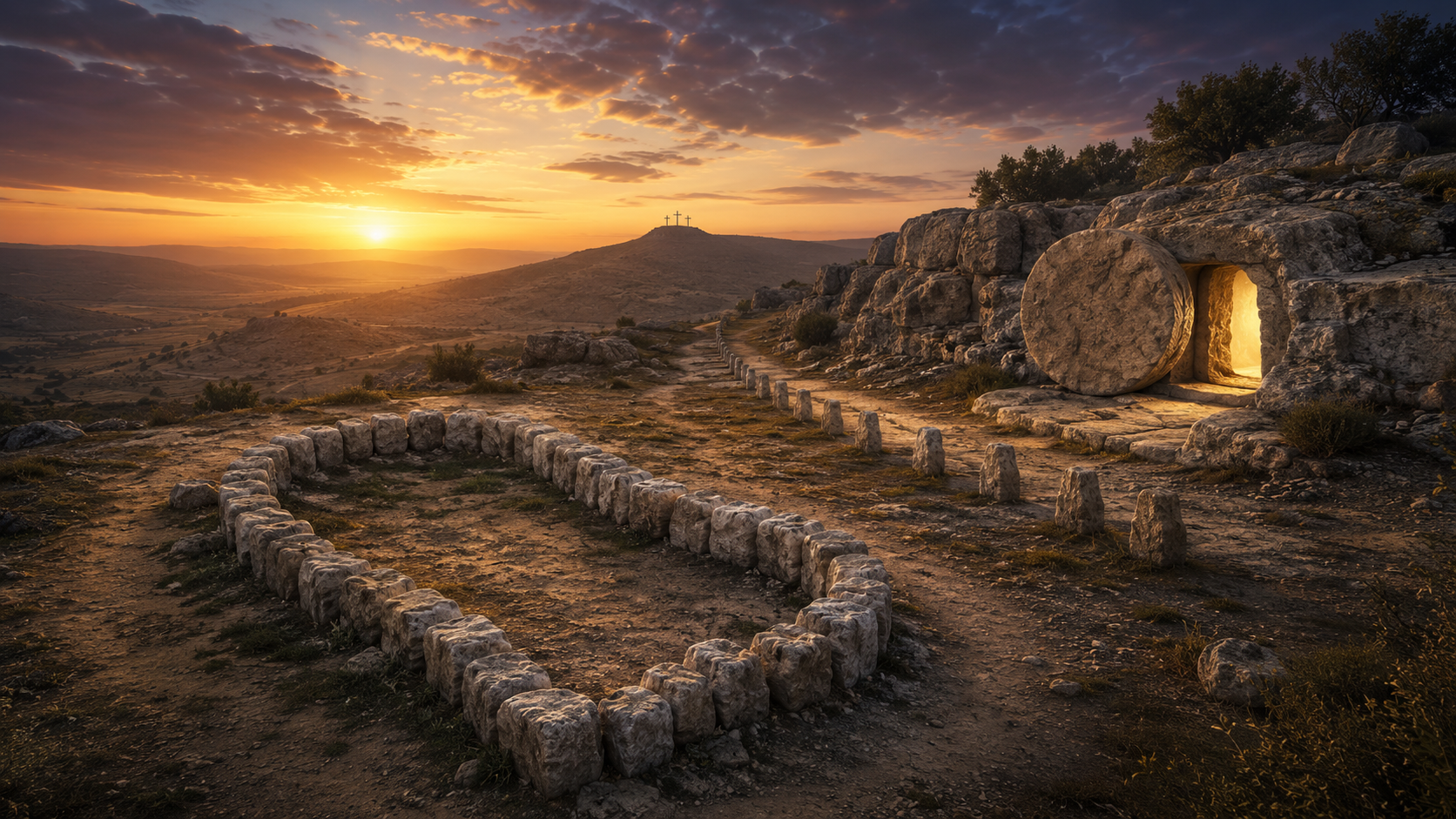
“And he rolled a stone unto the door of the sepulchre.”
—Mark 15:46
Then, in the last verse of Mark chapter 15, readers are left with Mary Magdalene and Yeshua’s mother, beholding where Yeshua laid. The world waits 3 days, but we only have to turn to chapter 16.
Future Understanding
Mark 15:46 does more than prepare the tomb; it prepares the reader for a revelation not yet understood.
Everything is covered: the body by linen, the tomb by stone, and the meaning of the moment by grief. The disciples see burial, but they do not yet understand resurrection. The scene is concealed before it is revealed.
Wrapped Before Revealed
 Before Joseph rolls the stone, Mark gave us an important detail:
“And he bought fine linen, and took him down, and wrapped him in the linen.”
—Mark 15:46
This sets the scene for the understanding that is still to come. The meaning of what has happened remains covered from those who loved Him. They see burial, but they do not yet understand resurrection.
The fine linen in Mark 15:46 arks back to another Joseph from Genesis. Consider Pharaoh’s prophetic question in Genesis 41:38 — And Pharaoh said unto his servants, Can we find such a one as this is, a man in whom the Spirit of God is?
After Joseph interpreted Pharaoh’s dreams and displayed the wisdom God had given him, Pharaoh declared:
“Forasmuch as God hath shewed thee all this, there is none so discreet and wise as thou art.”
—Genesis 41:39
Pharaoh then clothed Joseph in fine linen:
“And Pharaoh took off his ring from his hand, and put it upon Joseph’s hand, and arrayed him in vestures of fine linen.”
—Genesis 41:42
The first Joseph emerged from confinement and was clothed in fine linen after God revealed hidden meaning through him. Joseph of Arimathea brings fine linen as Yeshua enters the tomb, while the meaning of His death remains hidden.
The connection should not be pushed beyond what the text says, but the echo is beautiful. Joseph in Genesis was brought up from the pit, and what had been hidden was made known. In Mark, another Joseph wraps Yeshua in fine linen and places Him within the rock. Soon the stone will be rolled away, and what no one yet understands will begin to be revealed.
- The linen covers Him before the stone closes the door.
- Concealment comes before understanding.
- Burial comes before revelation.
- Only then does Joseph roll the stone into place.
From Gilgal to Golgotha
That appearance near Jericho adds another dimension to Gilgal. The rolling away was not merely the removal of reproach; it prepared the way for crossing, revelation, and new life.
The same pattern appears again at the tomb of Lazarus. A stone covered the entrance until Yeshua said, “Take away the stone.” John does not say that Lazarus’s stone was rolled away, but the image still points forward. The barrier was removed, the voice of Yeshua entered the place of death, and Lazarus came out alive. It was a foreshadowing—but not yet the fullness. Lazarus emerged because another removed his stone. And others removed the burial linens that bound him. Soon, at Yeshua’s own tomb, Yeshua would remove his own burial linens and the stone would be found rolled away, and the One inside would rise never to return to death.
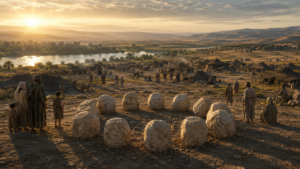 The words—“rolled a stone” in Mark 15:46 —arc back to Gilgal.
After Israel crossed the Jordan and entered the Promised Land, the LORD said:
“This day have I rolled away the reproach of Egypt from off you. Wherefore the name of the place is called Gilgal unto this day.”
—Joshua 5:9
Gilgal was the place where reproach was rolled away. It stood at the boundary between the wilderness and the inheritance. Israel had crossed through the Jordan, and twelve stones were raised to mark the place where God had made a way for His people:
“These stones shall be for a memorial unto the children of Israel for ever.”
—Joshua 4:7
Stones Mark God’s Footsteps
Stones repeatedly mark significant moments in the footsteps of God.
Jacob raised a stone at Bethel after encountering Him and declared:
“Surely the LORD is in this place; and I knew it not.”
—Genesis 28:16
Joshua placed twelve stones at Gilgal
After Israel crossed the Jordan, Joshua placed twelve stones. . Elijah rebuilt the altar of the LORD with twelve stones. Again and again, stones became witnesses to places where God met His people, renewed covenant, or opened a way forward.
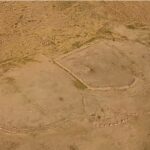
The gilgal near Jericho may be especially significant because it stands close to the place of a heavenly appearance. After Israel crossed the Jordan and encamped at Gilgal, Joshua encountered the Commander of the LORD’s army near Jericho. Joshua fell facedown before him and was told, “Remove your sandal from your foot, for the place where you stand is holy.” The words echo Moses at the burning bush. Gilgal was therefore more than a memorial circle at Israel’s boundary. It stood within a landscape of revelation—a place where Israel crossed over, covenant was renewed, and Joshua met the heavenly Commander before entering Jericho.
Archaeologists have discovered several large, foot-shaped stone enclosures in the Jordan Valley and the hills of Samaria. Archaeologist Adam Zertal proposed that these ancient enclosures were connected with Israel’s entrance into the land. He associated their shape with the biblical idea of taking possession by placing one’s foot upon the land:
These Gilgalim, the plural of Gilgal, look like stone markers of God’s footsteps through the land.
“Every place whereon the soles of your feet shall tread shall be yours.”
—Deuteronomy 11:24
Then We Arrive at Golgotha
Something old had been rolled away. A new life in the land was beginning. The movement continued —from the reproach rolled away at Gilgal, to the stone removed at Bethany, and finally to the stone rolled away from Yeshua’s tomb. What began as a crossing into the land becomes, at Golgotha, a crossing from death into new creation.
Gilgal Becomes Golgotha
The name Golgotha means “the place of a skull.” The Aramaic form behind Golgotha may be written:
גלגלתא
Within it we can see Gilgal: גלגל
All that is added is: תא — Tav–Aleph. Tav is the 22nd, last letter in the Hebrew Aleph-Bet. It’s ancient shape is like two crossed sticks. Aleph is the first letter, and has a numerical vale of 1.
The movement is visually striking:
גלגל + תא = גלגלתא
Gilgal + Tav–Aleph = Golgotha
The Hebrew Aleph-Bet ordinarily moves from Aleph to Tav—את: from the first letter to the last, from beginning to completion.
At Golgotha, however, those two letters appear in reverse in Hebrew: Tav–Aleph—תא. It is as though they are meant to be read as we read English. Aleph to Tav—תא.
The last returns to the first.
The ending turns back toward the beginning.
This is my observation within the letters, not a claim that Mark explains. Yet the pattern is there, and it deserves meditation.
- At Gilgal, God rolled away the reproach of Egypt.
- At Golgotha, Yeshua carried our reproach.
- At Gilgal, Israel crossed the Jordan and entered its inheritance.
- At Golgotha, Yeshua crossed through death and opened the way into new life.
- At Gilgal, twelve stones testified that God had brought His people through the waters.
- At Golgotha, one stone was rolled against the entrance of a tomb.
Even the order of the added letters tells a story.
Tav–Aleph:
- From completion back to creation.
- From the last letter back to the first.
- From death back to life.
A Place Worthy of a Rolled Stone
Mark 15 is filled with fulfilled prophecy. Yet after all those words have been fulfilled, the chapter ends without another speech. It ends with a stone.
Joseph rolls the stone toward the door in Mark 15. In Mark 16, the women discover that the stone has been rolled away:
“And when they looked, they saw that the stone was rolled away: for it was very great.”
—Mark 16:4
The same God who rolled away the reproach of Egypt at Gilgal rolled away the stone at the tomb.
The footsteps of Yeshua appeared to stop there. But the stone did not mark where God’s movement ended. It marked where His next footsteps would begin.
- Gilgal leads us to Golgotha.
- Golgotha leads us to the rolled stone.
- The rolled stone at Golgotha takes us from Tav back to Aleph—from what appeared to be the end into the beginning of a new creation.
Mark 15 is truly a place worthy of a rolled stone.
Epilogue: The Fifteenth Chapter
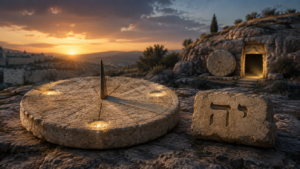 One final observation: I cannot help noticing that this is Mark 15.
Mark did not create the chapter divisions; they were added many centuries later. Therefore, I would not present the chapter number as an intentional code placed there by Mark. Nevertheless, the resonance is difficult for ME to ignore.
In Hebrew, Yod—י has a value of ten, and Heh—ה has a value of five. Together they form: יה—Yah. The numerical value of Yah is fifteen.
Jewish tradition normally writes the number fifteen as ט״ו, rather than י״ה, precisely to avoid casually writing the divine name.
The context makes this even more striking. Mark 15 brings us to Passover, the festival beginning on the fifteenth of Nisan. The chapter numbered fifteen brings us to the season of the fifteenth—and to the place where reproach is carried and ultimately rolled away.
Mark also carefully records the hours:
– Yeshua is placed upon the cross at the third hour.
– Darkness covers the land beginning at the sixth hour.
– He cries out at the ninth hour.
The sixth and ninth hours together equal fifteen:
6 + 9 = 15—Yah
And all three hours together equal eighteen:
3 + 6 + 9 = 18—Chai, life
The chapter of fifteen brings us to the festival of the fifteenth. Within it, the sixth and ninth hours again give us fifteen—Yah. Yet when every hour Mark names is gathered together, they give us eighteen—life.
Coincidence? Perhaps. But it is this kind of coincidence that makes me stop, look again, and meditate.