Moving In to One
Three, Two, One—to the Thousand
A study by Jonah
In the traditional reconstruction of the Tabernacle, the Holy of Holies contains one thousand cubic cubits. In Hebrew, one thousand is elef—אֶלֶף—spelled like Aleph, the first letter, valued at one.
The Torah has a mathematical dimension that modern readers may not immediately appreciate. In Hebrew tradition, letters also have numerical values. The first three Hebrew letters are Aleph—one, Bet—two, and Gimel—three.
But when we move inward through the Tabernacle, those numerical values appear in reverse:
Gimel → Bet → Aleph
Three → Two → One—to the thousand.
The Pattern Given to Moses
The Tabernacle was not designed according to human preference. God told Moses:
“According to all that I show you—the pattern of the Tabernacle and the pattern of all its furnishings—so shall you make it.”
—Exodus 25:9
God repeated the instruction:
“See to it that you make them according to the pattern which was shown you on the mountain.”
—Exodus 25:40
The measurements were part of the pattern. Exodus describes the boards, curtains, coverings, and veil from which the Tabernacle’s dimensions are traditionally reconstructed (Exodus 26:15–33).
Those dimensions reveal a movement toward unity.
Entering Through Love
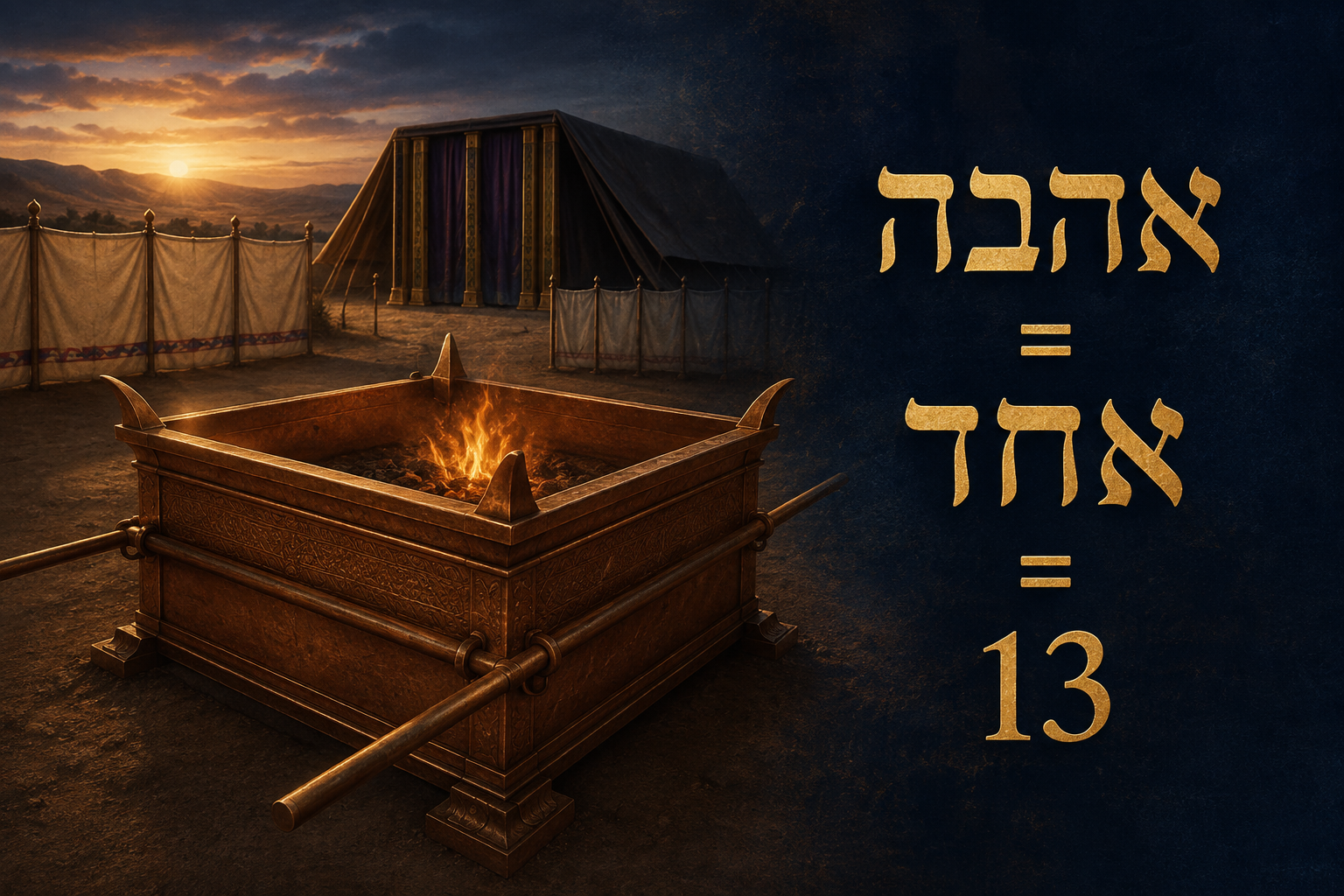 Before reaching the Holy Place, the worshipper encountered the altar in the courtyard. God instructed Moses:
“You shall make an altar five cubits long and five cubits wide—the altar shall be square—and its height shall be three cubits.”
—Exodus 27:1
The sum of the altar’s three stated dimensions is thirteen. Thirteen is the gematria of אהבה—ahavah, meaning “love.” Thirteen is also the gematria of אחד—echad, meaning “one.”
The altar therefore brings together two words with the same numerical value:
Love and One.
This same connection appears in the Shema:
“Adonai our God, Adonai is one. You shall love Adonai your God with all your heart, with all your soul, and with all your strength.”
—Deuteronomy 6:4–5
The declaration that God is One leads immediately to the command to love Him. The journey inward begins where love and oneness meet.
The Ratios Lead Inward
The complete Tabernacle is traditionally reconstructed as thirty cubits long, ten cubits wide, and ten cubits high. Its proportion was:
3:1:1
The veil divided the structure:
“The veil shall be a divider for you between the holy place and the Most Holy.”
—Exodus 26:33
The Holy Place had the proportion 2:1:1. The Holy of Holies had the perfect proportion 1:1:1.
The movement inward is therefore:
3:1:1 → 2:1:1 → 1:1:1
Three becomes two. Two becomes one. Unequal dimensions become equal. The journey ends in a perfectly proportioned chamber associated with the presence of God.
The First Three Hebrew Letters—in Reverse
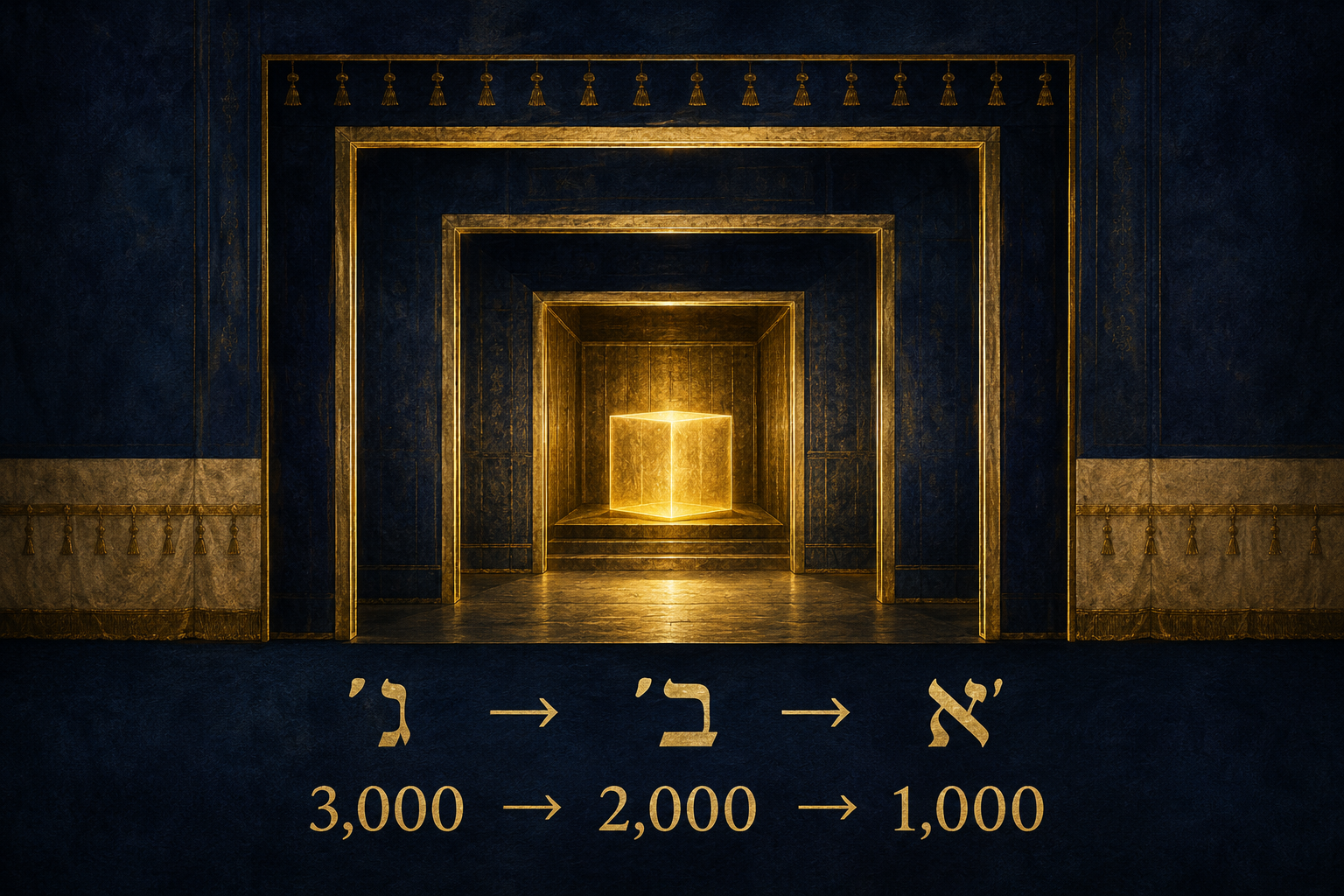 The nested volumes carry the same message:
The complete Tabernacle contained 3,000 cubic cubits.
The Holy Place contained 2,000 cubic cubits.
The Holy of Holies contained 1,000 cubic cubits.
The progression is:
3,000 → 2,000 → 1,000
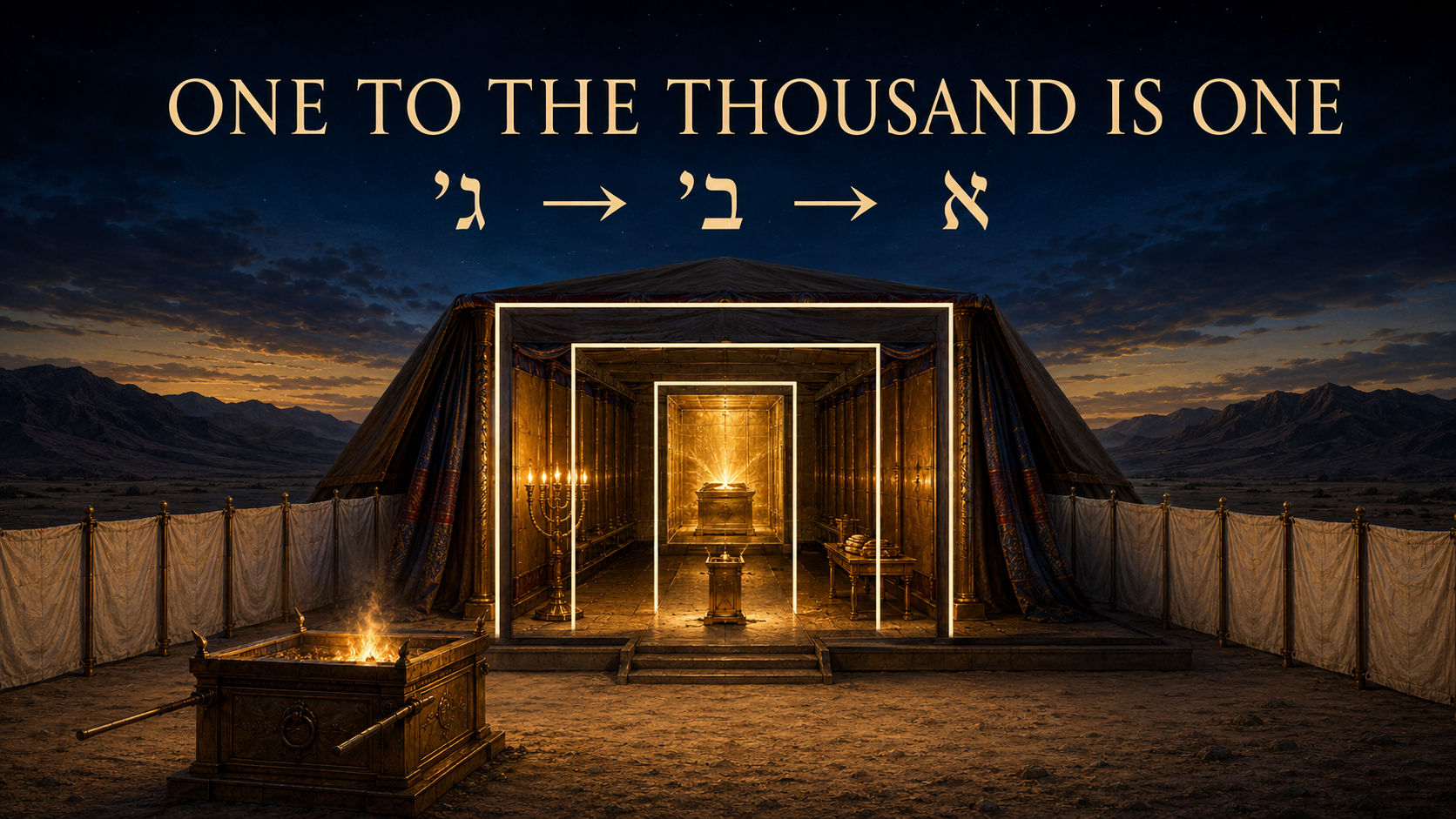
This is not merely three, two, one. It is three, two, one—to the thousand.
When read in the thousands, these values may be represented by the first three Hebrew letters in reverse:
ג׳ — Gimel: 3,000
ב׳ — Bet: 2,000
א׳ — Aleph: 1,000
The normal order moves outward from Aleph:
Aleph → Bet → Gimel
One → Two → Three
But the Tabernacle takes us in the opposite direction:
Gimel → Bet → Aleph
Three → Two → One
It leads us backward through the first three Hebrew letters toward the beginning.
The Meaning of the Letters—to the Thousand
 In Scripture, one thousand may be an exact number, but it can also express vastness, abundance, and fullness. God keeps His covenant “for a thousand generations” (Deuteronomy 7:9). The cattle on “a thousand hills” belong to Him (Psalm 50:10). He remembers His covenant “for a thousand generations” (Psalm 105:8).
A thousand does not always mean “without limit.” Nevertheless, in these passages it communicates something extended far beyond ordinary human measure. The thousand therefore does more than enlarge the three numbers. It may also magnify the traditional imagery associated with their Hebrew letters.
Gimel: Giving to the Thousand
In rabbinic interpretation, Gimel is associated with gomel—one who gives or bestows kindness. The Talmud connects Gimel and Dalet with gomel dalim: one who gives to the poor (Shabbat 104a).
The complete Tabernacle contained 3,000 cubic cubits:
ג׳—Gimel to the thousand.
The Tabernacle was made possible through giving. God gave Israel the pattern and the promise of His presence. The people freely contributed the materials needed for its construction (Exodus 25:1–9; 35:21–29).
God declared the purpose of the sanctuary:
“And let them make Me a sanctuary, that I may dwell among them.”
—Exodus 25:8
Gimel to the thousand may suggest giving magnified.
Bet: The House to the Thousand
Bet is the first letter of bayit, meaning “house.” Its traditional imagery is associated with a house, dwelling, or enclosed place.
The Holy Place contained 2,000 cubic cubits:
ב׳—Bet to the thousand.
The Tabernacle was more than a tent. It was the dwelling place established for God among His people. Bet to the thousand may suggest the dwelling magnified.
Gimel gives. Bet receives what is given and forms it into a dwelling. The movement takes us from giving into the House.
Aleph: One to the Thousand
Aleph is the first Hebrew letter and has the numerical value one. In traditional interpretation, it is associated with unity and with Aluf—Master or Sovereign.
The Holy of Holies contained 1,000 cubic cubits:
א׳—Aleph to the thousand.
Aleph is carried to the thousand, but it does not cease to signify One. Its meaning is not divided by its magnitude. It is magnified.
The Hebrew word for one thousand is אֶלֶף—elef. The name of the first Hebrew letter is אָלֶף—Aleph. The words are pronounced differently, but without vowel markings both are written:
אלף
The final chamber is one thousand cubic cubits—elef. Elef brings us to Aleph, and Aleph brings us to One.
This is One—to the thousand.
“Hear, O Israel: Adonai our God, Adonai is one.”
—Deuteronomy 6:4
The progression now carries more than numerical meaning:
Gimel → Bet → Aleph
Giving → Dwelling → One
Each image is carried to the thousand:
Giving magnified → the dwelling magnified → oneness magnified.
The Perfect Inner Room
The Tabernacle’s Holy of Holies is traditionally reconstructed as a perfect cube with the proportion:
1:1:1
Scripture explicitly tells us that Solomon’s later Holy of Holies was also a perfect cube:
“The inner sanctuary was twenty cubits long, twenty cubits wide, and twenty cubits high.”
—1 Kings 6:20
The same form appears in the New Jerusalem:
“Its length, breadth, and height are equal.”
—Revelation 21:16
The Pattern Repeats:
The Tabernacle’s Holy of Holies is traditionally reconstructed as a cube.
Solomon’s Holy of Holies was explicitly a cube.
The New Jerusalem has equal length, width, and height.
The place associated with God’s presence is marked by complete unity:
1:1:1
Moving In to One
The message does not require complicated calculations. The proportions move:
3:1:1 → 2:1:1 → 1:1:1
The volumes move:
3,000 → 2,000 → 1,000
The first three Hebrew letters move in reverse:
Gimel → Bet → Aleph
Three → Two → One—to the thousand.
The journey begins at the altar, where love and one share the value thirteen. It moves from Gimel, traditionally associated with giving, through Bet, associated with the house, and arrives at Aleph—the letter of One.
Life draws us outward into multiplication—more divisions, more distractions, more fears, and more competing voices. The Tabernacle leads us in the opposite direction. It draws us inward toward simplicity, unity, and the presence of God.
Moving In to One: Heaven and Earth Joined in Aleph
The journey begins at the altar, where אהבה—love and אחד—one share the value thirteen. It moves from Gimel, traditionally associated with giving, through Bet, associated with the house, and arrives at Aleph—the letter of One.
But Aleph itself contains one final message.
The Form of Aleph
Jewish sages and mystics have observed that the written form of Aleph may be seen as three letters: an upper Yod, a lower Yod, and a diagonal Vav connecting them.
The upper Yod may represent the heavenly realm; the lower Yod, the earthly realm. Between them stands the Vav, joining what is above with what is below. In Jewish mystical teaching, the Vav has therefore been compared to a channel through which divine blessing descends into the world.
When prefixed to a word, the Hebrew letter Vav functions as the conjunction “and.” It joins one word or thought to another. Within Aleph, the Vav stands between heaven and earth, visually joining the upper and lower realms.
Aleph is One, but within that One are heaven, earth, and the connection between them.
Aleph and the Lord’s Prayer
This heaven-and-earth movement stands at the center of the prayer Yeshua taught his disciples:
“Our Father in heaven… Your kingdom come. Your will be done on earth as it is in heaven.”
—Matthew 6:9–10
The upper Yod corresponds naturally with heaven. The lower Yod corresponds with earth. The Vav joins the two.
The movement of the prayer follows the movement within the letter:
“Our Father in heaven”—the upper Yod.
Your kingdom come—the movement downward. Your will be done on earth—the lower Yod.
“As it is in heaven”—the two brought into agreement.
The prayer does not ask humanity to escape the earth. It asks that the will of heaven descend and become visible here. Heaven and earth are not confused, but they are brought into harmony under the will of the One.
There is no textual proof that Yeshua constructed the Lord’s Prayer as an interpretation of Aleph. Yet the correspondence is profound. The central concept of the prayer is visibly reflected in the form of the letter:
Heaven above. Earth below. The Vav connecting them.
Aleph becomes a picture of the prayer: may what is true in heaven be established on earth.
The Vav and the Veil
The name vav means a hook or connecting peg. The Torah uses the related plural word vavim for the golden hooks from which the Tabernacle veil was suspended:
“You shall hang it upon four pillars of acacia wood overlaid with gold. Their hooks shall be of gold.”
—Exodus 26:32
The Vav within Aleph connects the upper and lower Yods. The golden vavim of the Tabernacle connected the veil to its pillars. Both images concern joining—what is above being connected with what is below.
A Christian reader may see another reflection. Because the Vav has traditionally been pictured as a hook, peg, or nail, it may recall the nails by which Yeshua was fastened to the cross (John 20:25).
This is not the Jewish interpretation of Aleph, nor is it proof of a Christian message secretly encoded within the letter. It is a Christian meditation upon the same biblical image: heaven and earth joined through the Messiah.
The Vav connects heaven and earth within Aleph.
The vavim suspended the veil within the Tabernacle. The nails held Yeshua upon the cross. Each image concerns a connection between the heavenly and the earthly.
Aleph, YHVH, and Love
The numerical value within the form of Aleph adds another dimension:
Yod + Vav + Yod
10 + 6 + 10 = 26
Twenty-six is also the gematria of the divine name:
יהוה—YHVH
10 + 5 + 6 + 5 = 26
Twenty-six is also twice thirteen:
13 + 13 = 26
Earlier, the altar’s dimensions brought us to thirteen—the shared value of אהבה, love, and אחד, one. Inside the form of Aleph, that value appears doubled.
We may see one love descending from above and another rising from below: God’s love reaching toward humanity and humanity’s love returning toward God. The upper and lower Yods are joined by the Vav.
Love above + love below = 26
אהבה (13) + אהבה (13) = 26
26 is also the gematria of יהוה – YHVH
Again, this is a meditation upon a numerical correspondence, not an equation the Torah explicitly declares. Yet it gathers the article’s patterns into one final image:
Aleph is formed from two Yods joined by a Vav.
Their combined value is twenty-six—the value of YHVH and twice the value of love.
The Tabernacle leads us from three to two to one. Aleph then shows us what this unity means: heaven and earth joined under the will of the One.
Life draws us outward into multiplication—more divisions, more distractions, more fears, and more competing voices. The Tabernacle leads us in the opposite direction. It draws us inward toward unity and the presence of God.
We enter through love.
We pass from three to two.
We arrive at Aleph—to the thousand.
Within Aleph, heaven and earth meet.
And Aleph remains One.
The Torah gives us the letter. Yeshua gives us the prayer. The Jewish mystical reading sees divine blessing joining heaven and earth.
The Christian reading sees that same joining reflected through the Messiah.
The readings remain distinct, but they arise from the same Scriptures and direct our attention toward the same One.
Two Stories. One Book. One God.
Note: I wrote a follow-up to this post.
See: 32 To The Thousand
These are humble observations rather than declarations of hidden doctrine. Scripture gives us the pattern; the traditional reconstruction reveals the progression. I am neither a rabbi nor a pastor. I have no authority. I write to think—and this pattern gives us something worth thinking about.