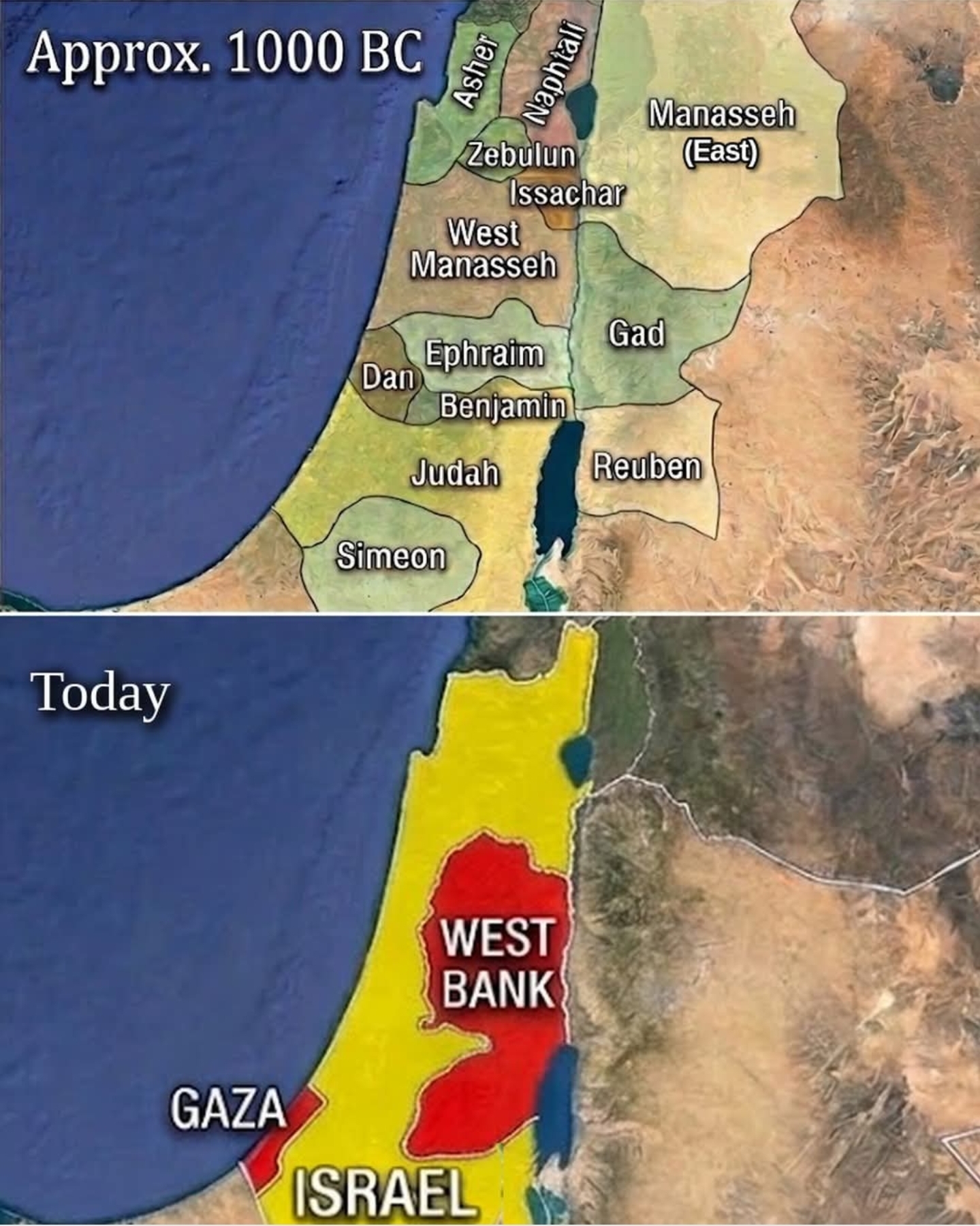
Two maps. One ancient landscape. Roughly three thousand years apart.
The top map is a simplified reconstruction of the tribal territories described in Joshua. These tribal identities remained important around 1000 BC, when David was king, although this should not be mistaken for a precise political map of David’s kingdom.
The tribal inheritances were assigned by lot before the LORD. At Shiloh, before the tent of meeting, Joshua cast lots for the seven tribes that had not yet received their portions (Joshua 18:8–10). The land was understood as an inheritance from God—not property obtained through negotiation or awarded to the highest bidder.
Count the Names
Here is the part many people miss: Levi is not there.
The tribe set apart for sacred service received no territorial province because the LORD and the offerings made to him were their inheritance (Joshua 13:14, 33). Joseph, meanwhile, is represented through his two sons, Ephraim and Manasseh. Manasseh appears on both sides of the Jordan because that tribe received territory in both regions.
The Levites were not left homeless. They received forty-eight cities with surrounding pasturelands inside the territories of the other tribes (Joshua 21).
The Levitical Cities Were Spread Out:
– The descendants of Aaron received 13 cities from Judah, Simeon and Benjamin.
– The remaining Kohathite families received 10 cities from Ephraim, Dan and western Manasseh.
– The Gershonite families received 13 cities from Issachar, Asher, Naphtali and eastern Manasseh.
– The Merarite families received 12 cities from Zebulun, Reuben and Gad.
That placed Levitical communities throughout the land:
– In the south: Judah, Simeon and Benjamin.
– In the center: Dan, Ephraim and western Manasseh.
– In the north: Issachar, Asher, Zebulun and Naphtali.
– East of the Jordan: Reuben, Gad and eastern Manasseh.
That distribution mattered. The Levites were charged with sacred service and with teaching God’s instruction:
“They shall teach Jacob your rules and Israel your law” (Deuteronomy 33:10).
Instead of concentrating the teachers of God’s Word in one isolated priestly territory, God scattered them throughout Israel. Few Israelites would have lived far from a Levitical community—from people whose sacred responsibility included preserving and teaching God’s instruction.
Most of the forty-eight Levitical cities have been associated with known or proposed locations. Many can still be visited today—some as inhabited communities and others as archaeological sites—while several identifications remain uncertain.
Try finding that combination anywhere else: the ancient names, the identifiable places, the ancestral people and the biblical language—all returned to the same landscape after three thousand years!
The lower map shows the same general landscape today.
Much of the ancient hill country associated with Judah, Benjamin, Ephraim and western Manasseh now lies within what is called the West Bank. Gaza occupies part of the ancient Philistine coastal region.
Simeon’s territory was located within Judah’s inheritance from the beginning. Over time, Simeon lost its separate territorial prominence and was largely absorbed into Judah, although Simeonite communities remained identifiable later in the biblical record.
Ancient tribal allotments cannot be matched perfectly with modern political borders. But the geography has not moved.
The names have changed. The governments have changed. The borders have changed. But the mountains, valleys and coastline remain.
The Purpose of Adonai’s Geography
“Life is a journey” can sound like a modern expression, but Genesis 12 gives it spiritual depth. God tells Abram:
“Go from your country, your people and your father’s household to the land I will show you.”
Abram is called to leave what is familiar without being shown the entire road ahead. But the journey is not merely about where Abram is going. It is about what God intends him to become:
“I will bless you… and you will be a blessing.”
That may be the greater biblical meaning of life’s journey: God blesses us along the way so that we may become a blessing to others.
The destination matters—but so does what we become, whom we encounter, and what we leave behind along the road.
The Aaronic Blessing deepens the theme because it was given to Israel while the people themselves were on a journey through the wilderness.
Abram’s journey begins with God’s promise:
“I will bless you… and you shall be a blessing.”
—Genesis 12:2
Generations later, God entrusts Aaron and his sons with words by which they are to place his name upon the people:
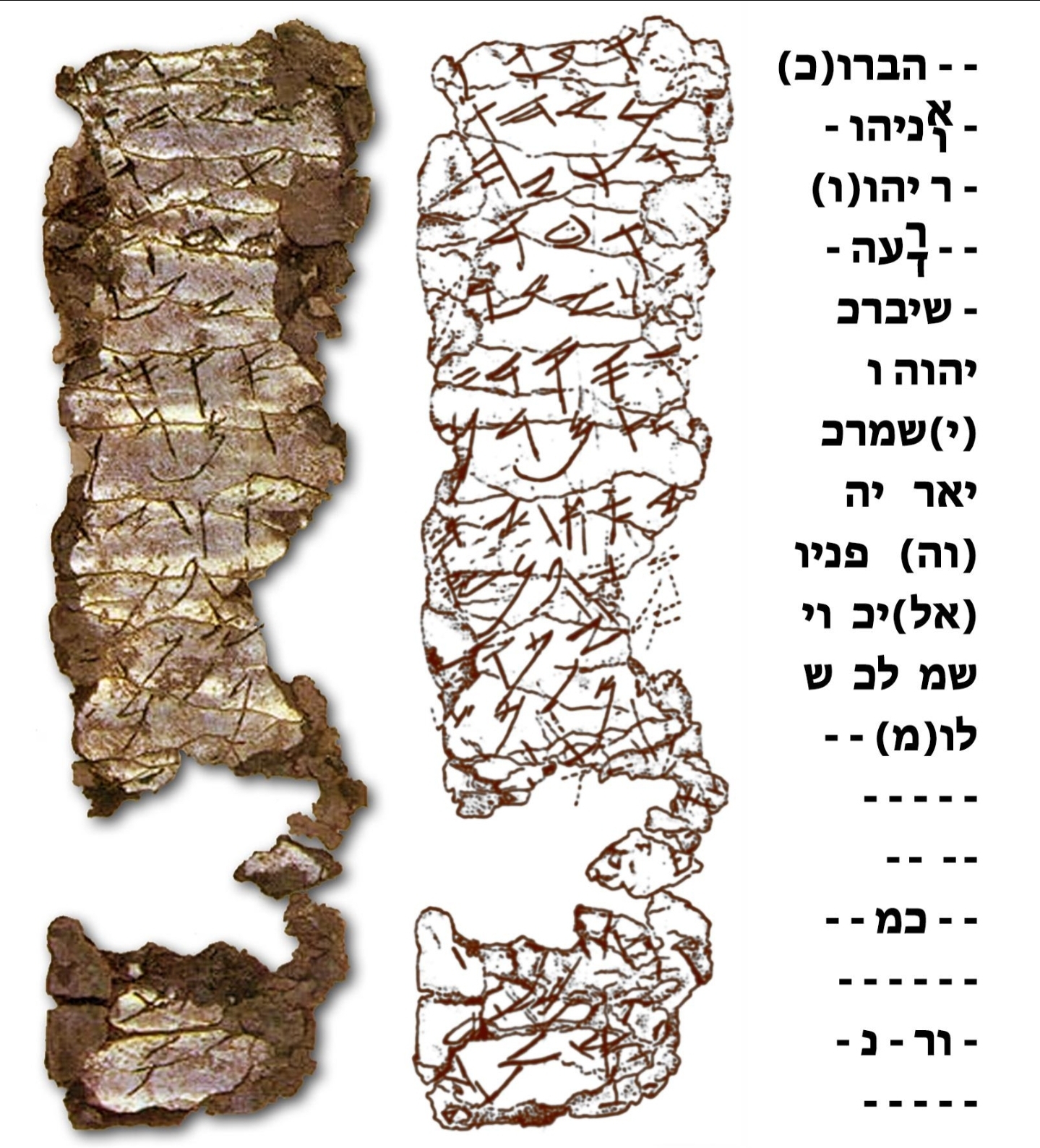
“The LORD bless you and keep you;
the LORD make his face shine upon you and be gracious to you;
the LORD lift up his countenance upon you and give you peace.”
—Numbers 6:24–26
The connection is beautiful. Abraham was blessed so that he and his descendants would become a blessing. Aaron’s descendants were then commanded to speak God’s blessing over Israel.
Later, the Levitical families—including the priestly descendants of Aaron—were given cities scattered throughout the land.
The blessing was not to remain in one place; those entrusted with it were dispersed among the people.
So the biblical journey has a direction beyond reaching a destination:
Receive the blessing. Carry the blessing. Be a blessing.
God calls Abram onto the road. God places his name upon Israel along the road. Then Israel is called to carry the knowledge, grace and peace of God into the world.
Perhaps “Life’s a journey” is biblical—but Scripture completes the thought:
Life is a journey upon which God blesses us, keeps us, shines his face upon us, and teaches us to become a blessing wherever the road takes us.