
Note: A New Format
A friend recently told me that my writings “are loaded with dynamite!” He added, “For my absorption I must be physically and mentally refreshed to enjoy your writings.”
I received that as both encouragement and wise advice. There is much packed into this study, so I am trying something different with this post: two parts within one blog.
Part One presents the central message as a continuous meditation. Part Two goes beneath it, unpacking the Scripture, Hebrew words and letters, gematria, and Jewish mystical ideas that support it.
Those who simply want the meditation may read Part One and let it settle. Those who want to see what is packed inside may continue into the deeper study—perhaps after a little rest.
This format gives the message room to breathe without sacrificing its depth.
Preface
I began with one of the most familiar sentences in Scripture:
“For God so loved the world…”
We usually hear “the world” as another way of saying mankind. Mankind is certainly included, but the world is much more than mankind. The world is God’s creation filled with life. Without life, it would be only a silent planet. But God formed it as a home, filled it with living things, and then placed mankind within it with a purpose: to serve it and guard it.
That simple thought carried me from the first chapter of Genesis to the final chapter of Revelation.
It led me from Bet, the first letter of Torah and the letter associated with a house, to the pure river and Tree of Life in Revelation 22. It led through mankind’s responsibility toward creation, Torah as the way we are meant to walk, Mem as the letter of water, emet as truth, tahor as purity, chokmah as the wisdom woven into creation, and the Ruach HaKodesh who enables the human heart to walk in God’s way.
At the center stands Yeshua’s declaration:
“I am the way, the truth, and the life.”
And beneath it all stands Daniel’s promise:
“And many of them that sleep in the dust of the earth shall awake, some to everlasting life…”
לְחַיֵּי עוֹלָם — le-chayei olam
To life everlasting.
—Daniel 12:2
Daniel promises that mankind will awaken from the dust to life everlasting. Revelation shows the home of that life: a restored world where pure water flows from the throne, the Tree of Life nourishes creation, its leaves bring healing to the nations, and mankind once again serves in the presence of God.
This meditation is about that living world—how God created it, how He entrusted it to us, how we departed from His way, and how His love leads creation back to life.
PART ONE: TO LIFE EVERLASTING
A Meditation on Daniel 12:2 and John 3:16
“And many of them that sleep in the dust of the earth shall awake, some to everlasting life…”
—Daniel 12:2
The Hebrew words are לְחַיֵּי עוֹלָם — le-chayei olam: to life everlasting.
I began with one of the most familiar verses in the Bible:
“For God so loved the world, that he gave his only begotten Son…”
—John 3:16
Many of us have heard that verse. Most of the time, I think we hear “the world” and quietly replace it with “mankind.” God loved mankind. That is true. Mankind is certainly at the center of the promise: “whosoever believeth in him should not perish, but have everlasting life.”
But John did not write that God so loved mankind. He wrote that God so loved the world.
The world is more than the people standing upon it. The world is God’s creation filled with life. Without life, this earth would be only a silent planet—rock, soil, and water. But that is not the world described in Genesis. God filled the waters, the heavens, and the land with life. Seed produced after its kind. The seas moved with living creatures. Birds crossed the firmament. Animals walked upon the earth. Finally, mankind was formed from the dust and received the breath of life.
The world testifies to life in every way. It also testifies to truth. Creation is what God spoke it to be. Seed bears after its kind. The heavens declare His glory. The order of the living world bears witness to the wisdom and faithfulness of the One who formed it.
And John 3:16 is all for the sake of God’s love of that world.
A Home for Life
The Torah begins with the Hebrew word בְּרֵאשִׁית — Bereshit which begins with the Hebrew letter בְּ Bet. Bereshit means “In (the) beginning…”
Bet is also the first letter of בַּיִת — bayit, a house or home. I cannot help seeing creation in that image. God was not merely forming a planet. He was preparing a home for life.
First He formed the spaces: light and darkness, waters above and below, sea and dry land. Then He filled them: lights in the firmament, life in the waters, birds in the heavens, animals upon the land, and mankind bearing His image.
The world became a living house.
God looked upon everything He had made—not mankind alone, but the whole living creation—and called it “very good.” The earth belonged to Him. Its life came from Him. Its goodness rested in His word. Creation was good because the word that called it forth was true.
This is where the first story begins.
Given A Purpose
When God placed Adam in the garden, He gave him a purpose:
“The LORD God took the man, and put him into the garden of Eden to dress it and to keep it.”
—Genesis 2:15
“Dress it” does not mean clothing the garden. The Hebrew word is avad: to work, cultivate, or serve. “Keep it” is shamar: to keep, watch, guard, or preserve.
Mankind was not placed in the garden merely to consume whatever it offered. Adam was placed there to serve and guard what God had made.
Dominion was responsibility before it became power.
The earth did not become Adam’s possession. “The earth is the LORD’s, and the fulness thereof.” Adam was a caretaker living inside a house he did not build, tending life he did not create.
That remains true of us. Adam was taken from the adamah, the ground. We breathe the world’s air, drink its water, and eat what grows from its soil. Mankind only continues if the living world continues. If the world that sustains life is destroyed, mankind disappears with it.
We are important within creation, but we are not independent of it. God joined our future to the world He entrusted to us.
The Way of Life
The Torah establishes mankind’s responsibilities toward the world and toward life.
The land must be allowed to rest. Working animals receive Sabbath rest. The ox may eat while it works. A fallen animal must be helped, even when it belongs to an enemy. Fruit trees must not be destroyed during war. The poor and the stranger may gather from the field. Human blood is sacred because mankind bears the image of God.
These are not scattered regulations. Together they reveal a way of walking truthfully within God’s living world. Falsehood distorts our relationship with God, with one another, and with creation. Torah keeps calling us back to what is true: the earth belongs to God, life is sacred, our neighbor bears His image, and power carries responsibility.
The Hebrew word for “way” is דֶּרֶךְ — derekh. It can mean a road, a path, a course of conduct, or an entire way of life. A derekh is not merely something we believe. It is something we walk.
Its first appearance in Scripture comes after mankind’s failure in Eden. God placed cherubim “to keep the way of the Tree of Life”:
דֶּרֶךְ עֵץ הַחַיִּים — derekh etz hachayim
the way of the Tree of Life.
Adam had been told to keep the garden. When he failed, the cherubim kept the way to the Tree.
But the way was not destroyed. It was guarded.
The rest of Scripture tells us how God teaches mankind His way—the way of righteousness, justice, mercy, truth, and life. Torah gives that way commandments. The prophets call mankind back to it. Wisdom describes her ways as pleasantness and peace and calls herself a Tree of Life to those who take hold of her.
The way must be true, because a false way cannot lead to life.
Then Yeshua says something astonishing:
“I am the way, the truth, and the life.”
—John 14:6
He does not merely say that He knows the way. He places Himself at its center.
Water at the Heart of Life
There can be no living world without water.
Genesis begins with the Spirit of God moving upon the face of the waters. A river flows from Eden and waters the garden. Wells become places of survival and promise. The Torah speaks of mayim chayim—living water. The prophets see water returning to dry places and bringing the world back to life.
Ezekiel sees water flowing from the sanctuary. The river grows deeper, heals the waters, feeds trees, produces fruit, and carries life wherever it goes:
“Every thing shall live whither the river cometh.”
—Ezekiel 47:9
Water does more than sustain life in Scripture. It also cleanses. Ezekiel promises that God will sprinkle pure water upon His people, give them a new heart, place His Spirit within them, and cause them to walk in His statutes.
Pure water. A new heart. God’s Spirit. The ability to walk in His way.
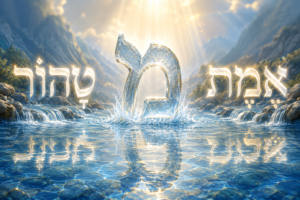
“And ye shall know the truth, and the truth shall make you free.” —John 8:32
Yeshua described himself as, “The Way, the Truth, and the Life.”
The Hebrew word for truth is אֱמֶת — emet. Jewish tradition calls truth the seal of God. Aleph stands at its beginning, Mem at its heart, and Tav at its end. Truth reaches from beginning through the middle to completion. It cannot be true only at the beginning or only at the end. Truth must hold together all the way through.
At the center of emet stands Mem, the letter long associated with mayim, water.
I do not offer that as a dictionary definition or a doctrine proved by letters. I offer it as an observation: water, without which there is no life, stands symbolically at the heart of truth.
Truth and purity also belong together. Truth is without falsehood; purity is without corruption. God’s word is called both true and pure. Truth tells us what life is. Purity removes what poisons it. The pure water promised by Ezekiel therefore fits naturally with the new heart and the Spirit: God does not restore life by leaving its corruption in place.
Yeshua brings these images together. He does not merely say that He speaks truth. He says, “I am the truth.” He calls Himself the Life. He offers living water. John explains that He spoke of the Spirit. The Spirit who moved over the waters in the beginning now moves within mankind, giving a new heart capable of walking in God’s way.
Torah can place the way before us. Truth can reveal the way clearly. But the Ruach HaKodesh must write that way within us. We do not need only correct information. We need our inward life brought into agreement with what is true.
The Spirit moved over the waters to form a living world. The Spirit moves within mankind to restore us to our purpose within it.
Life Everlasting
This brings me to Daniel 12:
“And many of them that sleep in the dust of the earth shall awake, some to everlasting life…”
Daniel calls it chayei olam—life everlasting.
Daniel does not describe mankind escaping creation. Those who sleep in the dust awaken from the dust. Adam was formed from the earth, and Daniel sees mankind raised from the earth.
The next verse says:
“And they that be wise shall shine as the brightness of the firmament…”
—Daniel 12:3
The Hebrew speaks of the zohar, the radiance, of the raqia, the firmament. Raqia takes us back to Genesis 1. Daniel uses the language of creation to describe resurrection.
Those raised to life everlasting shine with the radiance of the heavens God made in the beginning.
This is not the abandonment of creation. It is creation delivered from death.
John 3:16 tells us why: God so loved the world.
God did not give His Son because He had stopped loving what He made. He gave His Son because He had not surrendered His living world to death.
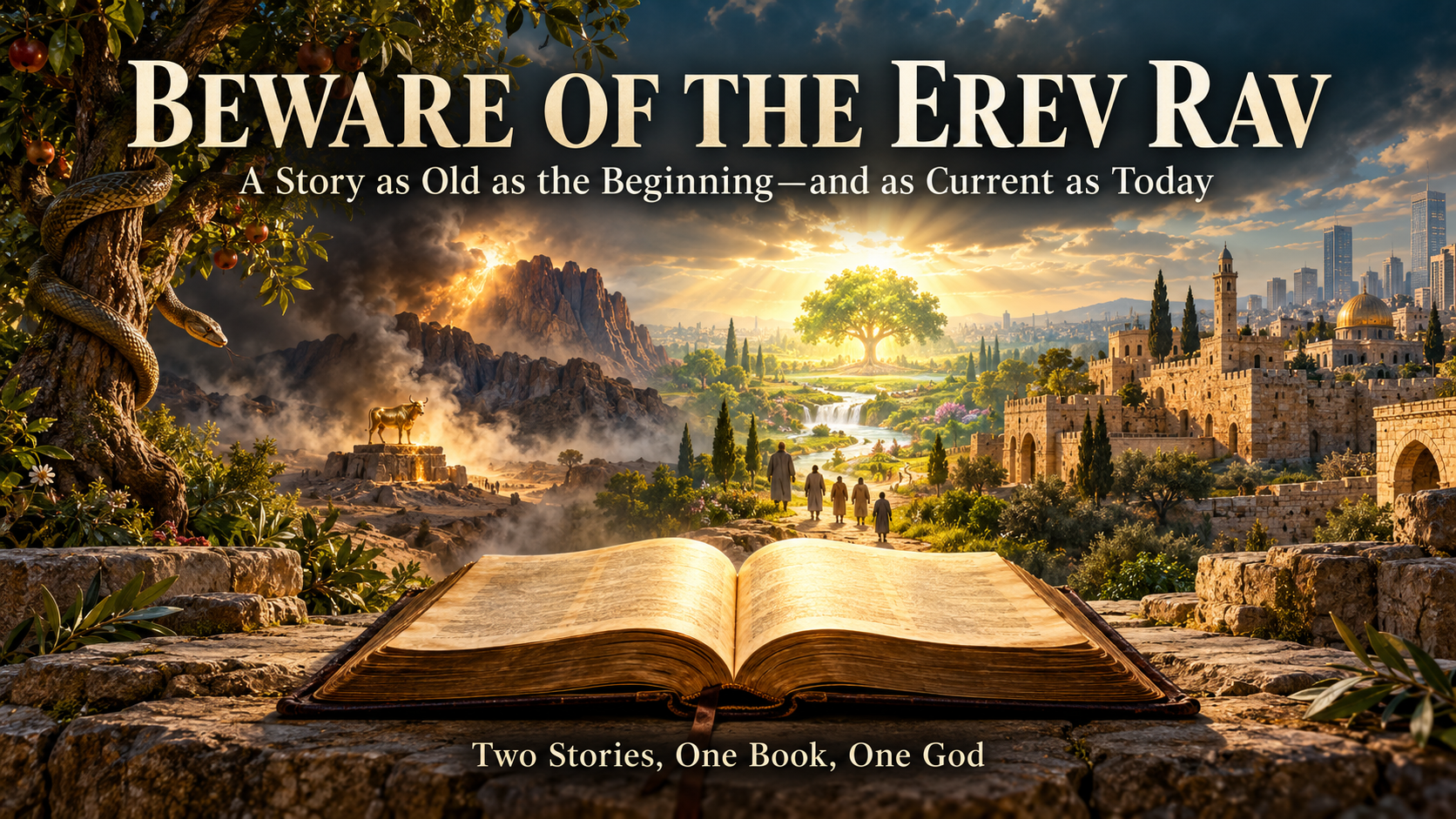
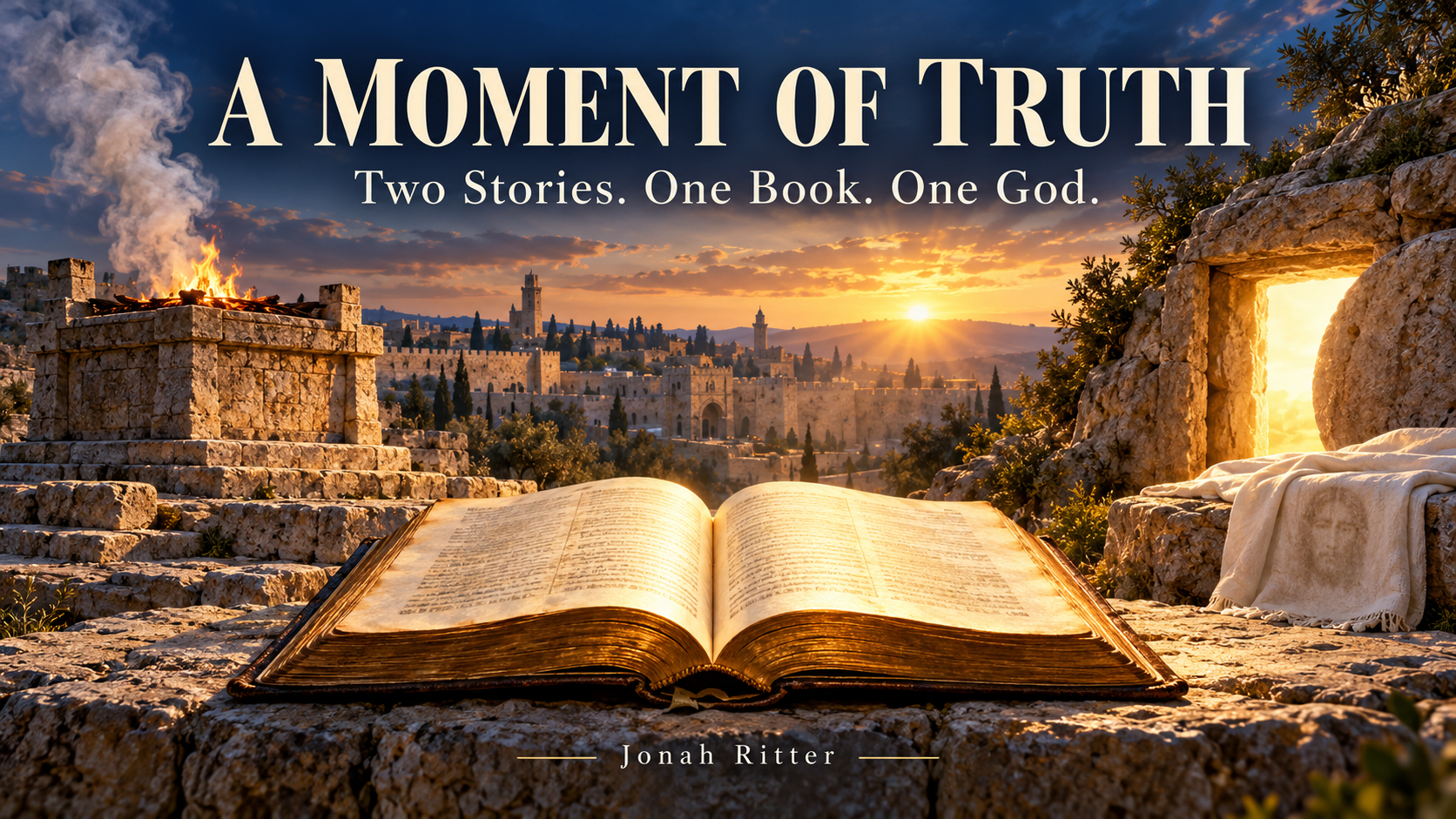
Two Stories, One Book, One God
Some people read the Bible as though Genesis and Revelation tell different stories—as though the God who created the world in the beginning later decided to abandon it.
I see two stories, one book, one God—and one truth running through it all.
The two great movements are creation and restoration. Truth is the unbroken line between them. Revelation is not God replacing what He made in Genesis. It is God proving His original word true.
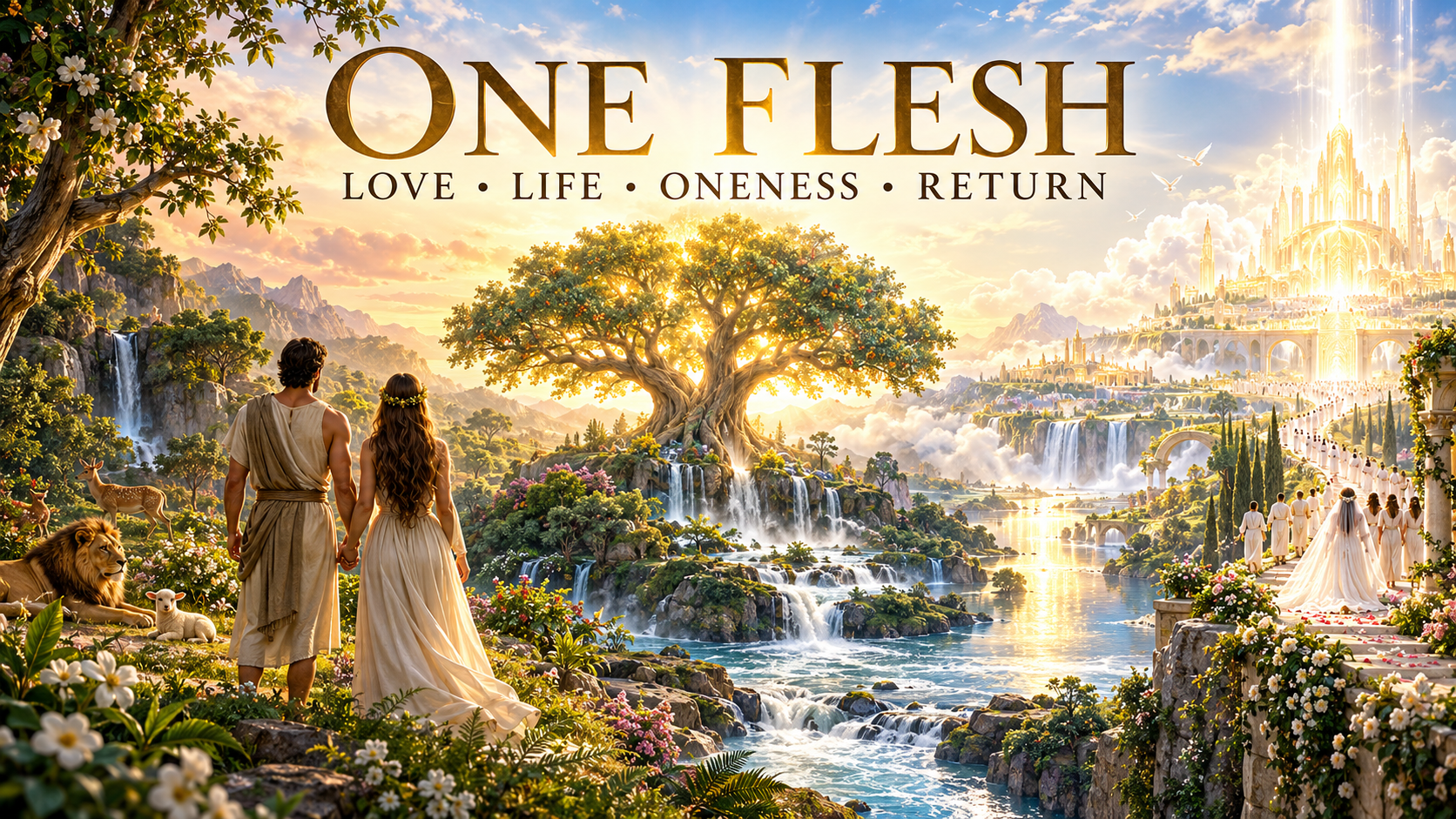
The first story begins with a world formed as a home for life. It contains water, a garden, a river, the Tree of Life, God’s presence, and mankind given the work of serving and guarding creation.
That story is wounded by human disobedience. Mankind departs from the way. The Tree of Life becomes inaccessible. The ground is cursed. Work becomes painful. Life falls beneath the shadow of death.
But God does not discard the first story. He carries it toward restoration.
The second story reaches its fullness in Revelation 22. Once again, there is water, a river, the Tree of Life, God’s presence, and mankind serving Him. But now the river is the water of life, clear as crystal. The Tree continually bears fruit. Its leaves are for the healing of all the nations. The curse is gone. God’s servants see His face, serve Him, and reign forever.
The garden has become a garden-city. The first home has become an everlasting home. Mankind’s purpose has not disappeared; it has been restored.
The garden returns…
> The river returns.
> The Tree of Life returns.
> Mankind’s service returns.
…But the curse does not return.
Two stories, one book, one God.
Genesis is creation begun. Revelation is creation fulfilled. Daniel stands between them, promising that mankind will awaken from the dust to life everlasting. Yeshua stands at the center as the way, the truth, and the life.
The God who forms life in Genesis is the God who promises life everlasting in Daniel. The God whose Spirit moves over the waters is the God whose river of life flows from the throne. The God who gives mankind responsibility for the living world is the God who restores mankind to service within that world. God does not change the truth of His purpose midway through the Book. What He called very good in the beginning, He heals and brings to completion at the end.
Daniel’s Promise Fulfilled In Revelation 22:1-2
1 And he shewed me a pure river of water of life, clear as crystal, proceeding out of the throne of God and of the Lamb.
2 In the midst of the street of it, and on either side of the river, was there the tree of life, which bare twelve manner of fruits, and yielded her fruit every month: and the leaves of the tree were for the healing of the nations.
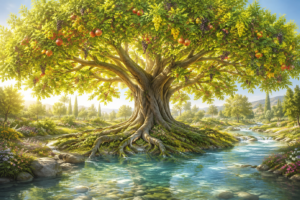 Daniel tells us that mankind will awaken to chayei olam, life everlasting. Revelation 22 shows us a world fit for everlasting life: pure water, unending light, meaningful service, nourishing fruit, healed nations, and the presence of God and the Lamb.
The Tree does not nourish only one person or one nation. Its leaves are for the healing of the nations. The river does not end at the throne. It flows outward, carrying life from its pure source.
This is where John 3:16 has been leading all along. God restores the world because God loves the world.
God loved the world He formed as a home for life. He loved mankind, whom He made from its dust and entrusted with its care. He loved the nations that would one day be healed. He loved His creation too much to surrender it to falsehood, corruption, and death. So “He gave His Son.”
Not so that we might forever abandon the world God made, but so that death would not have the final word over it.
Creation testifies to life.
> Torah establishes our responsibility toward life.
Truth keeps us in agreement with the Giver of life. The prophets promise the restoration of life.
Perhaps my meditation shines some light on the meaning to be found when Yeshua says “He is the way, the truth, and the life.”
> Daniel promises awakening to life everlasting.
> Revelation shows that life flowing through a world restored.
The love expressed in John 3:16:
God so loved the world—the living house He built—that He gave His only begotten Son so that those who believe in Him should not perish, but have life everlasting.
לְחַיֵּי עוֹלָם — le-chayei olam.
Part II: Opening Statement — Eyes to See
 Before going deeper, I want to explain the approach I am taking in this part of the study.
But first, I must warn you: this part is long. So make sure you are, as my friend advised, “physically and mentally refreshed” in order to enjoy the “dynamite” packed into it.
Some readers become uncomfortable when they encounter the words Jewish mysticism. I understand that concern because not everything described as mystical comes from God. Tarot cards, mediums, palm reading and other forms of divination represent what I consider the pursuit of forbidden “hidden knowledge.” Scripture expressly commands us not to seek or consume such knowledge. God warned Israel against divination, sorcery, consulting spirits and attempting to communicate with the dead (Deuteronomy 18:10–12).
But searching more deeply within the Word God has already given us is something entirely different. I am not attempting to obtain knowledge from another spirit or source. I am examining Scripture—its words, letters, numbers, patterns and connections—while asking the Ruach HaKodesh, the Holy Spirit, to guide my understanding. Who can deny the mysterious nature of the Holy Spirit? We cannot command the Spirit, place Him beneath a microscope or fully explain how He reveals truth—yet His presence moves throughout Scripture, from the waters of creation to the promise of everlasting life. Forbidden mysticism seeks hidden knowledge apart from God. Biblical meditation seeks a deeper understanding of what God has already revealed.
The Bible contains history, but it cannot be reduced to history. If we removed the supernatural from Scripture, there would be very little Scripture left. Creation, the Spirit moving upon the waters, the burning bush, the parting of the sea, the words of the prophets, the miracles of Jesus, the Resurrection and the promise of everlasting life all deal with realities beyond ordinary scientific explanation.
The issue is not whether supernatural realities exist; Scripture plainly tells us they do. The issue is their source. I want nothing that draws me away from God. I want to search more deeply within the Word that draws me nearer to Him.
One of the most compelling physical witnesses to that mystery may be the Shroud of Turin. Barrie Schwortz, the official documenting photographer for the STURP investigation, was raised as an Orthodox Jew and approached the Shroud skeptically. Yet after years of examining the evidence, he became convinced that it was authentic—the burial cloth that had wrapped Jesus. The scientific investigation could identify many ways in which the image was not produced, but it could not explain how the image came to be. Science brought its instruments to the cloth, but the mystery remained.
The Shroud also brings me back to the number eight. Seven represents the completed natural order; eight points beyond it—to covenant, new creation and life beyond death. It is difficult for me to find a more compelling physical witness to a reality beyond the natural order. The image does not force faith upon anyone, but it invites us to look more deeply. It stands at the boundary between what can be examined and what has not been explained.
That is how I approach the Hebrew letters, their numbers and the patterns I find throughout Scripture. I offer these patterns as observations, not doctrines. I cannot compel anyone else to see what I see, nor do I expect every reader to agree with every connection.
I should also make clear that I am not constructing these numerical connections. The Hebrew letters already possess established numerical values, and they already stand in an ordinal order from Aleph to Tav. The mathematics is present before I begin looking.
In that sense, my approach is observational. Newton did not create gravity; he observed an existing order and found a mathematical way to describe it. I am not comparing my observations with Newton’s scientific achievement. I am comparing the process of looking. I am examining the words, letters and numbers already present in Scripture and asking whether their relationships reveal an order I did not put there.
The numerical facts themselves can be verified. What those facts signify must be considered prayerfully and tested against Scripture. I may not interpret every pattern correctly, but interpretation is different from construction. I am not placing mathematics into the Word. I am seeing mathematics already embedded within it—and asking what, if anything, the Spirit of Truth may be showing through it.
Some of what follows reaches beyond the plain meaning of the text into meditation upon its words, letters, numbers and correspondences. I recognize that I am looking, connecting and sometimes projecting what I see. But if there is truth in what I have observed, then the same Holy Spirit who guided the writing of the Word can give the reader eyes to see what may have been hidden beneath its surface.
This is not an invitation to invent whatever meaning we please. The Spirit of Truth does not contradict the Word of Truth. Every pattern must remain anchored in Scripture and consistent with its greater testimony. Yet being careful does not require us to stop looking. God is more mysterious and wondrous than human beings typically recognize. There is always more of Him to discover in His Word when we seek Him with humility.
John wrote:
“In the beginning was the Word, and the Word was with God, and the Word was God.”
That statement reaches backward to Genesis and forward to Revelation. The Word was present when the world was formed, entered the world in flesh and will be present when the world is restored. Creation and Revelation are not disconnected stories. The Hebrew Scriptures and the New Testament are not competing witnesses. They are two stories, one Book, one God.
Perhaps some of these patterns were placed in the Word for those willing to search. Perhaps some can be seen only when history, language, number, creation and revelation are allowed to illuminate one another. I do not claim to possess every answer. I am asking the reader to look with me—to test what I observe, to search the Scriptures and to pray for eyes to see.
What follows is the deeper foundation beneath Part I: the Scriptures, Hebrew words, letters, numbers and mystical correspondences that led me to see John 3:16 in a larger light. God so loved mankind, but His love does not stop with mankind. He loves the world He created as a home for life. From the first waters of Genesis to the pure River of Life in Revelation, the Word tells one continuing story: creation, responsibility, redemption and restoration—to life everlasting.
Coming Soon: Part II…