
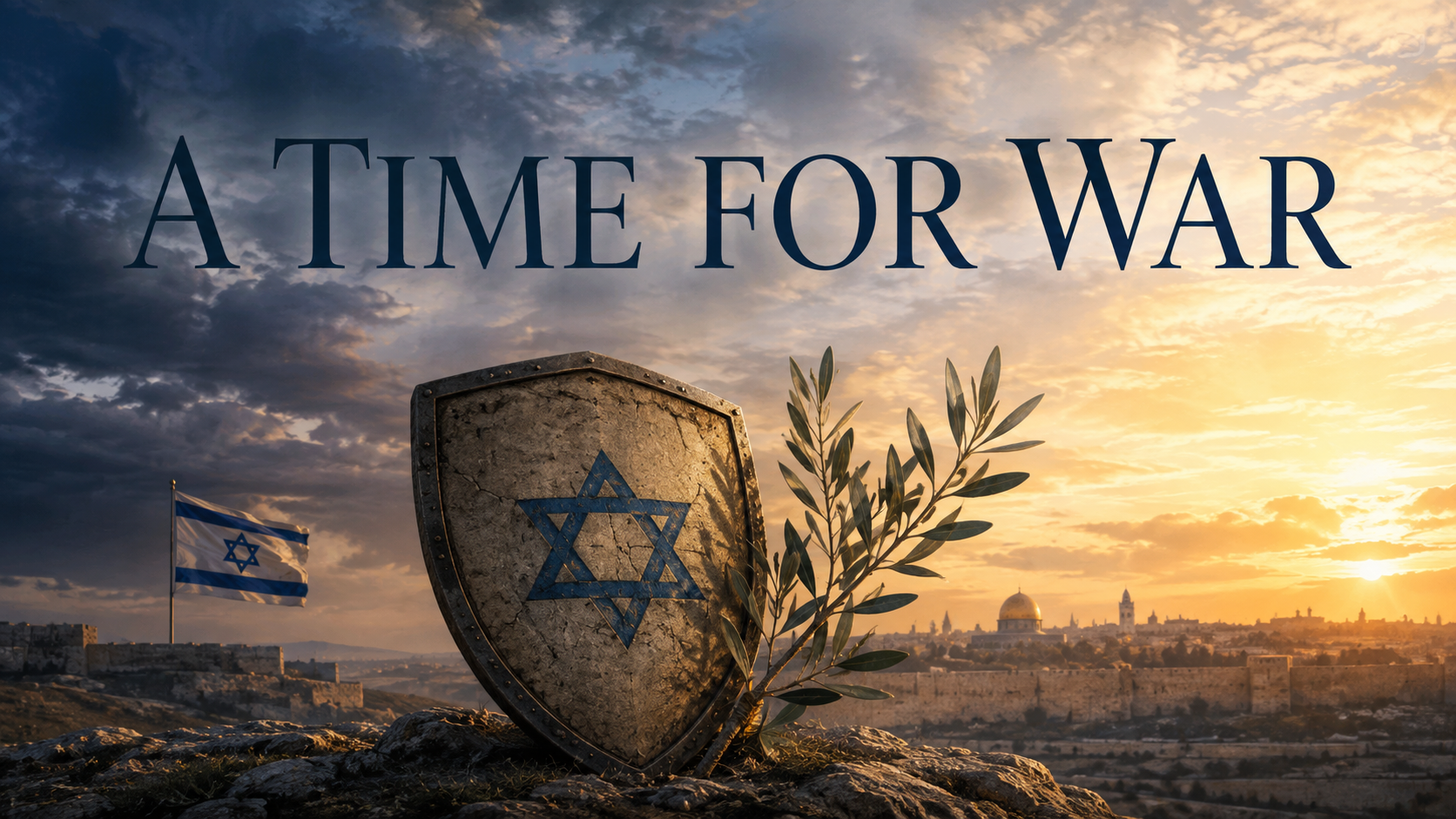
“A time to love, and a time to hate; a time of war, and a time of peace.” Ecclesiastes 3:8
A BIBLICAL CASE FOR
Israel’s Battle Against Hamas
My theological opinion on protection, civil authority, moral restraint, and the tragic necessity of defensive force.
Jonah
Peace is the biblical hope. Restraining violent evil may nevertheless be a present responsibility. The duty to protect:
Ha-ba lehorgecha—“If someone comes to kill you, rise and stop him first”
— Sanhedrin 72a
“But if any provide not for his own, and specially for those of his own house, he hath denied the faith, and is worse than an infidel.”
— 1 TIMOTHY 5:8 (KJV)
The immediate subject of this verse is personal responsibility within a family. It is not a direct command concerning national defense. Yet it expresses a broader moral principle: love carries responsibility for those entrusted to our care. A government likewise bears a solemn duty to protect its citizens from organized violence.
When Hamas attacks Israeli communities, takes hostages, and declares its intention to continue the conflict, Israel cannot simply abandon its people. Refusing to defend them would not necessarily be compassion. It could become a failure of responsibility toward the threatened.
We are given the authority to restrain evil. ROMANS 13:4 (KJV) says, “For he is the minister of God to thee for good. But if thou do that which is evil, be afraid; for he beareth not the sword in vain.”
Romans 13 describes civil government as having authority to restrain wrongdoing. The sword symbolizes coercive power, including force when necessary. In Christian thought, that authority does not make government morally infallible; it makes government accountable for using power toward the public good.
Hamas is not merely a political party with which Israel disagrees. Its deliberate attacks on civilians, hostage-taking, and stated objective of eliminating Israel place it within the category of violent evil that government exists to oppose. Israel therefore has both a national right and a moral obligation to protect its people and prevent further attacks.
Jewish Law and the Pursuer
Jewish law recognizes the principle of the rodef—רודף, “the pursuer.” When someone is actively threatening innocent life, the threatened person and others are authorized—and sometimes obligated—to intervene. This principle rests partly upon Leviticus 19:16: “You shall not stand idly by the blood of your neighbor.” The Talmud understands this as a duty to rescue a person threatened by violence. Sanhedrin 73a. The purpose is prevention, not punishment or revenge.
Applied by analogy to national defense, the principle of rodef supports Israel’s responsibility to stop an enemy actively seeking to harm its people. Israel is not required to stand idly by while its citizens are threatened. Yet the law of the rodef also imposes restraint: force exists to end the danger and preserve life—not to satisfy hatred, inflict needless suffering, or pursue revenge.
Justice Without Vengeance
Scripture forbids personal vengeance, but it does not erase the distinct responsibility of civil authority described in the following chapter. The Christian may surrender a personal claim to retaliation; a ruler may still be obligated to protect neighbors whose lives are endangered. Turning the other cheek concerns my willingness to surrender my own rights. It does not automatically grant me permission to surrender another person’s life to an attacker.
For Israel, force against Hamas should not be understood as personal revenge. It is a tragic necessity when required to restrain evil, defend the innocent, recover hostages, and prevent another mass attack. Israel should fight not because killing is desirable, but because leaving its people defenseless would be morally unthinkable.
Golda Meir’s famous words illustrate the terrible burden of defensive war: a nation may be forced to choose between allowing violence and using force to stop it.
Golda Meir captured this terrible burden in 1969 when she said that Israelis might eventually forgive their enemies for killing their sons, but would find it harder to forgive them for forcing Israel to kill theirs. Her documented wording referred to ‘sons,’ although it is now frequently paraphrased using ‘children.’
The point is not that a defender bears no responsibility for its conduct. Nor should the saying be used to make every civilian death someone else’s fault. Its moral insight is narrower: an aggressor can impose a terrible choice upon a society that did not seek war. Defensive force may be justified while remaining grievous.
The Christian Just-War Tradition
Christians have never spoken with one voice about the use of force. The earliest Christians often accepted persecution without resistance, following Yeshua’s command to love their enemies and refusing personal vengeance. Their willingness to suffer rather than retaliate remains a powerful Christian witness.
As Christians later became responsible for families, communities, and governments, another question arose: Is it loving to stand aside while innocent people are destroyed?
Augustine argued that force could sometimes be morally necessary, not because hatred is permitted, but because ordered love may require the protection of one’s neighbor. He insisted that the inward motive mattered: punishment and defense must not become cruelty, domination, or delight in another’s suffering.
This reasoning sought a moral path between two dangers: treating all force as forbidden, even when others desperately need protection, and blessing violence merely because a ruler invokes God.
Thomas Aquinas later organized the tradition around three central requirements: legitimate public authority, a just cause, and a right intention. War could not be a private feud. It needed to answer genuine wrongdoing and aim at justice and peace rather than conquest or revenge.
Later Christian reflection added other safeguards commonly described as necessity, proportionality, discrimination between combatants and civilians, and a reasonable prospect of achieving a just peace. These principles do not make war good. They place boundaries around an act that may be tragically necessary.
Christians confronting Nazism faced the same terrible tension. Some maintained a commitment to complete nonviolence. Others concluded that organized resistance was required to defend those marked for destruction. Dietrich Bonhoeffer moved from public opposition to participation in the German resistance, believing that faithful responsibility could demand action against a murderous state.
The lesson is not that every claimed emergency justifies war. History is filled with exaggerated threats and religious excuses for aggression. The lesson is that noninvolvement is not always morally neutral. When one possesses the ability and authority to protect the threatened, refusing to act may allow grave evil to continue.
Christian history also records the corruption of ‘holy war.’ Rulers and movements have invoked God to justify conquest, persecution, forced conversion, and political ambition. Any biblical defense of force must therefore include judgment upon the defender as well as the aggressor
Hamas still refuses disarmament. It must also be recognized that, despite the enormous force Israel has already employed and the suffering this war has caused, Hamas maintains a vision of eliminating Israel, and driving out Jews from the Jordan River to the Mediterranean Sea. That amounts to a pledge to commit genocide.
Israel’s Conduct Under Scrutiny
A defensive war must pursue protection rather than hatred. Its force must be necessary and proportionate. Combatants must be distinguished from civilians. Humanitarian relief should be permitted where reasonably possible. Wrongdoing by one’s own side must remain subject to investigation and correction. Peace, not permanent domination, must remain the objective.
Israel can make a credible case that its purpose is protection rather than hatred: it is fighting an organization that attacked its communities, took hostages, and promised further attacks. John Spencer, a former U.S. Army officer and chair of urban-warfare studies at West Point’s Modern War Institute, concluded that “Israel has done more and implemented more measures to prevent civilian harm than any military in the history of urban warfare.” He points to evacuation warnings, telephone calls, detailed maps, and other measures intended to move civilians away from danger. These precautions have not prevented terrible suffering, and every military action remains subject to scrutiny; nevertheless, they support the distinction between Hamas’s deliberate attacks upon civilians and Israel’s stated effort to defeat Hamas while reducing civilian harm.
No one is declaring every Israeli decision righteous. Israel remains accountable for how it conducts war, while Palestinian civilians retain their God-given human worth. Grief for Palestinian suffering is not disloyalty to Israel.
At the same time, concern for civilians cannot mean that a terrorist organization gains immunity by operating among them. Such a rule would reward the deliberate exploitation of civilian surroundings. Responsibility for civilian protection rests upon every party, including Hamas, while the party using force remains responsible for its own choices.
The Christian moral tradition therefore rejects two extremes: the claim that Israel must remain defenseless in order to be righteous, and the claim that a just cause makes every method permissible. Israel possesses a just cause for removing Hamas as a continuing military threat, while still bearing a strict obligation to use force with restraint and moral seriousness.
Prominent Christian theologian Albert Mohler has argued that Israel cannot permit Hamas to remain an operational force because the survival of the Jewish state is at stake. Israel therefore has the right to pursue Hamas wherever its leadership, weapons, financing, and operational networks are found—not from personal vengeance, but to prevent the organization from rebuilding and repeating its attacks. This position is also reflected in a broader evangelical statement supporting Israel’s right of defense, signed by numerous Christian leaders.
Conclusion: A Tragic Responsibility
Defensive force can be a public responsibility without becoming private hatred. Israel’s battle against Hamas can therefore be defended as a tragic necessity to protect its people, recover those taken captive, and prevent further slaughter. That defense is strongest when it refuses triumphalism, acknowledges every innocent life, and accepts moral limits even under extreme pressure.
Loving peace does not require leaving evil unopposed. But opposing evil must never make us indifferent to human suffering.
Epilogue:
Perspective: An estimated over 940,000 people were killed by direct post-9/11 war violence in Iraq, Afghanistan, Syria, Yemen, and Pakistan by USA led forces. That was our retaliation for one terrorist attack on 9.11. That is nearly 12x the number killed in Gaza. During the Iraq War (2003–2011), an estimated 186,000 to 210,000+ civilians were killed.
But Israel ….