The Author of Life, and the Open Gate of Repentance
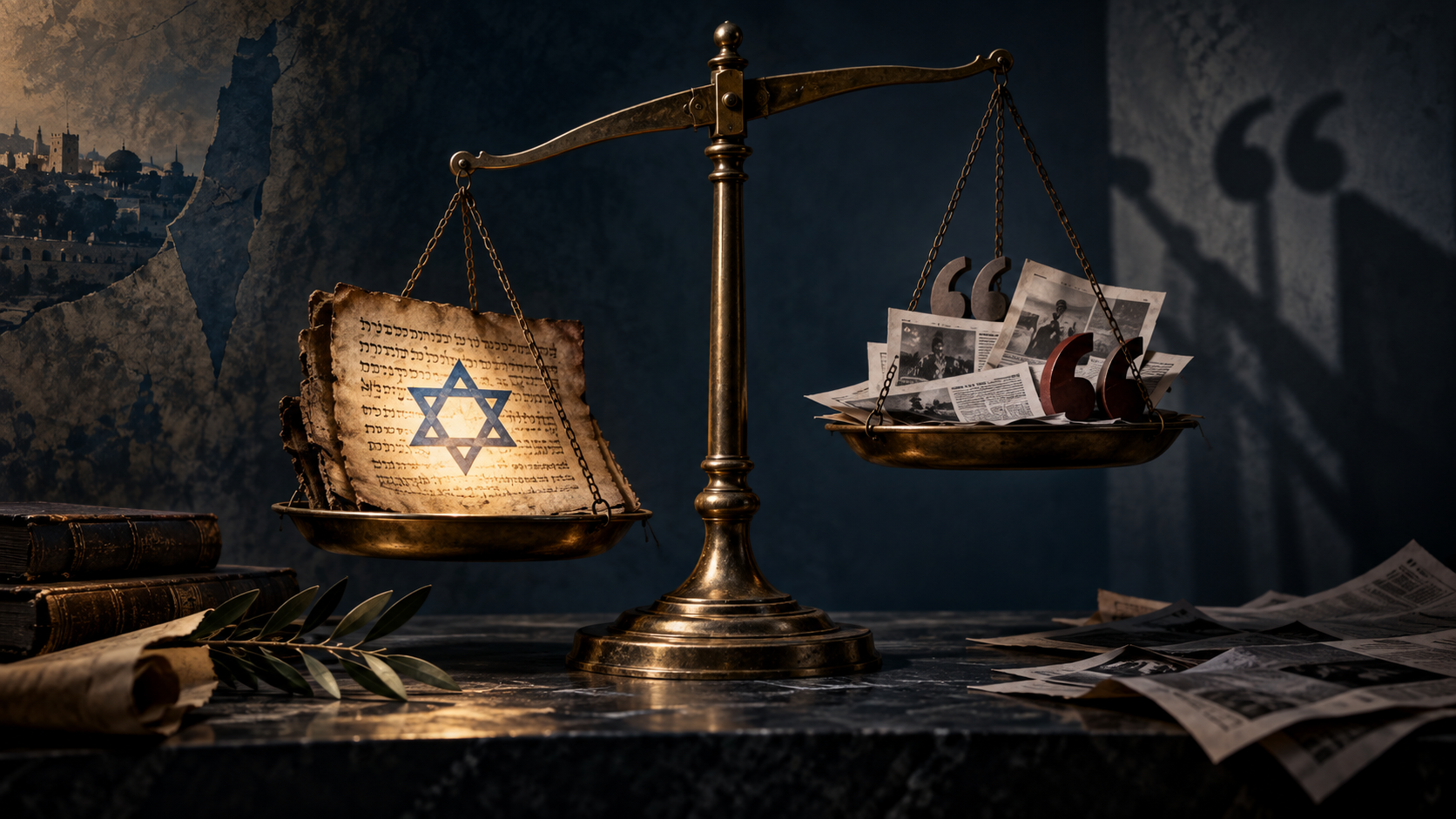
Two Stories, One Book, One God
Observations by Jonah
Preface:
The Tanakh is deep and endlessly rich. For centuries, rabbis and sages have debated its words, interpretations, and meanings—and they continue doing so millennia after the events themselves. That long tradition should not prevent us from meditating upon Scripture and searching for meaning ourselves. The New Testament brings into view things that were present but concealed in the Tanakh. In my own search to understand the Scriptures I inherited, I opened the book of Matthew. From there, I continued into the story of Yeshua and those who followed him. This essay on Acts 3 is one example of what I began to see.
Acts 3 is a pivotal chapter because it shows the promises announced at Pentecost becoming visible in public life. The chapter also introduces the two responses that shape the rest of Acts: some see the sign and believe, while others acknowledge the evidence but resist what it means.
I was seventeen years old when my temple began using Gates of Repentance, the Reform Jewish prayer book for Rosh Hashanah and Yom Kippur. The prayer book did not create the feeling I remember. That feeling belongs to the Jewish experience of the High Holidays themselves. The title simply gave words to something we already understood: the gates of repentance were open, but Yom Kippur was drawing to its close.
Rosh Hashanah means the “Head of the Year.” The Hebrew calendar literally changes into a new year. It also begins the Days of Awe, when we live with the image of the Book of Life opened before God. By the time we reached Yom Kippur and its final service, Ne’ilah, the question felt intensely personal: would we be inscribed and sealed in the Book of Life for another year?
I can still remember the pace of the service beginning to quicken. As daylight faded and the final sounding of the shofar—the ram’s horn—drew near, the rabbi would move faster through the prayers. The gates were not merely an abstract idea. You could feel them closing in the rhythm of the service. Mercy remained available. Repentance was still possible. But the day was ending, and the opportunity could no longer be treated casually.
This was also how I learned to hear Scripture in the Temple. When we read about Sinai, I did not want merely to hear about people who stood there long ago. I tried to stand with them. On Yom Teruah—the biblical “Day of Blasting,” known today as Rosh Hashanah—when I heard the blast of the shofar, I was at Sinai. Not physically, of course, but the words were being spoken to me in that moment. The story was not dead history. I was being asked to listen as one who had come near the mountain.
That memory returned to me while reading the book of Acts.
A Word About What I Am Doing
I write to think. Writing is how I organize what I am reading, notice connections, and work toward understanding. I am not writing as anyone’s pastor or rabbi. I am another student of Scripture asking questions and sharing what I think I see.
These are observations. I am lifting impressions from the words on the page and trying to hear them as though they were spoken to me. I do not want only to read that a crowd marvelled. I want to stand among them and ask why I am marvelling. I do not want only to observe the man at the gate. I want to see the scene through his eyes. That does not turn an impression into proof. It is simply the way I try to listen.
In this and other articles, I place passages, Jewish practices, historical events, and personal memories beside one another to explore the arcs connecting the two stories of the Bible. Some connections are explicit quotations or stated fulfillments. Others are narrative parallels, thematic echoes, or later traditions that help illuminate an earlier scriptural pattern. They are not all the same kind of connection, and I do not present them as though they were.
The Ne’ilah (⁵closing” or “locking”) service and the later Reform machzor—the High Holiday prayer book—called Gates of Repentance are not sources for Acts 3. I am not claiming that Acts 3 happened on Yom Kippur. I am noticing that the Jewish experience of an open gate, a call to return, and the increasing urgency of a closing hour helps me hear something in Peter’s words that I might otherwise pass over.
I can show you what I see, but I cannot make you see it—or believe it. That work belongs to the Ruach HaKodesh, the Holy Spirit. My question is simply: Do you see what I see? Do you want to believe?
Setting the Scene
Acts 2 begins with Shavuot, the Jewish Feast of Weeks called Pentecost in the New Testament. The Ruach HaKodesh comes upon the disciples, Peter proclaims the death and resurrection of Yeshua—the Hebrew name of Jesus—and about three thousand people respond. Peter tells them:
“Repent, and be baptized every one of you in the name of Jesus Christ for the remission of sins, and ye shall receive the gift of the Holy Ghost. For the promise is unto you, and to your children, and to all that are afar off, even as many as the Lord our God shall call.” —Acts 2:38–39
That promise has a movement built into it: to you, to your children, and to those who are afar off.
Just before Shavuot, Luke tells us that about one hundred and twenty believers were gathered together. The number is given in Acts 1, when Peter stands among them before the Spirit is poured out in Acts 2. I do not want to press the number beyond what Scripture says, but it creates an arresting arc back to Moses.
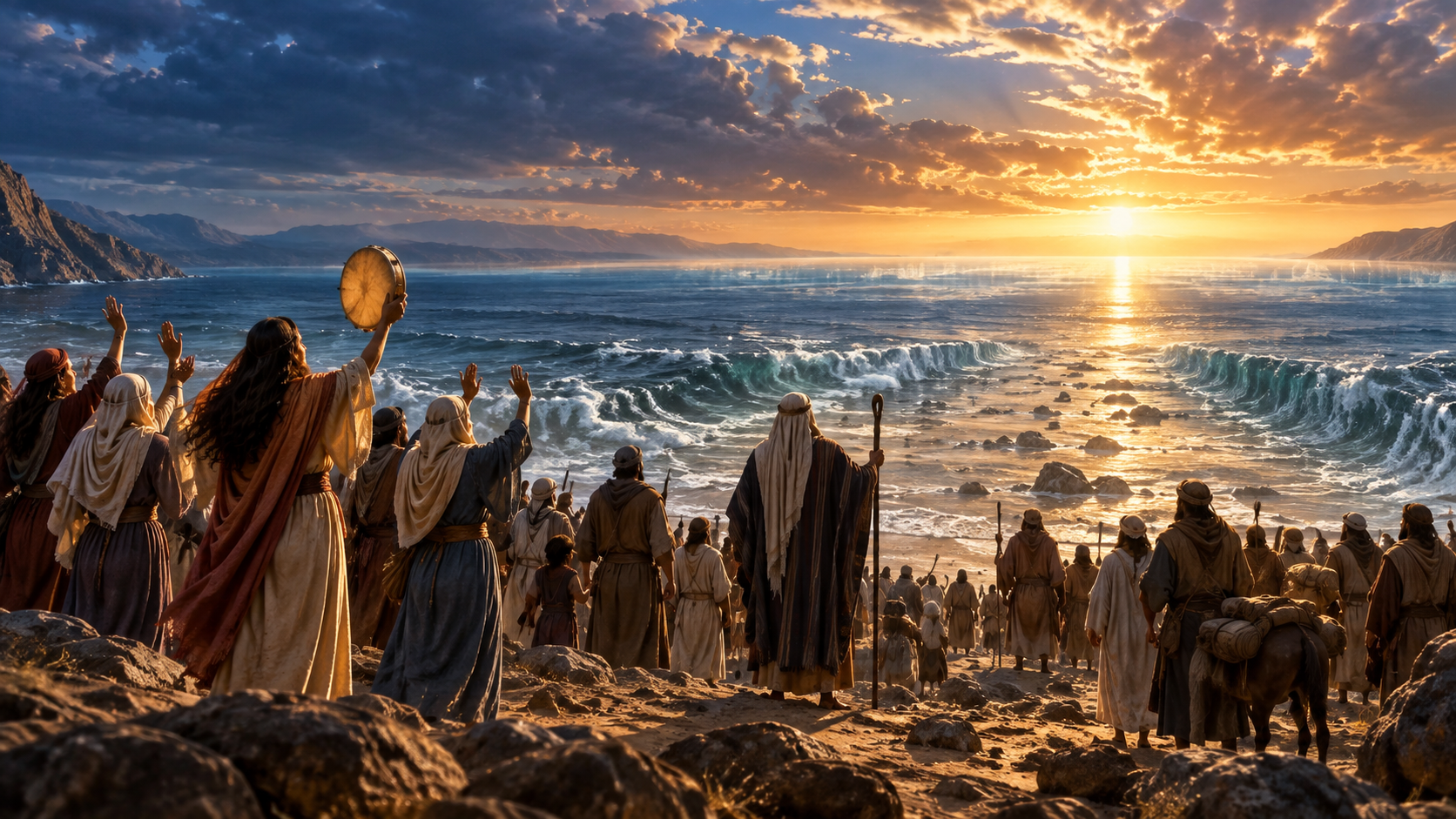
Moses reached one hundred and twenty years at the completion of his ministry. He had led Israel out of Egypt and to the edge of the land, but he would not take them across the Jordan. He laid his hands upon Joshua—Yehoshua—who was filled with the spirit of wisdom and commissioned to carry the people forward. In Acts, about one hundred and twenty wait at another threshold. Then the Spirit comes, and the followers of Yeshua—whose name is the later shortened form of Yehoshua—are empowered to carry his work forward.
This is not an equation Luke explicitly explains. It is a narrative pattern worth holding carefully: Moses at 120, his work passing to Yehoshua; approximately 120 disciples, waiting for the Spirit after Yeshua’s ascension. One transition leads Israel across the Jordan. The other begins carrying the promise from Jerusalem toward the ends of the earth.
Acts 3 begins putting that movement into visible motion. It starts in Jerusalem, inside Israel’s Temple life, and will eventually move through Samaria and outward to the nations. Paul is not yet on the scene. Peter and John are carrying forward what Yeshua taught them from Moses, the Prophets, and the Psalms. Luke ended Acts 2 by mentioning apostolic signs and wonders; Acts 3 gives us one particular sign and shows how people react when prophecy appears to take bodily form before them.
The Ninth Hour
“Now Peter and John went up together into the temple at the hour of prayer, being the ninth hour.” —Acts 3:1
The ninth hour was approximately three o’clock in the afternoon, although ancient daylight was divided into twelve seasonal hours rather than fixed sixty-minute periods. It was the established afternoon hour of Temple prayer, associated with the daily offering. The Old Testament does not call it “the ninth hour,” but it establishes the morning-and-evening pattern of sacrifice and incense around which prayer developed.
David prayed:
“Let my prayer be set forth before thee as incense; and the lifting up of my hands as the evening sacrifice.” —Psalm 141:2
Elijah, Ezra, and Daniel are all associated with prayer at the time of the evening offering. Peter and John are not abandoning Israel’s worship after Yeshua’s resurrection. They enter the Temple in continuity with it.
There is another echo that is difficult not to notice. According to the Gospels, Yeshua died around the ninth hour. Now, at the ninth hour, power in his name raises a man who has never been able to walk. I cannot prove that Luke intends us to make that connection, but it belongs beside the scene: the hour associated with Yeshua’s death becomes an hour in which his living name gives strength.
Expecting Alms
The man had been unable to walk from birth. Acts 4 later tells us that he was more than forty years old. Every day he was carried to the gate called Beautiful so that he could ask alms from those entering the Temple.
Before going farther, I have to decide where I am standing. Am I only reading about him? Am I one of the people passing through the gate? Or can I imagine being the man Peter sees?
“And Peter, fastening his eyes upon him with John, said, Look on us.” —Acts 3:4
People had probably seen this man every day. Peter stopped and truly looked at him. The man looked back expecting to receive something familiar. If I place myself there, I have to feel the narrowness of that expectation. He was not waiting to leap. He was hoping for enough to continue another day as before.
People entering to pray would be mindful of tzedakah—charitable righteousness—and the Torah’s command not to close the hand against the poor. The man expected Peter and John to participate in that familiar act of mercy.
“And he gave heed unto them, expecting to receive something of them.” —Acts 3:5
He expected a coin—enough help to get through another day while remaining dependent upon others to carry him.
Peter answered:
“Silver and gold have I none; but such as I have give I thee: In the name of Jesus Christ of Nazareth rise up and walk.” —Acts 3:6
He expected money but received healing. He expected temporary relief but received restoration. He expected to remain outside asking worshipers for help but entered the Temple as a worshiper himself.
The Torah commanded generosity, so Peter was not rejecting almsgiving. He gave something beyond an ordinary gift. The man came seeking the charity of worshipers and encountered the God who had said:
“I am the LORD that healeth thee.” —Exodus 15:26
In Hebrew: Ani Adonai rof’echa—I am the LORD, your healer.
Taken by the Right Hand
“And he took him by the right hand, and lifted him up: and immediately his feet and ankle bones received strength.” —Acts 3:7
Peter later insists that the healing did not occur by his own power or holiness. That makes the right hand significant. In the Tanakh—the Hebrew Scriptures of Torah, Prophets, and Writings—God repeatedly takes his people by the hand and raises or strengthens them:
“For I the LORD thy God will hold thy right hand, saying unto thee, Fear not; I will help thee.” —Isaiah 41:13
Peter reaches out, but God gives the strength. The language also carries the feeling of resurrection: the man is helpless, told to rise, and lifted up. Peter soon declares that the people killed the Author of Life, “whom God hath raised from the dead.”
In a sense, we are all waiting at that gate. I do not mean that physical disability is evidence of personal sin. It is not. I mean that every one of us knows weakness, dependence, brokenness, or some place where we cannot make ourselves whole. None of us has yet risen into the final restoration. The day will come when the call to rise will stand before us. The question is not only what happened to this man. The question is whether I can recognize myself in him.
The Lame Man Leaps
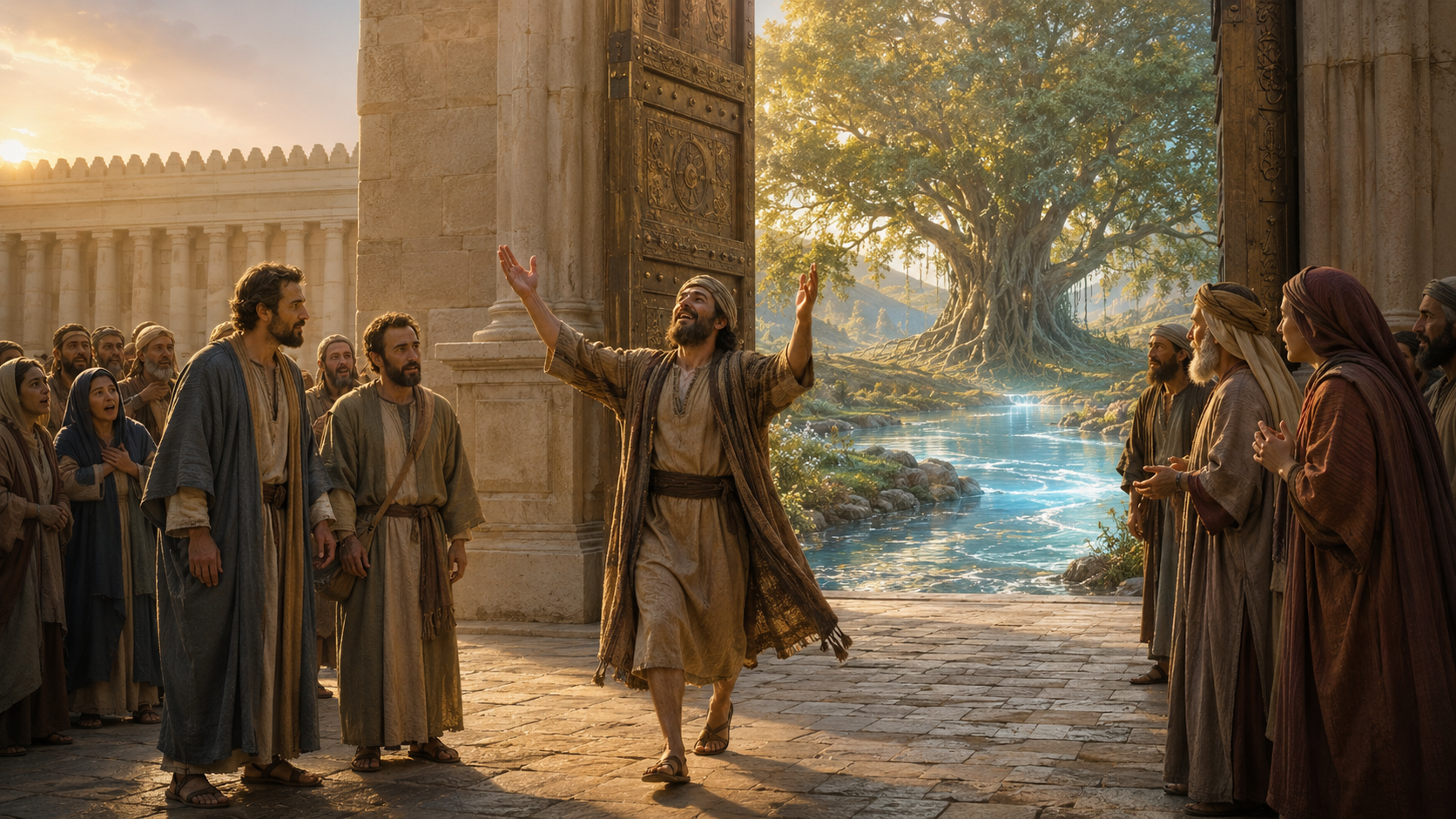
“And he leaping up stood, and walked, and entered with them into the temple, walking, and leaping, and praising God.” —Acts 3:8
This is where the earlier story comes clearly into view:
“Then shall the lame man leap as an hart.” —Isaiah 35:6
Isaiah 35 describes God coming to save and restore: weak limbs are strengthened, blind eyes open, deaf ears hear, and the lame leap. Luke does not merely say that this man moved; he specifically says that he leaped. Isaiah did not need to predict this individual man by name for his healing to become a living picture of the restoration Isaiah described.
The man’s entire position changes:
Carried by others → laid at the gate → expecting alms → raised by the right hand → standing → walking → leaping → entering → praising God.
He is not simply the subject of Peter’s sermon. He is standing there as its living illustration.
Acts says, “all the people saw him walking and praising God.” First Peter sees him in his need. Then all the people see him restored. They are not being asked to consider an invisible theory. The man they knew is moving through the Temple before their eyes.
There may also be a Joshua echo in the man’s movement through the gate. Moses brought Israel to the boundary, but Joshua—Yehoshua—led them through. The priests first placed their feet in the Jordan, the waters stopped, and Israel crossed into its inheritance. In Acts 3, Luke draws our attention specifically to the strengthening of the man’s feet and ankles. He had been carried daily to the boundary of the Temple, but through the name of Yeshua he crosses the threshold for himself.
Joshua’s sign brought a people who could not cross forward into the land. Yeshua’s name brings a man who could not walk forward into worship. I do not think Luke directly identifies the healing as a fulfillment of Joshua. But the pattern belongs beside Isaiah’s clearer echo: boundary, strengthened feet, crossing, inheritance, and entry into the presence of God.
There is one more movement connecting Acts 3 with Revelation 22. When John sees the final vision, he falls before the angel who showed it to him. The angel immediately says, “See thou do it not…worship God.” In Acts 3, the crowd looks toward Peter and John as though their power or holiness made the man walk, but Peter redirects them toward God. The healed man already understands. He does not bow before Peter. He enters the Temple walking, leaping, and praising God. Acts and Revelation give the same instruction: do not confuse the messenger with the source. Worship God.
At Solomon’s Porch
The people recognize him. They know that this is the man who had sat at the Beautiful Gate. Their wonder is understandable because his condition had been public and longstanding.
“And as the lame man which was healed held Peter and John, all the people ran together unto them in the porch that is called Solomon’s, greatly wondering.” —Acts 3:11
The healed man holds onto Peter and John, connecting the undeniable result to the apostles. The crowd gathers, and a private act of mercy becomes a public sign requiring interpretation.
Peter immediately refuses to make himself the center:
“Why marvel ye at this? or why look ye so earnestly on us, as though by our own power or holiness we had made this man to walk?” —Acts 3:12
Wonder is not yet understanding. A miracle may attract attention, but Peter redirects that attention away from himself and toward the God of Abraham, Isaac, and Jacob.
The word “marvel” deserves a pause. Pilate marvelled at Yeshua when Yeshua stood silently before him. Now the people in the Temple marvel at what is being done through Yeshua’s name. The same basic Greek verb is used in Mark 15:5 and Acts 3:12. Pilate marvelled at Yeshua standing before him. The crowd marvelled at the work of Yeshua’s living name after God had raised him.
Yet marvelling can stop short of faith. The crowd looks at Peter and John as though their own power or holiness made the man walk. Peter turns their eyes away from the men through whom the sign occurred and toward the name through which the man was made strong:
“And his name through faith in his name hath made this man strong, whom ye see and know.” —Acts 3:16
They see the man. They know the man. What they must now decide is what his strength means.
Solomon’s Porch may carry another resonance. John’s Gospel says that Yeshua walked there during the Feast of Dedication when people surrounded him and asked, “If thou be the Christ, tell us plainly.” His answer was not simply another claim. He pointed to the evidence already before them:
“I told you, and ye believed not: the works that I do in my Father’s name, they bear witness of me.” —John 10:25
Yeshua went on to say that his sheep hear his voice, follow him, and receive eternal life, concluding, “I and my Father are one.” His answer joined words, works, identity, and the willingness to believe. Yeshua is putting Himself in the Shema.
Now Peter and John stand in that same general location with a man healed through Yeshua’s name. In John 10, Yeshua’s works in his Father’s name bore witness to him. In Acts 3, a work done through Yeshua’s name bears witness that God raised and glorified him. The earlier question—“Are you the Messiah?”—is answered not only by Peter’s words but by the restored man standing beside him.
Luke does not tell us that Peter and John consciously intended to reenact John 10, so I hold the connection lightly. Still, the parallel is worth seeing: in both scenes the evidence is visible, and people must decide what it means.
Peter Reads the Sign Through the Tanakh
Peter is the primary public interpreter, with John beside him as a witness. Luke says that the risen Yeshua had already opened the Scriptures to his disciples and then taught them for forty days before his ascension. Peter is not improvising an explanation after the crucifixion; he is reading the event through what Yeshua taught from Moses, the Prophets, and the Psalms.
Peter now places Yeshua inside Israel’s scriptural story. He calls him:
- God’s Servant
- The Holy and Righteous One
- The Author, Prince, or Source of Life
- The Messiah foretold by the prophets
- The prophet like Moses
- The seed through whom Abraham’s blessing reaches all families of the earth
These are not ideas detached from the Tanakh. Peter moves through Abraham, Moses, the prophets, covenant, suffering, repentance, and restoration. Acts 3 is one of the clearest examples of the New Testament standing on the foundation of the Old.
The healing enacts Isaiah. Peter’s sermon explains the larger arc.
Stand Among Them
Acts 3 asks more of me than reading the chapter from the safety of the next page. I have to imagine entering the Temple at the ninth hour. I have to recognize the man I had passed for years and now see him standing, walking, and leaping. Then I have to hear Peter say that the power did not belong to him. It came through faith in the name of Yeshua—the Holy and Righteous One whom Jerusalem had rejected.
Whether Jew or Gentile, the reader should try to stand there. If I am a Gentile, do I recognize that I have entered a thoroughly Jewish moment—Israel’s Temple, Israel’s hours of prayer, Israel’s covenant, and Israel’s prophets? If I am Jewish, can I hear Peter placing Yeshua inside the story of Abraham, Moses, and the prophets I already know? In either case, would I merely marvel, or would I allow the sign to question me?
And I should not imagine myself only among those watching. I should imagine myself as the man at the gate. What if I had expected a coin and received strength? What if a hand reached toward me and I crossed a threshold I could never cross for myself? What would praise sound like if it came from my own mouth while everyone who knew me watched me walk?
Do not merely read what the crowd saw. Stand among them. Do not merely study the man. For a moment, see through his eyes.
The Author of Life and the Book of Life
Peter accuses his listeners of denying the Holy and Righteous One and killing the “Author of Life.” That title is especially powerful beside the Jewish image of the Book of Life.
The paired titles “Holy” and “Righteous” also reach toward the Bible’s closing chapter. Revelation 22 speaks of the unjust remaining unjust and the filthy remaining filthy, while the righteous remain righteous and the holy remain holy. The Greek words are the same basic pair found in Acts 3, although Revelation reverses their order. In Acts, the Holy and Righteous One is denied. In Revelation, as his coming approaches, every person is finally revealed in relation to holiness and righteousness.
The Book of Life is not merely a later rabbinic invention. Moses speaks in Exodus 32 of God’s book and the possibility of being blotted out. Psalm 69 speaks of the book of the living. Daniel 12 promises deliverance for those found written in the book. Malachi describes a book of remembrance before God. Yeshua tells his disciples to rejoice because their names are written in heaven.
Then Peter says:
“Repent ye therefore, and be converted, that your sins may be blotted out.” —Acts 3:19
Here is a contrast I had not fully appreciated. The Hebrew Scriptures warn of a person’s name being blotted out of God’s book. Peter offers the opposite possibility: it is not their names but their sins that may be blotted out.
The one Peter calls the Author of Life is offering life even to those who rejected him.
John records Yeshua saying, “I am the way, the truth, and the life.” This is not a direct reference to later High Holiday language; in context, he is speaking about the way to the Father. Yet John repeatedly locates life in Yeshua, and Acts 3 belongs in that same arc: strength through his name, the Author of Life, sins blotted out, times of refreshing, and the restoration of all things.
From the Prophets to the Tree of Life
Peter seems to stand in the present while speaking backward and forward at the same time. He looks backward to what God had shown through the prophets: Messiah would suffer. He speaks to the people standing before him: repent, return, and have your sins blotted out. Then he looks forward to the times of refreshing, the return of Yeshua, and the restoration of all things.
Past: the prophets foretold Messiah’s suffering → Present: repentance remains open → Future: Messiah returns and all things are restored.
Peter had not read Revelation; it had not yet been written. But through Israel’s prophets, Yeshua’s teaching, and the Ruach HaKodesh, he already knew the shape of the ending.
Revelation does not invent another ending. It unfolds in pictures what Acts 3 announces in words.
Acts speaks of “times of refreshing” coming from the presence of the Lord. The Greek word carries the sense of relief or renewed breath. Revelation 22 shows life flowing directly from that presence: a pure river of the water of life proceeds from the throne of God and of the Lamb. Beside it stands the Tree of Life, its leaves given for the healing of the nations. The curse is removed, God’s servants see his face, and life is no longer kept outside the gate.
The image becomes even more amazing when I slow down and look at it. Revelation speaks of the Tree of Life in the singular, yet places it “on either side of the river.” I cannot explain its arrangement as though John had drawn us a botanical diagram. I can only notice what my eyes see: one Tree appearing on both banks, nourished by one river flowing from one throne—the throne of God and of the Lamb.
I see an image of two banks but one source of life. I see Jew and Gentile, not made identical and not left separated, receiving from the same river and the same Tree. I also see the two Testaments: promise and fulfillment, root and fruit—not one story replacing the other, but both held together in one Messiah.
Two banks, two Testaments, Jew and Gentile—but one root, one river, one Tree, and one Messiah.
The order in Acts already leans in that direction. Peter speaks to Israel first, as children of the prophets and the covenant. Then he reaches back to Abraham and the promise that all families of the earth will be blessed. In Acts 3, one Israelite is healed at the gate. In Revelation 22, the leaves of the Tree are for the healing of the nations.
Acts 3 begins with the restoration of one man and then looks toward the restoration of all things. Revelation 22 completes the picture. At the Beautiful Gate, one man receives strength and enters praising God. In the New Jerusalem, living water flows, the Tree of Life is restored, and the nations are healed. The man’s healing is not the final restoration, but it is a sign in miniature—a small, visible prophecy of what God intends to do for creation.
Genesis ends with humanity kept from the Tree of Life. Acts 3 shows a man unable to pass beyond the gate under his own strength. Through Yeshua’s name he rises, crosses the threshold, and enters praising God. Revelation 22 restores the Tree, removes the curse, and brings God’s servants before his face. If I can imagine myself as the man at the gate, perhaps I can begin to imagine how beautiful that final scene will be.
The Yom Kippur Echo
When the Temple stood, Yom Kippur centered upon the sanctuary, sacrifice, and confession. Yet sacrifice was never meant to operate apart from repentance; the prophets called Israel to return to God with the whole heart. After the Temple’s destruction in 70 CE, rabbinic Judaism placed even greater practical emphasis upon teshuvah—the Hebrew idea of repentance as a return to God—along with prayer, confession, reconciliation, fasting, and acts of righteousness, while remembering the Temple service in the liturgy.
The final prayer is Ne’ilah, meaning closing or locking. The Mishnah, an early collection of Jewish oral law, already knows this concluding service, so the idea did not originate only after the Temple fell. Later Jewish liturgy gives powerful expression to the image of the gates closing as the day fades and the final prayers rise.
The rabbis warned against presuming upon that mercy. A person could not deliberately continue in sin while saying, “I will repent later.” The open gate was an invitation to return, not permission to delay.
This is the thematic echo I hear in Acts 3. Peter stands in the still-functioning Temple and says, in effect, that the gate remains open. He does not answer the crucifixion with personal vengeance. He calls his listeners “brothers,” acknowledges that they and their rulers acted in ignorance, and offers repentance, forgiveness, refreshing, and restoration.
But he also quotes Moses’ warning that those who refuse to hear God’s promised prophet will be accountable. Mercy is genuinely offered, yet the visible fulfillment of prophecy creates an increasing urgency to respond.
The gate is open, but the hour is growing late.
Annual Atonement and a Completed Sacrifice
Every year Yom Kippur returned. Sacrificial blood was presented, Israel confessed, and atonement was made. Leviticus treats this as a genuine God-given means of cleansing, but the service had to be repeated. Hebrews later reads that repetition as pointing beyond itself: the high priest entered repeatedly with sacrificial blood; Yeshua offered himself once. The earlier sacrifices were not discarded as meaningless. Their pattern reached its intended fulfillment in the Messiah.
That later explanation helps us hear Peter’s announcement without claiming that Peter presents the full theology of Hebrews here. He announces that the Messiah suffered, God raised him, and repentance can result in sins being blotted out.
The earlier pattern and later fulfillment belong to one story, stretching all the way to the final restoration:
Annual atonement → repeated sacrifice → prophetic expectation → Messiah’s suffering → resurrection → sins blotted out → times of refreshing → Messiah’s return → the river and Tree of Life → restoration of all things.
Two Reactions to One Undeniable Sign
Acts 3 and 4 present two basic reactions.
Many see the healed man, hear Peter’s explanation, and believe. Acts 4 says that the number of believing men grows to about five thousand. They do more than marvel at the miracle; they receive its meaning.
The Temple authorities respond differently. The priests, the captain of the Temple, and the Sadducees are disturbed because Peter and John proclaim resurrection through Yeshua. They arrest the apostles and demand that they stop speaking in his name.
We should be precise here. Acts does not say that every leader consciously recognized Isaiah 35 being fulfilled and then knowingly rejected it. It says something both more modest and more troubling: they recognized that an undeniable sign had occurred.
“That indeed a notable miracle hath been done by them is manifest to all them that dwell in Jerusalem; and we cannot deny it.” —Acts 4:16
They accept the evidence that the man has been healed but resist Peter’s explanation of what the evidence means.
The deepest division is not simply between common people and religious leaders. It is between those who receive the sign’s meaning and those who see the same evidence but resist what it may require them to reconsider.
Even then, the gate does not immediately close upon the leaders. Acts 5 introduces Gamaliel, who warns the council that if the apostles’ work is from God, they will not be able to overthrow it and may find themselves fighting against God. Acts 6 later says that a great company of priests becomes obedient to the faith.
The invitation was real even for the priests.
The Promise Begins to Move
Acts 2 promised the Spirit “unto you, and to your children, and to all that are afar off.” Acts 3 addresses Israel first:
“Ye are the children of the prophets, and of the covenant which God made with our fathers.” —Acts 3:25
Peter then reaches back to Abraham:
“And in thy seed shall all the kindreds of the earth be blessed.” —Acts 3:25
Finally, Peter emphasizes the order:
“Unto you first God, having raised up his Son Jesus, sent him to bless you, in turning away every one of you from his iniquities.” —Acts 3:26
The King James Version reads “his Son Jesus.” The underlying Greek word, pais, can also be translated “servant,” which recalls both Peter’s earlier wording and Isaiah’s Servant passages.
Israel is not discarded. The promise comes to Israel within Israel’s Temple, covenant, prophets, and prayers. But Abraham’s blessing was always intended to reach all families of the earth.
Acts 3 therefore begins visibly carrying Acts 2:39 forward:
Promise announced → Spirit given → healing demonstrated → Israel addressed first → Abraham’s worldwide blessing recalled → the message begins moving toward those afar off.
The healed man is a small picture of that larger movement. He begins at the gate, unable to enter by his own strength and dependent upon others. Through Yeshua’s name he is raised, restored, and brought into the praising community.
What Happened Just After
The sign does not bring universal agreement. It brings the apostles into conflict with the Temple authorities. Peter and John are arrested, questioned, threatened, and ordered to stop speaking in Yeshua’s name.
They do not respond by asking for vengeance. When the believers pray in Acts 4, they ask for boldness to continue speaking and for God to continue healing.
The pattern is:
Power received → healing demonstrated → Messiah proclaimed → opposition encountered → boldness increased.
The crucifixion is answered not by apostolic revenge but by resurrection, healing, and testimony. Yeshua’s future return also remains ahead: heaven receives him “until the times of restitution of all things.” The healing is therefore not the completed restoration or the Second Coming itself, but a visible foretaste.
Before the Gates Close
I began with my memory of Ne’ilah: the fading light, the quickening prayers, the approaching shofar, and the feeling that the gates of repentance were drawing closed.
Acts 3 occurs in a different setting and at a different time. But I hear a related tension.
A man comes expecting alms and receives healing. Isaiah’s lame man appears to leap inside the Temple. The God of Abraham, Isaac, and Jacob acts through the name of Yeshua. Peter calls him the Author of Life and offers the blotting out of sins. Moses, Abraham, the prophets, covenant, sacrifice, resurrection, and restoration all meet in one public moment.
Peter is preaching at the meeting place of past, present, and future. Behind him stand Moses and the prophets. Before him stands a restored man and a crowd being called to repentance. Ahead of him are the return of Yeshua, the refreshing that comes from God’s presence, and the restoration Revelation will finally picture as living water and the Tree of Life.
Some believe. Some resist. Everyone has seen the same man standing there.
I try to hear the chapter as I once heard the story of Sinai in the Temple. I do not want the shofar to sound only for ¹someone else. I do not want the man to leap only in front of someone else. I want to stand close enough to the words that Peter’s question becomes my question, his call to return is spoken to me, and the man’s praise makes me long for the day when all things are restored.
I can only place the two stories beside one another and point to the arc I think I see. The work within the reader belongs to the Ruach HaKodesh.
The man expected a coin. He received strength.
The crowd expected an ordinary afternoon prayer. They witnessed prophecy take a step, then another, and then leap before their eyes.
Peter had not read the final chapter, but he was already preaching toward it.
But once fulfillment is standing in front of us, how long can we remain only amazed?
Do you see what I see?
Do you want to believe?
This article is a personal theological reflection and part of my continuing study, “Two Stories, One Book, One God.” The connections discussed include direct quotations, clear scriptural echoes, typological interpretations, and later Jewish resonances. They are identified as carefully as I know how, and readers are encouraged to study the passages and draw their own conclusions.