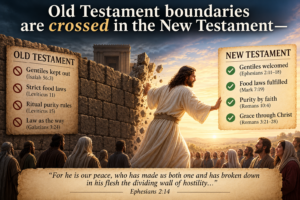
 I’ve been developing two themes in my blog. One follows the way Old Testament boundaries are crossed in the New Testament—moments of land, water, impurity, fear, and even death giving way to faith and restoration. The other is two stories, one book, one God, a way of tracing the arcs and parallels of Scripture, where separate passages echo one another and reveal a larger biblical pattern.
This article overlaps both themes. It brings boundary-crossing and biblical parallelism together in one reading.
The opening arc
In the Torah, all of the Israelites stood at the boundary of a gentile land God had promised and failed through fear to cross over.
In Numbers 13–14, the children of Israel approached the land of promise and drew back. The spies convinced the Israelites that the people could not be conquered. They saw the boundary, heard the report, and let fear rule the moment. The land was there, but they could not cross in faith. What should have been entry became refusal, and death in wilderness became the result of unbelief. God then declared that the unbelieving generation would die in the wilderness.
Mark 5.1—And they came over unto the other side of the sea, into the country of the Gadarenes.
In the New Testament, chapter Mark 5 and Luke 8 show the reverse. The same God who once called His people to cross now appears in Jesus, leading them again through every boundary they feared. At the opening of Mark 5, Jesus brings his Jewish disciples across the Sea of Galilee to Garderenes, which is in the Decapolis region, meaning it was part of a largely Gentile, Hellenized area east of the Sea of Galilee. Sources describe its cities as pagan, with Greek and Roman cults, temples, games, and worship of local and imported deities.
Mark 5 gives the other side of the same pattern. Peter is not facing giants in a land, but Jesus crosses over into contested space, meets “Legion” in Pagan territory, and drives out the multiplied enemy. Legion can be read as a shadow of the hostile powers Israel once feared in the land, the many forces that seemed too great to face. Where Israel shrank back, Jesus confronts the enemy directly and drives it out. He does what Israel was meant to do in the first place.
The “Legion” narrative at the opening of Mark 5 introduces Jesus as the one whose power reaches into the territory and into the realm of the unclean, since the man lives among tombs and the pigs are associated with impurity in Jewish symbolism. The point is not only that a demonized man is healed, but that Jesus overcomes a hostile power that seems total and untamable. The same God who once called His people to cross now appears in Jesus, leading them again through every boundary they feared.
There is a parallel. God told Israel to dispossess the nations in Canaan because of their wickedness and idolatry. The faith of the 12 tribes in the Old Testament failed to conquer their fear. In Mark 5, Jesus demonstrates to the 12 apostles that the One God of Israel can drive out demons in an unclean land. This is a foreshadow of later in Mark and Luke when Jesus will send the Apostles out two-by-two to drive out demons.
Israel was not explicitly told to drive out unclean spirits in Canaan the way Jesus later sent out the apostles. They were told to drive out the inhabitants and destroy idolatrous influence in order to remain faithful to God. But what see further down in chapter Mark 5 are two great demonstrations of faith. That is where it is pretty obvious that there is pattern related to twelve.
The two twelves
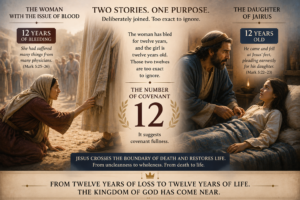 Then the story turns to the daughter of Jairus and the woman with the issue of blood. Here the two stories are not random. They are deliberately joined. The religious leader’s daughter who is twelve years old. The woman who has bled for twelve years. Those two twelves are too exact to ignore.
We can hear the twelve tribes in the story of the temple leader finding faith that Jesus can heal his daughter, who witnesses her ressurection. We can hear the twelve apostles in the faith of the woman whose blood ends signaling a time that is coming when there will not be the need for animal sacrifices.
The fringe and the law
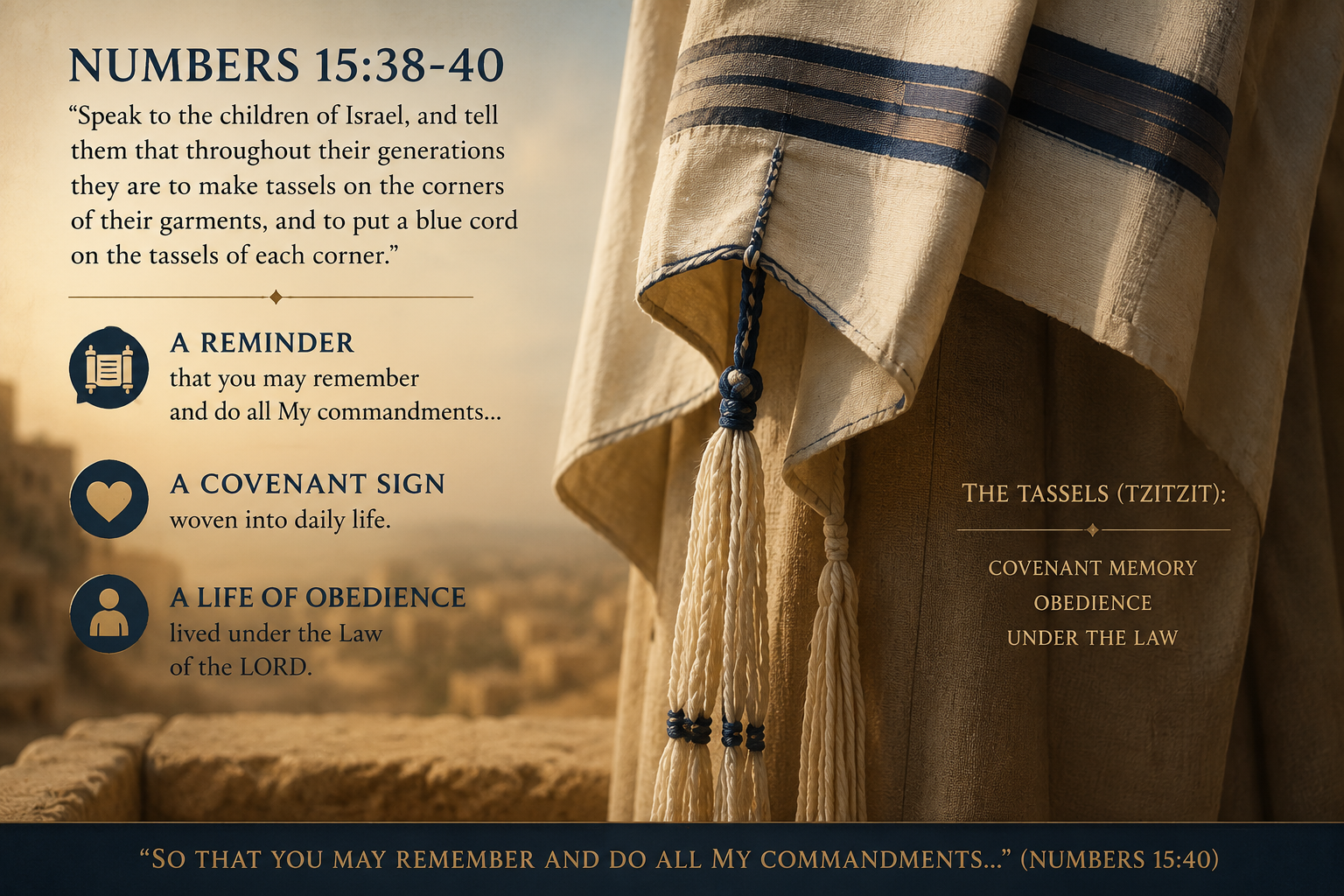
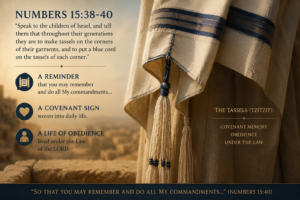 The woman’s action carries that symbolism even further. The book of Luke chapter 8 offers another witness to the same scenes in Mark 5, but Luke is especially careful to say that the woman touched the fringe of Jesus’ garment. That fringe is the tzitzit, the tassels worn on the corners of the garment according to the command in Numbers 15. The story in the new testament that first reminds of Numbers 13-14, picks up again at Numbers 15.
Those tassels were not decoration. They were a reminder to remember and do the commandments of God. They stood for covenant memory, obedience, and a life lived under the Law.
That means the woman is not merely touching cloth. She is reaching for the covenant edge. She is touching the sign of life under the Law, the sign that Israel was meant to remember, obey, and live by.
Wings and mercy
In some interpretive traditions, those corners are also spoken of as the wings of the garment. That deepens the image. Wings suggest shelter, covering, refuge, and protection. So the woman’s touch can be heard as a movement toward the wing of covenant mercy, the place where holiness and protection meet desperate need.
This is where Jesus gives the tassels new meaning. He does not discard the old meaning of the Law; he fulfills and transforms it. What once served as a reminder of the commandments now becomes, in his presence, a living point of healing. The fringe still speaks of holiness, but now holiness flows outward from Jesus in restoring power verses blood sacrafice. The woman reaches for the sign of obedience, and in touching him she finds not only law remembered but life restored. The Law is not abolished in the scene; it is filled full, made living, and brought to its intended goal in him.
Faith in motion
That is why the woman’s act is the message of faith. She does not merely think belief; she acts on it. She crosses the boundary of fear, uncleanness, and shame. Her movement is faith in motion. And Jesus answers her not with rebuke but with recognition: “Daughter, your faith has made you well.” The woman’s action becomes a sermon without words, a visible declaration that faith reaches where fear would have stopped.
There is also the blood itself. Jesus stops the flow of blood, and that too is symbolically rich. Blood in Scripture is bound up with life, sacrifice, covenant, cleansing, and loss. So the stopping of her blood can be heard as a reversal of life draining away.
Death and resurrection
Then comes the girl. Jairus, a synagogue leader, comes first, but the woman’s healing interrupts his request, and then Jesus goes on to the house. By the time Jesus arrives, the girl is dead. (Watch a reenactment of this biblical account in a episode of The Chosen.) Here the boundary is no longer only sickness or uncleanness. It is death itself.
The woman crosses the boundary of ritual impurity; the girl stands at the final boundary of the grave. One story is about chronic loss, and the other is about final loss. One is about blood stopped; the other is about life returned.
This is why the two conditions work symbolically together. The woman’s faith and the girl’s resurrection form one sign. Jesus meets both ongoing affliction and final death with restoring power. Mark 5 is not the first resurrection in the New Testament overall, but it is one of the clearest early resurrection signs, and it helps develop the Gospel pattern that teaches the reader not to fear death. Even if the boundary is met by death, resurrection lies beyond it in the power of Jesus.
The command
That is why Jesus’ words matter so much: “Do not be afraid; only believe.” Those words answer more than Jairus. They answer Israel at Canaan. They answer Peter at the water. They answer the woman at the hem. They answer the synagogue leader at the grave. And they answer every later reader who stands at the edge of some impossible threshold. Fear once blocked entry. Faith now reaches. Jesus restores. Jesus raises.
One unfolding pattern
I encourage you to read numbers 13-15 back-to-back with Mark 5 and Luke 8. There are other parallels. The stories are not isolated miracles. They belong to one unfolding biblical pattern. Israel failed at the first boundary through fear. Peter obeyed at the water boundary. The woman reached at the garment boundary. Legion stood as the shadow of the enemies in the land. Jairus crossed the boundary of death through Jesus’ word. The two twelves point backward to the tribes and forward to the apostles. The tassels recall the Law, and Jesus turns that lawful sign into a living channel of healing. The old story is not discarded; it is fulfilled, intensified, and brought to life in him.
Jesus repeatedly turns to the Old Testament because the Law, the Prophets and the Psalms are the evidence and framework of his ministry, and he presents himself as their fulfillment. His ministry is not detached from the Old Testament; it is evidenced by it. He reads Israel’s Scriptures as the witness that points to his person, his work, and his fulfillment of the promises.
John 5:39: “These are the very Scriptures that testify about me.”
Luke 24:27: “Beginning with Moses and all the Prophets, he explained to them what was said in all the Scriptures concerning himself.”
Luke 24:44: “Everything written about me in the Law of Moses, the Prophets and the Psalms must be fulfilled.”
Matthew 5:17: “I have not come to abolish them but to fulfill them.”
Some verses are so subtle that, unless you take notice and dig, you can miss a fantastic point. That is why I’m drawn to identify arcs and parallels: they reveal the deeper coherence of Scripture.
The payoff is that the Bible reads less like isolated statements and more like an interconnected whole, where earlier passages illuminate later ones and small details point to larger themes. That makes close reading feel less like analysis and more like discovery.
In doing so, the God’s Spirit reveals and guides us into truth so that God’s devine word is seen more clearly.
Two stories. One book. One God. The same God who called His people to cross now stands in one named Yeshua saying: “Do not be afraid. Believe.”
Below is a song that is very well know in some churches and is often played at funerals. It has many memories for me. It points me to Psalm 23.