What Grace Teaches Us
A Study in Two Stories, One Book, One God
Preface
An old high school friend invited me to dinner. He is a faithful Christian, so I was certain that we would begin the meal by saying grace. It also happens that his favorite number is seven.
Those two details caused me to think about the Seven Species named in Deuteronomy 8 and the Jewish practice of Birkat Hamazon—grace after meals. Christians and Jews both thank God for their food, but the traditions do it somewhat differently. That made me curious.
Most of my studies begin by applying the Bible to the Bible. This one begins with a religious practice and asks what happens when we bring that practice back to the Bible.
What follows is a study of that difference and of the biblical connections I found along the way.
So, when grace is mentioned, what number comes to mind? In this study, the answer is seven.
Grace Before and Grace After
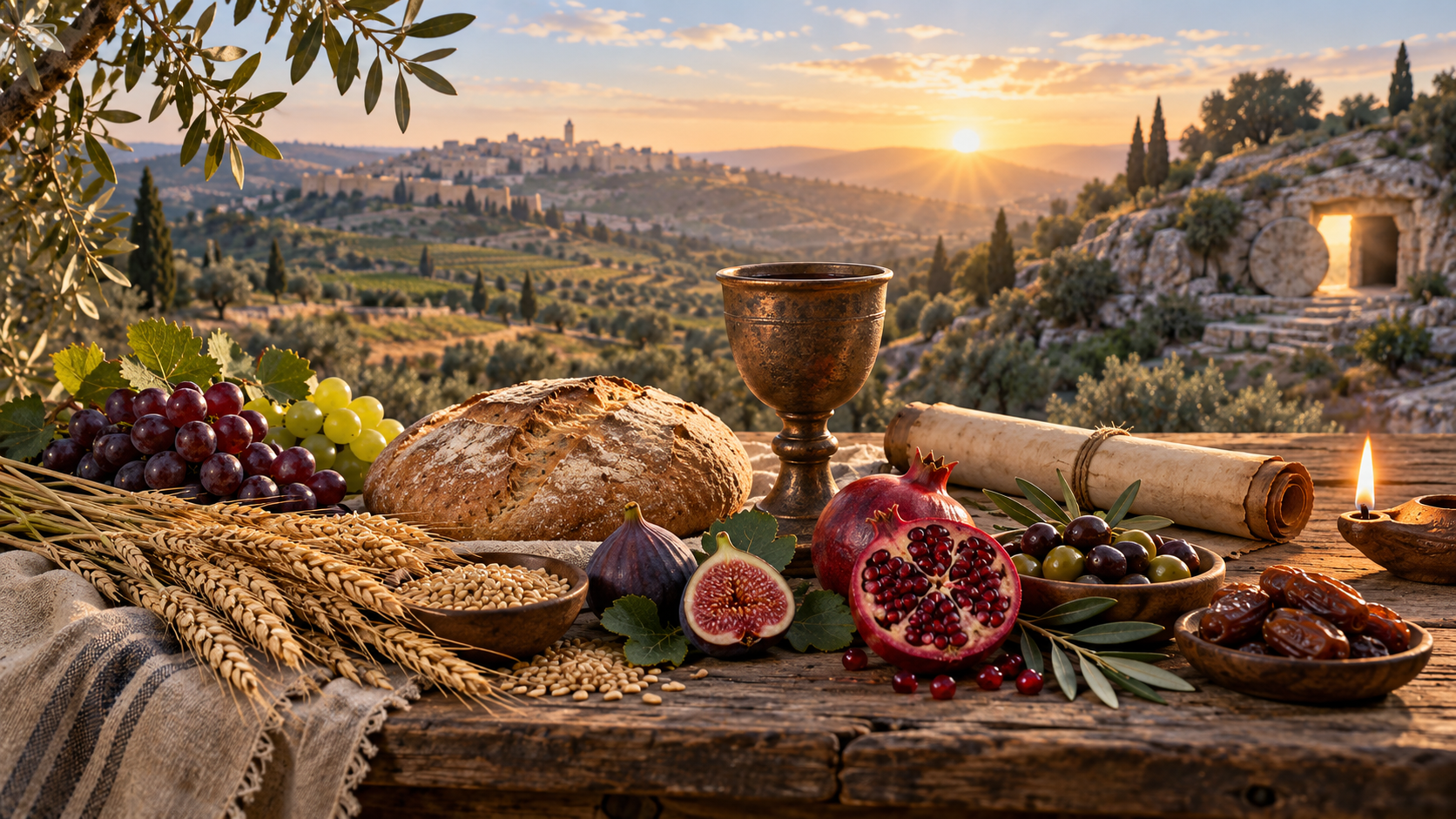 Most Christians say grace before a meal. They thank God for the food placed before them and ask Him to bless it. Jews also say blessings before eating. There are particular blessings for bread, wine, fruit, grain and other foods. But the Torah specifically commands Israel to bless God after eating:
“When you have eaten and are satisfied, you shall bless the LORD your God for the good land He has given you.”
—Deuteronomy 8:10
This command is the biblical foundation of Birkat Hamazon, the Jewish Grace After Meals.
Grace before eating expresses expectation. The provision has been placed before us, but we have not yet received its nourishment. Grace after eating expresses satisfaction. We have received the provision and now look back in gratitude.
Both are appropriate. Before eating, we recognize that provision is not owed to us. After eating, we show that the Provider has not been forgotten once our need has been satisfied.
The Good Land and Its Provision
The context of Deuteronomy 8 matters. Moses is speaking to Israel before the people enter the Promised Land. They have survived the wilderness, where food came as manna and daily dependence upon God could not easily be ignored. Now Moses describes what awaits them:
“For the LORD your God is bringing you into a good land—a land with streams of water, springs and deep waters flowing through valley and mountain; a land of wheat and barley, grapevines, figs and pomegranates; a land of olive oil and honey; a land where you will eat bread without scarcity, where you will lack nothing.”
—Deuteronomy 8:7–9
The “honey” is generally understood in Jewish tradition as date honey. The Seven Species are therefore wheat, barley, grapes, figs, pomegranates, olives and dates.
In Deuteronomy, the provision is still to come. Israel has not yet entered the Land, planted its fields or eaten from its abundance. God, speaking through His prophet Moses, anticipates that Israel will receive His provision and become satisfied.
There is expectation before there is satisfaction.
The Seven Species
The Seven Species are more than a list of available foods. Together they describe the goodness of the Land and the different ways it will sustain the people.
Wheat is the principal grain used for bread. It represents basic sustenance, human labor and settled life.
Barley is a hardy, early-ripening grain associated with the Omer. It suggests simplicity, humility and beginnings.
Grapes provide fruit and wine. They are associated with joy, blessing, fruitfulness and the sanctification of time.
Figs ripen gradually and must be gathered patiently. Jewish tradition connects them with the sweetness and continuing discovery of Torah study.
Pomegranates contain many seeds. They have come to represent mitzvot, hidden merit, abundance and unity within multiplicity.
Olives produce oil through pressing. Olive oil brings light and is associated with holiness, endurance, peace and sacred service.
Dates provide the sweetness of date honey. The upright date palm is associated with righteousness and flourishing.
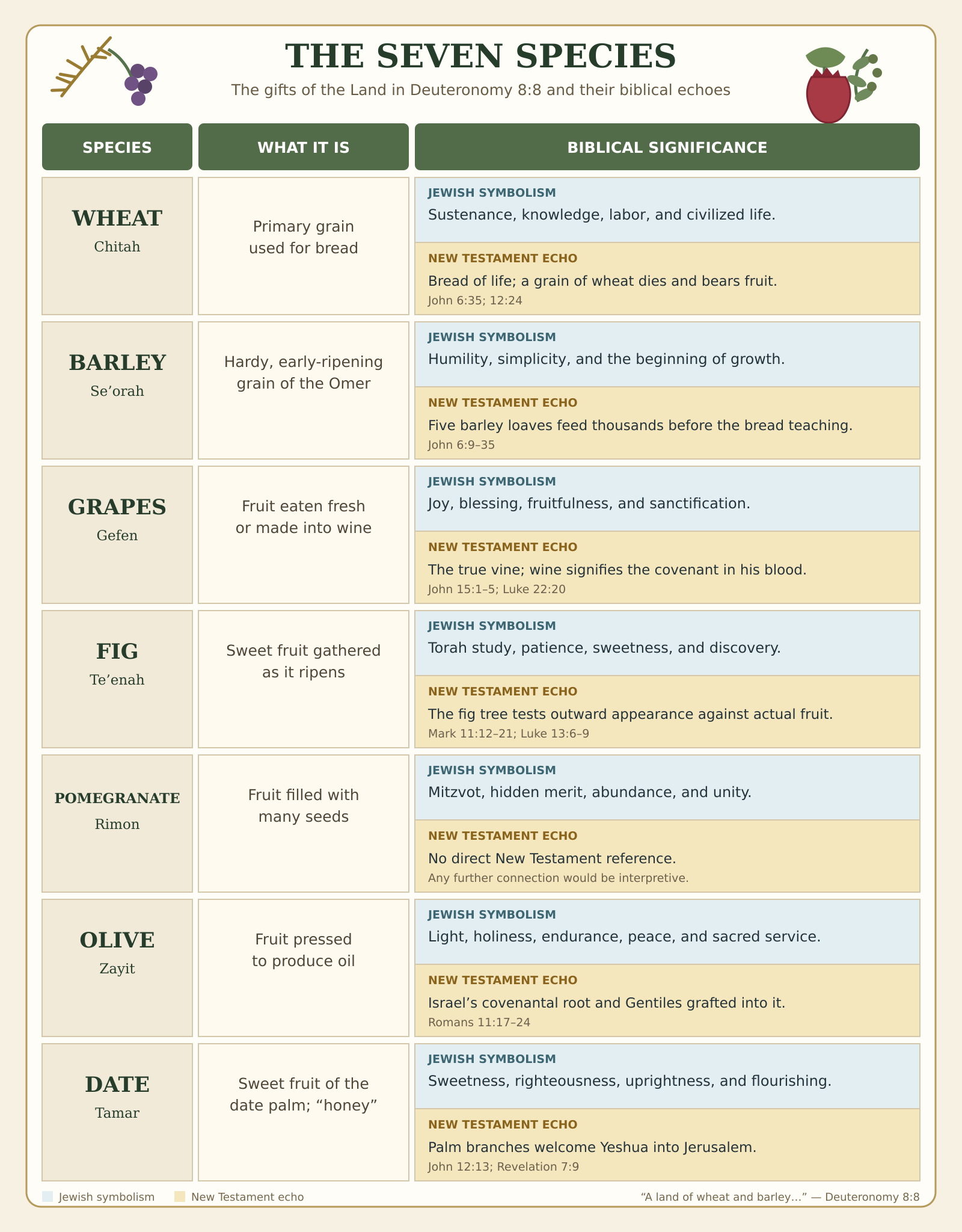
Several of these foods also appear prominently in the New Testament. Yeshua speaks of bread, wheat, vines and figs. Five barley loaves feed the multitude in John 6. Paul uses the olive tree to describe Israel’s covenantal root and Gentiles grafted into it. Palm branches are carried when Yeshua enters Jerusalem.
These references should not be forced into a claim that each species secretly predicts Yeshua. The pomegranate is not directly mentioned in the New Testament, and the date-palm connection is less developed than the others. The contextual continuity is enough. Yeshua teaches through the food, farming and physical landscape of Israel—the Land Moses described.
What Is Birkat Hamazon?
Birkat Hamazon means “the Blessing of Nourishment.” It is recited after a meal that includes bread. Its opening blessing praises God as the One who feeds the entire world:
Blessed are You, LORD our God, King of the universe, who nourishes the entire world with His goodness, with grace, kindness and mercy. He gives food to all flesh, for His lovingkindness endures forever.
The traditional prayer contains four principal blessings:
Hazan—The One Who Nourishes: God feeds and sustains the world.
Nodeh Lecha—We Thank You: gratitude for the Land, covenant, Torah, life and food.
Rachem—Have Mercy: prayer for Jerusalem, Israel and the Davidic kingdom.
Hatov Vehameitiv—Who Is Good and Does Good: recognition of God’s continuing goodness and mercy.
The practice of blessing God in connection with meals existed before Yeshua and before the destruction of the Temple. Deuteronomy commands blessing after satisfaction. The Dead Sea Scrolls describe blessings over bread and wine at communal meals. Josephus reports that the Essenes prayed before eating and praised God afterward.
The exact wording of today’s Birkat Hamazon developed over time. We should not assume that Yeshua or his apostles recited the complete prayer in its present form. But its foundation—provision, covenant, the Land, Jerusalem, thanksgiving and remembrance—belongs to the Jewish scriptural world in which Yeshua lived and taught.
A Familiar Meal and a Different Expectation
At the Last Supper, Yeshua does something his Jewish apostles know well. He blesses bread and wine. The action itself is familiar. What he says about them is new:
“This is my body…”
“This cup…is the new covenant in my blood.”
In Deuteronomy, God directs Israel’s expectation toward the Promised Land and what it will provide. At the Last Supper, Yeshua directs expectation toward his approaching crucifixion and resurrection and what they will provide.
In Deuteronomy, the provision sustains Israel’s life in the Land. At the Last Supper, Yeshua uses physical bread and wine to speak of covenant, sacrifice and spiritual life.
The apostles could recognize the setting, the blessing, the bread and the wine. What they could not yet fully recognize was the story being told through them. Yeshua was speaking unmistakably about himself, but the event had not happened. His body had not yet been given, his blood had not yet been shed and the resurrection was still ahead.
He was telling them what the meal would mean before they could fully understand what they were being asked to remember.
Remembrance Before the Event
Remembrance is central to Deuteronomy 8:
“You shall remember all the way which the LORD your God led you.”
—Deuteronomy 8:2
“You shall remember the LORD your God, for it is He who gives you power to produce wealth.”
—Deuteronomy 8:18
Biblical remembrance is more than recalling information. To remember God is to allow what He has done to govern how we live. Passover provides the clearest example. The deliverance is retold and enacted through a meal so that it remains present to every generation.
Yeshua uses that familiar Jewish understanding when he says:
“Do this in remembrance of me.”
—Luke 22:19
But there is something unusual about the timing. Yeshua establishes the remembrance before the event to be remembered has occurred. The meal begins in expectation. After the crucifixion and resurrection, it becomes remembrance.
Yeshua gives the apostles the meaning first. They witness the event afterward. Only then can they repeat the meal with a fuller understanding of what he told them to remember.
There is also a historical question worth asking carefully. The standardized form of Birkat Hamazon developed over time, and some of its language and themes resemble those found in Yeshua’s teaching. There is no evidence that allows us to claim direct influence. Both may simply reflect their common roots in Deuteronomy and Jewish meal practice.
Still, the possibility presents a striking irony worth considering. Yeshua said, “Do this in remembrance of me.” If any echo of his teaching entered the later language of grace—and we cannot establish that it did—then remembrance may have survived in an unexpected form.
That remains a question, not a historical claim.
The Warning in Deuteronomy
Deuteronomy 8 does not simply promise abundance. Moses also warns Israel about what may happen after the people receive it.
The danger is satisfaction without remembrance. Once the people have eaten well, built good houses, increased their herds and accumulated wealth, their hearts may become proud:
“You may say in your heart, ‘My power and the strength of my hand have made me this wealth.’”
—Deuteronomy 8:17
Hunger naturally reminds us that we are dependent. Satisfaction can create the illusion that we are self-sufficient. Israel may enjoy God’s provision while forgetting the One who provided it.
Moses prescribes remembrance as the antidote:
“But you shall remember the LORD your God, for it is He who gives you power to make wealth.”
—Deuteronomy 8:18
Birkat Hamazon puts that remembrance into practice. After eating, the satisfied person stops and blesses God. The prayer interrupts the movement from provision to pride. It says, in effect: I am satisfied, but I am not self-sufficient.
Yeshua’s Warning
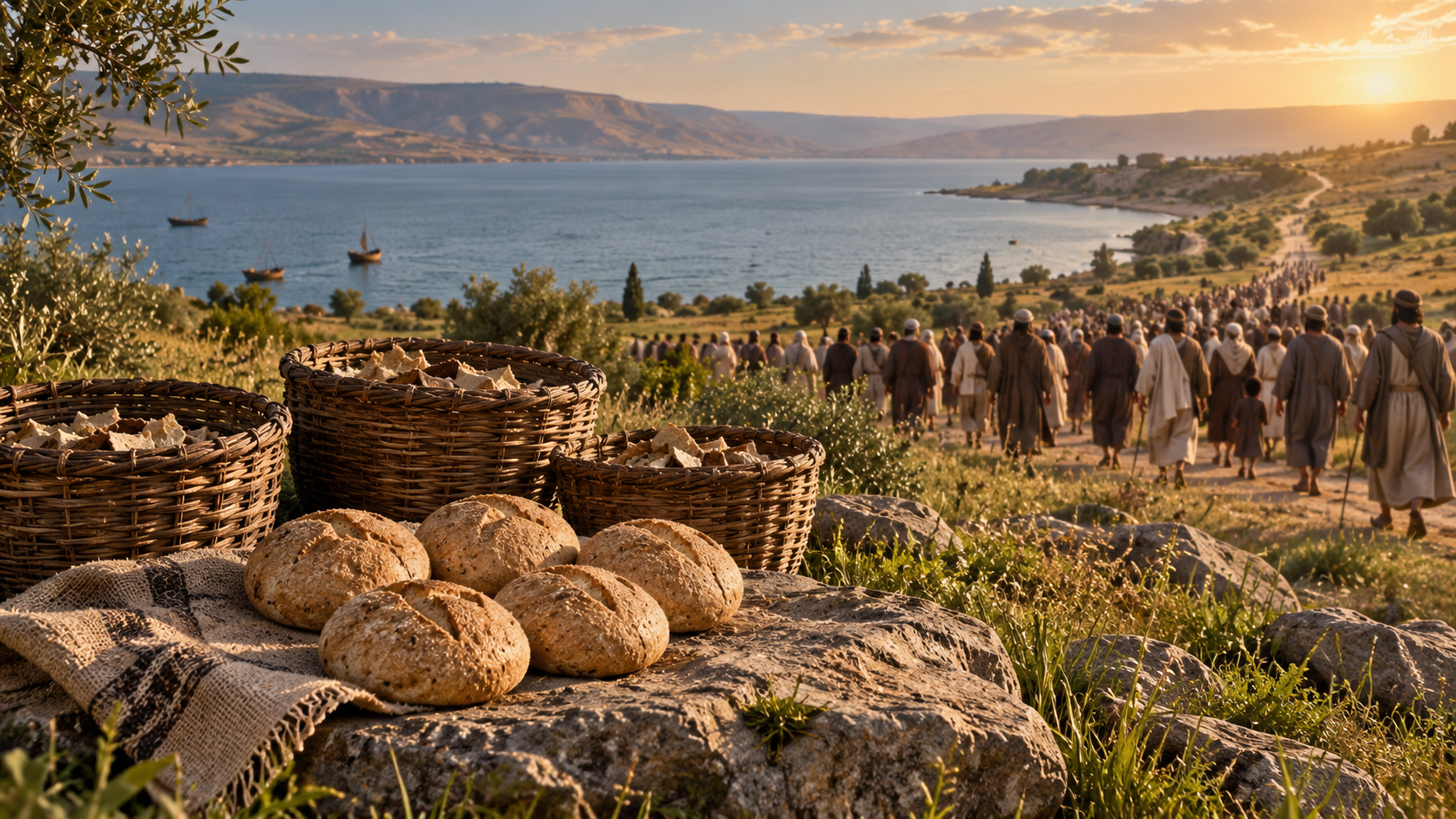
The strongest New Testament parallel appears in John 6. Yeshua feeds a multitude with five barley loaves—one of the Seven Species. The people eat and are satisfied:
“When they had eaten their fill…”
—John 6:12
The crowd then pursues Yeshua, but he warns that they have misunderstood what happened:
“You seek me…because you ate your fill of the loaves.”
—John 6:26
They received the provision but risked missing what it revealed. Their attention remained on the bread that satisfied the flesh.
Yeshua redirects them:
“Do not labor for the food that perishes, but for the food that endures to eternal life.”
—John 6:27
He then says:
“I am the bread of life.”
—John 6:35
The parallel to Deuteronomy is close. Israel would receive the produce of the Land, eat and become satisfied. Moses warned the people not to forget the Provider. In John 6, the multitude receives barley bread, eats its fill and then seeks more bread. Yeshua warns them not to receive the food and miss the meaning of the sign.
Yeshua had already quoted Deuteronomy 8 during his temptation:
“Man shall not live by bread alone, but by every word that comes from the mouth of God.”
—Matthew 4:4; Deuteronomy 8:3
Moses warns: Do not receive God’s provision and forget Him.
Yeshua warns: Do not receive the bread and miss what it reveals.
In both stories, satisfaction carries a spiritual danger. We can become occupied with the gift and lose sight of its source and meaning. In both, the answer is remembrance.
Two Stories, One Book, One God
Jewish grace after a meal and Christian grace before a meal are not identical practices. Nor did Yeshua invent the Jewish custom of blessing bread and wine before eating. The differences should not be erased.
But the shared pattern is difficult to miss. Moses and Yeshua both speak about provision before it is fully received. Both connect provision with a meal. Both anticipate satisfaction. Both attach a warning to that satisfaction. And both make remembrance essential.
Deuteronomy looks toward the Promised Land and all it will provide. The Last Supper looks toward the crucifixion and resurrection and all they will bring. John 6 stands between physical bread and the bread of life, warning us not to stop at what satisfies the body.
Christians and Jews both say grace because both understand that provision has a source. Saying it before the meal expresses expectation. Saying it afterward protects remembrance. Perhaps the fullest lesson is found in doing both: receiving with gratitude and remaining grateful after we have been satisfied.
Epilogue: Nourishment and the Prophet
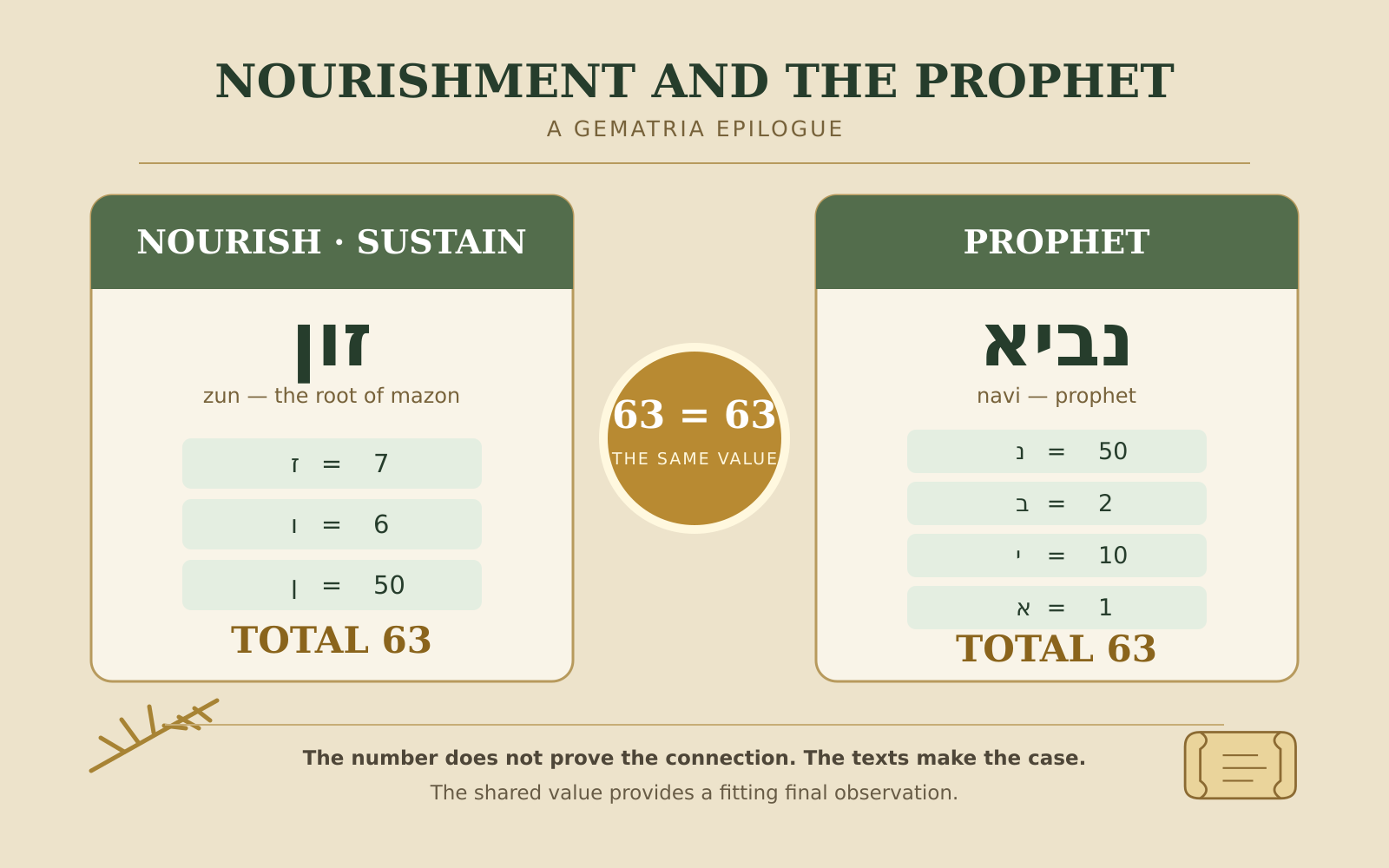
There is one final numerical connection worth noticing.
Gematria does not prove a biblical interpretation. Still, the correspondence is appropriate to what takes place in Deuteronomy 8. Moses is acting as God’s prophet. He speaks of nourishment that Israel has not yet received, anticipates the people’s satisfaction and then gives them a serious spiritual warning: do not enjoy God’s provision and forget the One who provided it.
Yeshua does something similar. He speaks beforehand of the provision that will come through his crucifixion and resurrection. He also warns those who ate the barley loaves and were satisfied not to stop at the food that perishes and miss what the sign reveals.
In both stories, the prophet speaks of nourishment still to come. In both, provision carries an expectation. In both, satisfaction carries a warning. And in both, the answer is remembrance.
The numerical connection proves none of this. The texts already make the case. But it provides a fitting final observation:
The root of nourishment and the Hebrew word for prophet share the number 63.