On these “days of assembly” I had a curious thought: might a sign of Yeshua be hidden in the totals of the animal sacrifices listed in chapter 29 of Bamidbar—the Book of Numbers? It led to an equally curious finding.
Numbers 29 details the blood sacrifices appointed for Rosh Hashanah, Yom Kippur, Sukkot, and the eighth-day assembly. As a Jewish believer who understands Yeshua as our substitute in atonement, I wondered whether even the animal counts might offer an interesting connection.
What stirred my curiosity was the precision of God’s instructions. He specified the number of each animal for each appointed day. I believe God does nothing by chance, so those numbers were deliberately chosen. Might their purpose extend beyond the counting of offerings? That question made me look more closely.
So I added them up.
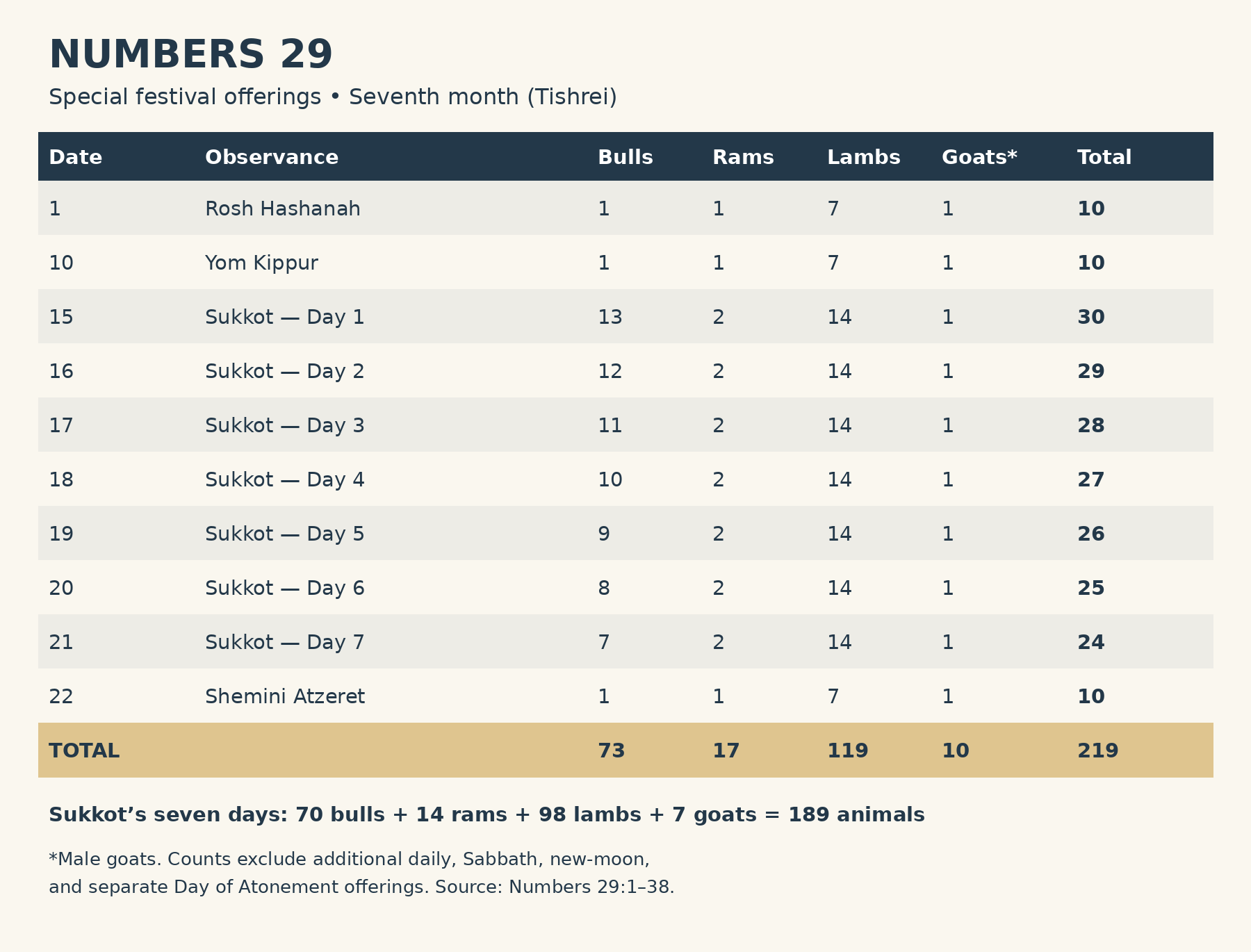
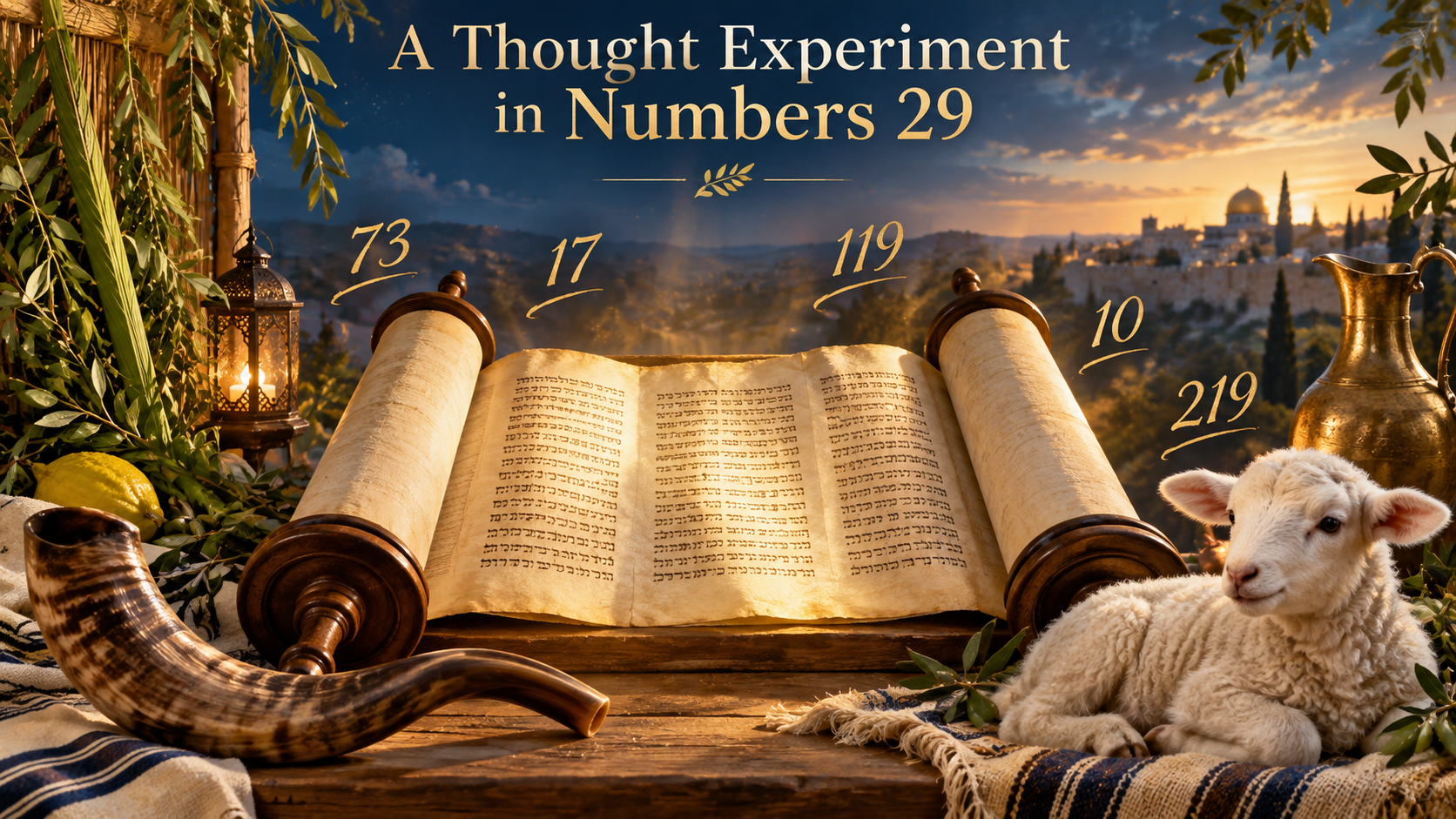
The special offerings explicitly enumerated in the chapter total 73 bulls, 17 rams, 119 lambs, and 10 male goats—219 animals altogether. These counts exclude the additional daily, Sabbath, new-moon, and separate Day of Atonement offerings.
Then I explored their gematria—the numerical values of Hebrew letters.
73: Wisdom. חכמה (Chokhmah) totals 73: chet (8), kaf (20), mem (40), and heh (5).
17: Good. טוב (tov) totals 17: tet (9), vav (6), and bet (2).
119: Little or few. מעט (me’at) totals 119: mem (40), ayin (70), and tet (9). With 119 lambs in the tally, I thought of Yeshua’s description of his disciples as a “little flock” (Luke 12:32). This is a thematic echo rather than an exact Hebrew word match.
10: Yod. The letter י has a value of ten and an association with the hand. To me, it brought to mind the hand of God.
219: The spirit. הרוח (ha-ruach) totals 219: heh (5), resh (200), vav (6), and chet (8). That exact spelling appears in Numbers 11:17, where God promises to share the spirit upon Moses with the elders who will help him lead the people. The initial heh matters: ruach alone equals 214; ha-ruach, “the spirit,” equals 219.
Interestingly, the first animal tally and the grand total brought me to concepts already joined in Scripture: 73 corresponds to Chokhmah, “wisdom,” and 219 to ha-ruach, “the spirit.” God equips Bezalel with spirit and wisdom to build the sanctuary, while Isaiah describes the coming ruler from Jesse’s line as receiving “a spirit of wisdom and understanding.” (Exodus 31:3; Isaiah 11:2) The numerical matches remain a thought experiment, but the connection between wisdom and spirit is firmly rooted in the biblical text.
There is also an established rabbinic interpretation within these offerings. The 70 bulls sacrificed during Sukkot’s seven days correspond to the seventy nations, while the single bull of the eighth-day assembly represents Israel (Sukkah 55b).
Sukkot, the Spirit, and Jonah
Another connection emerged within Sukkot itself. The Jerusalem Talmud relates that Jonah son of Amittai received the Holy Spirit while attending the water-drawing celebration (Jerusalem Talmud, Sukkah 5:1). His father’s name is related to emet, “truth.” Alongside the seventy bulls associated with the nations and the eighth day’s single bull associated with Israel, we encounter a prophet of Israel who would carry God’s warning to a foreign nation. Spirit, truth, Israel, and the nations meet within the festival’s traditions—another intriguing thread in this thought experiment.
Jonah also brings this reflection back to Yeshua, who explicitly invokes “the sign of Jonah,” linking the prophet’s three days and nights in the fish with his own coming burial (Matthew 12:39–40). Here, the connection goes beyond numerical association: Yeshua himself identifies Jonah’s story as a sign pointing toward his own.
Wisdom, goodness, a little flock, the hand of God, and the spirit: these associations gave me something to ponder as a Jewish believer in Yeshua. In light of his sacrificial role, I find it natural to look for foreshadowings of him in the offerings of God’s appointed holidays.
Was this a hidden message? Some say there are no coincidences in Scripture. Perhaps these numerical echoes reflect a purpose I have only begun to glimpse. I offer them as a curious thought—an invitation to look more closely, rather than a claim to have unlocked a hidden message.
Two Stories, One Book, One God.