
A Story as Old as the Beginning—and as Current as Today
By Jonah Ritter
Preface
Yehuda Meitav creates songs and videos about Jewish life, Israel, and antisemitism. His latest song, “The Devil Was a Painter from Austria”, portrays evil reappearing in different forms. His written post, “The Erev Rav Walks Among Us,” got me thinking. I went back to Scripture and noticed a recurring pattern that fits my theme, “Two Stories, One Book, One God.” This article follows that pattern from Bereishit to today. A link to his post appears in my closing paragraph.
That’s why I write—to think things through. Maybe what I write will get you thinking, too.
The story is as old as the Beginning and as current as today. God calls people into relationship with Him. Deception undermines their trust. People yield to it. God calls leaders to bring them back.
To understand that pattern, I want to begin with God’s purposes as Scripture presents them.
In the Beginning
Bereishit. God creates the heavens and the earth. He makes humanity in His image and places the first humans in a garden, with provision, responsibility, and a command to honor (Genesis 1–2).
Relationship with God comes before religious institutions.
In Tanya, Shaar HaYichud VehaEmunah, chapter 1, Rabbi Shneur Zalman teaches that God’s creative word continually sustains existence.
The serpent challenges what God has said. He contradicts God’s warning and suggests that God is withholding something desirable. Eating the fruit, he tells the woman, will make them like God, knowing good and evil (Genesis 3:1–5).
The deception undermines trust in God’s word and goodness.
The consequences are shame, hiding, blame, and separation from the Garden. The relationship has been wounded. The people who received God’s gifts now hide from His presence.
The pattern begins: deception undermines trust and leads to disobedience and separation.
What Does God Desire?
God continues to reach toward humanity. He calls Abraham and promises that through him all families of the earth will be blessed (Genesis 12:1–3). He later sends Moses to deliver Israel from Egypt and lead the people toward the land promised to their ancestors.
Israel is called to become a kingdom of priests and a holy nation (Exodus 19:5–6).
The Torah tells us what this relationship requires: love God wholeheartedly; love your neighbor as yourself; love the stranger, remembering that we were strangers in Egypt (Deuteronomy 6:5; Leviticus 19:18, 34).
I see a consistent direction here: people living faithfully before God and responsibly with one another. Fellowship and love have substance. They include obedience, justice, mercy, and care for the vulnerable.
While Moses Is on the Mountain
At Sinai, uncertainty about Moses becomes the justification for a substitute. The people ask Aaron to make gods to go before them because they do not know what has happened to Moses (Exodus 32:1).
While Moses receives God’s instruction, people below prepare to abandon it.
Jewish commentary identifies a particular influence behind the episode. Exodus 12:38 mentions the Erev Rav, the mixed multitude who left Egypt with Israel. Rashi, drawing upon midrash, connects them with instigating the Golden Calf and leading others astray (Rashi on Exodus 32:4, 7).
This identification comes from commentary. In that reading, influence within the community redirects its trust and worship.
Aaron receives the gold, fashions the calf, builds an altar, and announces a festival. His standing lends authority to the failure. Whatever pressures or intentions we consider, his actions help facilitate it.
Aaron’s participation raises a lasting question: whose purposes does a leader serve when he yields to corrupting influence?
Later Jewish mystical teaching extends the Erev Rav beyond the group that left Egypt. The Zohar describes them among corrupt leaders, judges, and people who use bribery (Nasso 125a). This gives me a traditional basis for examining a recurring spiritual danger: people within the community using their influence against the purposes they claim to serve. It does not automatically identify anyone today, but it makes the warning relevant beyond the wilderness generation.
Even Inside the Priesthood
Later, Aaron’s sons, Nadab and Abihu, offer fire God has not commanded (Leviticus 10:1–3). Once again, people entrusted with sacred responsibility depart from His instruction.
Rashi on Deuteronomy 9:20 connects the loss of two of Aaron’s sons with God’s earlier anger against Aaron and Moses’ intercession.
That connects the episodes without identifying the sons as Erev Rav.
Aaron remains silent after their deaths and Moses’ explanation. I wonder whether he remembered his own failure with the calf and the mercy shown him. That is my question, not something Scripture tells us about his thoughts. His silence is treated honorably in Rashi’s commentary.
Sacred office does not guarantee faithful service.
Fear at the Border of the Promise
The spies’ report brings another crisis. Fear spreads through the congregation. The people propose appointing another leader and returning to Egypt (Numbers 14:1–4).
They reject entry into the promised land and demand a return to bondage.
God identifies the failure as unbelief despite the signs they have witnessed (Numbers 14:11). Moses later describes their refusal as rebellion against God’s command (Deuteronomy 1:26, 32).
Rabbinic teaching connects the spies’ report with destructive speech. Rashi on Numbers 13:2 observes that they failed to learn from Miriam’s punishment; Arakhin 15a examines the damage their evil report caused.
Again, words undermine trust. Fear spreads. The people reject God’s direction and seek to replace His leader.
God nevertheless carries His promise forward. Joshua and Caleb are excepted from the judgment upon the counted generation aged twenty and upward. Joshua leads the next generation into the land (Numbers 14:29–31).
God’s covenant purpose continues through a new leader and generation.
When Shepherds Serve Themselves
The Tanakh keeps returning to the responsibility of religious leadership. Eli’s sons abuse their position and treat the offerings with contempt (1 Samuel 2:12–17). Ezekiel condemns shepherds who feed themselves while neglecting the flock (Ezekiel 34:1–10). Malachi rebukes priests whose instruction causes people to stumble (Malachi 2:7–9).
God sends prophets to call people back. Hosea emphasizes steadfast love and knowledge of God over offerings detached from them (Hosea 6:6). Micah calls for justice, kindness, and humble walking with God (Micah 6:8).
God’s correction serves restoration.
These accounts describe different failures, but I notice a common result: people are drawn away from God’s instruction. Sometimes fear drives them. Sometimes leaders misuse their authority. Sometimes worship itself becomes corrupted. God continues to send correction and call His people back. That recurring conflict is the pattern I am following.
The Accuser Stands Beside the Priest
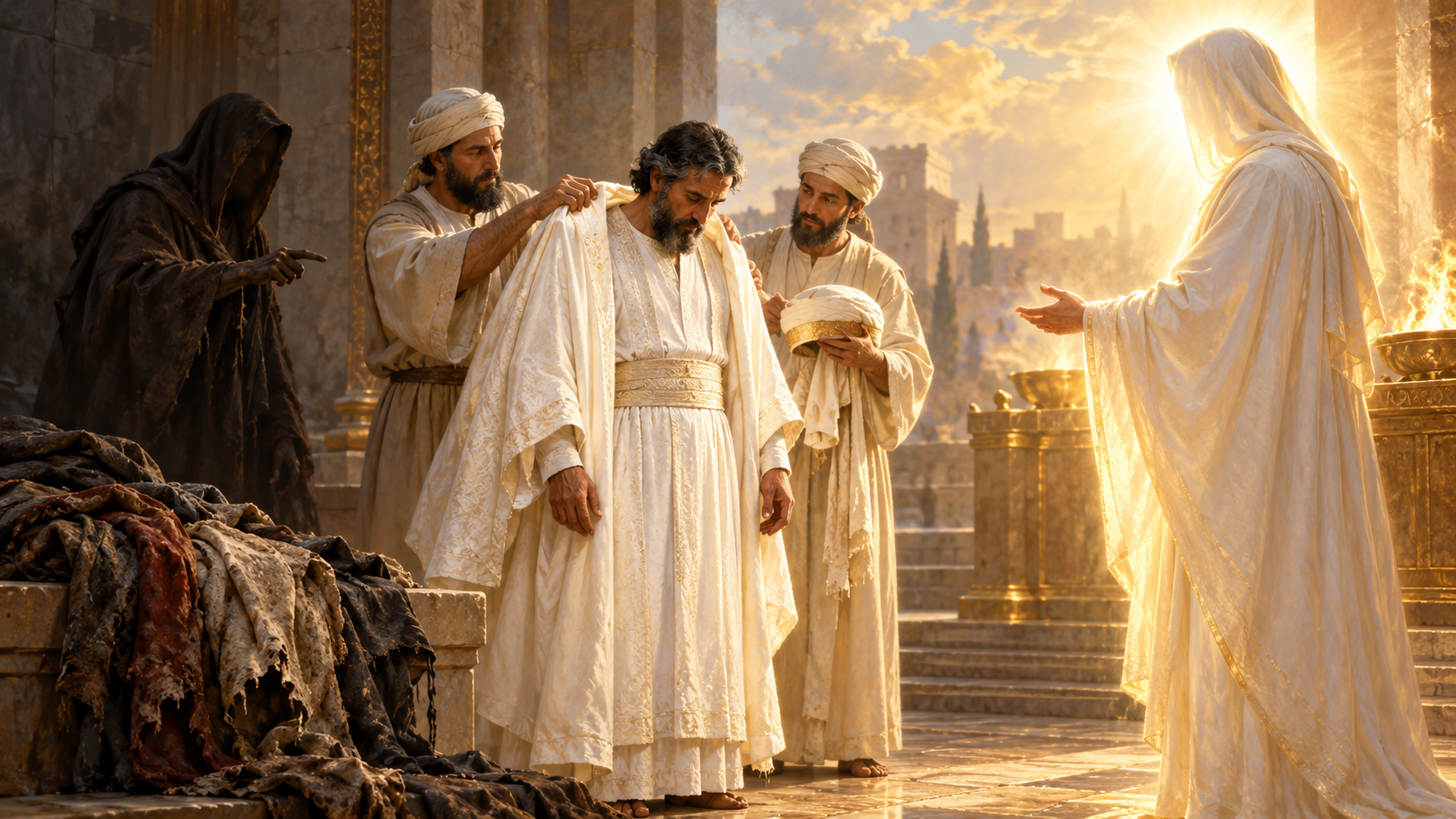
Zechariah 3 brings the conflict into a vivid scene. Joshua the high priest stands in filthy garments. Beside him stands ha-satan, the adversary or accuser, ready to accuse him.
God rebukes the accuser. Joshua receives clean garments, and his guilt is removed. He is charged to walk in God’s ways. Then comes the promise of God’s servant, the Branch (Zechariah 3:1–8).
Accusation, cleansing, mercy, and a coming servant appear together.
The prophets also expose wrongdoing, but to call people back to God. Truthful correction differs from malicious accusation.
Making Room for a Redeemer
The heart itself needs renewal.
Jeremiah promises a new covenant with the house of Israel and the house of Judah, with God’s Torah written upon their hearts (Jeremiah 31:31–34). Ezekiel promises cleansing, a new heart, and God’s Spirit enabling obedience (Ezekiel 36:25–27).
The prophets also look toward a righteous ruler from David’s line, a faithful shepherd, and a covenant of peace (Isaiah 11:1–9; Jeremiah 23:5–6; Ezekiel 34:23–31).
The Tanakh establishes the need and the hope: God will gather, cleanse, renew, and shepherd His people.
This is where I see the Tanakh making a place for a Redeemer.
And Then Comes Yeshua
As a Jew who follows Yeshua, I see his mission within these promises. I recognize that Jewish readers will differ with me about their fulfillment.
He calls people to repentance and proclaims God’s kingdom. Asked about the greatest commandment, he joins love of God with love of neighbor, drawing directly from Torah (Matthew 22:34–40).
He confronts hypocrisy and the neglect of justice, mercy, and faithfulness. He challenges traditions that undermine God’s commandments. When opponents accuse his disciples over their Sabbath conduct, he answers from Scripture and invokes God’s desire for mercy (Matthew 12:1–7; 23:23; Mark 7:8–13).
He calls people from fear toward trust, while helping those who struggle to believe (Mark 5:36; 9:24).
The Resistance Returns
Some opponents seek to trap, discredit, and kill Yeshua. Yet the leadership is not of one mind. Nicodemus urges a fair hearing. Joseph of Arimathea does not consent to the council’s decision. Later, Gamaliel warns the council that opposing the apostles could mean fighting against God (John 7:50–51; Luke 23:50–51; Acts 5:34–39).
Their different responses prevent a blanket judgment of the leadership.
My observation is that the corrupting pattern associated with the Erev Rav appears again. This is a thematic connection, not Scripture identifying these opponents as Erev Rav.
The New Testament also takes us back to the Garden. Revelation 12:9 identifies the ancient serpent with the devil and Satan. Yeshua describes the devil as a liar and the father of lies (John 8:44). In the wilderness temptation, the devil seeks worship, and Yeshua answers that worship belongs to God alone (Matthew 4:8–10).
Deception that draws people away from God serves the adversary’s purposes. People may participate knowingly or yield without understanding the consequences.
The Warning Includes the Church
The same examination reaches Yeshua’s followers. Paul warns elders that misleading teachers will arise from among their own number and draw disciples after themselves (Acts 20:28–30). Diotrephes uses malicious accusations and exclusion within a congregation (3 John 9–10). Hebrews 3–4 applies the wilderness generation’s warning to those following Yeshua.
The warning applies to synagogue, church, and me.
Whose purposes do our words and actions serve? Do we draw people toward God, or toward ourselves? Do we welcome truthful correction? Do we use fear to protect our standing? Are we practicing the love we preach?
Back Toward the Garden
Yeshua commands his followers to love one another and prays for their unity (John 13:34–35; 17:21). Revelation closes with God dwelling with His people, the curse removed, and the tree of life present again (Revelation 21:3; 22:1–5).
The story leads toward restored fellowship with God.
God continues to call through patriarchs and prophets. In Yeshua, I recognize the Redeemer who brings reconciliation and life with God.
Deception, distrust, and division also persist. We still must examine whose purposes our words and actions serve.
For me, “Beware of the Erev Rav” begins with examining influence, including my own. Does it strengthen faithfulness to God, or encourage fear, falsehood, and misplaced allegiance? Religious standing alone cannot answer that question.
Two Stories, One Book, One God.
The serpent’s deception begins with distrust and ends in separation. God’s call leads toward truth, faithfulness, and restored fellowship. From Bereishit through the prophets to Yeshua, that is the continuity I see: Two Stories, One Book, One God.
That brings me back to Meitav’s message. His Facebook post “The Erev Rav Walks Among Us” prompted this reflection. Consider his warning in light of the pattern we have traced. His specific accusations must be weighed on their own evidence. You can read Meitav’s original post here.