Do We Know Who We’re Battling?
By Jonah Ritter — October 8, 2026
Preface
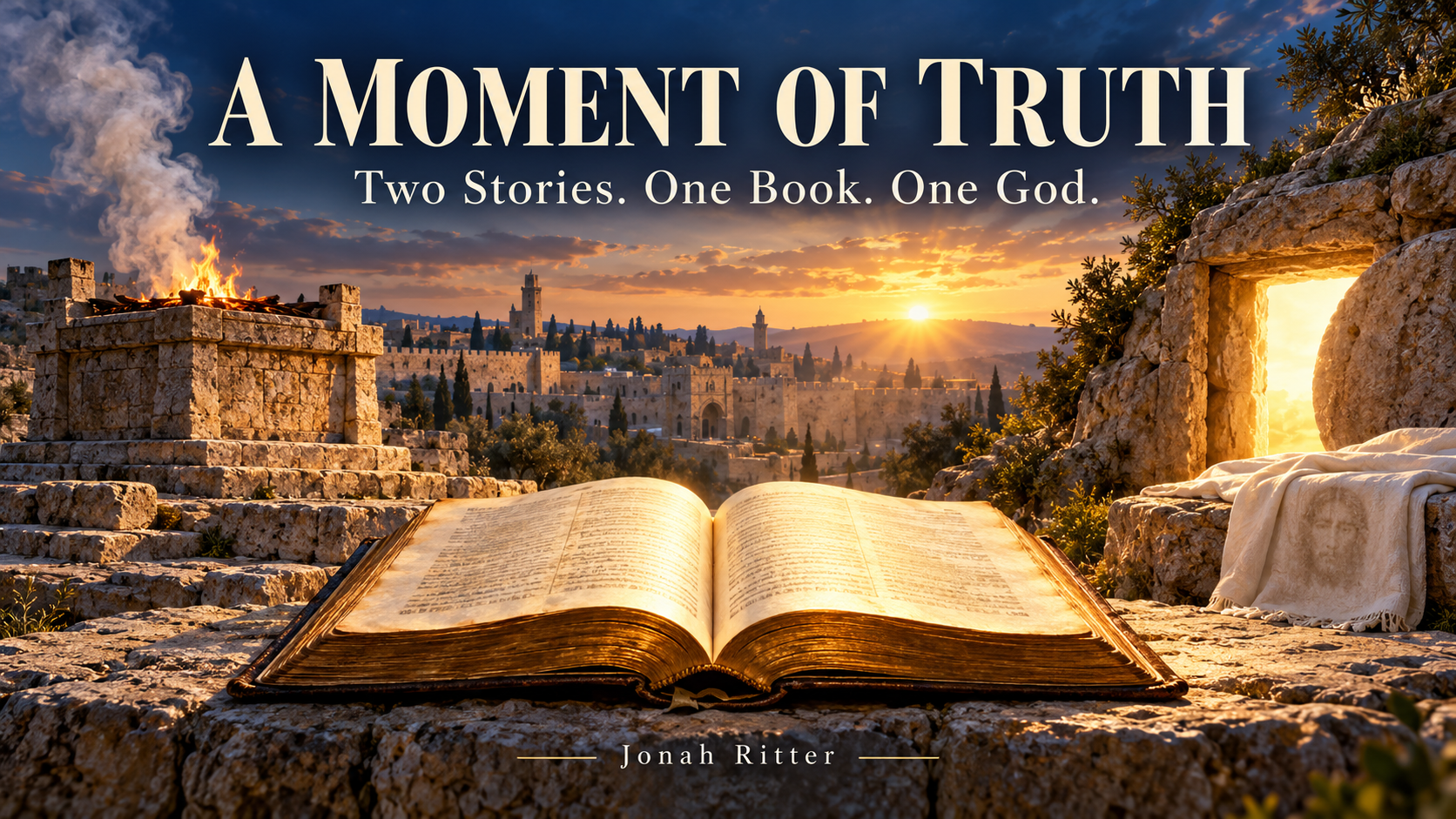
My previous article, A Moment of Truth, explored the questions that renewed Temple sacrifices would raise about atonement, Yeshua, and the relationship between Judaism and Christianity. Writing it led me to consider how those questions connect to the larger spiritual struggle surrounding Israel. Connect the Dots follows that thread, asking readers to look beyond isolated events and consider the pattern they may reveal.
Iran’s revolutionary regime never intended its revolution to stop at Iran’s borders. Its 1979 constitution envisioned extending the struggle abroad and building a worldwide community.
How often must its leaders call Israel the “Little Satan” and America the “Great Satan” before we take the hostility seriously? Europe belongs to the same West they denounce—a civilization profoundly shaped by its Judeo-Christian inheritance.
The military, political, and religious dimensions belong in the same picture. Documented connections provide the foundation; the larger spiritual interpretation is the thesis explored here. We cannot understand the danger by examining every crisis in isolation.
The Octopus
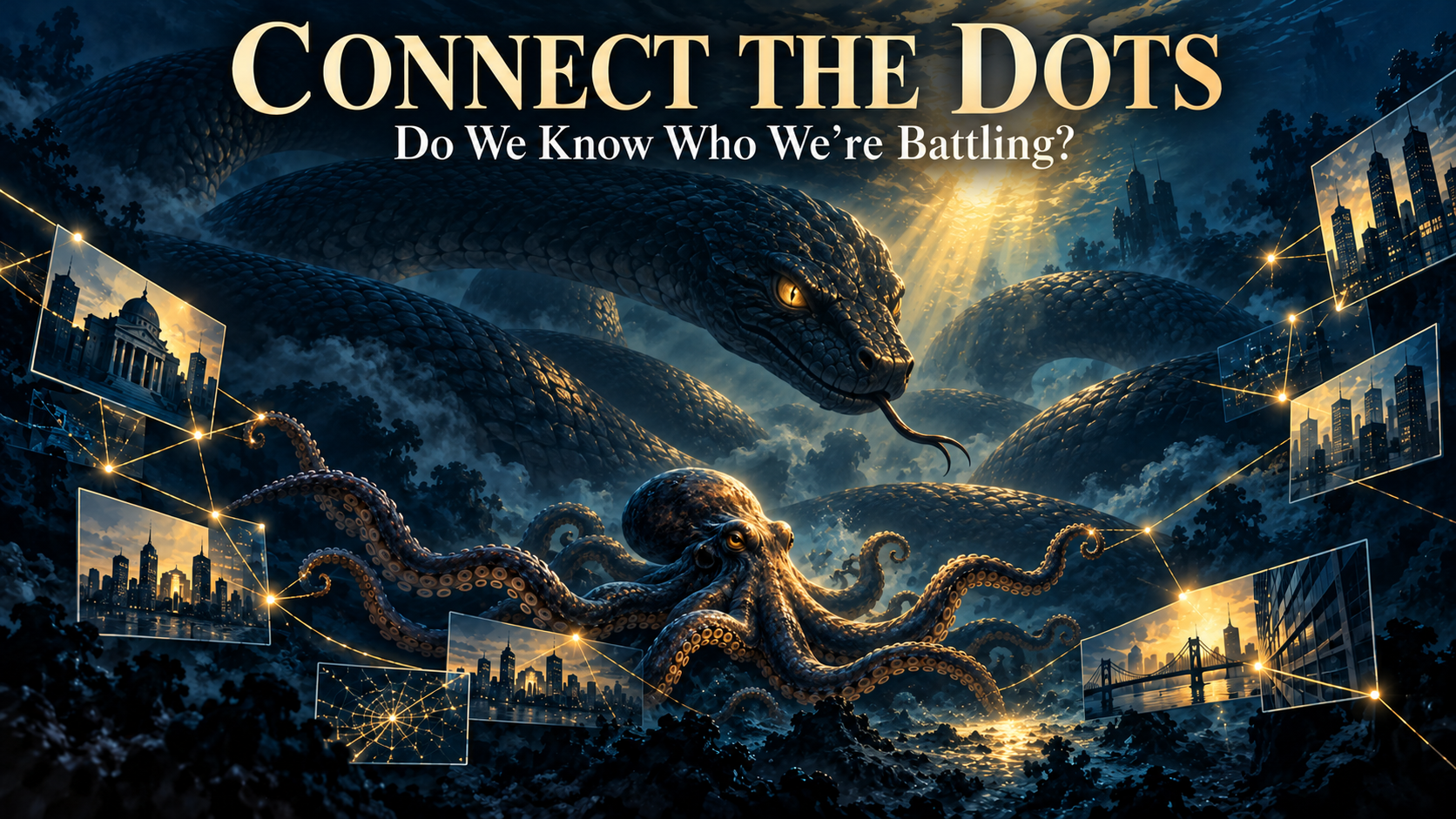
Iran is often called the “head of the snake” to describe Iran’s central role in directing a network of militant proxy groups and regional instability.
An octopus is a better metaphor, with Hamas, Hezbollah, the Houthis being the tentacles. Different organizations, different interests, but all supported by Tehran. Other arms reach through intelligence, financing, propaganda, and influence networks. Their degrees of dependence differ; Iran does not command every action.
An octopus has roughly two-thirds of its neurons in its arms, according to London’s Natural History Museum. Each tentacle “thinks” for itself. With Iran, local initiative and central direction coexist.
Like tentacles, the proxies are separate actors, advancing a shared strategy.
The metaphor extends to rebuilding. Like an octopus which can regenerate a lost tentacle, cutting off a tentacle does not necessarily defeat the larger strategy.
The purpose of October 7 was October 8 and the entire aftermath.
The attack on 10.7.23 was intended to unleash consequences far beyond the day itself.
Hamas leader Khalil al-Hayya told The New York Times that the aim was to “change the entire equation and not just have a clash.” He acknowledged that Hamas anticipated a major response.
Hamas’s 10.7 attack was designed to create spectacle. NewsGuard documented celebratory Hamas attack videos spreading across major platforms and garnering millions of views. What terrified the victims’ communities could exhilarate supporters celebrating the attack.
Hamas’s military strategy was designed to cause further spectacle.
John Spencer, a retired U.S. Army major and urban warfare specialist at West Point’s Modern War Institute, said Hamas: “uses human shields and human sacrifice as its strategy.”
Human shielding seeks to protect military objectives through civilian presence. In Spencer’s assessment, human sacrifice turns civilian deaths into political advantage: outrage generates pressure to halt Israel’s campaign before Hamas is eliminated.
Human shielding is unlawful. Civilians nevertheless retain protection, and Israel remains bound by the laws governing its attacks. Palestinian suffering is real; exploiting it compounds the tragedy.
An attack provokes war. Deaths generate outrage. Outrage becomes political leverage.
Turning outrage into influence
In July 2024, Director of National Intelligence Avril Haines reported Iranian government-linked actors impersonating activists online, encouraging Gaza protests, and providing financial support to protesters. Genuine protesters could be unaware of the foreign involvement.
In September 2024, U.S. intelligence also documented Iranian use of generative AI to produce social-media posts and fabricated news articles targeting American voters across the political spectrum.
By the third anniversary of October 7, the war has supplied a vast reservoir of emotionally powerful imagery. The argument here is that Tehran can exploit it for a revolutionary campaign extending beyond Israel.
Genocide accusations carry particular force. They require examination of evidence and intent; images alone do not settle the legal question. We should also ask who amplifies the accusations, who finances mobilization, and whose objectives the turmoil serves.
Bill O’Reilly recently warned that unrest in France would reach Britain and spread further.
Radical movements need not agree about the future to cooperate against a common enemy. The red–green alliance describes cooperation between particular leftist and Islamist factions with otherwise incompatible ideologies.
A shared target does not require a shared destination.
A revolutionary—and religious—objective
The calls to globalize the intifada and accusations of genocide were already circulating before Israel’s major ground offensive.
What ultimate objective does this revolutionary strategy serve? Within the IRGC’s religious worldview, part of the answer concerns the Mahdi, the Hidden Imam.
A Middle East Institute study documents IRGC teachings linking preparation for his return with eliminating Israel, challenging the international order, and encouraging political awakening in Europe and America.
Economic distress does not mean those ambitions have disappeared.
Iran scholar Mehdi Khalaji describes tension between apocalyptic thinking and self-preservation. The concern is not that every leader seeks annihilation. It is that leaders who regard conflict as preparation for a messianic confrontation may calculate risk differently from their opponents.
The Greater Spiritual Connection
Iran’s network is the octopus. Behind the octopus is the Serpent.
The serpent represents the evil that can exploit rival movements toward destruction and usurped authority. This is the theological interpretation.
Satan need not belong to left or right. Hatred, war, and chaos can prepare frightened people to accept domination from someone promising salvation.
Genesis 1 presents God bringing order to a world without form and void. The counterfeit exploits disorder and then offers control in God’s place.
The God at the center of this argument is the God of Israel, God Almighty—El Shaddai, who identifies Himself to Abraham in Genesis 17:1.
Daniel 11:36 describes a ruler exalting himself above every god. Daniel 7:13–14 presents enduring authority received from the Ancient of Days. The contrast is between power claiming God’s place and authority bestowed by God.
That warning about power claiming God’s authority also connects with the questions raised by preparations for renewed worship in Jerusalem. The Temple Institute says offerings could begin once an altar stands in its proper place, before a Temple building is complete; it gives no timetable. The questions raised by renewed sacrifices are explored in A Moment of Truth.
Here, the concern is how violence, deception, and division may prepare the world for an ultimate confrontation.
Fight the spiritual battle
 Military defense is necessary against armed threats. It cannot, by itself, defeat hatred and deception.
In the bible, the apostle Paul writes of spiritual weapons:
“For the weapons of our warfare are not carnal, but mighty through God to the pulling down of strong holds.” — 2 Corinthians 10:4, KJV
In Ephesians 6:12 he names the deeper struggle:
“For we wrestle not against flesh and blood…”
The armor that follows includes truth, righteousness, peace, faith, salvation, God’s word, and prayer (Ephesians 6:13–18).
God’s promised future reaches beyond today’s divisions. Isaiah 2:2–4 pictures nations learning His ways and turning swords into plowshares. Isaiah 19:21–25 brings Egypt, Assyria, and Israel into shared blessing.
Jews, Christians, and Muslims must all remain within our prayers and hope for reconciliation before the God of Israel. Seeking truth together need not erase Jewish identity or pretend differences in belief do not matter.
Joel’s promise of the Spirit poured out on all flesh—with dreams and visions—reminds us of the breadth of God’s reach (Joel 2:28–29; 3:1–2 in many Jewish editions).
Deception: Do We Recognize It?
The enemy’s chief weapon is deception. Its deepest success is persuading people that they see clearly while they are being misled. People may sincerely believe they are defending justice while advancing purposes they would reject if they understood them.
In Genesis 3:1–5, the serpent distorts God’s words and presents disobedience as enlightenment. The lie succeeds by appearing desirable and convincing.
Paul calls the enemy “the prince of the power of the air” (Ephesians 2:2). That passage does not describe modern broadcasting, but its imagery offers a striking parallel to deception spreading through screens, fabricated identities, and manipulated messages.
Iran’s documented use of fabricated online identities, AI-generated articles, and covert influence campaigns targets Western audiences, exploiting the same divisions debated across European and American media.
The God of Israel—El Shaddai—is faithful and just (Deuteronomy 32:4). Jeremiah 31:35–37 ties Israel’s enduring place before Him to the established order of creation.
The God of Israel promises Israel’s continued existence. A movement seeking Israel’s annihilation is opposing that promise. Whose purposes, then, is it serving?
That is the spiritual question beneath the political struggle. And it requires humility from all of us: sincerity and certainty do not make us immune to deception. We must test our convictions against Scripture and evidence, pray for discernment, and remain willing to be corrected.
Recognizing the enemy means recognizing deception—and refusing to let it govern our own hearts.
Connect the dots. Study the Scriptures. Pray—and stand firm in truth and love.
Epilogue:
These are concrete reasons to examine the network beyond the Middle East.
2019: The European Union sanctioned Iranian intelligence personnel and an entity over foiled attacks on European soil.
2025: MI5 reported tracking more than twenty potentially lethal Iran-backed plots in one year.
June 2026: Twenty-four countries jointly condemned Iranian lethal plotting and other malign activity across Europe, North America, and Australia.
October 2026: U.S. bombers deployed at RAF Fairford in England were withdrawn following reported Iranian-linked threats. Trump connected the move to the threat; attribution and operational details remain under investigation.
Sources:
- Iran’s constitution: preamble and Articles 3 and 154.
- U.S. Institute of Peace, “History of Iran-Israel Tensions”.
- Council of the EU, January 9, 2019 sanctions announcement.
- Natural History Museum, octopus biology.
- The Times of Israel, November 8, 2023, reporting Hamas leaders’ New York Times interviews.
- NewsGuard, Hamas’s celebratory videos.
- CNN interview with John Spencer, August 23, 2024.
- Lieber Institute, West Point, “What Is and Is Not Human Shielding?”.
- ODNI, Avril Haines statement, July 9, 2024.
- ODNI election-security update, September 23, 2024.
- Middle East Institute, “Iran’s Revolutionary Guard and the Rising Cult of Mahdism”.
- IMF, Iran country page.
- Mehdi Khalaji, Washington Institute, “Apocalyptic Politics: On the Rationality of Iranian Policy”.
- Temple Institute FAQ.
- Scripture: Genesis 1:1–5; Leviticus 19:18; Isaiah 2:2–4; Isaiah 56:7; Zechariah 8:23; Zechariah 14:9; Daniel 7:13–14; Daniel 11:36; Deuteronomy 13:1–5; 2 Corinthians 10:4–5; Ephesians 6:12–18; Isaiah 19:21–25; Joel 2:28–29 (3:1–2 in many Jewish editions). Scripture descriptions are paraphrases except the explicitly identified KJV quotations.
- Reuters, Trump says U.S. bombers moved from UK due to threats, October 5, 2026.
- UK government factsheet reproducing MI5’s 2025 assessment of more than twenty potentially lethal Iran-backed plots.
- Joint statement by twenty-four countries on Iranian state threats, June 10, 2026.