Love, Life, and the Biblical Marriage Arc
By Jonah Ritter
Abstract
Marriage forms one of Scripture’s great unifying arcs. Genesis begins with Adam and Chavah becoming basar echad—one flesh—beside the Tree of Life. Revelation concludes with Messiah, His Bride and humanity’s restored access to that tree. Between these two bookends, Scripture reveals marriage as both a covenantal union and a living picture of God’s faithful love. Chavah is associated with chai, life; ahavah means love; and echad means one. Although these words do not all share a linguistic root, together they illuminate the biblical pattern: life is joined by love, love preserves oneness, and God’s blessing multiplies that life beyond the couple. The serpent’s first attack fractured that unity through distrust, shame and blame.
For followers of Yeshua, First Corinthians 13 answers that division by describing the patient, kind, truthful and enduring love that sustains marriage. Ephesians 5 then reveals its greater mystery: a husband’s love for his wife reflects Messiah’s sacrificial love for His people. From the first tree and humanity’s exile to Jubilee, redemption and the restored Tree of Life, the biblical story moves from separation toward reunion—two stories, one flesh, one love and one God.
The Jewish apostle Paul makes a remarkable statement about marriage:
“He who loves his wife loves himself.”
—Ephesians 5:28
He is not merely saying that a husband should love his wife as much as he loves himself. His reasoning goes deeper. A husband and wife have become one flesh. When a man loves his wife, he is caring for the shared life of which they are both a part.
Her well-being is no longer separate from his. Her sorrow enters his life. Her security becomes his concern. Her happiness enriches his happiness. When she is wounded, something in their shared life is wounded. When he strengthens her, he strengthens their marriage—and therefore himself.
This is not self-centered love. It is an enlarged understanding of the self. In marriage, God transforms “me and you” into “us” without destroying either person.
The First One-Flesh Marriage
Paul reaches back to the first marriage:
“Therefore a man shall leave his father and mother and be joined to his wife, and they shall become one flesh.”
—Genesis 2:24
The Hebrew phrase is בָּשָׂר אֶחָד—basar echad—one flesh.
Adam’s first response to the woman is recognition: she is “bone of my bones and flesh of my flesh” (Genesis 2:23). He does not initially see her as a possession, competitor or stranger. He recognizes her as part of himself.
The two were not unrelated individuals who negotiated a partnership. God took the woman from Adam’s own side and brought her back to him. They became one flesh because, in a mysterious sense, they had first been one.
This means that Adam could not wound Chavah without wounding his own flesh. Nor could he cherish her without strengthening their shared life.
That is the foundation beneath Paul’s words: the husband who loves his wife loves himself.
Love Multiplies
God’s first words to the man and woman together are words of blessing:
“Then God blessed them, and God said to them, ‘Be fruitful and multiply; fill the earth…’”
—Genesis 1:28
The blessing immediately becomes multiplication:
Blessing → fruitfulness → multiplication → a world filled with life
The blessing was never meant to remain enclosed within the first marriage. Adam and Chavah’s love was designed to produce life, and that life would carry God’s blessing into generations they would never live to see.
Love joins two people, but it does not end with two people. Love multiplies.
The earth would not be filled by Adam alone or by Chavah alone. The future of humanity was placed within their one-flesh union. A husband loves his wife. Their union creates a home. From that union may come children, and through that home come identity, instruction, protection, faith and belonging.
Biologically, children can be conceived without love. But God’s design was never merely to fill the earth with bodies. He intended the world to be filled through families—through covenant, faithfulness, protection, instruction and love. A world can contain many people while remaining spiritually empty.
This helps explain why the enemy’s attack upon marriage is so destructive. If love multiplies, so can its absence. Faithfulness can pass from one generation to another, but so can abandonment, resentment and distrust. Marriage is therefore never entirely private. What husband and wife cultivate between themselves eventually reaches beyond themselves.
Not every marriage produces biological children. Some faithful couples cannot have children, while others marry beyond their childbearing years. Their union can still multiply hospitality, generosity, wisdom, service, discipleship and care. God’s blessing does not remain enclosed within the couple. It always seeks somewhere else to flow.
The pattern is simple:
- God blesses.
- Love joins.
- Oneness becomes fruitful.
- Fruitfulness multiplies life.
- Life fills the earth.
- Love does not divide when it is given away. Love multiplies.
Chavah: Life After the Sentence of Death
Eve’s Hebrew name is חַוָּה—Chavah. Scripture connects her name with חַי—chai, meaning “living” or “alive,” and with חַיִּים—chayim, meaning “life.” Adam calls her Chavah because she would become “the mother of all living” (Genesis 3:20).
The placement of that name is striking.
God has just told Adam that he will return to the dust. Mortality has entered the human story:
“For dust you are, and to dust you shall return.”
—Genesis 3:19
The very next thing Adam does is name his wife Chavah—Life.
Before the tree, death was not the defining human concern. Adam called her ishah—woman, because she was taken from ish—man. But after Adam hears that he will return to the ground, the continuation of life becomes central.
Chavah’s name may therefore be Adam’s first recorded expression of faith after the fall. He has heard the sentence of death, but he has also heard God speak of the woman’s coming seed. He does not name her “mother of the dying.” He calls her the mother of all living.
Adam came from the adamah—the ground, and he would return to it. But through Chavah, life would continue. Death had entered the world, but death would not have the final word.
Chavah, Ahavah and Echad
The Hebrew word for love is אַהֲבָה—ahavah. Chavah and ahavah sound somewhat alike when written in English, but they do not come from the same Hebrew root.
- Chavah—חוה is connected in Genesis with life and the living.
- Ahavah—אהבה comes from אהב—ahav, meaning “to love.”
Their relationship is thematic rather than etymological. Yet there is another genuine Hebrew connection that carries us directly back to marriage.
Hebrew Meaning ‐ Numerical value
אַהֲבָה—ahavah: Love – 13
אֶחָד—echad: One – 13
The values are:
Ahavah: א 1 + ה 5 + ב 2 + ה 5 = 13
Echad: א 1 + ח 8 + ד 4 = 13
In Jewish interpretation, this shared value expresses a beautiful truth: love is what enables two to become one.
The pattern deepens when love moves in both directions:
13 + 13 = 26
The numerical value of God’s covenant name, יהוה—YHWH, is also 26:
י 10 + ה 5 + ו 6 + ה 5 = 26
The husband’s love and the wife’s love meet within the presence of God. This is not a dictionary derivation or a mathematical proof. It is a traditional Hebrew meditation upon a spiritual reality: reciprocal love creates a dwelling place in which God’s character can be seen.
The pattern can be stated simply:
- Chavah is life.
- Ahavah is love.
- Echad is one.
God brought Chavah—life—to Adam. Through ahavah—love—the two live as echad—one.
When “Us” Became “You”
The serpent’s first attack was not against a government, nation or religious institution. It entered the first marriage.
The serpent spoke to Chavah. Adam failed to intervene. Both distrusted God’s word. Shame replaced openness, hiding replaced intimacy, and accusation replaced unity.
Before sin, Adam said:
“Bone of my bones and flesh of my flesh.”
After sin, he said:
“The woman whom You gave to be with me…”
The language moves from oneness to separation. She is no longer spoken of as “part of me,” but as “the woman You gave me.” Adam distances himself from both his wife and his God.
This remains one of the enemy’s most destructive strategies. He does not always need to remove a husband and wife from the same house. He only needs to turn us back into me against you.
Resentment, contempt, secrecy, selfishness, infidelity and the careful recording of old injuries dismantle one flesh from within. The damage seldom ends with two people. It reaches children, grandchildren, homes, faith and the ability to trust. What God designed to transmit love and truth can become a channel through which pain passes into another generation.
The breakdown of marriage is therefore one of Satan’s most destructive attacks because it strikes both backward and forward. It wounds the couple, rewrites their shared history and leaves consequences for people not yet born.
What Love Looks Like
First Corinthians 13 is often read at weddings, but it is easier to admire its words during a ceremony than to live them through decades of marriage.
Although Paul addressed the entire believing community, his description of love applies with particular force to husband and wife:
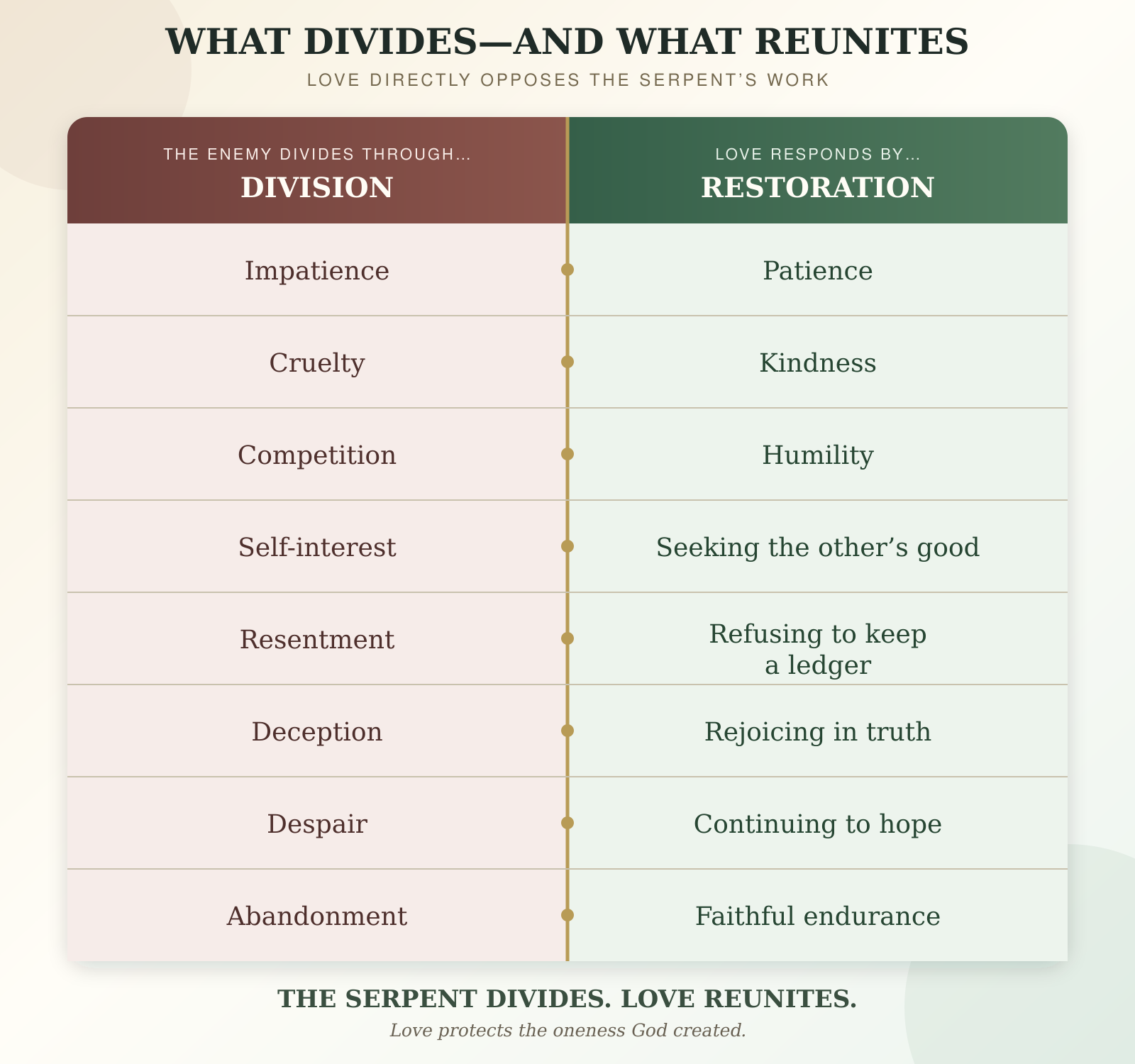
- Love is patient when my wife does not move at my pace.
- Love is kind when familiarity makes tenderness easy to forget.
- Love does not turn marriage into a competition.
- Love is humble enough to admit fault.
- Love refuses to use rudeness as a weapon.
- Love does not insist upon always having its own way.
- Love is not easily provoked.
- Love does not maintain a ledger of every injury.
- Love rejoices in truth.
- Love continues to bear, believe, hope and endure.
This is not sentimental love. It is covenantal love. It is how two people continue living as one—not by surrendering their individual identities, but by surrendering the selfishness that keeps them divided.
Paul says that love “keeps no record of wrongs” (1 Corinthians 13:5, NIV). The enemy builds his case against our spouse by preserving every accusation. Love does not deny wrongdoing, excuse abuse or abandon truth. But neither does it turn every forgiven failure into permanent ammunition.
Each quality of love directly opposes the serpent’s work:
Kohelet brings life, marriage and love together in a single remarkable sentence:
“Enjoy life with the wife whom you love…”
—Ecclesiastes 9:9
The Hebrew is even more revealing:
רְאֵה חַיִּים עִם־אִשָּׁה אֲשֶׁר־אָהַבְתָּ
Re’eh chayim im ishah asher ahavta.
Literally, the words say: “See life with the wife whom you have loved.”
The verse brings together the central ideas of this entire pattern:
-
- Chayim—חַיִּים: life
- Ishah—אִשָּׁה: wife or woman
- Ahavta—אָהַבְתָּ: you have loved
“Love your wife so you may live” is not a literal translation, because Kohelet does not explicitly say “so that.” But it captures a profound spiritual truth: Love your wife, and you will discover what it means to live.
Kohelet writes beneath the shadow of mortality. Our days under the sun are brief. The wife whom a man loves is therefore not incidental to his life; she is part of the portion God has given him in this life. He is not merely instructed to exist beside her. He is told to see life with her—to recognize, receive and enjoy the shared life God has placed before them.
Genesis calls the first wife Chavah—Life. Ecclesiastes tells a man to see chayim—life with the wife he loves. Ephesians says that the man who loves his wife loves himself.
The three passages form one continuous thought:
Your wife is joined to your life. To love her is to love the one life God has made from the two of you. In loving her, you do not lose your life—you discover it.
Love Your Wife as God Loves Us
Ephesians gives a husband two measures of love.
First, he must love his wife as his own body, because she is one flesh with him.
Second, he must love her as Messiah loved His people, giving Himself for their good.
The first measure comes from Creation: Adam and Chavah became one flesh.
The second comes from Redemption: Messiah gave Himself for His Bride.
God’s love teaches me that I possess value—not because I am perfect, but because I belong to Him. When I receive that love, I can love myself properly: not through pride or self-obsession, but with gratitude for the life God has given me.
Because my wife and I are one flesh, that God-given love cannot end with me. To care for myself while neglecting her contradicts the meaning of our union. Her life has been joined to mine. Her wounds become my concern, her joy becomes my joy, and her flourishing becomes part of my own.
I learn how to love her by remembering how God loves me: patiently when I struggle, mercifully when I fail, faithfully when I am difficult and sacrificially when love carries a cost.
In marriage, the “self” is no longer an isolated I. Covenant enlarges it into we.
The Tree, Exile and Jubilee
The Bible’s story of marriage unfolds within a larger movement of exile and return.
Adam and Chavah were not expelled simply because a tree existed. They disobeyed God at the forbidden tree and were then barred from the Tree of Life, lest they live forever in their fallen condition.
The movement begins:
Tree → disobedience → bondage → exile
Jubilee reverses that movement. Leviticus 25:10 commands Israel to proclaim liberty throughout the land. In the Jubilee, the enslaved are released, debts are lifted, ancestral property is restored, families return to their inheritance, and the land itself rests.
Jubilee is not merely freedom from bondage. It is freedom to return.
This gives the American Liberty Tree an unexpectedly biblical resonance. Humanity lost liberty at a tree. Americans later gathered beneath a tree as a symbol of resistance to bondage, while the Liberty Bell carried the Jubilee proclamation from Leviticus: “Proclaim liberty throughout all the land.”
True liberty, however, is not freedom to seize whatever we desire. That was the temptation at the first tree. Biblical liberty is release from the bondage created by sin, debt and death. It is the freedom to return home.
At one tree, humanity grasped and lost its liberty. At another tree, Messiah surrendered Himself to purchase liberty. In the final restoration, humanity returns to the Tree of Life.
The Two-Book Arc
Genesis opens with a marriage.
God forms Chavah, brings her to Adam and joins them as one flesh. The Bible begins with a husband, a wife, a garden and the Tree of Life.
Revelation closes with a marriage.
The Bride is prepared, the marriage supper of the Lamb is announced, the curse is removed, and humanity is welcomed again to the Tree of Life. The Bible ends with the Bridegroom, the Bride, a restored garden and the Tree of Life.
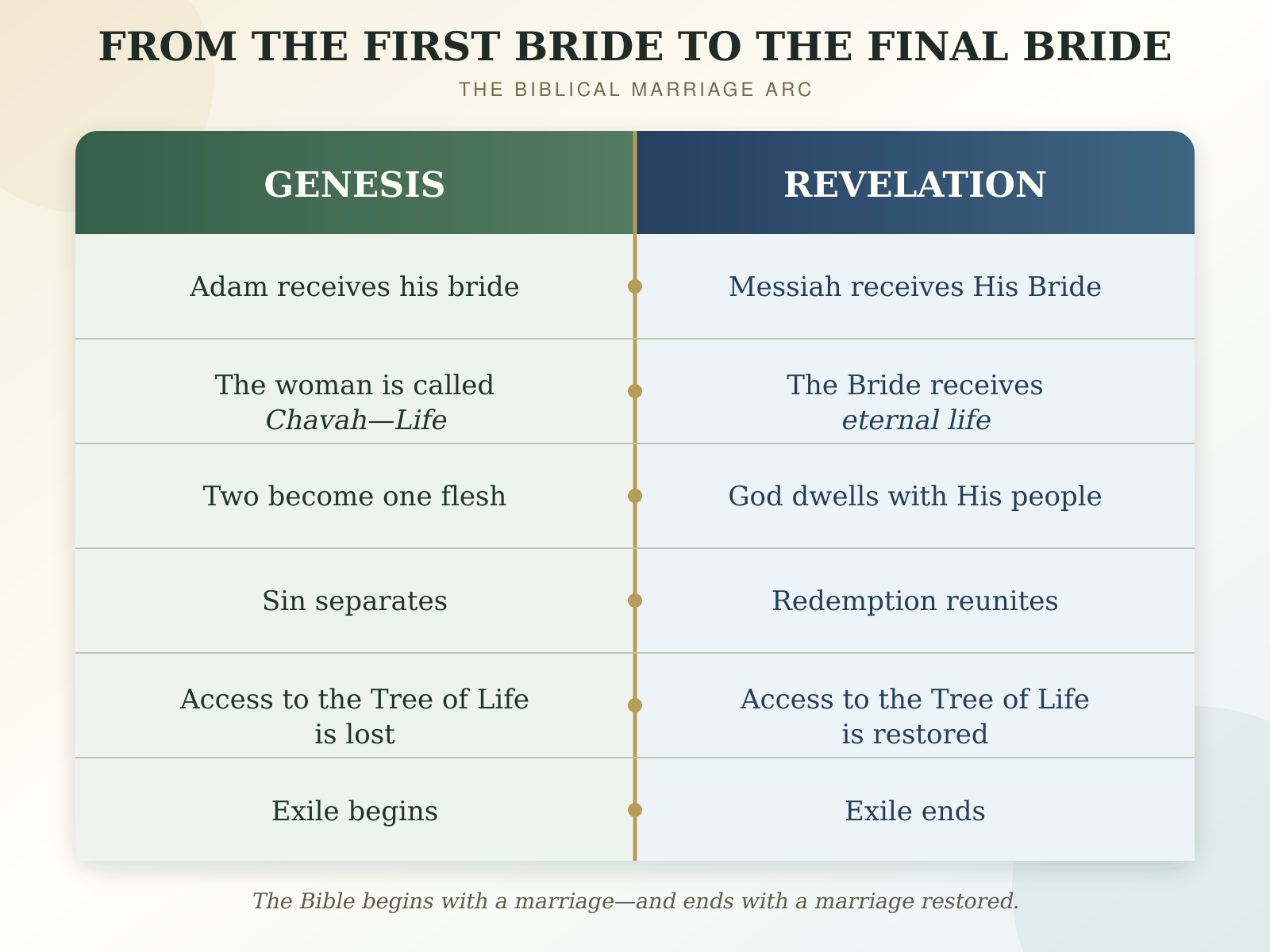
Marriage is not a side subject in Scripture. The entire biblical story is framed by marriage.
This is why Paul calls it a “great mystery” (Ephesians 5:32). Human marriage points beyond itself. It reflects the love of Messiah for His people.
-
- Adam gave from his body for his bride to be formed.
- Yeshua gave His body for His Bride to be redeemed.
Adam could say of Chavah, “flesh of my flesh.” Paul says that believers are members of Messiah’s body. Genesis shows two becoming one. First Corinthians tells us how love preserves that oneness. Ephesians reveals what the marriage represents. Revelation shows the Bride finally brought home.
Love Will Have the Final Word
Beauty changes. Strength weakens. Careers end. Children grow and establish homes of their own. Rooms are emptied and repurposed. Time alters nearly everything we once imagined would remain the same.
But covenantal love carries two lives through those changes.
When I love my wife, I love the one flesh God created from our two lives. When I love her patiently, kindly, truthfully and sacrificially, I reflect the way Messiah loves us.
The Bible begins with two people joined beside the Tree of Life. It ends with a redeemed people returning to that tree. Between those two bookends stands the long struggle between the serpent who divides and the God whose love restores.
The first tree marked our exile. Jubilee announces our return. The final Tree of Life tells us that death and separation will not prevail.
-
- Chavah is life.
- Ahavah is love.
- Echad is one.
Life is joined by love. Love protects oneness. And within that one-flesh covenant, God gives the world a living picture of His own faithful love.
Two people. Two stories. One flesh. One love. One God.
Scripture References
Genesis 1:27–28; Genesis 2:18–25; Genesis 3:1–24; Leviticus 25:8–13; Isaiah 61:1–2; Ecclesiastes 9:9; Luke 4:16–21; 1 Corinthians 13:1–13; Ephesians 5:21–33; Revelation 19:6–9; Revelation 21:1–5; Revelation 22:1–5, 14.