A Conversation, a Gate and an Unexpected Question
When a still, small voice is affirmed three times, I pay closer attention. This time, fittingly, it led me to Elijah.
Early this morning, on my way to the airport, I was telling a good friend about something I had written only a few days earlier. It concerned the Jewish practice of saying grace after a meal and the Hebrew word mazon, meaning food, nourishment or provision.
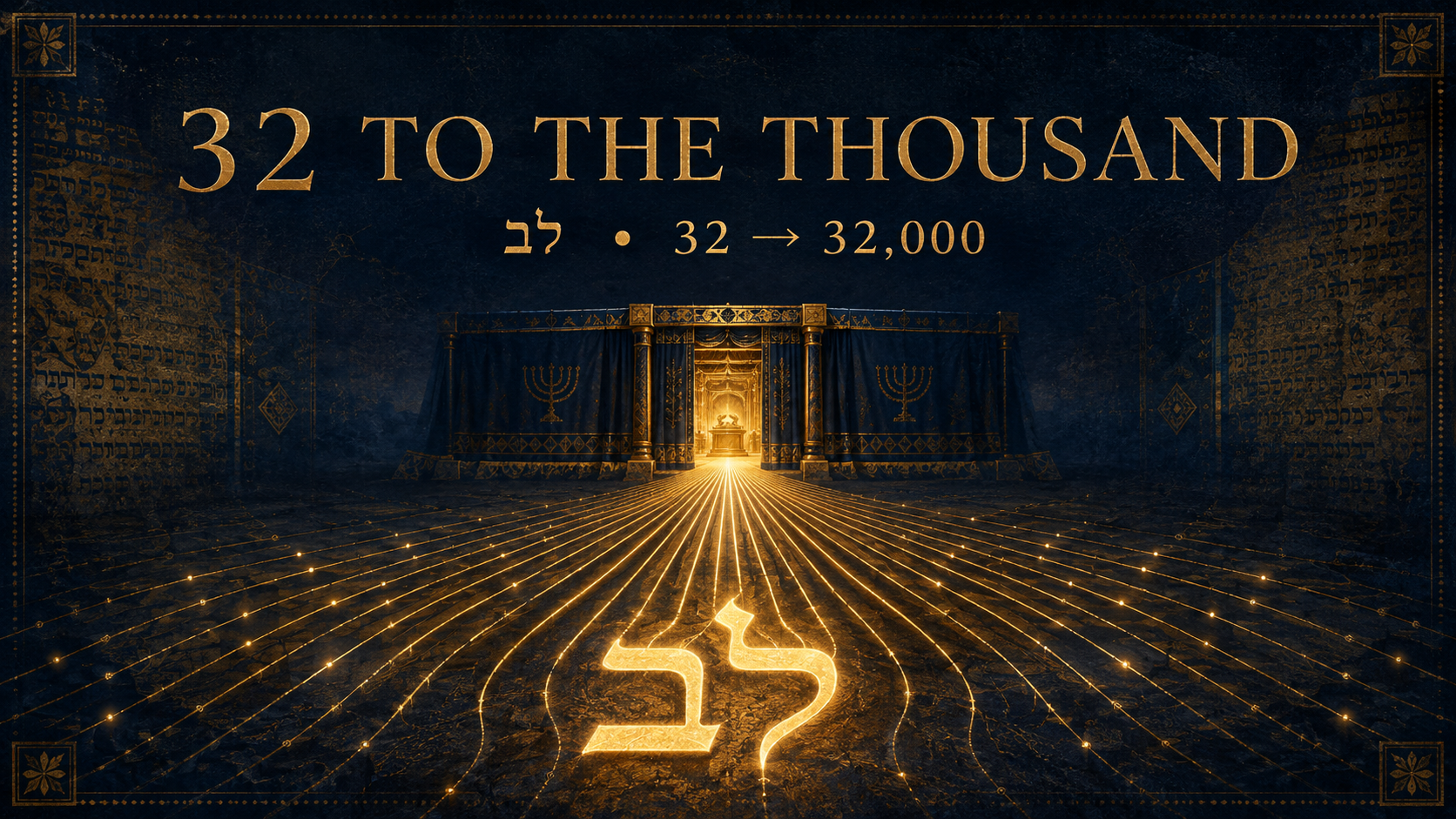
The Hebrew root of mazon is formed by the letters zayin, vav and nun. Their numerical values total 63. The Hebrew word navi, meaning prophet, also has a numerical value of 63.
There was something interesting in that connection: nourishment and prophet meeting at the same number.
When I arrived at the airport and checked in, I discovered that my flight was departing from Gate 63. I do not offer that as proof of anything. It simply felt like a personal affirmation of the connection I had been discussing that very morning.
Later that evening, another close friend called. His pastor wanted to know the Hebrew pronunciation of Elias, the prophet mentioned in the Book of James.
Elias is the Greek form of Elijah. His Hebrew name is Eliyahu—אֵלִיָּהוּ. He is commonly called Eliyahu Hanavi: Elijah the Prophet.
That question sent me to James 5. What I found brought me directly back to nourishment, provision and the number 63. It also opened a much larger biblical arc—one that begins in the Hebrew Scriptures, continues in Jewish tradition and reaches into the New Testament.
Once again, I found two stories, one Book and one God.
The Prophet Who Was Nourished

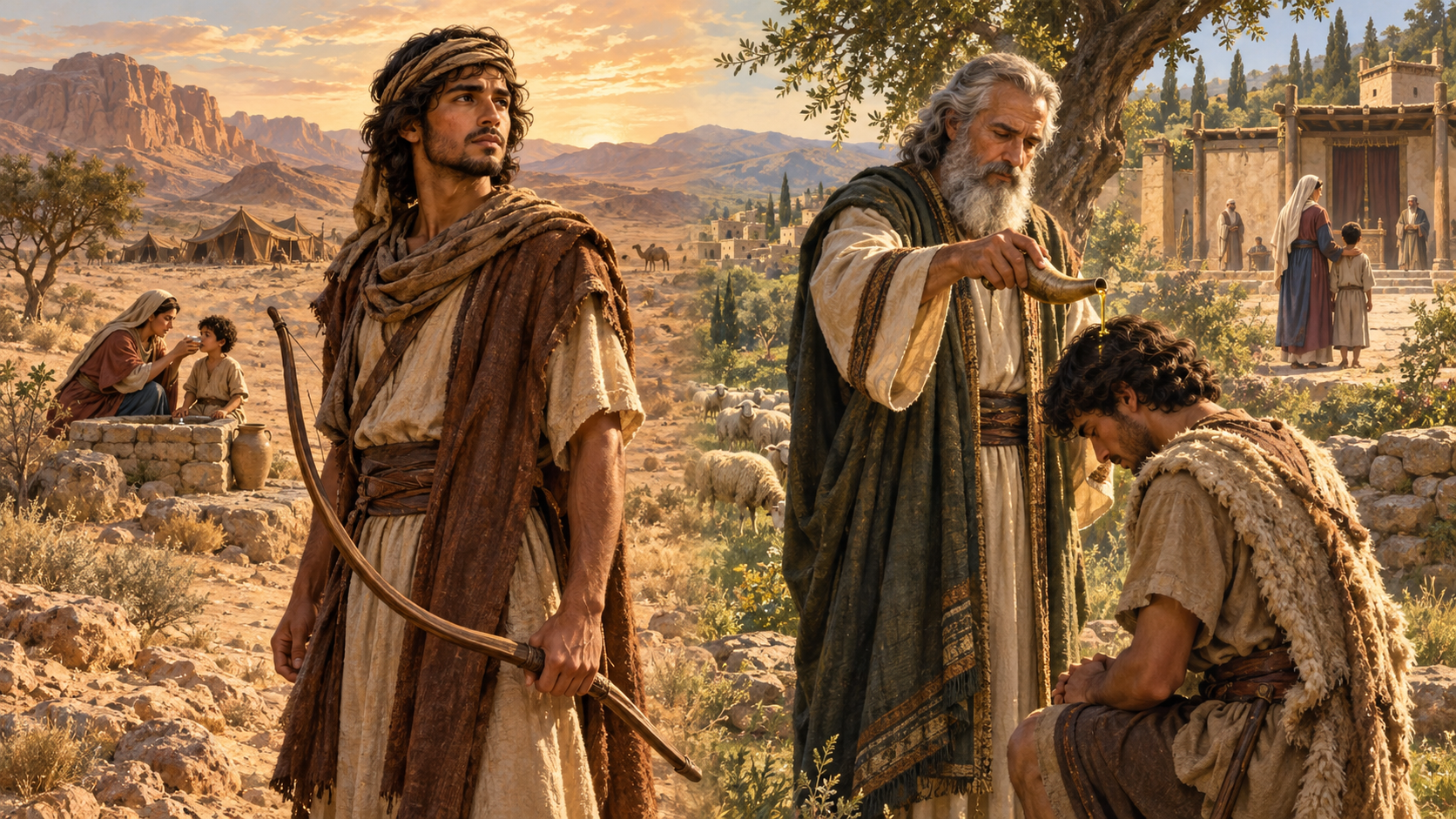
Elijah enters the biblical account during the reign of Ahab, one of Israel’s most wicked kings. Ahab and Jezebel promoted the worship of Baal, a false god associated with rain and fertility.
Elijah announced that there would be neither dew nor rain except according to his word. God then told him to hide beside the Brook Cherith.
“And it shall be, that thou shalt drink of the brook; and I have commanded the ravens to feed thee there”
—1 Kings 17:4
The ravens brought Elijah bread and meat in the morning and again in the evening. The navi was being sustained by God’s provision—by mazon.
When the brook eventually dried up, God sent Elijah to a widow in Zarephath. She possessed only a handful of flour and a little oil. She believed that she and her son were preparing their final meal.
Nevertheless, Elijah told her not to be afraid. He declared that the flour would not be exhausted and the oil would not fail until rain returned to the land. God then sustained Elijah, the widow and her son through the drought.
Later, after Elijah’s confrontation with the prophets of Baal on Mount Carmel, God provided for him again. An angel gave him bread and water as he journeyed toward Horeb. Elijah ate, rested and then ate again.
First the ravens fed him. Then a widow sustained him. Later an angel brought him nourishment.
The prophet who announced the absence of rain repeatedly experienced the presence of God’s provision.
That makes the numerical correspondence especially interesting. Navi, prophet, equals 63. The Hebrew root of mazon, nourishment, also equals 63. In the story of Elijah, the two ideas do not merely share a number. They meet in the biblical narrative.
God provides mazon for His navi.
Elijah in Jewish Expectation
Elijah holds an extraordinary place in Jewish tradition.
According to 2 Kings 2, he did not experience an ordinary death. He was taken up in a whirlwind. The prophet who departed so dramatically became the prophet whose return Israel continues to anticipate.
At a Jewish circumcision, a special chair is traditionally reserved for Elijah. At the Passover Seder, a cup is poured for him. His anticipated return is connected with the hope of redemption.
That expectation comes from the final words of the prophet Malachi:
“Behold, I will send you Elijah the prophet before the coming of the great and dreadful day of the LORD.”
—Malachi 4:5
Elijah therefore stands at the boundary between the present age and the promised redemption. He is the prophet expected to announce the coming of Messiah.
This expectation also appears at the conclusion of Havdalah.
What Is Havdalah?
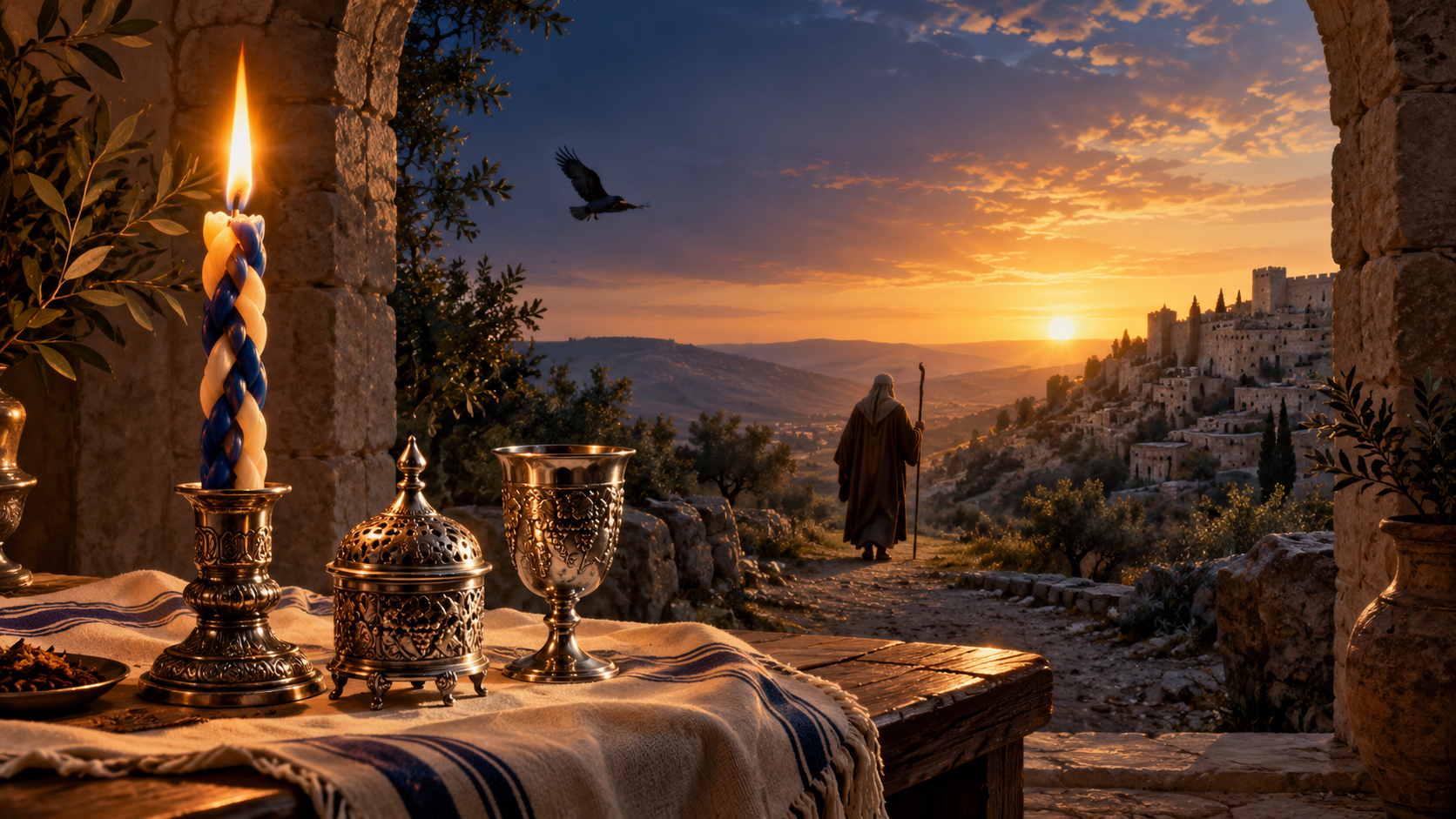
Havdalah is the Jewish ceremony marking the conclusion of Shabbat, the Sabbath, and the beginning of the ordinary workweek. The Hebrew word havdalah means separation or distinction.
The service engages several senses. We drink from a cup of wine, smell fragrant spices and look into the light of a braided candle. A blessing recognizes the God who distinguishes between sacred and ordinary, light and darkness, Israel and the nations, and the seventh day and the six days of labor.
Havdalah is beautiful, but it is also bittersweet. Shabbat has given us a taste of sacred rest, and now that special time is departing.
Jewish tradition does not allow the evening to end with that sense of loss. Immediately after Havdalah, we sing Eliyahu Hanavi—“Elijah the Prophet.” The song expresses the hope that Elijah will come soon, in our days, with Messiah, son of David.
That order matters: First comes separation. Then comes expectation.
The sacred day departs, but hope remains. We move from the presence of Shabbat into an ordinary week while singing for the prophet who will announce that Messiah is coming.
Departure and Promised Return
For Christians unfamiliar with Havdalah, this Jewish custom may illuminate something found in the New Testament. Yeshua—Jesus—also departed while leaving his followers with the promise of his return.
After his resurrection, Yeshua appeared to his disciples over a period of forty days. Then, as they watched, he was taken up from their sight.
The disciples remained looking toward heaven. Two men in white clothing then asked why they were standing there gazing upward:
“This same Jesus, which is taken up from you into heaven, shall so come in like manner as ye have seen him go into heaven.”
—Acts 1:11
His departure and promised return are placed together.
That is the movement I recognize in Havdalah. I am not suggesting that the rabbis composed Havdalah as a hidden Christian ceremony. Havdalah is thoroughly Jewish, and its longing for Messiah stands within Jewish tradition.
I have long understood its conclusion as an expression of that Jewish longing. What I had not considered until now was how its movement from departure to promised return might be understood in light of Yeshua.
Shabbat departs. Elijah is invoked. Messiah is awaited.
Yeshua departs. His disciples look toward heaven. They are immediately promised that he will return.
These are not identical events, but the parallel deserves consideration. Both place separation and expectation beside each other. The departure is real, but it is not final.
Why Does James Mention Elijah?
This brings me back to the telephone call that started this study.
The pastor had asked about “Elias” in the Book of James. When I opened James 5, I found that Elijah was being used as the great biblical example of effective prayer.
“The effectual fervent prayer of a righteous man availeth much.”
—James 5:16
James then explains:
“Elias was a man subject to like passions as we are, and he prayed earnestly that it might not rain: and it rained not on the earth by the space of three years and six months.”
—James 5:17
Elijah was an extraordinary prophet, but James emphasizes that he was also human. He prayed, the heavens withheld their rain, and then he prayed again and the rain returned.
This is clearly a lesson about prayer. Yet the surrounding passage may suggest something more.
Only a few verses earlier, James tells his readers to remain patient:
“Be ye also patient; stablish your hearts: for the coming of the Lord draweth nigh.”
—James 5:8
James speaks of the coming of the Lord, teaches patience during a time of waiting and then turns to Elijah. He also specifies that the drought lasted three years and six months.
Why include that precise period?
Three and a half years is half of seven. It recalls a prophetic pattern found in Daniel:
“A time and times and the dividing of time.”
—Daniel 7:25
Similar language appears in Daniel 12.
The Book of Revelation expresses the same period as 42 months and as 1,260 days. Revelation’s two witnesses are even given Elijah-like power:
“To shut heaven, that it rain not in the days of their prophecy.”
—Revelation 11:6
The arc is difficult to overlook:
- Elijah’s three-and-a-half-year drought
- Daniel’s time, times and half a time
- The Elijah-like witnesses who shut the heavens
- The coming of the Lord
James does not explicitly explain this entire connection. Therefore, I present it as an observation, not as something the text requires us to accept. Nevertheless, James places the coming of the Lord, patient expectation, fervent prayer, Elijah and the period of three and a half years within the same short passage.
That deserves our attention.
Forty-Two Months and the Name of God

Three and a half years also equals 42 months.
The number appears explicitly in Revelation. The nations tread the holy city for 42 months in Revelation 11:2. The two witnesses prophesy for the corresponding period of 1,260 days. In Revelation 13:5, the beast is permitted to exercise authority for 42 months.
In each case, 42 marks a divinely bounded period of conflict, witness, judgment or opposition. Whatever occurs during that time is not permitted to continue forever.
The number 42 also carries an important association in Jewish mystical tradition. It is connected with what is called the Forty-Two-Letter Name of God, or Shem Mem-Bet. Mem and bet are the Hebrew letters representing forty and two.
This is not one of the ordinary biblical names by which we address God. It is a mystical designation traditionally associated with combinations of Hebrew letters and with the prayer Ana B’Koach. The initial letters of that prayer’s words form a 42-letter sequence.
I am not claiming that James was secretly referring to the Forty-Two-Letter Name when he mentioned three years and six months. Nor does the text say that he was. But the association adds another layer worth observing.
Elijah’s drought lasted three and a half years—42 months. During that entire period, the land lacked rain, but Elijah did not lack God’s provision.
For 42 months, there was no rain—but there was still mazon.
The number associated in Jewish thought with the hidden Name of God becomes, in Elijah’s life, a period during which God’s activity may have been hidden but was never absent. A brook, ravens, a widow’s nearly empty containers, flour, oil, bread and water all became instruments of His provision.
The drought had a limit. God’s faithfulness did not.
Elijah Is the Bridge
Elijah does not appear in these passages as a collection of unrelated references. He is a special navi—a prophet—who transcends both stories.
He is a bridge.
Elijah was a man of prayer, but also a man of action. He confronted kings, challenged false prophets, cared for a widow and obeyed God even when the way forward was difficult. His faith never remained abstract. He was truly a doer.
Kings records his prayer, the drought and God’s provision. Malachi promises his return before the day of the Lord. Jewish tradition continues to wait for him. James recalls his prayer while teaching that faith must be expressed through action and while looking toward the coming of the Lord.
In remembering Elijah, we see the importance of both faith and good works. He connects prayer with provision, departure with return, and Jewish longing for Messiah with the New Testament promise of Yeshua’s return.
Elijah was a prophet who stepped out in faith and acted. He prayed fervently, and his prayers availed much. God provided nourishment for His prophet. Elijah is a wonderful bridge between the stories. Every time we say grace—before the meal as Christians do or after the meal as Jews do—we remember where our strength and provision come from. That is a very “63” thing to do.
Elijah, the prophet who stepped out in faith and took action. He prayed fervently and his prayers achieved mucĥ. God provided nourishment for the prophet. Elijah is a wonderful bridge between the stories and every time we say grace, whether it is before the meal as Christians do or after the meal as Jews do, we remember where our strength comes from. That is a very “63” thing to do.
Two stories, one Book and one God.