An Observation on David, Covenant Love and John 15
A Study by Jonah
David stands in the messianic line.
The prophets promised that the Messiah would come through David. The New Testament begins by identifying Yeshua as “the son of David,” and the title follows him throughout the Gospels. If we want to understand the Son of David, it makes sense to look closely at David—not only at the prophecies spoken about him, but also at the patterns formed around his life.
Sometimes the connection between the two stories is announced plainly: “This was done, that it might be fulfilled.”
Other times, the connection must be observed.
A person, covenant, meal or relationship in the Hebrew Scriptures establishes a pattern. That pattern appears again in the New Testament, but now it is enlarged and brought toward completion.
That is what I believe happens when the covenant between David and Jonathan is placed beside John 15.
Two Stories, One Book, One God.
JONATHAN LOVED DAVID AS HIS OWN SOUL
 Jonathan was the son of Saul and the natural heir to his father’s throne. David was the one God had chosen to become king.
Jonathan could have treated David as a rival. Instead, he recognized something in him and loved him.
“The soul of Jonathan was knit with the soul of David, and Jonathan loved him as his own soul.”
—1 Samuel 18:1
Jonathan then made a covenant with David:
“Then Jonathan and David made a covenant, because he loved him as his own soul.”
—1 Samuel 18:3
Jonathan removed his robe and gave it to David, along with his garments, sword, bow and girdle. The king’s son was placing the visible symbols of his own position upon the man God had chosen.
Jonathan did not cling to his privilege. He placed his position, inheritance and safety at risk for the friend he loved.
There is already something remarkable in the wording. Jonathan loved David “as his own soul.”
The Hebrew word is nefesh—soul, life or self.
The Greek Septuagint uses psychē, which can also mean soul or life. That same word appears in John 15:
“Greater love hath no man than this, that a man lay down his life for his friends.”
—John 15:13
Jonathan loved David as his own psychē—his own life.
Yeshua said that the greatest love is to lay down one’s psychē—one’s life—for one’s friends.
I do not believe we should call this an explicit prophecy. John does not say, “This was spoken concerning Jonathan.” But the words and pattern are close enough that I cannot pass over them.
Jonathan’s love shows us the pattern.
Yeshua brings it to fullness.
DAVID’S SORROW
Jonathan eventually died in battle beside his father. When David heard the news, he did not respond as a rival who had finally been cleared from his path to the throne. He mourned.
“I am distressed for thee, my brother Jonathan: very pleasant hast thou been unto me: thy love to me was wonderful.”
—2 Samuel 1:26
David remembered Jonathan’s love as something wonderful.
This adds another dimension to John 15. Yeshua told his disciples that he would lay down his life for his friends. He also knew that his death would fill them with sorrow:
“Because I have said these things unto you, sorrow hath filled your heart.”
—John 16:6
But Yeshua promised something David could not promise after Jonathan’s death:
“Ye shall be sorrowful, but your sorrow shall be turned into joy.”
—John 16:20
David lamented the covenant friend who had risked his life for him.
The disciples lamented the covenant friend who actually laid down his life for them.
But the Son of David rose.
David’s sorrow over Jonathan remained a lament. The disciples’ sorrow was transformed into resurrection joy.
FOR JONATHAN’S SAKE
The story does not end with Jonathan’s death.
Years later, after David had become king, he asked an extraordinary question:
“Is there yet any that is left of the house of Saul, that I may shew him kindness for Jonathan’s sake?”
—2 Samuel 9:1
David remembered his covenant.
The word translated “kindness” is chesed—steadfast, faithful, covenant love. David was not looking for someone who had earned his favor. He was looking for someone upon whom he could place the benefit of his covenant with Jonathan.
Jonathan had a surviving son named Mephibosheth. He was vulnerable, without political power and lame in both feet.
When Mephibosheth was brought before David, he fell upon his face and presented himself as a servant:
“Behold thy servant!”
—2 Samuel 9:6
He expected little and may have feared judgment. David’s first words to him were:
“Fear not: for I will surely shew thee kindness for Jonathan thy father’s sake.”
—2 Samuel 9:7
For Jonathan’s sake.
That phrase is the heart of the story.
Mephibosheth did not receive kindness because of something he had done. He received it because David remembered the covenant he had made with another.
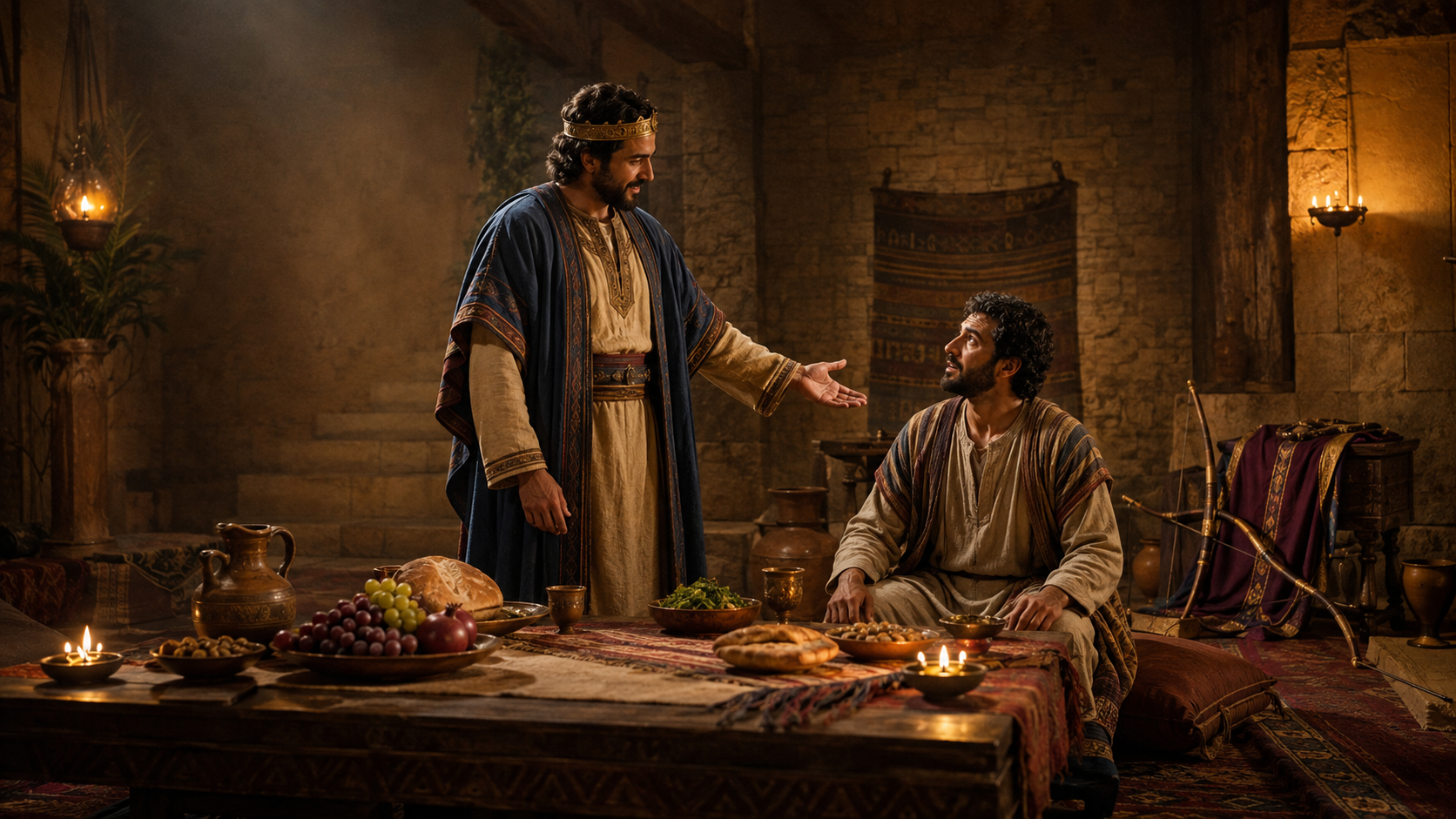
David restored Saul’s land to him. But he did something even more personal. He gave Mephibosheth a permanent place at the king’s table.
AS ONE OF THE KING’S SONS
The table is mentioned repeatedly:
“Thou shalt eat bread at my table continually.”
—2 Samuel 9:7
“Mephibosheth…shall eat alway at my table.”
—2 Samuel 9:10
Then comes the line that brings the meaning of the meal into focus:
“As for Mephibosheth, said the king, he shall eat at my table, as one of the king’s sons.”
—2 Samuel 9:11
Mephibosheth came before David saying, “Behold thy servant.”
David seated him at the table “as one of the king’s sons.”
The meal was not merely a way to provide him with food. The king’s table represented acceptance, protection, fellowship, inheritance and belonging. Mephibosheth was not kept alive somewhere at a safe distance. He was brought into the king’s presence.
He ate bread continually at the king’s table.
That word continually matters.
Jonathan was dead, but the covenant had not died. Its kindness remained active. Its benefits reached Jonathan’s son. Covenant love continued from one generation into another.
John 15 was not spoken in isolation. It belongs to Yeshua’s final discourse with his disciples surrounding their final meal together. The setting itself brings covenant, friendship and the table into the same picture.
Then I read the words of Yeshua in John 15:
“Henceforth I call you not servants; for the servant knoweth not what his lord doeth: but I have called you friends.”
—John 15:15
Mephibosheth called himself a servant, but David treated him as a son.
Yeshua told his disciples that he would no longer call them servants, but friends.
The movement in the two stories is remarkably similar.
The fearful servant is brought near. The covenant is remembered. The inheritance is restored. Bread is eaten in the king’s presence. The servant is received into the royal household.
THE TRUE VINE
 John 15 begins with Yeshua’s declaration:
“I am the true vine, and my Father is the husbandman.”
—John 15:1
The branches must abide in the vine because they cannot bear fruit by themselves. The word abide or remain is repeated throughout the chapter.
- Abide in me.
- Let my words abide in you.
- Abide in my love.
- Bear fruit that remains.
The covenant between Jonathan and David had also produced something that remained. Jonathan was gone, but a branch of his house survived. David sought out that remaining branch and brought him into his own household.
I would not say that Mephibosheth is the direct meaning of Yeshua’s vine. That would go beyond the text. But the resonance is difficult to miss.
In one story, a surviving branch of Jonathan’s house is preserved because covenant love remained.
In the other, Yeshua is the true vine. Those who abide in him receive life and produce fruit that remains.
BETWEEN MY SEED AND THY SEED
Jonathan’s covenant with David was not limited to the two men:
“The LORD be between me and thee, and between my seed and thy seed for ever.”
—1 Samuel 20:42
The covenant was intended to reach their descendants.
That promise is what David remembered when he searched for Jonathan’s surviving son. Mephibosheth became the living evidence that covenant love could reach beyond the death of the one with whom the covenant had been made.
Yeshua likewise speaks about fruit that will continue:
“Ye have not chosen me, but I have chosen you, and ordained you, that ye should go and bring forth fruit, and that your fruit should remain.”
—John 15:16
Jonathan’s covenant produced fruit that remained after his death. His son was found, restored and seated at the king’s table.
Yeshua chose his disciples to bear fruit that would remain after he laid down his life. His friends would carry the message outward, and others would be brought into the covenant household.
The love did not end with those who first received it.
It continued through them.
LOVE AND ONENESS
There may even be a quiet Hebrew numerical meditation within this pattern.
The Hebrew word for love is ahavah:
אהבה = 13
The Hebrew word for one is echad:
אחד = 13
Jonathan’s soul was knit to David’s soul. Two lives were joined through covenant love.
Love and oneness share the value thirteen.
Together they equal twenty-six—the value of the Divine Name, YHWH.
I would not use this as proof of anything. Gematria should not be asked to carry more weight than the text itself. But here it illustrates what the words already tell us: covenant love binds lives together before God.
THE SON OF DAVID AT THE TABLE
David’s name, דוד, has the numerical value fourteen. Matthew’s Gospel deliberately arranges Yeshua’s genealogy around groups of fourteen, drawing attention to David and to Yeshua’s identity as the Son of David.
David showed covenant kindness at his table.
The greater Son of David gave his disciples a covenant meal and promised them a place at his table in the kingdom:
“That ye may eat and drink at my table in my kingdom.”
—Luke 22:30
The connections now begin to form a complete arc:
- Jonathan loved David as his own life.
- Jonathan entered into covenant with David.
- Jonathan surrendered the symbols of his royal position.
- Jonathan risked his life for his friend.
- David mourned Jonathan’s death.
- David remembered their covenant.
- David sought Jonathan’s surviving son.
- Mephibosheth came before the king as a servant.
- For Jonathan’s sake, he received kindness.
- His inheritance was restored.
- He ate bread continually at the king’s table.
- He was treated as one of the king’s sons.
Then the Son of David sat at a table with his disciples and told them:
“I have called you friends.”
“Greater love hath no man than this, that a man lay down his life for his friends.”
TWO STORIES, ONE BOOK, ONE GOD
I write to think. And the more I think about John 15, the less its words seem to stand alone.
Behind Yeshua’s declaration is an older biblical pattern of friendship, covenant, royal surrender, sorrow, remembered kindness, restored inheritance and fellowship at the king’s table.
Mephibosheth came to David saying, “Behold thy servant.”
David answered with covenant kindness and gave him the place of a son.
Yeshua told his disciples, “I call you not servants.” He called them friends. Then he laid down his life for them and opened the way to his Father’s household.
Jonathan’s covenant gave his son a place at David’s table.
Yeshua’s covenant gives his friends a place at the table of the everlasting kingdom.
The first story established the pattern.
The second story revealed its fullness.
Two Stories, One Book, One God.