It is all one book. One story. Because it is one God.
The thesis of this essay is straightforward even if the argument takes time to unfold: from Genesis to Revelation, Scripture progressively reveals that salvation does not come through human flesh, but through the promise of God, the grace of God, the promised Seed, and the life-giving Spirit.
Genesis 3:15—”I will put enmity Between you and the woman, And between your offspring and hers; They shall strike at your head, And you shall strike at their heel.”
What begins in Genesis as the promise of a serpent-crushing Seed develops through Abraham’s covenant in the flesh, through Moses and the blood-seriousness of circumcision, through the prophet’ insistence on circumcision of the heart, and reaches open theological clarity in Jesus’s teaching on new birth and in the Jerusalem Council’s refusal to make circumcision the gate to Gentile salvation.
Scripture can be read as one coherent story which moves in parallel arcs within a larger pattern.These parallel arcs and structures operate on multiple levels to build theological depth. The sweeping plotline forms a cohesive framework. “Individual stories across the Old and New Testaments have been coordinated through repeated words and parallel themes.”
Readers who want a fuller explanation of the interpretive framework behind parallels and arcs can follow this link to the earlier companion essay on that subject.
Preface
Scripture contains more depth than many modern readers are accustomed to expecting, especially when the Hebrew texture of the text, its intertextual patterns, and the wider world of Jewish interpretation and mystical reflection are taken seriously. Not every reader is interested in that kind of work, and not every reader needs to be. Some dimensions of biblical meaning require patience, background knowledge, literary sensitivity, and a tolerance for complexity that many people quite reasonably do not wish to pursue. That is not a failure. It is simply a fact about how layered texts work.
At the same time, the accessibility of the Bible’s central message should never be denied. Much of the Bible’s narrative power, and certainly the basic force of Yeshua’s message, lies within reach of ordinary readers and even children. Yet Scripture also rewards long searching. Some readers are content with the plain sense. Others find joy in tracing deeper correspondences across the canon, especially where Hebrew thought, symbolic patterns, and theological echoes open richer dimensions of meaning. This essay belongs to the second kind of reading, while insisting that the deeper reading must remain accountable to the text itself.
Flesh and Spirit, Lineage and Grace: Reading the Bible as One Story
This essay will move directly to the arc that begins with the Seed promised in Genesis and follow that promise through Abrahamic circumcision and the covenant in the flesh. The arc is picked up in the New Testament in John 3:16 by Yeshua. In Acts 15, and Paul rests the arc where the deeper importance of that arc becomes unmistakable. It will also suggest that Jubilee provides a wider horizon for the arc, since the promised Seed does not merely preserve a line of descent but carries the story toward liberty, restoration, and release.
That final point requires caution. The essay’s central claims do not stand or fall on every symbolic extension. The core of the case rests on the biblical relationship between seed, circumcision, heart, Spirit, faith, and Gentile inclusion. The symbolic material strengthens the arc when it remains subordinate to the plain textual pattern.
Beginning with the Seed
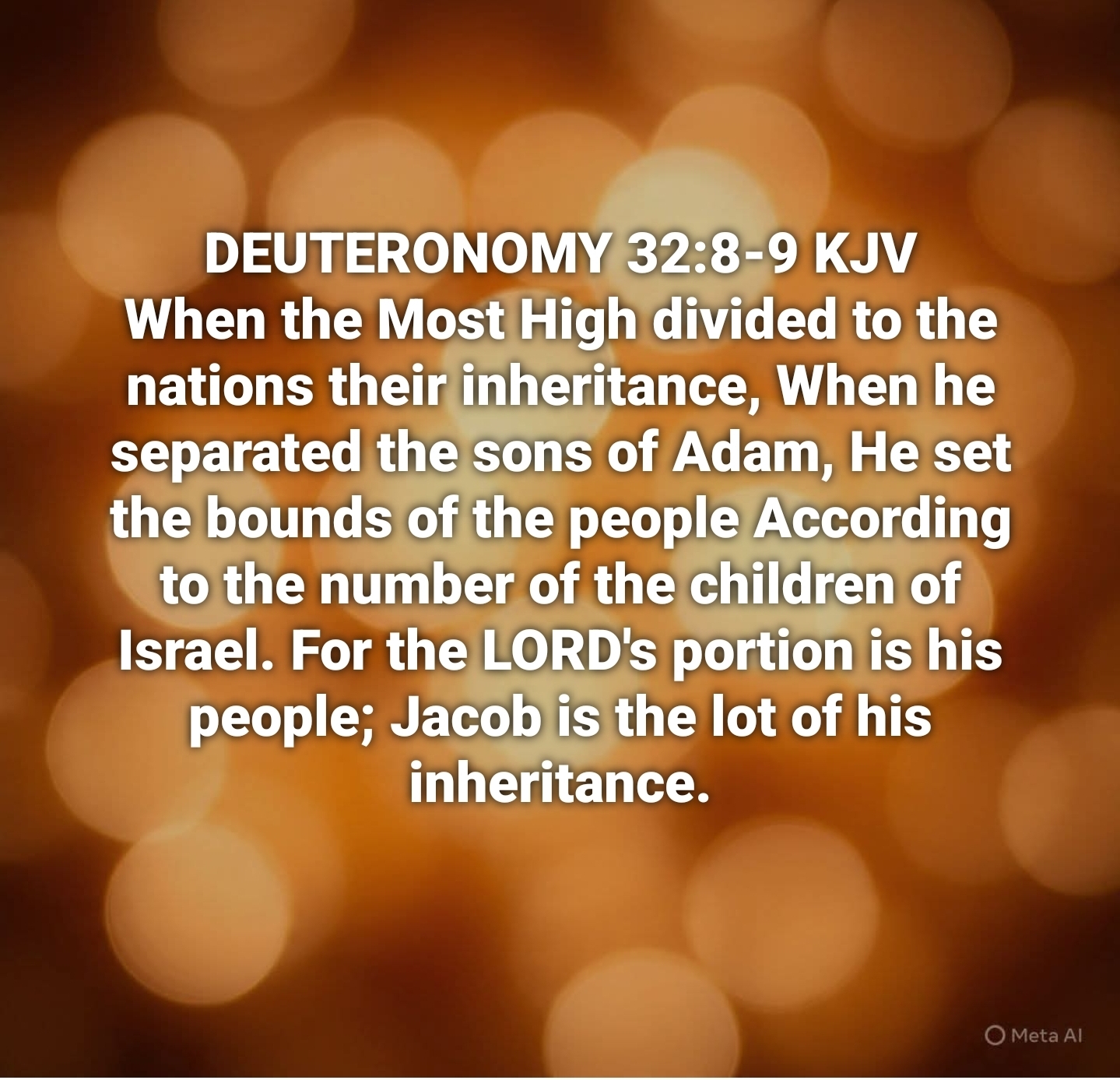
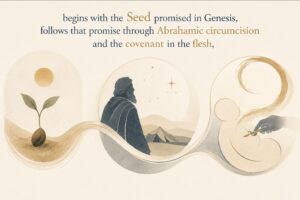 In Genesis 3:15, God declares enmity between the serpent and the woman, between the serpent seed and the woman’s seed, and promises that a coming descendant will strike the serpent’s head. This establishes several principles at once. History will unfold as conflict. Human descent will matter.
In Genesis, the creation and covenant blessings come as fertility commands: “be fruitful and multiply” to humanity, and later to Noah, Abraham, Isaac, and Jacob. That is not a bare head‑count instruction; it is a pronouncement over the line of seed—offspring, posterity, nations—that will come from them. To bless someone with multiplication is to bless their seed with increase, continuation, and future.
Circumcision first appears in the Torah in Genesis 17, when God commands Abraham to circumcise himself and all the males in his household as the sign of the covenant.
Circumcision is bound up with the identity of the future Messiah. Circumcision is the place where God writes his claim over the seed. The Messiah comes marked in that same flesh, identified as the promised Seed of Abraham, the one in whom the covenant of circumcision finds its completion.
In the Gospels, Luke 2 explicitly records Jesus being circumcised on the eighth day and named at that moment, publicly identifying him as a true son of Abraham and heir of the covenant promises.
Biological continuity alone will not explain the future. One line of descent carries promise, and one representative Seed will ultimately reverse the serpent’s work.
This matters because the Bible never treats genealogy as merely administrative. Genealogies track inheritance, vocation, covenant continuity, and redemptive expectation. But from Genesis onward, the story repeatedly shows that not every physical descendant stands equally inside the promise. Cain is not Abel. Ishmael is not Isaac. Esau is not Jacob. The canon is already teaching the reader to distinguish between descent in general and the line of promise in particular.
The opening form of the gospel is not an abstract doctrine but a promise about seed. Paul later intensifies this logic when he identifies the promises spoken to “Abraham’s seed” as ultimately converging on Messiah. However debated some details of that argument may be, the theological move is not arbitrary. It depends on a pattern already present in Genesis: redemptive history narrows toward a representative descendant.
Abraham: Covenant in the flesh
In the Genesis narrative, God counts Abraham’s faith before circumcision is given and performed. Abraham believes God’s promise about his seed and inheritance, and his faith “is counted to him as righteousness” prior to the institution of the circumcision covenant. The cut of circumcision does not create the covenant; it confirms it. The line of the Seed is first established by promise and trust, and only then inscribed upon the organ of generation.
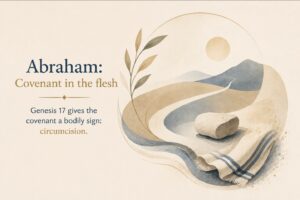
Genesis 17 gives the covenant a bodily sign: circumcision. The sign is not applied at random. It is cut into the organ of generation, the place from which seed proceeds. The symbolism is difficult to ignore. God marks the site of posterity itself, binding covenant, inheritance, identity, and future offspring to a visible sign in the flesh. The language of Genesis 17 is explicit: the covenant “in your flesh.”
Faith establishes righteousness. Circumcision establishes lineage. This is why circumcision becomes such a powerful marker in later Jewish life. It is not only about obedience. It is about belonging. It marks the bearer as inside Abraham’s covenant line and under the obligations and privileges of that line. It is therefore understandable that Jewish believers in the first century would assume that Gentiles entering Israel’s Messiah must pass through Israel’s covenant sign.
There is also a more symbolic reading worth naming carefully. Genesis 2:25 describes the man and the woman as naked and unashamed before the fall. In that light, circumcision can be read not only as covenant marking, but as a kind of uncovering at the source of seed: a partial sign, cut into fallen flesh, that gestures back toward unashamed creatureliness and forward toward a redeemed humanity no longer ruled by shame. This should be taken as theological reflection rather than as a plain lexical meaning of the rite, but it fits the larger pattern in which covenant, body, seed, and restoration remain closely joined.
Yet Abraham’s story already complicates any attempt to turn circumcision into a mechanism of salvation. Abraham is justified in Genesis 15 before circumcision is instituted in Genesis 17. Paul later makes much of this chronological fact because it shows that righteousness is not caused by the sign. The sign seals and symbolizes; it does not originate grace. Abraham’s covenant line matters, but his acceptance before God rests first on promise received by faith.
Moses: blood and the seriousness of covenantal flesh
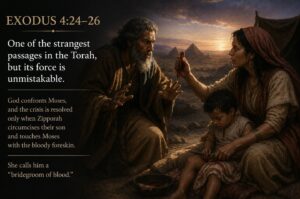
Exodus 4:24-26 is one of the strangest passages in the Torah, but its force is unmistakable. God confronts Moses, and the crisis is resolved only when Zipporah circumcises their son and touches Moses with the bloody foreskin. She calls him a “bridegroom of blood.”The episode makes clear that the Abrahamic sign cannot be neglected without peril, even by the man chosen to lead Israel’s exodus.
The theological importance of the scene lies in what it dramatizes. The future of Israel cannot proceed through unclaimed flesh. The line of deliverance itself must be brought under covenant blood. Circumcision therefore functions not as a casual badge but as a life-and-death sign. It marks the place where generative life, family continuity, and divine obligation intersect.
This is also why the issue of circumcision in Acts 15 is so charged. The debate is not about whether a minor ritual may be waived for convenience. It is about whether the bodily sign that carried Abraham’s legacy and Moses’ covenant seriousness remains a necessary threshold for salvation after the coming of Messiah and the outpouring of the Spirit.
The Tanach turns inward: heart before skin alone
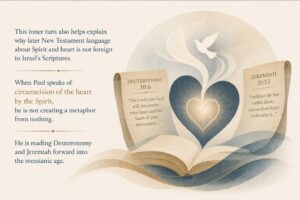 If the story stopped with Abraham and Moses, the later apostolic move would look like rupture. But the Tanach itself begins to undermine any confidence in outward sign divorced from inward transformation. Deuteronomy 10:16 commands Israel to circumcise the foreskin of the heart. Deuteronomy 30:6 goes further and promises that the Lord Himself will circumcise Israel’s heart so that Israel may love Him and live. Jeremiah 4:4 repeats the call and warns that uncircumcised hearts remain liable to judgment.
These texts are not rhetorical extras attached to an otherwise external covenant. They show that the covenant sign in the flesh was never the end of the matter. The true problem is not merely that the body lacks a mark, but that the heart remains stubborn. The Tanach therefore begins its own interior critique. Skin can witness to covenant, but skin cannot produce covenant faithfulness. Flesh can bear a sign, but flesh cannot heal rebellion.
This inner turn also helps explain why later New Testament language about Spirit and heart is not foreign to Israel’s Scriptures. When Paul speaks of circumcision of the heart by the Spirit, he is not creating a metaphor from nothing. He is reading Deuteronomy and Jeremiah forward into the messianic age.
Joshua: crossing with claimed flesh
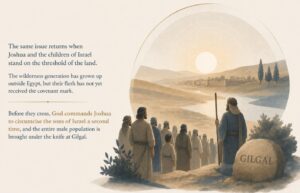 The same issue returns when Joshua and the children of Israel stand on the threshold of the land. The wilderness generation has grown up outside Egypt, but their flesh has not yet received the covenant mark. Before they cross, God commands Joshua to circumcise the sons of Israel a second time, and the entire male population is brought under the knife at Gilgal.
Only then does God say, “Today I have rolled away from you the reproach of Egypt.” The future cannot simply proceed through unclaimed flesh. In both Moses and Joshua, the people are not allowed to move into a new stage of promise until the organ of generation is marked. The line of seed has to be claimed in blood before it can carry history forward under covenant.
John 3: flesh and Spirit
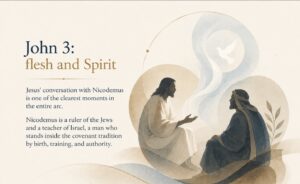 Jesus’ conversation with Nicodemus is one of the clearest moments in the entire arc. Nicodemus is a ruler of the Jews and a teacher of Israel, a man who stands inside the covenant tradition by birth, training, and authority. Yet Jesus tells him that unless one is born from above, one cannot see or enter the kingdom of God. He then states the principle with unforgettable bluntness: “That which is born of the flesh is flesh, and that which is born of the Spirit is spirit.”
This statement does not deny the importance of natural birth or Israel’s historical identity. It denies their sufficiency. Flesh produces flesh. It transmits bodily life, lineage, history, and even covenant location. But it cannot produce the qualitative life of the kingdom. Only the Spirit can generate that life. John’s broader theology reinforces this when it says that the children of God are born not of blood, nor of the will of the flesh, nor of the will of man, but of God.
John 3 therefore gives direct New Testament language to the distinction already forming in the earlier Scriptures. Lineage may place a person near promise, but only the Spirit brings a person into its salvific reality. This is why John 3 is so important for the thesis. It strips pedigree of salvific power without stripping covenant history of meaning.
There is another message. Identity in terms of lineage is not needed for salvation since its purpose has been fulfilled in Messiah. The long history of generation, circumcision, and covenant seed has reached its goal in him, so that identity grounded in ancestry is not needed. The Gentiles righteous is justified by faith. Like Abraham, whose righteousness was reckoned to him before he bore the mark in his flesh, the Gentiles’ righteousness doesn’t require circumcision. The Gentiles do not need to become Jews, thus circumcision’s mark of covenantal identity is unnecessary.
At the same time, a Jew has real reasons to maintain Jewish identity and practice. Ancestral promises to Israel and the Jews are still carried forward rather than erased—promises of land, of covenant, of God’s enduring faithfulness to Israel’s calling.
Genesis 12:3— “I will bless those who bless you, and him who dishonors you I will curse, and in you all the families of the earth shall be blessed.”
Acts 15: the church refuses to rebuild the wall
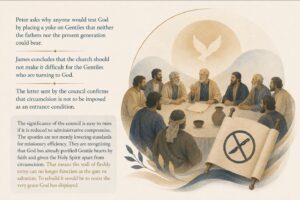 Acts 15 is the ecclesial moment where the scriptural trajectory becomes a formal communal judgment. Certain believers from the party of the Pharisees insist that Gentiles must be circumcised and required to keep the law of Moses. This demand is historically understandable. If circumcision has marked covenant belonging since Abraham and has been intensified by Mosaic obligation, then requiring it of Gentiles seems like a faithful preservation of Israel’s story.
But Peter and James judge the matter differently because they read not only Scripture but also the manifest work of God. Peter asks why anyone would test God by placing a yoke on Gentiles that neither the fathers nor the present generation could bear. James concludes that the church should not make it difficult for the Gentiles who are turning to God. The letter sent by the council confirms that circumcision is not to be imposed as an entrance condition.
The significance of the council is easy to miss if it is reduced to administrative compromise. The apostles are not merely lowering standards for missionary efficiency. They are recognizing that God has already purified Gentile hearts by faith and given the Holy Spirit apart from circumcision. That means the wall of fleshly entry can no longer function as the gate to salvation. To rebuild it would be to resist the very grace God has displayed.
Paul: children of flesh and children of promise
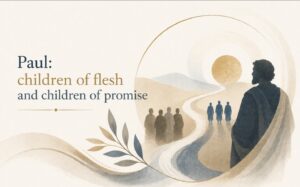 Paul gives theological precision to what Acts 15 resolves narratively. In Galatians, he argues that Abraham believed God and was counted righteous, and that those who share Abraham’s faith are his true children. He goes on to identify Christ as the promised Seed in whom the blessing of Abraham reaches the nations. In Romans, he states the principle with severe clarity: not all who are descended from Israel belong to Israel, and it is not the children of the flesh who are the children of God, but the children of the promise.
This is not anti-Jewish theology. It is intra-biblical theology. Paul is reading the Abraham narrative, the election narratives, and the prophetic tradition together. Isaac and Ishmael, Jacob and Esau, outward circumcision and inward transformation, all teach the same lesson: lineage matters in salvation history, but promise determines salvation itself.
The same logic appears in Romans 2:28-29 and Colossians 2:11. A true Jew is one inwardly, and true circumcision is a matter of the heart, by the Spirit. Believers undergo a circumcision made without hands in Christ. In other words, Paul does not abolish circumcision by indifference. He relocates its deepest meaning into Christ and the Spirit.
The Arc of Circumcision has Reached Fulfillment.
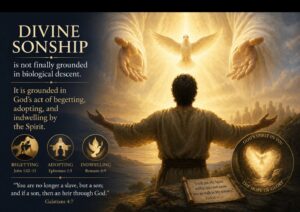
This arc reaches one of its clearest practical meanings in the phrase “a child of God.” In both Johannine and Pauline terms, divine sonship is not finally grounded in biological descent. It is grounded in God’s act of begetting, adopting, and indwelling by the Spirit. The child of God is not simply the person with the right ancestral line but the person brought by grace into the life of the Son.
This does not erase Israel’s role in history. It clarifies the terms of salvation. The biblical witness consistently refuses to let biology do the work that belongs to grace. Flesh may transmit identity, but it cannot produce eternal life. Bloodline may carry covenant memory, but it cannot itself generate the new birth.
Tanach and Jewish conversion: joining Israel by choice.
Read against this, the Tanach’s covenantal pattern is strikingly open. While Israel is indeed a people descended from Abraham, the Scriptures also envision “joining” the people as an act of loyalty and obedience rather than blood alone. A conversion to Judaism, including circumcision for a male, is an enacted acceptance into the nation of Israel with full covenant rights. The covert eceives the mark of the covenant in the flesh, and is welcomed as if born into the people. In this way, the covenant is not locked inside an ethnic line; it is offered to anyone who chooses to stand under God’s promises and commands.
Cosmological Horizon: From the Seed to Jubilee
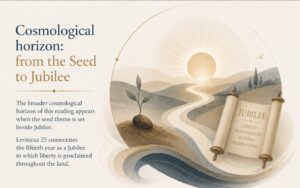 The broader cosmological horizon of this reading appears when the seed theme is set beside Jubilee. Leviticus 25 consecrates the fiftieth year as a Jubilee in which liberty is proclaimed throughout the land, people return to their property and clan, and the land itself rests. Jubilee is not only social policy. It is a theological image of restored order, released debt, recovered inheritance, and creation relieved from perpetual exploitation.
Within the present essay, Jubilee functions as a secondary but illuminating pattern. If the first promise concerns the Seed who will defeat the serpent, and if the later Torah develops the language of liberty, return, and release in the fiftieth year, then it is not unreasonable to see the biblical story moving from seed toward freedom, from enmity toward restoration, from curse toward release. The strongest form of this claim is not that every detail is explicitly connected in one verse, but that the canon’s redemptive movement coheres around that trajectory.
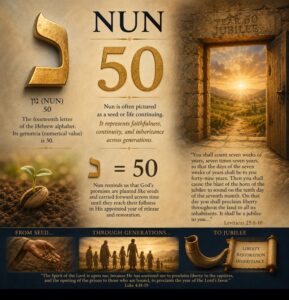
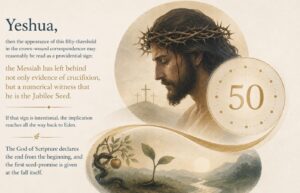 This is also the natural place to name the symbolic link between seed and fifty that has informed this essay from the start. In several streams of Hebrew reflection, the letter nun is associated with continuation, life, or ongoing inheritance, and its numerical value is fifty. That does not prove the thesis by itself, but it gives a compact symbolic grammar for it: the seed-line is ordered toward Jubilee. In that sense, seed is not merely about the multiplication of flesh; it is about the movement of history toward liberty, restoration, and final release.
From a Jewish perspective, however, Jubilee in its full halakhic sense remains suspended. According to traditional teaching, the Jubilee year can only be observed when all twelve tribes of Israel are dwelling in their allotted portions in the land, and those conditions have not yet been met. The number fifty therefore functions, for now, as an embodied promise rather than a completed practice: it marks the seed’s orientation toward freedom even as the people await the gathering of the tribes and the restoration of Jubilee in Israel.
That same symbolic grammar may also illuminate the burial cloths. Third-party summaries of Alan Whanger’s Polarized Image Overlay work report about seventy congruent patterns on the face and fifty or more on the back of the head and neck when the Shroud and the Sudarium are compared. Read conservatively, that means there are fifty clearly documented congruent blood patterns in the crown-of-thorns region, with Whanger leaving the door open to additional matches beyond that baseline. On a strictly forensic level, fifty already carries enormous evidentiary force. On a theological level, it is hard to miss the resonance: if nun is fifty and Jubilee is the fiftieth proclamation of liberty, then the wounded head of the crucified Messiah bears, even in death, a sign that he is the Seed ordered toward release. This claim should be stated carefully. The bloodstain congruences do not compel the theological reading on their own. They do, however, make room for it in a remarkable way. If the burial cloths are authentic witnesses to the death and resurrection of Yeshua, then the appearance of this fifty-threshold in the crown-wound correspondences may reasonably be read as a providential sign: the Messiah has left behind not only evidence of crucifixion, but a numerical witness that he is the Jubilee Seed. If that sign is intentional, the implication reaches all the way back to Eden. The God of Scripture declares the end from the beginning, and the first seed-promise is given at the fall itself. Jubilee is later written into Israel’s calendar as the fiftieth-year proclamation of liberty and return. So if Yeshua leaves a fifty-sign in the very wounds of the crown, then the burial cloths do not merely preserve evidence of death. They testify that the end was anticipated from the beginning: the Seed promised in Genesis already carried within himself the Jubilee toward which the whole story was moving.
[See the Epilogue for more on 50.]
Why this arc holds even where it stretches
It should be admitted that some parts of this reading are more direct than others. The link between Abrahamic circumcision and Pauline heart-circumcision is explicit. The link between John 3 and the insufficiency of lineage is explicit. The connection between Acts 15 and the refusal to make fleshly markers salvific is explicit. Those claims stand on their own textual feet.
Other parts of the argument operate more at the level of theological pattern. The movement from the Seed to Jubilee, the cosmological scope of release, and the concentration of bodily, covenantal, and redemptive meanings into a single arc require synthesis. But synthesis is not invention when it follows repeated canonical signals. The key is to keep the symbolic material answerable to the strongest textual anchors rather than letting it outrun them.
Conclusion
From a Jewish perspective, however, Jubilee in its full halakhic sense remains suspended. According to traditional teaching, the Jubilee year can only be observed when all twelve tribes of Israel are dwelling in their allotted portions in the land. Therefore, Circumcision and the number fifty functions, for now, as an embodied promise rather than a completed practice: it marks the seed’s orientation even as the people await the gathering of the tribes and the restoration of Jubilee in Israel.
Scripture is one book, one story, authored by one God, moving toward a Jubilee that is beyond our understanding.
Epilogue:
A deeper understanding of the letter Nun and its gematria value of fifty (50) will only enhance the reader’s appreciation for the significance of 50 congruent bloodstains on the Shroud of Turin and the Sudarium.
The forensically mapped congruences between the Sudarium and the Shroud include fifty identified points on the back, even if the investigator left open the possibility that more exist beyond what can be firmly demonstrated. In Scripture, fifty is the number of Jubilee, the year of proclaimed liberty, release from bondage, and return to one’s inheritance. If slavery in its deepest sense begins with disobedience in the garden, then humanity’s exile is a form of bondage: man is locked out of Eden and thereby locked into a world of death, toil, and estrangement. Against that background, the fifty blood marks associated with the back of the crucified head become a powerful sign. The Seed of the woman bears Jubilee on his head, at the very place where Genesis speaks of the serpent’s defeat, so that the Passion can be read as the moment when the ancient bondage begins to break and the lost inheritance of life with God is opened again.
In Hebrew mysticism, the letter Nun (which equals 50 in gematria) represents the miraculous, the transcendent, and the mysteries of spiritual rebirth. The meeting of these two concepts unlocks profound Kabbalistic truths about human limits, divine grace, and the ultimate levels of cosmic understanding.
1. The Fifty Gates of Understanding (Sha’arei Binah) – In Jewish thought, existence is governed by fifty spiritual gates of understanding or wisdom. The number 49 represents the absolute peak of the physical and natural universe—the culmination of human intellect. The 50th Gate, represented by the letter Nun, is entirely supernatural. It transcends time and space, representing direct divine revelation and miracles.According to mystical tradition, Moses reached the 49th gate of understanding during his lifetime, but attained the 50th gate as a divine gift at the very moment of his death.
2. The Letter Nun: Humility and Kingship – The numerical value of the 14th letter of the Hebrew alphabet, Nun, is 50. Its name translates to “fish” in Aramaic, which symbolizes vitality, hidden life beneath the water’s surface, and uninterrupted continuity (or the “seed”).
3. The Year of Jubilee and Freedom – In the biblical calendar, every 50th year is the Year of Jubilee (Yovel). During this time, all debts are forgiven, slaves are set free, and physical property returns to its original owners. Spiritually, the 50 represents a “cosmic reset,” a release from earthly constraints, and an era of pure divine grace.
4. The Hidden Promise in Psalm – 145A profound example of Nun’s mystical significance lies in Psalm 145, which is an alphabetical acrostic. While every letter of the Hebrew alphabet sequentially begins a verse, the letter Nun is noticeably missing.