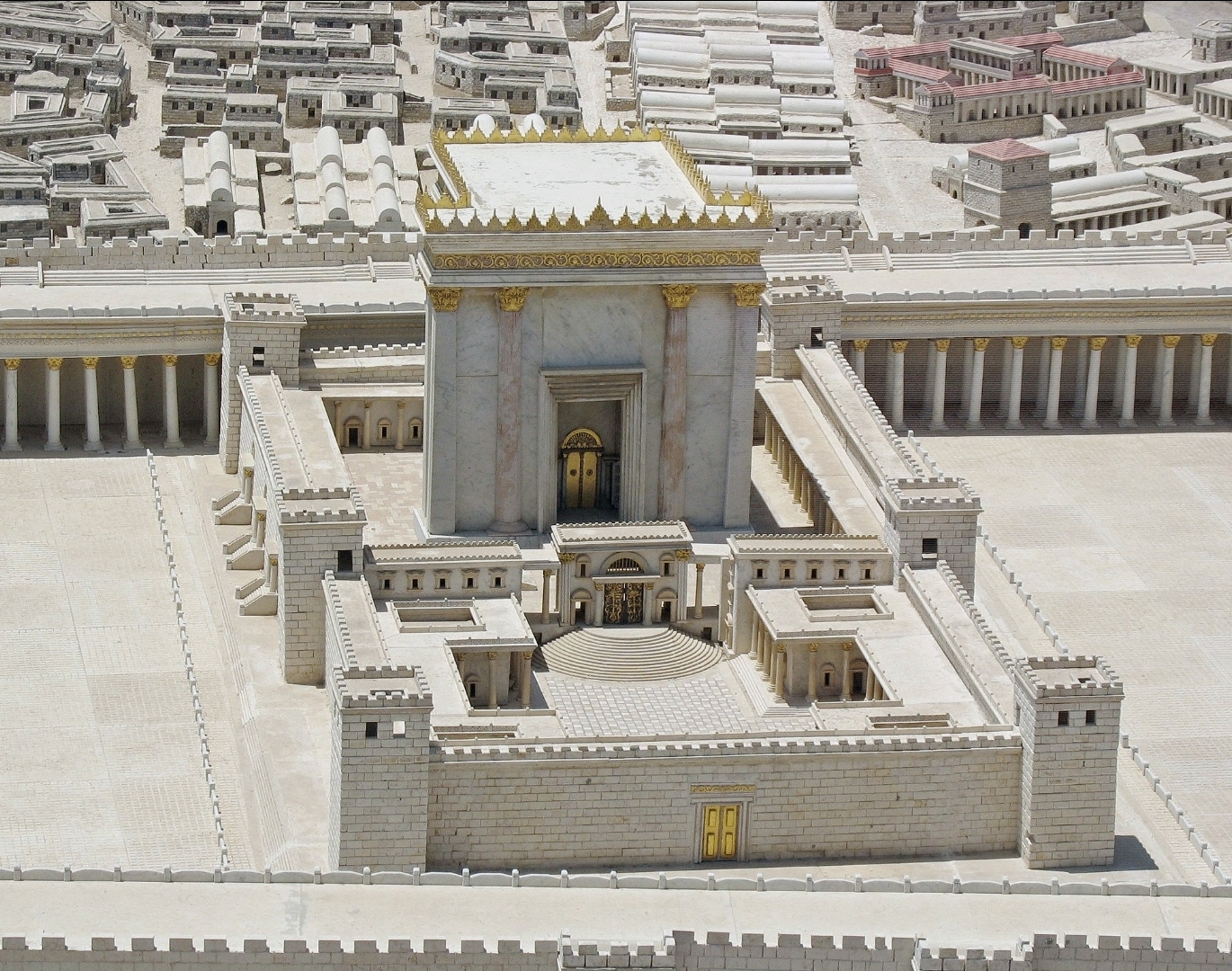
Isaiah 66:1-2 Masoretic—So says the Lord, “The heavens are My throne, and the earth is My footstool; which is the house that you will build for Me, and which is the place of My rest? And all these My hand made, and all these have become,” says the Lord. “But to this one will I look, to one poor and of crushed spirit, who hastens to do My bidding.
ACTS 7 AND CROSSING THE LONG ARC
Acts 7 is one of the clearest places where the Bible itself does what I’ve been trying to trace in my recent writing: it calls out the parallels that run between the Tenach and the New Testament as the story moves through its long arc from Genesis to Revelation. In Luke’s narrative, Stephen walks through Abraham, Joseph, Moses, the wilderness, the Temple, and the prophets, and shows that the same pattern keeps repeating until it converges on Yeshua the Messiah. In that sense, Acts 7 is not just a retelling of Israel’s history; it is the Bible modeling this kind of reading from within. It is the well-known idea—“the New is in the Old concealed, and the Old is in the New revealed”—happening in real time, inside the text itself, as Stephen pulls those connections into the open and sets them directly before the leaders accusing him.
Is Stephen accurate or not?
Acts 7 often raises the question: is Stephen telling the Old Testament story accurately? He begins with Abraham, moves through Joseph and Moses, and then speaks about the tabernacle, the Temple, and the prophets. He clearly depends on the Torah, but he also compresses events, rearranges emphasis, and draws together multiple scriptural lines in order to make a theological point.
The conclusion is that Stephen is faithful to the substance of the Torah and the Prophets, but he is not giving a neutral history lecture. Acts 7 is a covenant-lawsuit speech. Its purpose is to show that Israel, especially its leaders, has a long history of resisting the messengers God sends, and that this resistance has now reached a decisive point in relation to Yeshua the Messiah.
The repeated pattern Stephen names
Stephen’s structure is deliberate. Abraham receives promise while still a sojourner. Joseph is rejected by his brothers and later exalted as their deliverer. Moses is rejected as ruler and judge, sent away, sent back by God, and then resisted again in the wilderness. The generation in the wilderness experiences divine presence and yet turns to idolatry. The tabernacle and the Temple are real parts of Israel’s story, but even the prophets insist that God cannot be reduced to them.
These are not isolated incidents. Stephen gathers recurring lines in Israel’s history and stacks them together. What happens to Joseph, Moses, and the prophets prepares the reader for his final accusation: the present generation is continuing the same pattern rather than breaking from it.
Stephen’s point about the prophets is grounded in the Tanakh
Stephen’s question in Acts 7:52—“Which of the prophets did your fathers not persecute?”—is not an unsupported polemical statement. It is grounded in Israel’s own Scriptures. Nehemiah 9:26 says, “They killed Your prophets, who had admonished them to return to You,” and 2 Chronicles 36:16 gives a broader summary: “They mocked God’s messengers, despised His words and scoffed at His prophets.”[12][13][14] Elijah laments that Israel has “killed Your prophets with the sword” (1 Kings 19:10, 14), and narratives such as the stoning of Zechariah in the Temple court (2 Chronicles 24:20–22), the execution of Uriah son of Shemaiah (Jeremiah 26:20–23), and the mistreatment and imprisonment of Jeremiah himself show how prophets were mocked, threatened, beaten, and sometimes killed for speaking God’s word.
In other words, “persecution” in the Tanakh includes a range of hostile responses: mocking God’s messengers, despising His words, misusing and falsely accusing His prophets, and in some cases putting them to death. Stephen’s language matches this internal scriptural pattern rather than exaggerating it.
Yeshua Himself stands inside this same line when He laments, “O Jerusalem, Jerusalem, the city that kills the prophets and stones those who are sent to it,” and when He weeps over the city for not recognizing the time of its visitation (Matthew 23:37; Luke 13:34–35; Luke 19:41–44). Stephen is therefore echoing both Israel’s own Scriptures and Yeshua’s grief, not introducing a new accusation from the outside.
The deeper issue is truth
The larger issue in Acts 7 is not only whether Stephen recounts details correctly. The larger issue is truth. Who is actually telling the truth about God in the present moment?
In Acts 7, truth is ultimately defined not by possession of Scripture or proximity to the Temple, but by responsiveness to the Holy Spirit’s witness to what God has done in Yeshua the Messiah. Stephen’s climactic accusation—“You always resist the Holy Spirit…you have become the betrayers and murderers of the Just One…you received the law as ordained by angels and did not keep it”—shows that his hearers’ problem is not ignorance of holy things but hardened, uncircumcised hearts that refuse the very fulfillment their Torah and Prophets anticipated in the Messiah. Acts 7 therefore presents a portrait of faithless familiarity: a people saturated in divine revelation yet blinded to the glory of God when it appears in the Son of Man, and when the Spirit calls them to salvation in the Messiah, so that conviction becomes rage and rebellion rather than repentance.
Faithless familiarity with the things of God
A useful summary of Acts 6–7 is that faithless familiarity with the things of God blinds people to the glory of God and breeds rebellion. That is the condition Stephen identifies in his hearers. They know Torah, they know the Temple, they know Israel’s story, and they know the language of covenant faithfulness. Yet their familiarity has not produced circumcised hearts and ears. Instead, when confronted by the Spirit’s witness to Yeshua the Messiah, they harden rather than repent.
This is not a uniquely Jewish problem. It is a permanent religious danger. Familiarity with sacred things can become a shield against the living God. Acts 7 exposes this danger in the leadership of Jerusalem, but the pattern can repeat wherever people come to handle holy things routinely without true openness to the Spirit.
The irony of the blasphemy charge
Stephen is accused of speaking against Moses, God, the law, and “this holy place.” The assumption is that to speak of change in relation to Moses or the Temple is to attack God Himself. Stephen’s speech exposes the weakness of that assumption. He fully affirms that God appeared to Abraham, that God called Moses, that God gave the law, and that the tabernacle and Temple belong within Israel’s God-given history.
The issue is not whether these realities were holy. The issue is whether they have been made absolute. Abraham is not God. Moses is not God. The Temple is not God. Stephen’s point is not that the Temple was meaningless or unholy, but that even Israel’s prophets taught that the God of Israel cannot be contained by a structure made with hands. In that sense, the deeper irony is that the men who accuse Stephen of blasphemy are the ones resisting the Holy Spirit by absolutizing what was meant to mediate, not replace, the presence of God.
The Temple as the hinge point
Stephen’s argument, “The Most High does not dwell in temples made with hands,” is not contempt for the Temple. Stephen is not denying its God-given role in Israel’s history. He is stating that even within Israel’s own prophetic tradition, the Temple was never the final container of God’s presence.
This matters because Acts has already begun to show a shift. At Shavuot, the Spirit descends on people rather than on the Temple building. Stephen himself is “full of the Holy Spirit” when he sees the glory of God and the Son of Man standing at God’s right hand. Acts 7 says openly what the narrative has been preparing: the dwelling of God is no longer to be understood as centered in a house made with hands, but in a people who receive His Spirit through Yeshua the Messiah.
At this point in the biblical story, a major crossover takes place. The long arc has reached and crossed its center. The Temple is not discarded, but it is relativized by the reality to which it pointed.
Awe and glory in Acts 7:54–56
The end of Stephen’s speech makes the contrast as sharp as possible. The council is “cut to the heart,” yet responds with rage and gnashing of teeth. Stephen, by contrast, is “full of the Holy Spirit,” gazes into heaven, and sees the glory of God and the Son of Man standing at God’s right hand.
This is where the issue of glory becomes central. One group is surrounded by sacred texts, sacred memory, and sacred space, yet cannot see the glory of God when it appears before them in relation to the Messiah. The other, standing outside their approval, sees heaven opened. This is the difference between familiarity without faith and spiritual sight granted by the Holy Spirit.
Stopped ears and laid-down cloaks
Luke then records two details that carry more meaning than they first appear to have. First, the crowd “stopped their ears” and rushed upon Stephen with one accord. This physically enacts Stephen’s accusation that they are uncircumcised in heart and ears and that they always resist the Holy Spirit. Their bodily gesture becomes a visible refusal of revelation.
Second, the witnesses lay down their cloaks at the feet of a young man named Saul. Practically, this allows them to stone Stephen more freely. Narratively, it introduces Saul as an approving participant in the event. In one scene, the leadership enacts its refusal to hear, and Saul is marked as the young man standing within and consenting to that refusal.
Saul at the point of the rejection pattern
Acts 8:1 makes the point explicit: “Saul was consenting unto his death,” or in other translations, he approved of Stephen’s execution. Saul is not a detached observer. He is aligned with the killing of the Spirit-filled witness and then becomes a leading persecutor of the followers of the Way.
This places Saul at the concentrated point of the pattern Stephen has just named. Earlier generations persecuted prophets. The present generation betrayed and murdered the Just One. Saul stands at the point where the persecution of those who bear witness to the Messiah now intensifies.
Grace toward Saul as decisive reversal
Then Acts 9 interrupts that line. On the road to Damascus, Yeshua appears to Saul in a heavenly confrontation. Saul is not seeking the Messiah. He is persecuting His people. Yet Yeshua takes the initiative, stops him, blinds him, redirects him, and then has Ananias restore him so that he receives sight and the Holy Spirit.
This is a direct act of grace. It is unearned intervention toward an active enemy. Saul is not rewarded; he is overtaken. The one who stood at the point of killing the prophet-like witness becomes the one called to carry the name of Yeshua before Israel and the nations.

Job, Mazzaroth, and mazal
Thinking about mazal adds another layer. In Job 38, God asks Job whether he can bring forth the Mazzaroth in its season. The Mazzaroth is usually understood as the ordered heavenly signs or constellations. The point is that Job does not govern the heavens; God does.
This can be placed beside the later Jewish use of “Mazal.” Mazel in Hebrew originally means a flow or configuration of influence, like a “constellation” or “sign,” and is related to “Mazzaroth,” the biblical term for the ordered arrangement of the stars, the “constellations,” so the word carries the sense that what we call “luck” is really a patterned providence rather than random chance. In that sense, “mazel” becomes a picture-language way of talking about grace: the ordered “flow” of God’s favor and guidance into a life that did not earn it, where what looks like luck is actually mercy arriving on a path he already marked out.
Job is crucial for talking about mazel and grace because his story shows how a person can be struck by a terrible “flow from the heavens”—loss cascading into his life from above—without having earned it, so that his restoration in the end is not the sky finally “turning lucky” again but the unearned grace of God redirecting that flow into blessing.
Job lives under a heaven he cannot control, under suffering he cannot fully explain, while God insists that He alone governs the larger pattern. That makes Job a useful parallel to Israel’s long historical testing under the same God.
Acts 7–9 can be read in continuity with that framework. The God who orders the heavens has now brought forth, in its season, the decisive sign: the exalted Son of Man and the Spirit’s witness to Him.
Job’s friends and Stephen’s accusers
Job’s friends deepen the parallel. They use true-sounding theology to accuse the wrong man. They sit within the things of God and yet misread what God is doing in front of them. In the end, God rebukes them and vindicates Job.
Stephen’s accusers function in a similar way. They defend Torah, Moses, and the Temple, but they accuse the wrong man. They accuse the Spirit-filled witness whom God vindicates with an opened-heaven vision. In both stories, religious familiarity without true discernment results in false accusation.
The long arc crossing its center
Acts 7 is therefore more than a speech full of parallels. It is the point where the long arc of the biblical story reaches and crosses its center. Rejected patriarchal heirs, rejected deliverers, persecuted prophets, Temple-centered expectation, long testing under the God who orders the heavens, and resistance to the Holy Spirit all converge here.
At the same moment, the story turns. The Temple is relativized. The heavens are opened. Stephen is killed. Saul is marked. Grace comes down upon the persecutor. The word begins to move outward because it has now been rejected at the center.
This is why Acts 7 stands as such a large moment in the story. It is the point where the old pattern is exposed and the new direction becomes visible. The center has been crossed, and the word is going out toward salvation in the Messiah for the nations.
Three Linked Narratives that Embody Yeshua Mission
The story of the Good Samaritan, the Samaritan Women at the Well and Philip going to Samaria are all deeply connected by a single, powerful, and overarching theme: the radical, boundary-crossing grace of God and the breaking down of racial and social barriers.
The Samaria narrative arc is the ultimate “proof of concept” for the Great Commission. It bridges the gap between a localized Jewish movement and a global faith. The disciples initially struggled with this. By looking at Philip’s journey, we see the Holy Spirit forcing the early Church to live out the Great Commission by dismantling deep-seated racial prejudice. They could no longer claim the Gospel was only for people who looked, acted, and believed like them.
Philip takes the Gospel to a place the disciples previously wanted to destroy with fire (Luke 9:54) and instead brings them spiritual life.
The story still remains ordered
One final clarification matters here. None of this means that Israel is bypassed, that the law is discarded, or that sin has changed its nature. The movement outward in Acts does not erase Israel’s priority in the story. The apostolic witness later states the pattern plainly: the message is “to the Jew first and also to the Greek.” The outward turn to the nations is therefore not a replacement of Israel, but an ordered expansion flowing through the promises already given.
This also means that Yeshua’s fulfillment of Torah is not abolition of Torah. In Matthew 5:17, Yeshua says explicitly, “Do not think that I have come to abolish the Law or the Prophets; I have not come to abolish them but to fulfill them.” Acts 7 does not teach that sin is no longer sin or that holiness no longer matters. It teaches that the leaders’ possession of sacred structures and sacred texts did not excuse their resistance to the Holy Spirit. The issue is not whether God’s standards disappeared. The issue is whether those standards are finally understood and brought to their intended goal in Yeshua the Messiah.
This is also where the Temple and prophet themes meet directly in Yeshua’s own words to the Jewish leaders. In John 2, after conflict around the Temple, Yeshua says, “Destroy this temple, and in three days I will raise it up,” and John explains that He was speaking about the temple of His body. The same leadership pattern is already present there: misunderstanding, resistance, and a movement toward killing the one sent by God. That means Acts 7 is not introducing a new break from Yeshua’s own teaching. Stephen is standing inside the same line. The Temple is not denied, but its meaning is being brought to its decisive point in the Messiah Himself.
That helps keep the whole argument in balance. The center is crossed in Acts 7 not because God abandons His earlier revelation, but because that revelation reaches its decisive point in the Messiah. The word goes outward to the nations, but it does so in continuity with Israel’s Scriptures, Israel’s covenants, Israel’s Messiah, and the enduring reality that sin is still sin, holiness still matters and man needs Salvation.