Seven Fulfillment Arcs
נ NUN (50): Psalm 119:105—Your word is a lamp to my feet And a light to my path.
In this blog, I am exploring the seven “I Am’s” in the book of John in the New Testament.
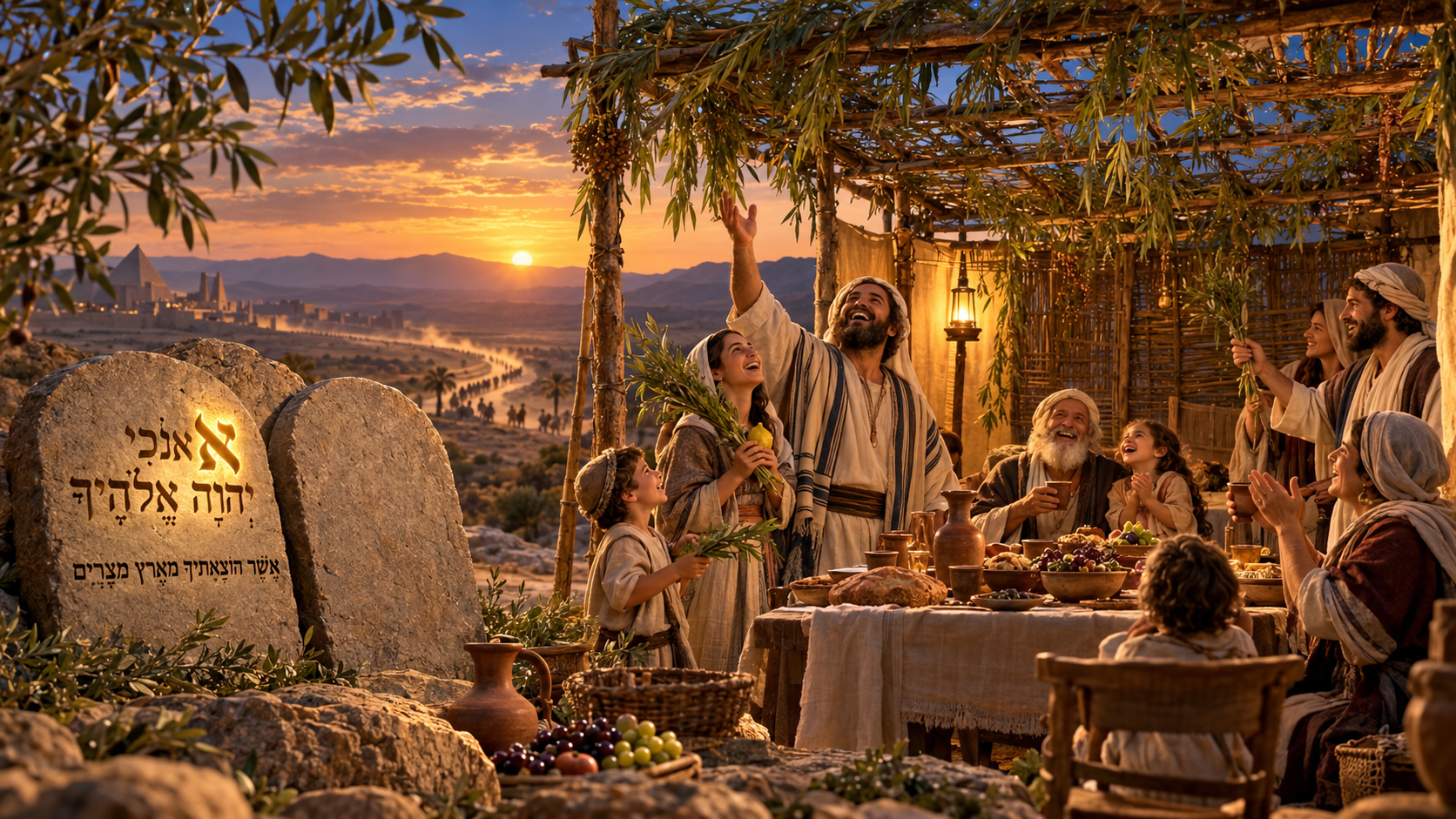
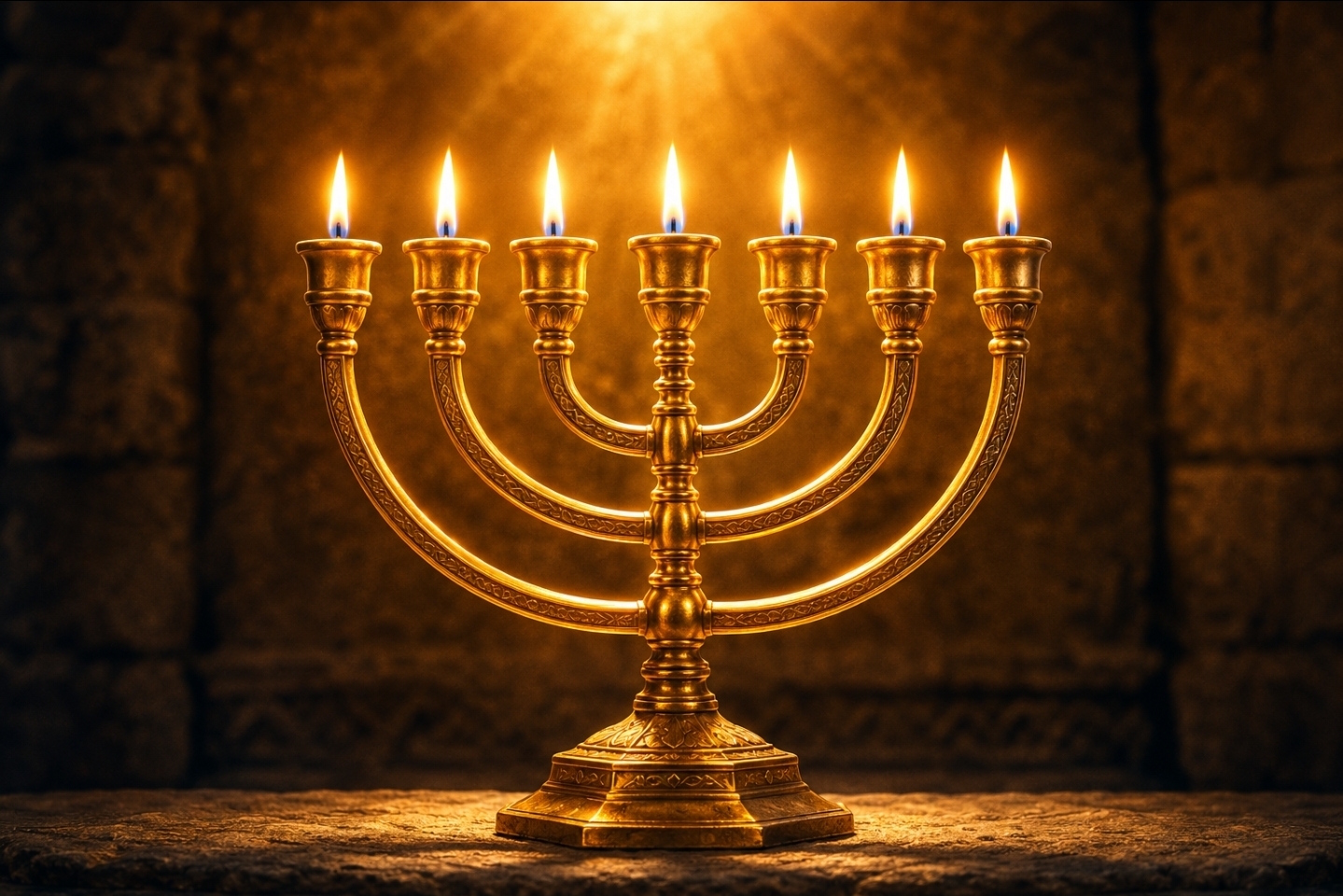
In Torah, the menorah is the seven-branched lampstand in the tabernacle and then the temple, burning pure oil and called “the lamp of God.” It stands opposite the Temple showbread (also written as “shewbread”), twelve sacred loaves of unleavened bread that were permanently displayed on a golden table inside the biblical Tabernacle and later the Temple in Jerusalem.
John’s Gospel has Yeshua twice say, “I am the light of the world,” and “I have come as light into the world,” applying to himself what Scripture says about God’s own light and the lamp that lets the priests serve. Many readers say the menorah “foreshadowed Jesus.”
John’s Gospel does not scatter the “I am” sayings at random. He sets them in place one by one, like lamps being lit on a menorah, until a full pattern begins to appear. By the end, what looked at first like separate sayings turns out to be one unified light: a covenant-shaped portrait of Yeshua drawn out of the Scriptures of Israel.
That is why these sayings are better understood not as isolated metaphors, but as fulfillment arcs. Each one reaches back into the Tenakh, gathers up a scriptural pattern—bread, light, gate, shepherd, life, way, vine—and then brings that pattern to embodied fullness in Yeshua. In that sense, the seven “I am” sayings disclose the better promises not by abolishing what came before, but by bringing the old covenant patterns to their living center.
The image may be pictured as a menorah. In the temple, seven lamps together filled the holy place with one radiance. So too in John: each time Yeshua says “I am,” another lamp is lit. One flame by itself gives light, but the full menorah gives understanding. That matters, because John’s own Gospel shows that the full meaning was not grasped all at once, even by the disciples.
Working thesis
In John’s Gospel, the seven “I am” sayings form seven fulfillment arcs in which Yeshua gathers up Israel’s covenant patterns and discloses them as the better promises: the same gifts of God now given fully, personally, and irrevocably in him.
Arc One — Bread of Life
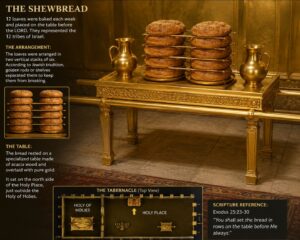
Translated literally from the Hebrew Leḥem haPānīm, means the “Bread of the Presence” or “Bread of the Face,” signifying that it was continuously set before the face of God. In the Torah it says, twelve sacred loaves of unleavened bread are to be permanently displayed on a golden table inside the biblical Tabernacle and later the Temple in Jerusalem.
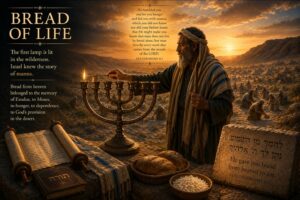
The first lamp is lit in the wilderness. Israel knew the story of manna. Bread from heaven belonged to the memory of Exodus, to Moses, to hunger, to dependence, to God’s provision in the desert. That is why John 6 matters so much: the feeding of the five thousand is not just a miracle of abundance, but an Exodus-shaped sign that pulls manna back into view.
Tanakh: “Then the LORD said to Moses, ‘I will rain down bread from heaven for you.’” — Exodus 16:4.
New Testament: “I am the bread of life. Whoever comes to me shall not hunger.” — John 6:35.
The crucial move in John 6 is that Yeshua refuses to let the crowd stop with Moses. The bread was never finally “from Moses.” It was from heaven, from the Father. And now the bread from heaven is no longer simply a substance given in the wilderness, but a person standing before them. The arc moves from manna to Messiah, from provision to presence.
And John does not hide how difficult this was to receive. When the Bread of Life discourse presses further, many of his disciples say, “This is a hard teaching.” Yeshua answers by pointing beyond the moment itself: “Then what if you see the Son of Man ascend to where he was before!” and, “The Spirit gives life; the flesh counts for nothing. The words I have spoken to you—they are full of the Spirit and life.” From that time many turn back and no longer follow him, and he asks the Twelve, “You do not want to leave too, do you?”
That scene matters for the whole article. It shows that the saying cannot be grasped merely at the level of first reaction. The bread arc already contains the pattern that will govern all seven lamps: offense, incomprehension, departure for some, perseverance for others, and a meaning that will only fully open through ascent, Spirit, and the larger whole of Yeshua’s person and mission.
Arc Two — Light of the World
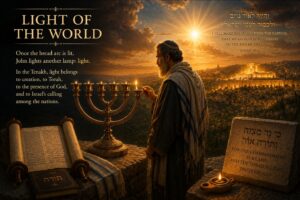 Once the bread arc is lit, John lights another lamp: light. In the Tenakh, light belongs to creation, to Torah, to the presence of God, and to Israel’s calling among the nations. Light is not a decorative image. It is one of the deepest ways Scripture speaks about God’s own activity.
Tanakh: “The LORD is my light and my salvation; whom shall I fear?” — Psalm 27:1.[2]
New Testament: “I am the light of the world. Whoever follows me will not walk in darkness.” — John 8:12.
This is not a minor claim. What the Psalms say of the LORD, Yeshua now says in the first person. The arc moves from divine light as gift to divine light embodied in a human life. Another lamp is lit, and the room grows brighter.
Arc Three — Door of the Sheep
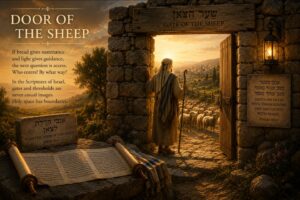 If bread gives sustenance and light gives guidance, the next question is access. Who enters? By what way? In the Scriptures of Israel, gates and thresholds are never casual images. Holy space has boundaries. The temple has entrances. Covenant life has ordered access.
Tanakh: “Lift up your heads, O gates! … that the King of glory may come in.” — Psalm 24:7.
New Testament: “I am the door of the sheep.” — John 10:7.
Here again John makes the pattern personal. The gate is no longer merely architectural or institutional. Entry into the flock is now identified with Yeshua himself. The arc moves from guarded entrance to living entrance.
Arc Four — Good Shepherd
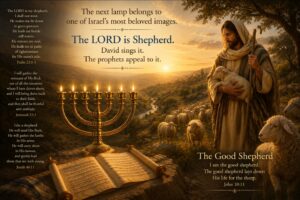 The next lamp belongs to one of Israel’s most beloved images. The LORD is shepherd. David sings it. The prophets appeal to it. Ezekiel condemns false shepherds and promises that God himself will come tend the flock. The shepherd motif therefore carries royal, prophetic, and divine weight all at once.
Tanakh: “The LORD is my shepherd; I shall not want.” — Psalm 23:1.
New Testament: “I am the good shepherd. The good shepherd lays down his life for the sheep.” — John 10:11.
This is where the arc sharpens. Yeshua does not merely claim to lead. He claims to shepherd in the very way Israel spoke of the LORD shepherding. And he does so through self-giving. The shepherd is not only guide and king; he is the one who lays down his life.
At this point, the pattern should begin to be visible. Bread, light, door, shepherd: these are not separate spiritual slogans. They are covenant functions. Each arc moves from sign to substance, from pattern to person, from something Israel knew in Scripture to someone now standing before Israel in John’s Gospel.
Arc Five — Resurrection and the Life
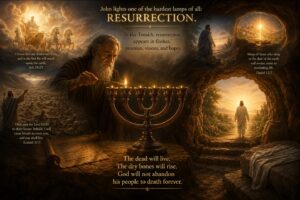 Then John lights one of the hardest lamps of all: resurrection. In the Tenakh, resurrection appears in flashes, promises, visions, and hopes. The dead will live. The dry bones will rise. God will not abandon his people to death forever. But in John 11, Yeshua does something staggering: he speaks resurrection not only as future event, but as present identity.
Tanakh: “Your dead shall live; their bodies shall rise.” — Isaiah 26:19.
New Testament: “I am the resurrection and the life.” — John 11:25.
The arc here moves from promise to person in the most concentrated way yet. Resurrection is no longer only something God will do at the end. In John’s presentation, it stands in front of Martha and speaks. Another lamp is lit, and now the whole structure is becoming difficult to ignore.
Arc Six — Way, Truth, and Life
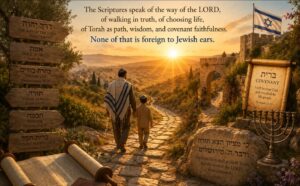 The sixth lamp gathers several streams into one. The Scriptures speak of the way of the LORD, of walking in truth, of choosing life, of Torah as path, wisdom, and covenant faithfulness. None of that is foreign to Jewish ears. What is difficult is the Johannine concentration of all of it into one “I am.”
Tanakh: “Teach me your way, O LORD, that I may walk in your truth.” — Psalm 86:11.
New Testament: “I am the way, and the truth, and the life.” — John 14:6.
This saying is often heard as offense before it is heard as arc. And of course it is offensive if it sounds like one man setting himself against Torah, against Israel, or against the covenant. But read inside the sevenfold menorah, it sounds different. “Through me” is not one candle against the rest; it is the claim that the full way, the full truth, the full life to which Torah was always pointing now stands gathered in one person.
Arc Seven — True Vine
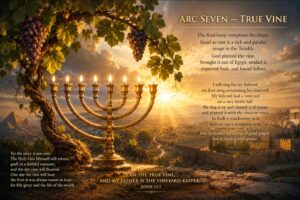 The final lamp completes the shape. Israel as vine is a rich and painful image in the Tenakh. God planted the vine, brought it out of Egypt, tended it, expected fruit, and found failure. The prophets and psalms return to this image because it is a covenant image, a national image, an image of vocation and disappointment.
Tanakh: “You brought a vine out of Egypt; you drove out the nations and planted it.” — Psalm 80:8.
New Testament:“I am the true vine, and my Father is the vinedresser.” — John 15:1.
By saying “true vine,” Yeshua does not discard Israel’s story. He steps into it. He takes up the place where Israel had failed and embodies in himself the faithful, fruitful vine. The arc moves from planted people to faithful person, from corporate image to messianic center.
The menorah fully lit
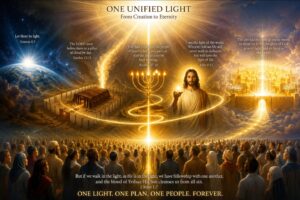
Taken together, these seven sayings are not random. They are seven lamps. Each one lights another part of the room. Bread, light, door, shepherd, resurrection, way, truth, life, vine—these are not detached claims but coordinated beams. They illuminate the same reality from different sides until the whole begins to shine.
And this is where the Jewish struggle in John becomes important. The Jews in Yeshua’s time are not facing one neat doctrinal proposition. They are being confronted, saying by saying, sign by sign, with a figure who keeps taking up scriptural patterns that belong to God’s provision, God’s presence, God’s kingship, God’s life, and God’s covenant identity. It is not surprising that this creates confusion, resistance, offense, attraction, and division all at once.
John is actually very honest about that process. The Gospel says the disciples did not understand these things at first. Only after Yeshua was glorified did they remember that these things had been written of him and done to him, and after he was raised they remembered his words and believed the Scripture and what he had said. John also says the Holy Spirit would teach them all things and remind them of everything he had said.
John 6 already gave the pattern in advance. Many hear the bread saying and cannot bear it. They stumble over it, murmur at it, and walk away. Yeshua points them forward to his ascent and says that the Spirit gives life. In other words, the saying was never meant to be exhausted at the level of first hearing. It would take more than a moment. It would take resurrection light, ascension perspective, and the Spirit’s own teaching for the full meaning to come together.
That means the seven “I am” sayings were never meant to be solved one lamp at a time. The New Testament itself shows the sayings doing their work slowly inside Jewish memory, Jewish Scripture, Jewish expectation, and Jewish resistance. One flame is lit, then another, then another. But the full menorah is not yet visible until the resurrection, and the understanding does not fully click until the Holy Spirit brings remembrance and illumination.
So by the end, John 14:6 can be heard in a deeper way. “No one comes to the Father except through me” is unbearable if heard as one isolated man against Torah, or one candle against the whole house of Israel. But heard after the seven fulfillment arcs, it becomes the claim that no one comes to the Father through fragments, through partial readings, or through a diminished covenant light. The way to the Father is through the fullness of God’s self-revelation, and John’s claim is that this fullness has come together in Yeshua.
Seen this way, the seven “I am” sayings are not devotional slogans. They are a menorah of fulfillment. Each saying lights another candle. Each candle adds light. And only when the whole menorah is burning does the full claim come into view: the God of Israel, known in bread, light, access, shepherding, life, truth, and vine, has brought those covenant patterns to their embodied center in Yeshua.
Epilogue:
50 is Significant
Historical timelines tracking the Shroud’s alleged journey often place its earliest documented presence in Edessa (modern-day Turkey) starting around 50 A.D.. According to forensic and medical analyses of the cloth reveal over 50 distinct puncture wounds scattered entirely across the scalp and the nape of the neck. Pathologists note that this pattern matches a brutal “helmet” or cap of thorns forced downward onto the head. In addition, there are exactly 50 blood spots on Sudarium of Oviedo (a facecloth often associated with the Shroud of Turin) that scientists have matched to the Shroud.
The Hebrew letter Nun, is symbolized by a sperma, a seed. The Hebrew letter Nun (נ) has a numerical value (gematria) of 50. In Jewish tradition and Kabbalah, it is deeply connected to the Temple Menorah and represents divine mysteries.
In mystical texts, the Menorah in the Holy Temple had 42 decorative elements (such as cups, spheres, and flowers). When added to the 7 branches of the Menorah, the total is 49.
The number 49 represents the highest levels of human wisdom and spiritual understanding (the 49 Gates of Binah). Reaching the 50th level of wisdom requires a gift from Above. Kindling the Menorah to serve the Divine is believed to help tap into this transcendent 50th gate. Nuns symbolize the power to rise above the 50 gates of impurity/negativity, transforming descents into spiritual elevations.
In Psalm 119, the verses associated with Nun (נ)—the 14th (14 is the gematria value of “David”) letter of the Hebrew alphabet—are verses 105 through 112. This section focuses on God’s word providing direction in the midst of affliction and snares. Below are those verses:
Psalm 119:
105 Your word is a lamp to my feet,
And a light to my path.
106 I have sworn and confirmed
That I will keep Your righteous judgments.
107 I am afflicted very much;
Revive me, O Lord, according to Your word.
108 Accept, I pray, the freewill offerings of my mouth, O Lord,
And teach me Your judgments.
109 My life is continually [a]in my hand,
Yet I do not forget Your law.
110 The wicked have laid a snare for me,
Yet I have not strayed from Your precepts.
111 Your testimonies I have taken as a heritage forever,
For they are the rejoicing of my heart.
112 I have inclined my heart to perform Your statutes
Forever, to the very end.