
From Eden to Final Judgment: The Bible’s Clothing Arc and the Wonder of Skin
Clothing is woven through the biblical narrative long before we notice how much it has been sewing the story together.
Clothing tells the story, but it was never meant to be needed. In creation, God already gave us incredible skin—a living, sensing, healing covering that was enough for a world without shame. Only after the fall do fig leaves and garments enter the picture, and even then God Himself becomes the first dresser of humanity, making and placing the garments of skin on Adam and Chavah.
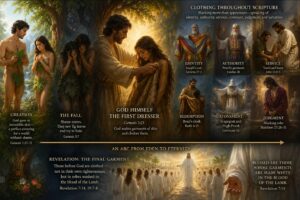 The Bible gives far more attention to clothing than many readers first notice. Garments, sandals, robes, belts, linens, skins, and coverings appear again and again at decisive moments, and when they do, they usually mark something larger than appearance. Clothing becomes one of Scripture’s recurring ways of speaking about shame, identity, authority, service, covenant, judgment, and salvation.
This arc begins in Eden, where humanity first feels the need to hide, and it runs all the way to Revelation, where the final condition of people before God is described in terms of robes, linen, nakedness, and garments washed in the blood of the Lamb. Once that pattern becomes visible, many scenes that might otherwise seem incidental begin to read differently. Clothing is not background detail. It is one of the Bible’s symbolic languages.
Eden and the First Need for Clothing
 The clothing story begins at the point where humanity first needs clothing. Before the fall, the man and the woman are naked and not ashamed. There is no attempt to cover, conceal, or protect themselves from one another or from God. After the fall, their eyes are opened, they realize they are naked, and they sew fig leaves together to make coverings for themselves. Clothing enters the story at the exact point where innocence gives way to guilt and where exposure becomes unbearable.
That matters because the first human act of clothing is self-made concealment. The fig leaves are not fashion. They are a response to shame. Humanity immediately begins trying to manage its new condition by covering itself. But the text does not leave those coverings in place. God makes garments of skin for Adam and his wife and clothes them Himself. That shift is decisive: the first adequate clothing in the Bible is not fabricated by man but provided by God.
That first divine clothing act carries several meanings at once. It covers shame, it marks a changed human condition, and it introduces the idea that true covering comes from outside the self. The garments of skin also imply death. Whatever else is said about the verse, the clothing now comes through skin, and skin means life has been taken in order for shame to be covered. From that point on, clothing is tied not only to embarrassment but to mercy under judgment.
Clothing, Identity, and Misidentification
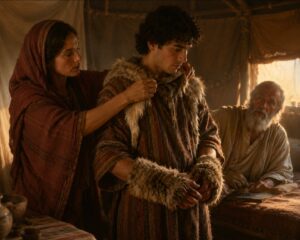
Once Scripture moves beyond Eden, clothing quickly becomes a visible marker of identity. Rebekah dresses Jacob in Esau’s garments and places goat skins on his hands and neck so that Isaac will receive him as Esau. In that scene, clothing and altered skin work together as instruments of misidentification, allowing Jacob to receive a blessing under another man’s embodied identity. The scene is especially striking because garments alone are not enough. The deception reaches all the way to simulated skin.
Joseph’s coat is another obvious example. Jacob’s special garment marks Joseph out as favored, and the brothers understand the message immediately. The coat is not incidental decoration. It publicly signals distinction, election, and paternal favor, which is why it becomes such a flashpoint of jealousy. Later, Joseph is stripped of that garment by his brothers, and the coat becomes a piece of false evidence dipped in blood. Clothing in that scene functions almost as testimony. It says something before Joseph can say anything for himself.
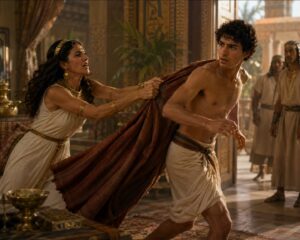
A second Joseph scene intensifies the point. Potiphar’s wife seizes Joseph’s garment when he flees, and that garment is then turned into evidence against him. Once again, clothing becomes a witness in a courtroom-like moment, but this time the witness is false and weaponized. The garment Joseph leaves behind marks both his righteousness in fleeing and his vulnerability to slander.
The same pattern appears in other narratives. Tamar’s robe marks royal status and then, when torn, becomes a sign of violated identity. Saul’s torn robe becomes a sign that the kingdom will be torn from him. Jonathan’s transfer of robe and armor to David functions as a symbolic transfer of honor and recognition. In all these scenes, clothing is not merely what a person wears. It makes a statement about who a person is, what is happening to that person, or what role that person carries before others.
Priestly and Royal Clothing
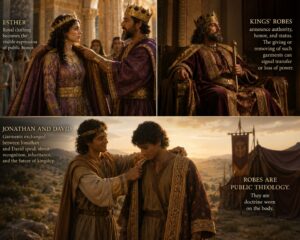
The symbolism becomes even more explicit in the high priestly garments. Exodus describes them as holy garments made for glory and for beauty. These clothes are intentionally designed to communicate office, consecration, and mediation. The ephod, the breastpiece, the stones bearing the names of the tribes, the robe, the turban, and the gold plate inscribed “HOLY TO THE LORD” all make visible claims about the man wearing them and the God before whom he stands.
Royal garments function similarly. Kings’ robes announce authority, honor, and status, and the giving or removing of such garments can signal transfer or loss of power. In Esther, royal clothing becomes the visible expression of public honor. In David’s story, garments exchanged between Jonathan and David speak about recognition, inheritance, and the future of kingship. Scripture repeatedly treats robes as public theology. They are doctrine worn on the body.
This matters for the wider clothing arc because priestly and royal garments reveal that clothing is not only about covering shame. It also announces vocation and office. The same Bible that begins with clothing as a response to guilt later presents clothing as a sign of holiness, mediation, and rule.
Sandals, Girding, and the Meaning of Removal
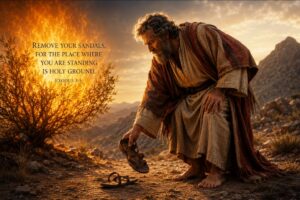
Footwear is part of this symbolic world too. Sandals are basic biblical clothing, but in key scenes they carry legal, covenantal, and sacred meaning. Moses is told to remove his sandals because the ground where he stands is holy. Joshua receives the same command. In those moments, removing footwear is not a casual detail. It is an enacted recognition that the place belongs to God and that the person standing there must yield claims, comfort, and ordinary distance.
In legal settings, sandal removal can mark transfer or relinquishment. Biblical and related ritual traditions connect the shoe with inheritance, claim, and right of redemption, which is why footwear appears in covenantal and property-related scenes. Sandals therefore expand the clothing theme downward: garments mark identity and status; sandals often mark where and how a person stands in relation to holy ground, land, or covenant responsibility.
Girding garments adds another layer. To gird the loins is to gather loose clothing and secure it for action. It is a practical move that becomes symbolic shorthand for readiness, service, conflict, vigilance, and obedience. Elijah girds himself for movement, Job is told to gird up his loins for divine encounter, and New Testament believers are told to have their loins girded with truth. Yeshua Himself girds Himself with a towel to wash the disciples’ feet, turning girding into a scene of humble service. Clothing here is no longer only about what covers the body, but about whether the body is prepared for the task God sets before it.
Circumcision and the Passing of Identity
One of the most striking bodily clothing statements in Scripture is circumcision. Circumcision removes a natural covering and marks the flesh with covenant. It is not textile clothing, but it belongs in the same symbolic world because it concerns covering, removal, exposure, blood, and belonging.
What makes circumcision especially telling is where the sign is placed. Genesis 17 ties circumcision directly to Abraham’s offspring throughout their generations and says the covenant is to be marked in the flesh as a lasting sign. The sign is not placed on the hand, the forehead, or the foot. It is placed on the generative organ, at the very point where seed, lineage, inheritance, and embodied identity are physically passed on.
That means circumcision is not only the removal of skin. It is the removal of skin at the site where a man passes on his truest embodied identity. The fleshly covering is cut away precisely where natural life extends itself into the next generation. In that sense, the sign makes a profound statement: even what is most natural, private, reproductive, and ancestral must come under God’s covenant claim.
Later biblical reflection deepens this symbolism by speaking of the circumcision of the heart and, in Colossians, of a circumcision made without hands in Messiah, described as a putting off or stripping away of the body of flesh. So the physical act marks the bodily line through which human identity is transmitted, while the Messianic fulfillment points to a deeper reworking of identity itself. What is passed on in flesh is not enough. It must be cut, marked, claimed, and ultimately transformed.
Yeshua’s Clothing in the Passion
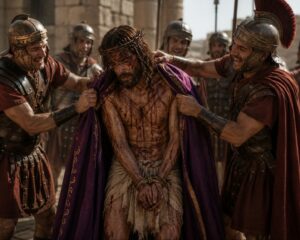
In the scourging, the violence does not stop at cloth. The whip tears into and off His own skin—the first garment God gives every human—so that even His real covering is ripped away before He is nailed up stripped and exposed.
The clothing motif intensifies again in the death of Yeshua. During the Passion, His garments are handled at multiple points. He is stripped, mock-clothed in a robe, redressed, and finally crucified while soldiers divide His garments and cast lots for His tunic. The Gospels do not mention these details casually. They show humiliation, mock kingship, public exposure, and scriptural fulfillment all at once.
The seamless tunic is especially important because it remains undivided while the other garments are distributed. The scene places Yeshua at the center of a contest over clothing while His body is being offered up. In a book-length clothing arc, this is one of the clearest moments where garments become interpretive signs rather than incidental narrative data.
Then comes what may be the most telling clothing element of all: His burial linens. Joseph of Arimathea wraps Yeshua’s body in linen, according to Jewish burial custom. The burial cloths matter because they are later found lying in the tomb, with the face cloth set apart. This has long been read as evidence that the body was not stolen in haste but that a deliberate, ordered resurrection has taken place. The one who was wrapped for burial is no longer in the garments of death. He leaves those linens behind.
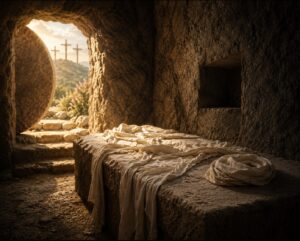 That is why the burial cloths belong near the center of the clothing arc. Eden begins with God clothing the guilty in skin. The Passion reaches a point where the innocent one is stripped, wrapped, and then leaves the wrappings of death behind. The clothing story does not end at the cross. It moves through the tomb.
Yeshua’s burial linens give us one more clothing moment, but this time by contrast. His body is wrapped in linen, the standard cloth of death and burial. When the disciples reach the tomb, they do not find Him inside those wrappings. They find the linens lying there, the head cloth set apart, with His body gone.
What those cloths reveal is not a robed figure, but His naked absence. The linens show where His body was and that it is no longer clothed by them. In that sense, He leaves behind a naked image of Himself: the shape that had been covered is now uncovered, the garments of death no longer on His skin. The story that began in Eden with shame-driven clothing circles back here. The sinless one steps out of the tomb with no burial clothes, back to nakedness without shame, while the empty linens bear silent witness that death’s last attempt to cover Him has failed.
Clothing in Acts and the Early Church
The motif does not stop after the resurrection. Just before Stephen is stoned, the witnesses lay down their cloaks at the feet of a young man named Saul. That detail has practical force, since outer garments would hinder the violence, but it also has symbolic weight. The cloaks lying at Saul’s feet visually place the act under his approval and make the garments themselves part of the scene’s testimony.
This is one more example of clothing acting as witness. In Eden, garments signal shame and divine mercy. In Joseph’s story, garments become evidence. In Acts 7, the mob’s cloaks become a visible sign of complicity and authority. Clothing continues to speak.
The New Testament churches also receive clothing language as exhortation and warning. The faithful are promised white garments. The self-satisfied are warned that they are naked and need true covering. The metaphor moves inward and ecclesial. Clothing is now about how communities stand before Messiah.
Revelation and the Final Clothing Scenes
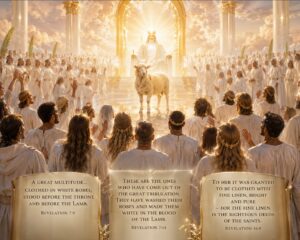
Revelation brings the entire arc to a final concentration. Clothing appears repeatedly and meaningfully throughout the book. The Son of Man is seen in a long robe with a golden sash, imagery that strongly evokes priestly and royal office. The churches are addressed in terms of nakedness, white garments, and spiritual shame.
The great multitude stands before the throne and before the Lamb clothed in white robes. Those robes are said to have been washed and made white in the blood of the Lamb. The Bride is given fine linen, bright and pure, and the text explicitly explains that this linen is the righteous deeds of the saints. By contrast, Babylon is clothed in luxury and display, wearing the garments of counterfeit glory before being stripped in judgment.
That is why the clothing arc can be said to run from Eden to final judgment. The story begins when man first needs clothing to hide shame and to live in a changed identity. It ends with clothing as verdict: washed robes, white garments, bright linen, counterfeit adornment stripped away, and final access or exclusion marked in clothing language.
From Scriptural Clothing to Living Skin
After all this talk of garments, robes, sandals, girdles, linens, and coverings, one fact stands out. Every one of these outer layers rests on top of something more basic and more astonishing: living human skin. All the Bible’s visible clothing scenes involve external coverings, but beneath every robe and sandal is the original body-covering God gave at creation.
That contrast matters. Animal skins, linen wrappings, wool garments, priestly robes, and royal fabrics all do symbolic work, but none of them can do what actual skin does. They do not heal. They do not sense. They do not regulate temperature. They do not repair damage. They do not fight infection. In that sense, all the later coverings are, in comparison, secondary skins.
The Amazing Qualities of Real Skin
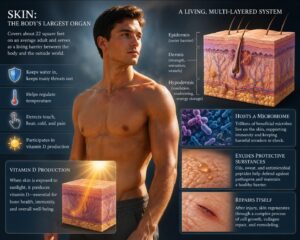 Skin is the body’s largest organ, covering about 22 square feet on an average adult and serving as a living barrier between the body and the outside world. It keeps water in, keeps many threats out, helps regulate temperature, detects touch, heat, cold, and pain, and participates in vitamin D production. It hosts a microbiome, exudes protective substances, and repairs itself after injury.
That means the first clothing humanity wears is already astonishing. Before fig leaves, before garments of skin, before priestly robes and burial linens, man is wrapped in living tissue that protects, senses, heals, and renews. Theologically, that gives the later clothing scenes even more force. Every outer garment in Scripture is layered over a creature already clothed in a remarkable God-given covering.
This is where the contrast between fake skins and real skin becomes useful. Garments can symbolize protection, but skin actually protects. Robes can symbolize honor, but skin actually holds the living body together. Burial cloths can wrap the dead, but skin belongs to the mystery of life itself. All the symbolic garments in the Bible echo, imitate, or intensify realities that living skin already performs at the biological level.
Conclusion
Seen as a whole, the arc is clear. It starts in Eden, where man first needs clothing to hide shame and to inhabit a new condition after sin. It moves through deception garments, favored coats, priestly robes, kingly clothing, sandals on holy ground, girded loins, circumcised flesh, the stripped and mocked Messiah, burial linens left behind, cloaks laid at Saul’s feet, and finally the robes and linen of Revelation.
Then, after tracing all those symbolic coverings, the inquiry circles back to the living covering given at creation. Real skin does what no robe can do. It is active, self-repairing, sensitive, and protective. All the later clothing scenes in the Bible unfold on top of that first astonishing gift. The story of clothing in Scripture and the wonder of skin end up reinforcing one another. The Bible’s garments reveal how humanity hides, serves, rules, suffers, passes on identity, and is finally judged or redeemed. Skin reveals how deeply the idea of covering is built into the human condition from the start.
Epilogue
The Twenty-Two Detail
One detail especially stood out at the beginning of my inquiry into the science of skin. The average adult is covered by roughly 22 square feet of skin. That number immediately drew my attention because 22 had already become a number worth pausing over, a number that repeatedly seemed to signal that something meaningful was being revealed.
That made my scientific observation feel like more than trivia. It felt connected to the clothing arc in Scripture. So, that called me to write.
The same inquiry that began with Eden’s shame and God’s garments of skin opened naturally into a much larger reflection on clothing.