The scapegoat and the people who would not disappear
By Jonah Ritter
Hamas attacked Israel on October 7, 2023. Its terrorists murdered, brutalized, and took hostages. Yet in the aftermath, Jews around the world faced threats, hostility, and demands to answer for military decisions they did not make.
The OSCE documented how antisemitism following the attacks and ensuing war left Jews across numerous countries fearing for their safety and concealing their Jewish identity. Think about that: Jews hiding the fact that they are Jewish after Jews were massacred.
A Jewish child in Europe does not command the Israeli military. A synagogue in England does not determine Israeli policy. A Jew wearing a kippah in France is not responsible for the decisions of a government thousands of miles away.
Criticize a government’s decisions. Debate its policies. But hold people accountable for their own actions. When being Jewish becomes sufficient grounds for accusation, we are confronting something much older.
Scapegoating.
And there is a bitter irony in that word’s history.
A Jewish Ritual —and its Reversal
The English word scapegoat comes from a Jewish ritual.
On Yom Kippur, as described in Leviticus 16, two goats were selected by lot. One was designated for the LORD; the other for Azazel. Over the living goat, Aaron confessed the wrongdoing of the people of Israel. The goat was then sent into the wilderness, symbolically carrying their sins away.
The Sydney Jewish Museum explains that William Tyndale’s 1530 translation supplied the English expression that developed into scapegoat. The museum also observes the historical irony: Jewish people repeatedly experienced scapegoating themselves.
But pay attention to what preceded the goat’s departure.
The people acknowledged their own sins.
They did not declare that their neighbors had caused all their problems. The ritual required confession. Responsibility had to be faced before wrongdoing could be carried away.
How terribly history reversed that lesson.
Again and again, societies blamed Jews for their troubles. And again and again, driving Jews out created an opportunity to take what belonged to them.
Families behind the decrees
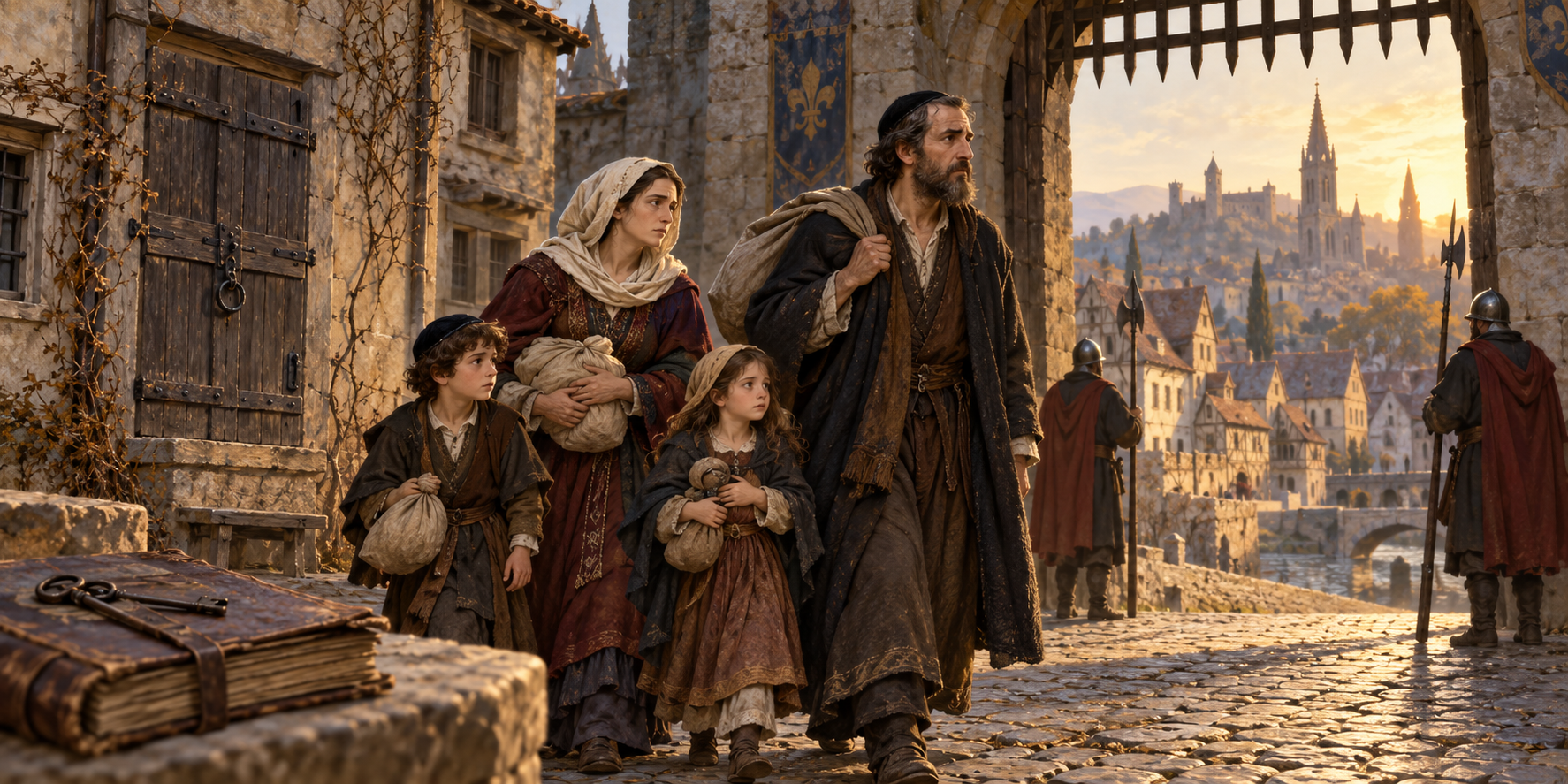
Behind every decree were families. Homes they could no longer enter. Livelihoods they could no longer pursue. Belongings they could not carry. Others remained behind to claim what generations had built.
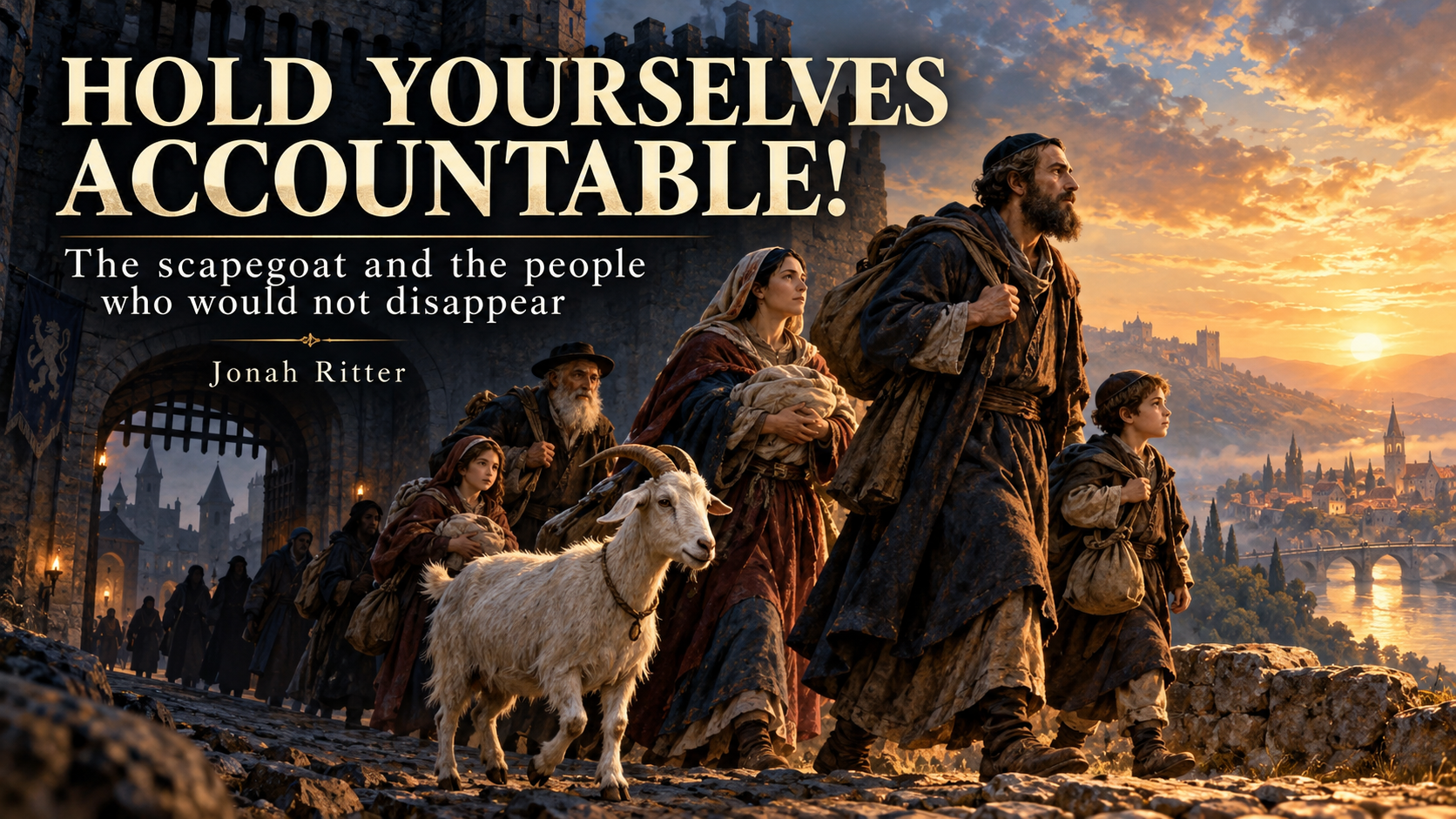
The illustrated video “Why Were Jews Expelled from Europe?” by Sunday Roast gives a visual sense of that displacement: families carrying bundles through streets, leaving the places they had called home.
Consider those families as you read the historical record.
Expel the Jews. Keep their property.
In 1182, Philip II expelled Jews from the French lands under his direct authority. Their land and buildings passed to the Crown while their movable possessions were hurriedly sold. (Source)
In 1290, Edward I expelled England’s Jews. The Crown seized property and took over outstanding debts owed to them. The creditors were expelled; their claims became royal assets. (Source)
In 1306, Philip IV expelled Jews from France, confiscated their property, and assumed the right to collect their loans. The king could profit from the removal of the very people whose lending had been condemned. (Source)
In Austria in 1420–1421, persecution combined expulsion, imprisonment, and executions. Jewish property was confiscated, and houses were sold or bestowed on favored individuals. (Source)
In Spain in 1492, Jews unwilling to convert were ordered to leave. They were permitted to sell property, but restrictions prevented them from exporting gold, silver, or coins. Desperate sellers facing a departure deadline could be forced to accept a fraction of their property’s value. (The expulsion decree; historical overview)
In Sicily, where the expulsion was also implemented under Spanish rule, thousands of Jewish houses were confiscated and a substantial levy imposed on the community. In Vienna in 1670, Jewish houses became city property and the principal synagogue was converted into a church. (Sicily; Vienna)
The mechanisms differed: confiscation, financial levies, forced sales. The consequences for families were devastating.
People lost homes, livelihoods, communities, and the accumulated work of generations.
Others acquired them.
The Holocaust: plunder down to the body
The Holocaust brought persecution and dispossession into a system of genocide driven by Nazi racial antisemitism.
Hitler’s regime falsely blamed Jews for Germany’s social, economic, political, and cultural problems. It also systematically stole from them. Homes, businesses, savings, and belongings passed into other hands. State institutions, companies, and ordinary people participated in or benefited from the plunder. (United States Holocaust Memorial Museum)
The theft did not end at the doors of the killing centers.
The Nazis took clothing, shoes, suitcases, and eyeglasses. The collections preserved at Auschwitz bear witness to the scale of that robbery—and to the human beings who owned those ordinary possessions.
They extracted gold dental work from bodies. Hair from murdered women was collected, processed, and sold for manufacturing textiles and felt. (Auschwitz Memorial)
There is also verified evidence from Buchenwald of lampshades made from prisoners’ skin. The memorial reports that forensic examinations confirmed human skin in a small lampshade and a fragment of another. Those findings do not identify the particular victims as Jewish, but they establish the atrocity itself. (Buchenwald Memorial)
Human beings were murdered, and even their remains were exploited.
We should not reduce the Holocaust to an economic scheme. Its purpose was the destruction of European Jewry. But neither should we overlook the theft that accompanied it or the people who profited.
The Warning for Today
As nations again struggle with debt and economic uncertainty, history warns us: hold leaders accountable for their decisions rather than turn Jews into scapegoats.
Even here in America, we are not immune to this pattern. Our national debt has passed $40 trillion, while the old antisemitic lie that “Jews control the banks” persists. Economic anxiety can become fertile ground for scapegoating. The responsibility for government borrowing and spending belongs to those making those decisions—not to Jews.
This danger is more than hypothetical. During the 2008 financial crisis, the Anti-Defamation League documented a wave of antisemitic conspiracy theories blaming Jews for the turmoil and reviving claims of Jewish control over banks and government. The crisis was real. The collective Jewish guilt was invented.
Governments must answer for their decisions. Political movements must answer for what they encourage. Individuals must answer for whom they threaten.
Jews did not become collectively responsible for national budgets, social unrest, or the decisions of Israel’s government merely by being Jewish.
Nor should concern for Palestinian suffering require hostility toward Jewish neighbors. A person can care deeply about civilians in Gaza while holding Hamas accountable for its atrocities and rejecting attacks on Jews.
When accusation spreads from particular actions to an entire people, responsibility is already being displaced.
Scapegoating begins when identity replaces individual responsibility.
Blaming Jews for exposing antisemitism
One accusation turns accountability upside down: Jews are accused of exploiting antisemitism to create Islamophobia. In this telling, exposing hatred against Jews becomes the offense, while those spreading that hatred escape responsibility.
Law professor Khaled Beydoun makes this connection explicitly. In his November 2023 essay, he accuses Netanyahu of using “politicized anti-Semitism as both a shield and a sword” and calls that approach “brazenly Islamophobic.” Here, accusations of antisemitism are themselves presented as instruments of anti-Muslim prejudice.
Tucker Carlson offers a related example. In a December 2025 interview with The American Conservative, he blamed Israel’s government and its American supporters for promoting the perception that radical Islam is America’s greatest threat. That framing turns concern about Islamist extremism into suspicion of the people warning about it.
Blaming Jews for exposing antisemitism repeats the logic of blaming Jews for their own persecution—even the Holocaust. The perpetrators escape accountability, and the victims become the accused.
Jews do not owe anyone silence about antisemitism. Those who promote it owe an accounting for their own words and actions.
Azazel and the accuser
Jewish interpretations of Azazel add another dimension.
In Jewish tradition, the goat becomes associated with Israel’s spiritual accuser. The ritual is portrayed as preventing him from obstructing Israel’s atonement.
The Zohar (Hebrew: זֹהַר, meaning “Splendor” or “Radiance”) is the foundational and most important text of the Jewish mystical tradition. The Zohar likewise describes the goat through imagery of occupying the “Other Side,” allowing reconciliation between Israel and God.
These mystical interpretations are not a historical explanation of antisemitism. But the figure of the accuser gives me something to contemplate.
The Hebrew word satan means adversary or accuser. That image brings us back to the article’s central question: why are Jews repeatedly made to answer for the wrongdoing of others?
A Pattern in the Hebrew Letters
While considering Azazel, I noticed something that stopped me. In standard Hebrew gematria, עזאזל—Azazel—equals 115.
So do these words:
הנני — Hineni — “Here I am” — 115
סנה — S’neh — “Bush” — 115
אפלה — Afelah — “Darkness” — 115
חזק — Chazak — “Strong; be strong” — 115
I am not claiming that matching numbers prove a prophecy or that an ancient commentator arranged these words into this story. This is a reflection arising from a numerical correspondence. But together, they speak to me.
Hineni. Here I am.
The answer to a call. The willingness to stand before God.
S’neh. The bush.
Moses encounters a bush that burns without being consumed. I see in that image something of the Jewish experience: suffering that is real, fire that is terrible, and a people who remain.
Afelah. Darkness.
Exile. Expulsion. Confiscation. The killing centers. The empty places at family tables.
Chazak. Be strong.
And alongside those words stands Azazel, reminding me of the bitter irony of a people whose sacred ritual gave English its word for the burden others repeatedly placed upon them.
Burning, yet not consumed

Jewish survival does not erase Jewish suffering. It does not restore a murdered child or return every stolen home. But it does mean that those who sought our disappearance failed to achieve it. We remain.
This is a time for Jews to be chazak—חזק. Strong.
The same 115 that connects the words in my reflection brings me to a response: stand visibly as Jews, support one another, confront false accusations, and insist on accountability. Strength can mean speaking openly, teaching our children, protecting our communities, or standing beside someone who is afraid.
Hineni. Here I am. Through the darkness, burning yet not consumed. Chazak. Be strong.
And we have every right to insist that the world learn the lesson it so often demands that we forget.
The Yom Kippur ritual began with confession. The people had to acknowledge their own wrongdoing.
That responsibility belongs to everyone. Before you blame your Jewish neighbor, before you turn a synagogue into a target, before you make an entire people answer for your anger—
Hold yourselves accountable!