Genesis 6:14:—“Make thee an ark of gopher wood; rooms shalt thou make in the ark, and shalt pitch it within and without with pitch.”
Could there be a message hidden in the story of Noah’s Ark that is encoded not only in its narrative, but in its language, numerics, and striking singularities?
The Torah’s description of the Ark is theologically dense: one man, one vessel, one door, one unprecedented judgment, and one path of escape. Around these elements, the Hebrew text quietly layers a pattern of uniqueness, boundary, and love.
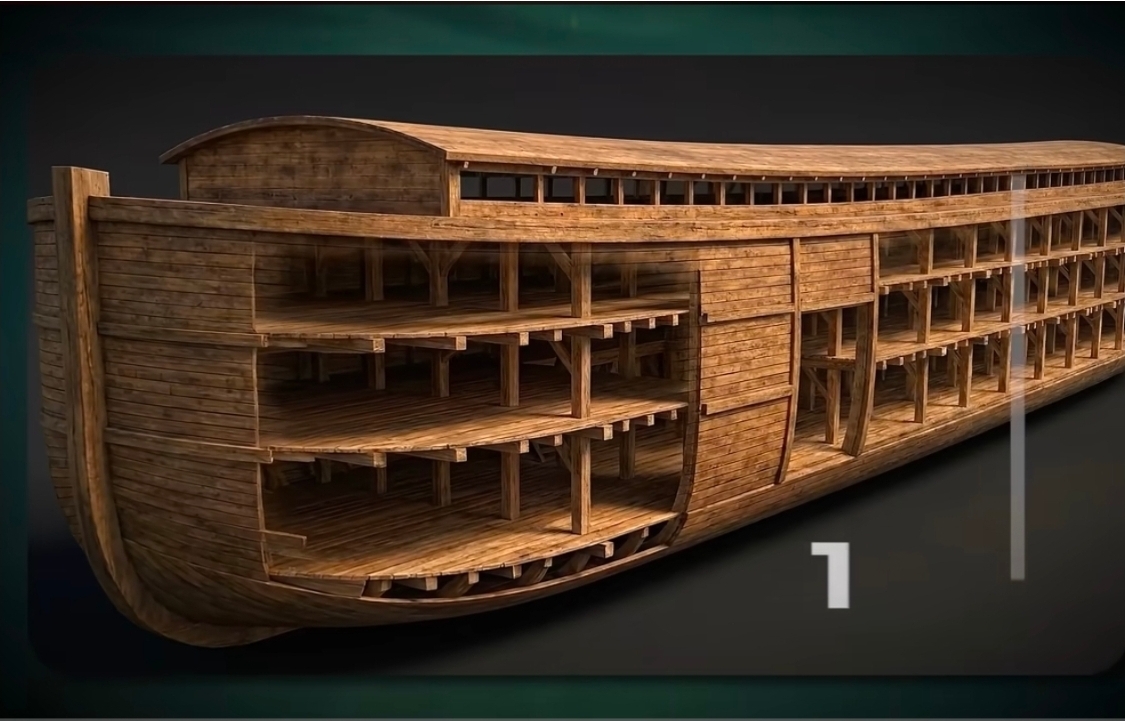
The Ark’s design is an engineering marvel. The specifics are incredibly functional. This video dives into that.
By Design From In Beginning
The Ark’s construction material is designated with a word that appears nowhere else in the entire Tanakh: גֹּפֶר (gopher). This rare term occurs only in Genesis 6:14, when God commands, “Make for yourself an ark of gopher wood.” Its status as a hapax legomenon* matches the narrative’s logic: a once‑for‑all judgment is matched with a once‑named wood, used for a once‑commanded structure. The vocabulary itself participates in the theology of the passage: one strange word for one strange vessel prepared for a singular crisis.
* A “hapax legomenona” word or expression appears only once in a specific body of text, within an author’s complete works, or throughout an entire language’s recorded history.
Gopher wood is an unidentified type of wood. As such, it invites speculation of a deeper meaning. Gematria is one means of discernment. Gopher גֹּפֶר (gimel–peh–resh) carries the value 283.
gimel–3
peh–80
resh–200
When reduced, 2 + 8 + 3 yields 13, and 1 + 3 then yields 4. At 13, we encounter a profound resonance: אַהֲבָה (ahavah, “love”) and אֶחָד (echad, “one”) both equal 13, so the numerical pathway of גֹּפֶר passes through the shared value of love and oneness.
From there, the final reduction to 4 brings us to דלת / דָּלֶת (delet/dalet, “door”), the fourth letter of the Hebrew alphabet, whose very name and common exposition identify it with a door or gate. In that sequence—283 → 13 → 4—the Ark’s “gopher wood” runs conceptually from material reality, through love/oneness, to the door.
Genesis 6:16—“A window shalt thou make to the ark… and the door of the ark shalt thou set in the side thereof; with lower, second, and third stories shalt thou make it.”
Genesis 7:16—“And they that went in, went in male and female of all flesh, as God had commanded him: and the LORD shut him in.”
Consider 4 – The Door of Faith
A door dovetails with the narrative emphasis on the Ark’s single door. God instructs Noah to place one door in the side of the Ark, a deliberate architectural detail that defines a single point of transition from the doomed world to the preserved space within. Noah does not close this door himself. Once he and those with him have entered, the text notes, “the Lord shut him in.” The boundary is set and sealed by God. The period of open invitation is over; the threshold becomes a line that may no longer be crossed. The door that once represented opportunity now marks final separation.
Kofer (“Pitch,” Covering)
Spelling: כ־פ־ר:
כ = 20
פ = 80
ר = 200
Total: 300
This is the same root used later for “ransom/atonement/covering” (כפר), which commentators often see as a deliberate wordplay against גפר (Gopher).
 In biblical and later Hebrew, כִּפָּה / kippah (“dome,” “covering,” and by extension the skullcap) is understood to derive from the same root כ־פ־ר (k‑p‑r) that underlies כֹּפֶר (kofer, pitch) and כִּפֵּר / כפרה (kipper / kapparah, atone, atonement). The Academy of the Hebrew Language explicitly connects this root to both “covering” and “coating,” and uses Genesis 6:14 as one of its key examples: Noah is commanded to “cover” (וְכָפַרְתָּ) the ark with כֹּפֶר, a coating substance, from inside and out. Standard Hebrew sources treat kippah as built on the same covering/atonement root complex.
Did People Laugh at Noah?
Interestingly, the Torah never explicitly says that people mocked Noah. The popular image of the old man building a gigantic ship while his neighbors laugh is a later homiletical development, arguably inferred from the generation’s wickedness and from later New Testament reflections on scoffers. The canonical emphasis is more chilling: people carried on “as usual” until the very day Noah entered the Ark. The evil of that generation lies less in vocal ridicule and more in total indifference to the looming structure rising in their midst.
As the Ark rose in the midst of Noah’s generation, it did so in quiet parallel with another, hidden rising—the waters that would soon surge up to engulf their world. For a long season, nothing seemed to change; people moved through their days as usual, yet the conditions for judgment were steadily gathering. Then the deep was released, and what had been only implied became undeniable reality: the waters rose, covering everything that had refused the one place of refuge in their midst. In that way, the story holds a dual ascent—an Ark lifted above, and waters lifting to overwhelm—two risings that meet in a single moment of separation between those sheltered within and those left outside.
 Conclusion
Together, these details suggest a hidden message in the story of Noah’s Ark. A unique, once‑named wood whose number passes through love and oneness to four, the number of the door. A single door in a single Ark, standing open for a time, then shut by God himself. A generation so absorbed in its own patterns that it ignores the silent sermon of a massive vessel under construction. In “days of Noah,” the text quietly insists, what matters is not reading the sky for signs, but recognizing—and entering—the one divinely appointed Ark while the door of love‑opened oneness still stands ajar.