
What does “Identity” and “Repentance” have to do with one another?
The Hebrew word teshuva (תשובה) is usually translated “repentance,” but what does it mean? That is what I will explore in this blog.
In Jewish High Holy Days liturgy it is said that “Teshuva (repentance), Tefilla (prayer), and Tzedaka (charity) avert the evil decree.” This is taken from the U’netaneh Tokef prayer, recited on Rosh Hashanah and Yom Kippur. This prayer recounts the power of the day’s holiness, for it is awesome and frightening. The “evil decree” is taken to mean a harsh or unfavorable judgment—especially about life, death, and suffering in the coming year.
They echo the older “three pillars” in the ancient Jewish classic, Pirkei Avot (Ethics of the Fathers):
- Teshuva connects to Torah and truth—returning to the path God lays out.
- Tefillah is the living “service of God,” an ongoing relationship, not just ritual.
- Tzedakah is acts of kindness in their strongest form—embodied justice and compassion.
Pirkei Avot is a foundational source for Jewish ethics and spirituality. For almost two thousand years, Jews have studied Pirkei Avot, especially in the weeks between Passover and Shavuot (Pentecost), as a way to internalize core Jewish values.
Ok, that’s enough to establish that Teshuva, (Repentance) is a pillar of morality in Judaism, so what does it actually mean?
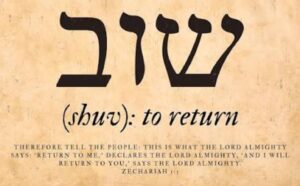
Teshuva quite literally means return—returning to God, to the right path, and to your truest self. Because teshuva literally means “return,” many Jewish teachers say it assumes there is a deeper, truer self to come back to.
Sin is then “going astray” or missing the mark; it’s you acting out of alignment with your God‑given nature and calling. This implies to me that if we don’t do Teshuva we are living as an imposter.
Writers in the Jewish tradition stress that teshuva is an active process of:
- Recognizing and regretting the wrong.
- Confessing it honestly before God (and, where needed, to people you hurt).
- Changing direction—abandoning the harmful behavior and choosing a better way.
Some modern Jewish teachers even say the goal of teshuva is to reconnect with your God‑given core identity as someone capable of good, not to fixate on shame. It’s “returning” to who you really are in relationship to God.
 Words Matter
The Hebrew word teshuva (תשובה) comes from the root ש־ו־ב (shuv), which means “to return” or “to turn back.” Shuv emphasizes that people must abandon idols and wrongdoing and come back to God’s law and ways. One common picture is that sin is “going astray,” and teshuva is coming back to where you were meant to walk in the first place.
The words for Repentance in Greek have a similar meaning. Greek metanoia is a “change of mind/heart,” and strepho/epistrepho is “to turn/turn back.”
The Roman Catholic Mass was celebrated in Latin for about 1,700 years. The Church transitioned to local vernacular languages in the late 1960’s. Paenitentia is a Latin noun meaning repentance, regret, or penitence. It describes a sincere change of heart, a feeling of remorse for past actions. It is tied to “being sorry, feeling regret.” It pulls your imagination toward emotion: “I must really feel bad.”
Those linguistic differences almost inevitably shape how “repentance” gets taught and felt in a Jewish school versus a Catholic school. The core ideas can overlap, but the instinctive emphasis is often different.

Eat the Soup: Healthy vs Unhealthy Guilt
Writers who think about this carefully distinguish between:
- Regret/conviction: a clear awareness “I did wrong” that moves you to repair, apologize, or change.
- Guilt as a state: a heavy, self‑focused feeling that can become self‑pity or self‑hatred and does not necessarily lead to change.
Jewish teachers often say we need regret but can “do without guilt” in the sense of lingering self‑condemnation. The productive pattern is: recognize the wrong, regret it, make amends, and resolve to act differently next time—then let go of the emotional weight instead of replaying it forever.
Jewish and Catholic “Guilt” Tendencies
Sociologists and popular writers sometimes talk about “Jewish guilt” and “Catholic guilt,” but they describe slightly different flavors.
Jewish guilt is often tied to not living up to expectations or communal ideals—“I haven’t done enough,” “I’ve let the family/people down.”
Catholic guilt is often portrayed as standing under the gaze of an all‑seeing God, afraid of breaking rules and of punishment or hell.
In both Jewish and Christian traditions, feelings of guilt are real and important, but they are meant to be a doorway to change, not a permanent place to live. When guilt becomes constant, vague, and fear‑soaked, both traditions would say it has drifted away from its healthy, spiritual purpose.
Jewish Guilt
Jewish discussions of teshuva often push back on staying in guilt. They emphasize that guilt is just an emotional state; and it may not even match reality.
The goal is regret + change. You’ve really done teshuva when, in the same situation again, you could repeat the wrong but choose differently.
Wallowing in “I’m bad” is unhelpful; the focus should be “I regret that action and I’m turning back and moving differently now.”
That is very close to the healthiest Christian teaching as well, which says guilt should move you to confession and repentance, then to forgiveness and a new start—not to a lifelong identity of “I am nothing but my sins.”
So, feelings of guilt can be a useful signal that something needs attention. Guilty feelings are used push you toward repair and change.
Doing Teshuva
Doing teshuva is the Jewish way of talking about actually returning—to God, to the right path, and to your best self—rather than just sitting in feelings of guilt. It is a concrete process, not just an emotion.
Jewish teachers stress that the goal is changed life and restored relationship, not endless self‑punishment. Guilt and regret are needed, but only as a catalyst to move you into honest confession, repair, and a different future.
We Are Talking About Action
In both teshuva and healthy Christian repentance, we’re ultimately talking about action, not just feelings. Regret matters, but only insofar as it leads to concrete turning—what you actually do differently next time.
Jewish teaching is very explicit that teshuva isn’t complete until behavior changes—when you’re in a similar situation and, this time, you act differently.
That matches the New Testament emphasis that repentance is a change of mind that bears “fruit” in new behavior, not just intense emotion. Repentance is meant to propel a change in how we actually speak, choose, and live.
Teshuva connects to Torah and truth—returning to the path God lays out. Tefillah is the living “service of God,” an ongoing relationship, not just ritual. Finally, Teshuva culminates in Tzedakah, acts of loving kindness.
Closing
At the start of this exploration I asked: What does “Identity” and “Repentance” have to do with one another?
Identity and repentance are inseparable, because teshuvah is not merely about changing behavior but about returning to who you truly are before God—your created, covenantal self, not your distorted, fallen persona. In that sense, every act of repentance is an unveiling of identity: the more deeply you turn back, the more clearly you remember, reclaim, and embody the self God named and knew from the beginning.
Epilogue:
Midrashic and Mystical Use
The Jewish gematria of both שׁוּב (shuv, “return/repent”) and קֹרַח (Korach), the infamous biblical rebel, have the numerical value 308.
The Gematria of Shuv
Shuv (שוב) is spelled ש (shin- 300), ו (vav-6), ב (bet-2). Summed: 300 + 6 + 2 = 308
The Gematria of Korach
Korach (קֹרַח) is spelled ק (kuf-100), ר (resh-200), ח (chet-8). Summed: 100 + 200 + 8 = 308.
Multiple contemporary summaries of midrashic material state explicitly: “The gematria of Korach is 308.” Sources discussing Korach’s rebellion note that “the gematria for shuv (שוב) is 308,” and juxtapose it with Korach’s own name at 308. This is used homiletically to say that when “given the opportunity to do shuv (repent), Korach rejected it,” playing on the numerical identity of his name and the word for “return.”
Korach’s path (308) could have been redirected into shuv (308), implying that his very identity contained the potential for return.
This kind of equivalence, where a rebel’s name shares a value with a word like shuv, is a classic example of how gematria is used as a bridge between narrative, ethical exhortation, and mystical speculation.